High Performance Anamorphic Prism Pairs Market, Size, Trends, Business Strategies 2026-2034

Global High Performance Anamorphic Prism Pairs Market was valued at USD 229 million in 2025 and is expected to reach USD 323 million by 2034, growing at a CAGR of 5.1% during the forecast period.

PDF Icon Download Sample Report PDF
  • Quick Dispatch

    All Orders

  • Secure Payment

    100% Secure Payment

Price range: $1,500.00 through $4,250.00

Clear

High Performance Anamorphic Prism Pairs Market Insights

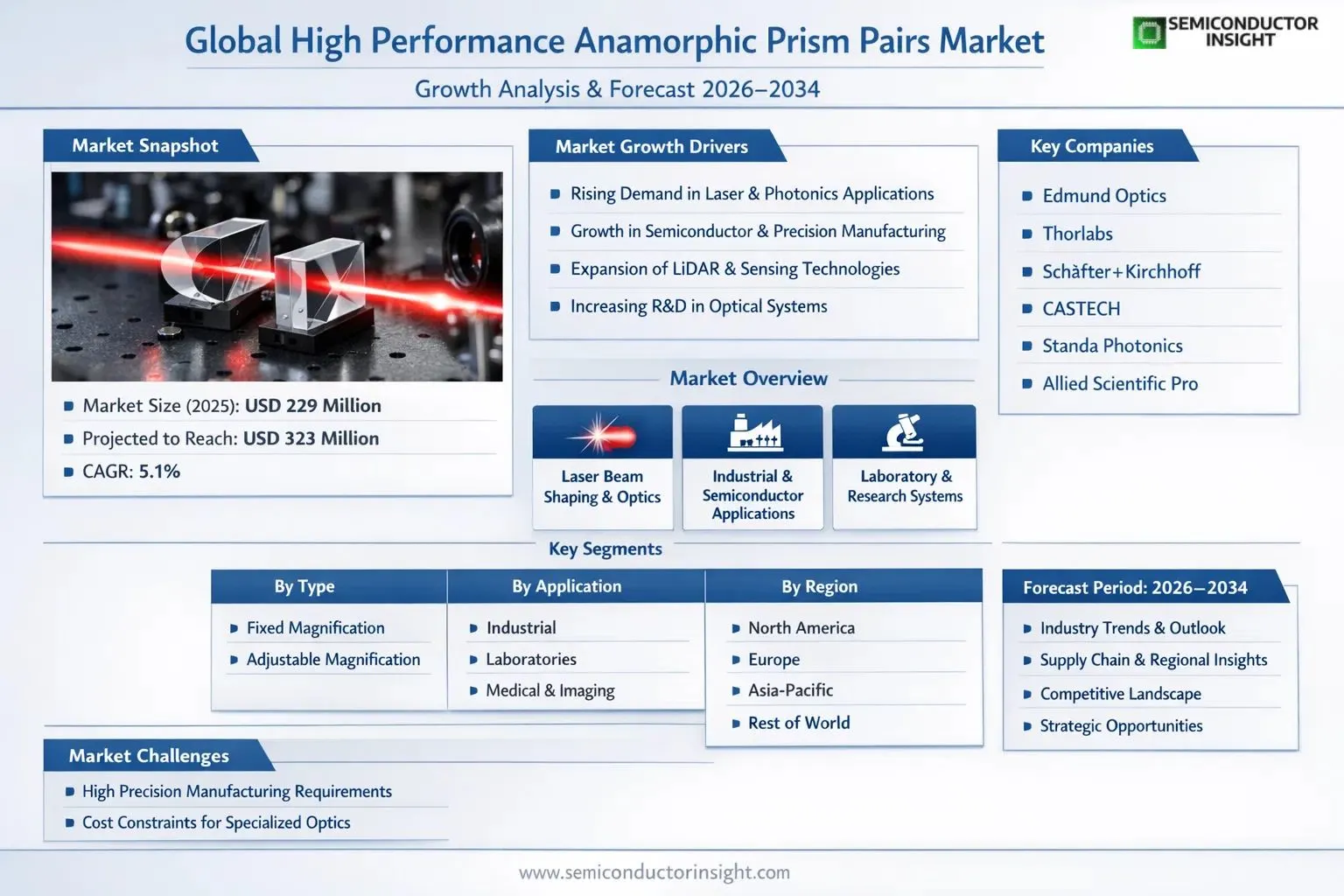
Global High Performance Anamorphic Prism Pairs market size was valued at USD 229 million in 2025. The market is projected to grow from USD 240.7 million in 2026 to USD 323 million by 2034, exhibiting a CAGR of 5.1% during the forecast period.

High Performance Anamorphic Prism Pairs are precision optical components specifically engineered to adjust the aspect ratio of laser beams, most commonly transforming elliptical beams into circular ones. These prisms are manufactured with exceptional accuracy to minimize optical aberrations and preserve beam quality, making them indispensable in applications that demand precise beam shaping , including laser optics, advanced microscopy, and high-resolution imaging systems. Their capacity to deliver efficient beam transformation while maintaining laser power and coherence makes them a foundational element in high-performance optical setups across both industrial and laboratory environments.

The market is steadily expanding, driven by growing adoption of laser-based technologies across semiconductor manufacturing, photonics research, and precision instrumentation. Furthermore, rising investments in R&D activities related to optical systems and the increasing deployment of laser diodes in communications and medical diagnostics continue to reinforce demand. Key manufacturers operating in the global High Performance Anamorphic Prism Pairs market include Edmund Optics, Schäfter+Kirchhoff, Tempotec Optics, Standa Photonics, Allied Scientific Pro (ASP), Thorlabs, Crysmit Photonics, Wikioptics, CASTECH, Core Optronics, and Ultra Photonics, among others.
High Performance Anamorphic Prism Pairs Market Insights

MARKET DRIVERS

Rising Demand from Laser and Photonics Industries

High Performance Anamorphic Prism Pairs Market is experiencing robust growth driven primarily by the expanding laser and photonics industries. Anamorphic prism pairs are essential optical components used to reshape elliptical laser beams into circular profiles, making them indispensable in applications ranging from semiconductor lithography to fiber optic communications. As laser-based manufacturing processes become increasingly prevalent across industries, the demand for precision-engineered anamorphic prism pairs continues to grow steadily. The proliferation of diode laser systems, which inherently produce asymmetric beam outputs, has further amplified the need for high-quality beam-shaping optics in industrial and scientific settings.

Technological Advancements in Optical Component Manufacturing

Significant advancements in precision optical fabrication technologies have been a key catalyst for High Performance Anamorphic Prism Pairs Market. Improvements in CNC grinding, polishing, and anti-reflection coating processes have enabled manufacturers to produce anamorphic prism pairs with tighter tolerances, superior surface quality, and enhanced optical transmission efficiency. The adoption of advanced metrology tools for quality verification has allowed manufacturers to consistently achieve wavefront error values well within the demanding specifications required by scientific instrumentation and defense-grade systems. These manufacturing improvements have expanded the addressable market by making high-performance optics more accessible across a broader range of application tiers.

The integration of high-performance anamorphic prism pairs in next-generation photonic systems, including LiDAR sensors, quantum computing research platforms, and advanced spectroscopy instruments, represents one of the most significant demand drivers reshaping the competitive landscape of the precision optics sector.

The growing adoption of LiDAR technology in autonomous vehicles and industrial mapping systems has emerged as a particularly strong driver for High Performance Anamorphic Prism Pairs Market. LiDAR systems depend on highly collimated, circularly symmetric laser beams to achieve accurate distance measurements, making anamorphic beam-shaping components a critical part of their optical architecture. As investments in autonomous mobility and smart infrastructure continue to scale globally, procurement of advanced beam-shaping optics including anamorphic prism pairs is expected to increase correspondingly, reinforcing sustained market momentum.

MARKET CHALLENGES

High Precision Requirements and Manufacturing Complexity

One of the most significant challenges facing High Performance Anamorphic Prism Pairs Market is the inherent complexity involved in manufacturing components that meet stringent optical performance specifications. Anamorphic prism pairs must be fabricated with exceptional angular accuracy, surface flatness, and coating uniformity to deliver the required beam magnification ratios without introducing unwanted aberrations or losses. Even minor deviations in prism angle or surface quality can result in measurable degradation of beam quality, making quality control an ongoing operational challenge for manufacturers. The need for specialized equipment, skilled optical engineers, and controlled manufacturing environments contributes to elevated production costs and limits the number of qualified suppliers capable of serving the high-performance segment.

Other Challenges

Supply Chain Constraints for Specialty Optical Glass

High Performance Anamorphic Prism Pairs Market faces ongoing supply chain vulnerabilities related to the availability of specialty optical glass substrates. High-performance anamorphic prism pairs typically require glass materials with precisely controlled refractive indices and dispersion characteristics, which are produced by a limited number of specialty glass manufacturers globally. Disruptions in the supply of these critical raw materials , whether due to geopolitical factors, production bottlenecks, or logistics challenges , can constrain manufacturing output and lead to extended lead times, posing a material risk to market participants dependent on consistent component delivery schedules.

Competition from Alternative Beam-Shaping Technologies

The market also faces competitive pressure from alternative beam-shaping solutions, including cylindrical lens pairs, Powell lenses, and fiber-based beam conditioning systems. While anamorphic prism pairs offer distinct advantages in terms of compactness, wavelength flexibility, and low insertion loss, the availability of competing optical approaches means that system designers may select alternative solutions based on cost, form factor, or ease of integration. Educating end-users on the specific performance advantages of high-performance anamorphic prism pairs over these alternatives remains an ongoing commercial challenge for market participants.

MARKET RESTRAINTS

Elevated Cost Barriers Limiting Broad Market Penetration

The high unit cost of precision-grade anamorphic prism pairs represents a meaningful restraint on broader market adoption, particularly among price-sensitive end-user segments. The combination of expensive specialty optical substrates, labor-intensive fabrication processes, and rigorous quality assurance requirements results in per-unit costs that may be prohibitive for small-scale research institutions, startups, and emerging market customers. This cost barrier restricts the addressable market predominantly to well-funded industrial, defense, and academic research customers, limiting the overall volume growth potential of High Performance Anamorphic Prism Pairs Market compared to more commoditized optical component segments.

Niche Application Scope and Specialized End-User Base

Unlike broad-use optical components such as standard lenses or mirrors, anamorphic prism pairs serve a relatively specialized set of applications centered on beam shaping for laser and photonic systems. This niche application scope inherently limits the size of the potential customer base and constrains market scalability. High Performance Anamorphic Prism Pairs Market is therefore more susceptible to fluctuations in capital expenditure cycles within the laser, semiconductor, and defense sectors. Periods of reduced R&D spending or delayed capital equipment procurement by key end-user industries can have a disproportionately negative impact on demand for premium anamorphic optical components.

Regulatory and Export Control Constraints

High-performance optical components, including advanced anamorphic prism pairs used in defense and dual-use applications, are subject to export control regulations in multiple jurisdictions, including ITAR (International Traffic in Arms Regulations) in the United States and equivalent frameworks in the European Union and other regions. These regulatory constraints complicate international trade and can limit the ability of manufacturers to serve global customers efficiently. Compliance requirements add administrative costs and can extend product delivery timelines, acting as a structural restraint on the international growth trajectory of High Performance Anamorphic Prism Pairs Market.

MARKET OPPORTUNITIES

Expansion of Quantum Photonics and Advanced Research Applications

The accelerating global investment in quantum computing, quantum communication, and quantum sensing presents a compelling growth opportunity for High Performance Anamorphic Prism Pairs Market. Quantum photonic systems rely on precisely conditioned laser beams for qubit manipulation, ion trapping, and entanglement generation , applications where beam quality and symmetry are critically important. As government and private sector funding for quantum technology research expands across North America, Europe, and Asia-Pacific, demand for precision beam-shaping components including high-performance anamorphic prism pairs is expected to grow in parallel with broader quantum ecosystem development.

Integration Opportunities in Next-Generation LiDAR and Sensing Systems

The rapid scaling of LiDAR technology for autonomous vehicles, industrial automation, and geospatial mapping applications represents a significant commercial opportunity for High Performance Anamorphic Prism Pairs Market. As LiDAR system architectures evolve toward higher resolution, longer range, and more compact form factors, the optical design requirements for beam quality and collimation become increasingly demanding. Manufacturers of anamorphic prism pairs that can deliver miniaturized, high-throughput components optimized for LiDAR wavelengths , particularly in the near-infrared spectrum , are well-positioned to capture growing procurement volumes from this dynamic and rapidly expanding end-use segment.

Emerging Demand from Asia-Pacific Photonics Manufacturing Hubs

Asia-Pacific is emerging as an increasingly important growth frontier for High Performance Anamorphic Prism Pairs Market, driven by rapid expansion of domestic photonics manufacturing capabilities in China, Japan, South Korea, and Taiwan. Government-backed initiatives to build self-sufficient semiconductor and advanced optics supply chains across the region are stimulating investment in precision optical component production and procurement. Local demand for high-performance anamorphic prism pairs is growing in applications spanning semiconductor inspection, laser processing equipment, and scientific instrumentation. Market participants that establish regional manufacturing partnerships or localized distribution networks within Asia-Pacific are positioned to benefit from this structural demand shift in the global optics industry.

MAIN TITLE HERE () Trends

Rising Demand for Precision Beam Shaping Drives High Performance Anamorphic Prism Pairs Market

High Performance Anamorphic Prism Pairs Market is witnessing sustained growth driven by increasing adoption across laser optics, advanced microscopy, and precision imaging systems. As industries demand greater beam quality and optical efficiency, anamorphic prism pairs have become indispensable components in setups that require transformation of elliptical laser beams into circular profiles. The growing integration of high-powered laser systems in industrial manufacturing, semiconductor processing, and scientific research is reinforcing the need for optically superior beam-shaping solutions. Manufacturers are responding with enhanced designs that minimize aberrations while preserving beam coherence and power, catering to increasingly stringent application requirements.

Other Trends

Expansion Across Industrial and Laboratory Applications

High Performance Anamorphic Prism Pairs Market is experiencing a notable shift in application diversity. Industrial environments are increasingly deploying these optical components in laser cutting, material processing, and quality inspection systems, where beam uniformity is critical to output precision. Simultaneously, laboratory and research institutions are adopting anamorphic prism pairs for spectroscopy, holography, and fluorescence microscopy, where optical fidelity directly influences experimental accuracy. This dual-sector demand is expanding the addressable market and encouraging suppliers to develop application-specific product variants tailored to distinct performance thresholds.

Growth of Fixed and Adjustable Magnification Segments

Within High Performance Anamorphic Prism Pairs Market, both fixed magnification and adjustable magnification product types are gaining traction. Fixed magnification prism pairs remain preferred in high-throughput industrial setups due to their optical stability and cost-effectiveness. Adjustable magnification variants, however, are gaining ground in research and development environments where beam ratio flexibility is essential. This product segmentation is enabling manufacturers such as Edmund Optics, Thorlabs, and Schäfter+Kirchhoff to address a broader spectrum of customer requirements, fostering competitive differentiation based on optical performance parameters and customization capabilities.

Regional Dynamics and Competitive Landscape Shaping Market Trajectory

Geographically, North America and Europe continue to represent established markets for high performance anamorphic prism pairs, supported by strong photonics research ecosystems and mature industrial laser adoption. Asia-Pacific, particularly China, Japan, and South Korea, is emerging as a high-growth region driven by expanding semiconductor fabrication and optical manufacturing industries. Key global players including Thorlabs, CASTECH, Tempotec Optics, Allied Scientific Pro, and Standa Photonics are actively strengthening their production capabilities and distribution networks to capture regional demand. The competitive landscape is further shaped by ongoing investments in precision manufacturing technologies and the development of next-generation optical coatings that improve transmission efficiency and durability of anamorphic prism pairs across diverse operating conditions.

COMPETITIVE LANDSCAPE

Key Industry Players

High Performance Anamorphic Prism Pairs Market Competitive Dynamics and Leading Manufacturers

The global High Performance Anamorphic Prism Pairs market, valued at approximately USD 229 million in 2025 and projected to reach USD 323 million by 2034 at a CAGR of 5.1%, is characterized by the presence of a diversified mix of established optical component manufacturers and specialized photonics firms. Edmund Optics and Thorlabs emerge as dominant global players, leveraging their extensive distribution networks, broad product portfolios, and strong R&D capabilities to maintain commanding market shares. These companies benefit from deep integration across laser optics, microscopy, and advanced imaging supply chains, enabling them to serve both industrial and laboratory end-users at scale. Schäfter+Kirchhoff and CASTECH further reinforce the competitive upper tier, with precision-engineered anamorphic solutions recognized for superior beam shaping performance and minimal optical aberration. The top five players collectively accounted for a significant portion of global revenue in 2025, underscoring the market’s moderately consolidated structure driven by technological expertise and manufacturing precision.

Beyond the leading incumbents, High Performance Anamorphic Prism Pairs Market features several agile niche players that compete on specialization, customization, and cost-efficiency. Standa Photonics, Allied Scientific Pro (ASP), Tempotec Optics, Crysmit Photonics, Wikioptics, Core Optronics, and Ultra Photonics each occupy focused segments of the market, catering to research institutions, OEM integrators, and specialized industrial laser applications. These companies differentiate through offerings in both Fixed Magnification and Adjustable Magnification product categories, addressing diverse beam transformation requirements. The competitive landscape is further shaped by increasing demand from semiconductor, biomedical, and defense sectors, prompting manufacturers to invest in advanced coating technologies and tighter tolerancing capabilities. Strategic collaborations, product line expansions, and geographic diversification , particularly across North America, Europe, and Asia-Pacific , continue to define competitive strategies among both established and emerging market participants.

List of Key High Performance Anamorphic Prism Pairs Companies Profiled

Segment Analysis:

Segment Category Sub-Segments Key Insights
By Type
  • Fixed Magnification
  • Adjustable Magnification
Fixed Magnification prism pairs represent the dominant product type in High Performance Anamorphic Prism Pairs Market, owing to their robust and stable optical design that ensures consistent beam transformation without the need for mechanical adjustments.

  • Fixed magnification variants are widely preferred in production-grade laser systems and OEM integrations where repeatable, reliable beam shaping is critical to system performance and longevity.
  • Their simplified construction results in reduced optical alignment complexity, lower susceptibility to vibration-induced misalignment, and easier integration into compact photonic assemblies.
  • Adjustable magnification prism pairs, while commanding a premium, are gaining traction in research-intensive environments where beam diameter flexibility is necessary to accommodate multiple laser sources or experimental configurations within a single optical setup.
By Application
  • Industrial
  • Laboratories
  • Medical & Healthcare
  • Others
Industrial applications constitute a significant and growing end-use segment for High Performance Anamorphic Prism Pairs, driven by the expanding adoption of high-power laser systems in precision manufacturing, material processing, and automated inspection.

  • Industrial laser systems used in cutting, welding, and surface treatment increasingly require precise beam shaping capabilities to maximize energy efficiency and processing quality, making anamorphic prism pairs an integral optical component in these setups.
  • The Laboratories segment holds strong relevance, particularly in photonics research, spectroscopy, and advanced microscopy, where beam quality and coherence preservation are paramount to experimental accuracy and reproducibility.
  • Emerging medical and healthcare applications, including ophthalmic laser surgery systems and diagnostic imaging platforms, are beginning to incorporate high-performance beam shaping optics, broadening the addressable market for anamorphic prism pairs beyond traditional domains.
By End User
  • Academic & Research Institutions
  • Defense & Aerospace Organizations
  • Commercial Laser Manufacturers
Commercial Laser Manufacturers represent the leading end-user segment in High Performance Anamorphic Prism Pairs Market, as these companies integrate precision beam shaping optics directly into their laser product lines to enhance performance specifications and competitive differentiation.

  • OEM laser manufacturers sourcing anamorphic prism pairs from established optical component suppliers such as Edmund Optics, Thorlabs, and Schäfter+Kirchhoff benefit from standardized quality benchmarks and scalable supply arrangements that support high-volume production.
  • Academic and research institutions drive demand for highly customizable and application-specific anamorphic prism configurations, fostering close collaboration with manufacturers to develop bespoke optical solutions for frontier research in quantum optics, photonics, and biophotonics.
  • Defense and aerospace end users require anamorphic prism pairs that comply with stringent environmental durability standards, including resistance to thermal extremes and mechanical shock, necessitating advanced coating technologies and precision fabrication processes from suppliers.
By Coating Type
  • Anti-Reflection (AR) Coated
  • Uncoated
  • Custom Wavelength-Specific Coated
Anti-Reflection (AR) Coated anamorphic prism pairs dominate this segment, as minimizing reflection losses at optical surfaces is fundamental to preserving laser power and beam quality in high-performance photonic systems.

  • AR-coated variants are especially critical in high-power laser applications where even minor surface reflections can lead to significant power losses, thermal lensing effects, or damage to sensitive upstream optical components.
  • Custom wavelength-specific coatings are witnessing growing demand as end users increasingly deploy laser systems operating across a diverse range of wavelengths, from ultraviolet to near-infrared, requiring tailored optical coatings to ensure maximum transmission efficiency across specific spectral bands.
  • Uncoated prism pairs retain relevance in cost-sensitive laboratory configurations or prototype development environments where budget constraints outweigh the need for optimized transmission performance, though their use is gradually declining in professional-grade applications.
By Material
  • N-BK7 Glass
  • UV Fused Silica
  • Specialty Optical Glass
UV Fused Silica is emerging as the leading material choice for high-performance anamorphic prism pairs, particularly in demanding laser and photonics applications that require exceptional transmission across a broad spectral range and superior resistance to laser-induced damage.

  • UV fused silica offers a combination of very low absorption, high homogeneity, and excellent thermal stability, making it the preferred substrate material for prism pairs deployed in ultrashort pulse laser systems, UV lithography, and precision spectroscopy instruments.
  • N-BK7 glass remains the most widely used material for standard visible-wavelength applications, offering a cost-effective balance between optical clarity, ease of fabrication, and mechanical durability for general photonics laboratory use.
  • Specialty optical glass materials are increasingly being explored for niche applications requiring unique refractive index profiles or enhanced chemical resistance, driving ongoing material innovation among key manufacturers such as CASTECH and Core Optronics.

Regional Analysis: High Performance Anamorphic Prism Pairs Market

North America

North America stands as the dominant force in High Performance Anamorphic Prism Pairs Market, driven by its robust base of advanced optical manufacturing, defense technology investment, and a deeply entrenched ecosystem of precision photonics research. The United States, in particular, serves as the primary engine of regional growth, with its extensive network of defense contractors, laser system integrators, and academic research institutions consistently demanding high-grade optical components. The region benefits from sustained government funding directed toward laser-based defense systems, directed energy applications, and space exploration technologies , all of which rely heavily on precision beam-shaping optics such as anamorphic prism pairs. Canada contributes meaningfully through its growing photonics industry and collaborative research frameworks with U.S.-based institutions. Furthermore, North America’s leadership in semiconductor fabrication and LiDAR technology development continues to generate strong downstream demand. The presence of globally recognized optical component manufacturers, combined with a well-developed intellectual property framework that incentivizes innovation, positions North America as the benchmark region for quality standards and technological advancement within High Performance Anamorphic Prism Pairs Market through 2034.
Defense & Aerospace Demand
North America’s defense and aerospace sectors serve as foundational demand drivers for High Performance Anamorphic Prism Pairs Market. The U.S. Department of Defense and allied agencies continue to advance directed energy weapons, targeting systems, and satellite communication platforms , all requiring precisely engineered beam-shaping optics. This sustained institutional procurement pipeline reinforces the region’s market dominance and sets rigorous performance benchmarks.
Advanced Manufacturing Infrastructure
The region hosts a concentration of precision optical manufacturing facilities equipped with cutting-edge fabrication and coating technologies. This infrastructure enables domestic production of high-tolerance anamorphic prism pairs that meet stringent application requirements. Investment in automated polishing, ion-beam figuring, and anti-reflection coating processes ensures that North American manufacturers maintain a competitive quality advantage in global supply chains.
R&D and Innovation Ecosystem
North America’s dense network of university photonics laboratories, national research institutes, and private R&D centers accelerates innovation in optical design. Collaborative grants and technology transfer programs bridge the gap between academic breakthroughs and commercial deployment, enabling faster development cycles for next-generation anamorphic prism pair solutions suited to emerging laser and sensing applications.
Semiconductor & LiDAR Integration
The rapid scaling of LiDAR systems for autonomous vehicles and industrial sensing in North America creates a growing ancillary demand for precision beam-collimating optics. Anamorphic prism pairs are increasingly integrated into compact LiDAR modules and semiconductor laser assemblies, with the region’s technology giants and startups alike sourcing high-performance optical components to enhance system accuracy and output efficiency.

Europe
Europe represents a strategically significant and technically sophisticated region within High Performance Anamorphic Prism Pairs Market. Germany, the United Kingdom, France, and the Netherlands anchor European demand, supported by world-class optical research institutions such as the Fraunhofer Institute and strong industrial laser manufacturing sectors. The region’s medical technology industry , particularly laser-based ophthalmology, dermatology, and surgical equipment , generates consistent demand for high-precision beam-shaping optics. European defense modernization initiatives under NATO frameworks are also expanding procurement of advanced photonic systems. The region’s commitment to sustainability is fostering interest in laser-based material processing and renewable energy alignment tools, both of which utilize anamorphic prism pairs. Stringent EU quality standards and environmental compliance requirements have further elevated the bar for optical component performance, encouraging domestic innovation and supplier development across High Performance Anamorphic Prism Pairs Market landscape in Europe through the forecast period.

Asia-Pacific
Asia-Pacific is emerging as one of the fastest-evolving regions in High Performance Anamorphic Prism Pairs Market, propelled by rapid industrialization, expanding semiconductor manufacturing, and increasing defense expenditure across key economies. China, Japan, South Korea, and Taiwan are the primary contributors, each possessing well-established electronics and photonics manufacturing capabilities. China’s aggressive investment in domestic laser technology development and its growing defense modernization programs are significantly amplifying demand for precision optical components. Japan and South Korea, as global leaders in consumer electronics, industrial lasers, and display technologies, rely extensively on anamorphic prism pairs for beam management in laser diode modules. The region’s expanding telecommunications infrastructure, including fiber optic network rollouts and 5G deployment, further supports photonic component demand, making Asia-Pacific a dynamic and competitive market across High Performance Anamorphic Prism Pairs Market forecast horizon to 2034.

South America
South America occupies a nascent but gradually developing position in High Performance Anamorphic Prism Pairs Market. Brazil leads the regional landscape, with its growing investment in industrial laser

Report Scope

This market research report provides a comprehensive analysis of High Performance Anamorphic Prism Pairs Market, covering the forecast period 2026–2034. It offers detailed insights into market dynamics, technological advancements, competitive landscape, and key trends shaping the industry.

Key focus areas of the report include:

  • Market Overview: The report begins with an overview outlining its current market scenario, key growth indicators, and industry transformation drivers. It discusses macroeconomic factors, demand–supply balance, regulatory landscape, and the strategic role of high precision optical components in powering advancements across industries such as laser optics, microscopy, advanced imaging systems, and industrial automation.
  • Market Size & Forecast: Historical data and future projections for revenue, unit shipments, and market value across major regions and segments.
  • Segmentation Analysis: Detailed breakdown by product type (Fixed Magnification, Adjustable Magnification), application (Industrial, Laboratories), and end-user industry to identify high-growth segments and investment opportunities.
  • Regional Insights: Insights into market performance across North America, Europe, Asia-Pacific, Latin America, and the Middle East & Africa, including country-level analysis where relevant.
  • Competitive Landscape: Profiles of leading market participants, including their product offerings, R&D focus, manufacturing capacity, pricing strategies, and recent developments such as mergers, acquisitions, and partnerships.
  • Technology Trends & Innovation: Assessment of emerging technologies, integration of AI/IoT, optical design trends, fabrication techniques, and evolving industry standards in beam shaping and laser optics.
  • Market Drivers & Restraints: Evaluation of factors driving market growth along with challenges, supply chain constraints, regulatory issues, and market-entry barriers.
  • Stakeholder Insights: Insights for component suppliers, OEMs, system integrators, investors, and policymakers regarding the evolving ecosystem and strategic opportunities.

Primary and secondary research methods are employed, including interviews with industry experts, data from verified sources, and real-time market intelligence to ensure the accuracy and reliability of the insights presented.

FREQUENTLY ASKED QUESTIONS:

What is the current market size of High Performance Anamorphic Prism Pairs Market?

-> Global High Performance Anamorphic Prism Pairs Market was valued at USD 229 million in 2025 and is expected to reach USD 323 million by 2034, growing at a CAGR of 5.1% during the forecast period.

Which key companies operate in High Performance Anamorphic Prism Pairs Market?

-> Key players include Edmund Optics, Schäfter+Kirchhoff, Tempotec Optics, Standa Photonics, Allied Scientific Pro (ASP), Thorlabs, Crysmit Photonics, Wikioptics, CASTECH, Core Optronics, and Ultra Photonics, among others.

What are the key growth drivers?

-> Key growth drivers include rising demand for precision laser beam shaping, expanding applications in microscopy and advanced imaging systems, growing adoption in industrial laser processing, and increasing investments in photonics and optical research infrastructure.

Which region dominates the market?

-> Asia (including China, Japan, South Korea, and Southeast Asia) is among the fastest-growing regions, while North America and Europe remain dominant markets owing to their advanced laser optics and photonics industries.

What are the emerging trends?

-> Emerging trends include integration of anamorphic prism pairs in next-generation laser systems, development of adjustable magnification configurations, miniaturization of optical components, and growing demand from laboratory and industrial end-users seeking high beam quality and coherence preservation.

High Performance Anamorphic Prism Pairs Market, Size, Trends, Business Strategies 2026-2034

Get Sample Report PDF for Exclusive Insights

Report Sample Includes

  • Table of Contents
  • List of Tables & Figures
  • Charts, Research Methodology, and more...
PDF Icon Download Sample Report PDF

Download Sample Report

Table of Content

Table of Contents
1 Research Methodology and Statistical Scope
1.1 Market Definition and Statistical Scope of High Performance Anamorphic Prism Pairs
1.2 Key Market Segments
1.2.1 High Performance Anamorphic Prism Pairs Segment by Type
1.2.2 High Performance Anamorphic Prism Pairs Segment by Application
1.3 Methodology & Sources of Information
1.3.1 Research Methodology
1.3.2 Research Process
1.3.3 Market Breakdown and Data Triangulation
1.3.4 Base Year
1.3.5 Report Assumptions & Caveats
2 High Performance Anamorphic Prism Pairs Market Overview
2.1 Global Market Overview
2.1.1 Global High Performance Anamorphic Prism Pairs Market Size (M USD) Estimates and Forecasts (2019-2032)
2.1.2 Global High Performance Anamorphic Prism Pairs Sales Estimates and Forecasts (2019-2032)
2.2 Market Segment Executive Summary
2.3 Global Market Size by Region
3 High Performance Anamorphic Prism Pairs Market Competitive Landscape
3.1 Global High Performance Anamorphic Prism Pairs Sales by Manufacturers (2019-2025)
3.2 Global High Performance Anamorphic Prism Pairs Revenue Market Share by Manufacturers (2019-2025)
3.3 High Performance Anamorphic Prism Pairs Market Share by Company Type (Tier 1, Tier 2, and Tier 3)
3.4 Global High Performance Anamorphic Prism Pairs Average Price by Manufacturers (2019-2025)
3.5 Manufacturers High Performance Anamorphic Prism Pairs Sales Sites, Area Served, Product Type
3.6 High Performance Anamorphic Prism Pairs Market Competitive Situation and Trends
3.6.1 High Performance Anamorphic Prism Pairs Market Concentration Rate
3.6.2 Global 5 and 10 Largest High Performance Anamorphic Prism Pairs Players Market Share by Revenue
3.6.3 Mergers & Acquisitions, Expansion
4 High Performance Anamorphic Prism Pairs Industry Chain Analysis
4.1 High Performance Anamorphic Prism Pairs Industry Chain Analysis
4.2 Market Overview of Key Raw Materials
4.3 Midstream Market Analysis
4.4 Downstream Customer Analysis
5 The Development and Dynamics of High Performance Anamorphic Prism Pairs Market
5.1 Key Development Trends
5.2 Driving Factors
5.3 Market Challenges
5.4 Market Restraints
5.5 Industry News
5.5.1 New Product Developments
5.5.2 Mergers & Acquisitions
5.5.3 Expansions
5.5.4 Collaboration/Supply Contracts
5.6 Industry Policies
6 High Performance Anamorphic Prism Pairs Market Segmentation by Type
6.1 Evaluation Matrix of Segment Market Development Potential (Type)
6.2 Global High Performance Anamorphic Prism Pairs Sales Market Share by Type (2019-2025)
6.3 Global High Performance Anamorphic Prism Pairs Market Size Market Share by Type (2019-2025)
6.4 Global High Performance Anamorphic Prism Pairs Price by Type (2019-2025)
7 High Performance Anamorphic Prism Pairs Market Segmentation by Application
7.1 Evaluation Matrix of Segment Market Development Potential (Application)
7.2 Global High Performance Anamorphic Prism Pairs Market Sales by Application (2019-2025)
7.3 Global High Performance Anamorphic Prism Pairs Market Size (M USD) by Application (2019-2025)
7.4 Global High Performance Anamorphic Prism Pairs Sales Growth Rate by Application (2019-2025)
8 High Performance Anamorphic Prism Pairs Market Consumption by Region
8.1 Global High Performance Anamorphic Prism Pairs Sales by Region
8.1.1 Global High Performance Anamorphic Prism Pairs Sales by Region
8.1.2 Global High Performance Anamorphic Prism Pairs Sales Market Share by Region
8.2 North America
8.2.1 North America High Performance Anamorphic Prism Pairs Sales by Country
8.2.2 U.S.
8.2.3 Canada
8.2.4 Mexico
8.3 Europe
8.3.1 Europe High Performance Anamorphic Prism Pairs Sales by Country
8.3.2 Germany
8.3.3 France
8.3.4 U.K.
8.3.5 Italy
8.3.6 Russia
8.4 Asia Pacific
8.4.1 Asia Pacific High Performance Anamorphic Prism Pairs Sales by Region
8.4.2 China
8.4.3 Japan
8.4.4 South Korea
8.4.5 India
8.4.6 Southeast Asia
8.5 South America
8.5.1 South America High Performance Anamorphic Prism Pairs Sales by Country
8.5.2 Brazil
8.5.3 Argentina
8.5.4 Columbia
8.6 Middle East and Africa
8.6.1 Middle East and Africa High Performance Anamorphic Prism Pairs Sales by Region
8.6.2 Saudi Arabia
8.6.3 UAE
8.6.4 Egypt
8.6.5 Nigeria
8.6.6 South Africa
9 High Performance Anamorphic Prism Pairs Market Production by Region
9.1 Global Production of High Performance Anamorphic Prism Pairs by Region (2019-2025)
9.2 Global High Performance Anamorphic Prism Pairs Revenue Market Share by Region (2019-2025)
9.3 Global High Performance Anamorphic Prism Pairs Production, Revenue, Price and Gross Margin (2019-2025)
9.4 North America High Performance Anamorphic Prism Pairs Production
9.4.1 North America High Performance Anamorphic Prism Pairs Production Growth Rate (2019-2025)
9.4.2 North America High Performance Anamorphic Prism Pairs Production, Revenue, Price and Gross Margin (2019-2025)
9.5 Europe High Performance Anamorphic Prism Pairs Production
9.5.1 Europe High Performance Anamorphic Prism Pairs Production Growth Rate (2019-2025)
9.5.2 Europe High Performance Anamorphic Prism Pairs Production, Revenue, Price and Gross Margin (2019-2025)
9.6 Japan High Performance Anamorphic Prism Pairs Production (2019-2025)
9.6.1 Japan High Performance Anamorphic Prism Pairs Production Growth Rate (2019-2025)
9.6.2 Japan High Performance Anamorphic Prism Pairs Production, Revenue, Price and Gross Margin (2019-2025)
9.7 China High Performance Anamorphic Prism Pairs Production (2019-2025)
9.7.1 China High Performance Anamorphic Prism Pairs Production Growth Rate (2019-2025)
9.7.2 China High Performance Anamorphic Prism Pairs Production, Revenue, Price and Gross Margin (2019-2025)
10 Key Companies Profile
10.1 Edmund Optics
10.1.1 Edmund Optics High Performance Anamorphic Prism Pairs Basic Information
10.1.2 Edmund Optics High Performance Anamorphic Prism Pairs Product Overview
10.1.3 Edmund Optics High Performance Anamorphic Prism Pairs Product Market Performance
10.1.4 Edmund Optics Business Overview
10.1.5 Edmund Optics High Performance Anamorphic Prism Pairs SWOT Analysis
10.1.6 Edmund Optics Recent Developments
10.2 Schäfter+Kirchhoff
10.2.1 Schäfter+Kirchhoff High Performance Anamorphic Prism Pairs Basic Information
10.2.2 Schäfter+Kirchhoff High Performance Anamorphic Prism Pairs Product Overview
10.2.3 Schäfter+Kirchhoff High Performance Anamorphic Prism Pairs Product Market Performance
10.2.4 Schäfter+Kirchhoff Business Overview
10.2.5 Schäfter+Kirchhoff High Performance Anamorphic Prism Pairs SWOT Analysis
10.2.6 Schäfter+Kirchhoff Recent Developments
10.3 Tempotec Optics
10.3.1 Tempotec Optics High Performance Anamorphic Prism Pairs Basic Information
10.3.2 Tempotec Optics High Performance Anamorphic Prism Pairs Product Overview
10.3.3 Tempotec Optics High Performance Anamorphic Prism Pairs Product Market Performance
10.3.4 Tempotec Optics High Performance Anamorphic Prism Pairs SWOT Analysis
10.3.5 Tempotec Optics Business Overview
10.3.6 Tempotec Optics Recent Developments
10.4 Standa Photonics
10.4.1 Standa Photonics High Performance Anamorphic Prism Pairs Basic Information
10.4.2 Standa Photonics High Performance Anamorphic Prism Pairs Product Overview
10.4.3 Standa Photonics High Performance Anamorphic Prism Pairs Product Market Performance
10.4.4 Standa Photonics Business Overview
10.4.5 Standa Photonics Recent Developments
10.5 Allied Scientific Pro (ASP)
10.5.1 Allied Scientific Pro (ASP) High Performance Anamorphic Prism Pairs Basic Information
10.5.2 Allied Scientific Pro (ASP) High Performance Anamorphic Prism Pairs Product Overview
10.5.3 Allied Scientific Pro (ASP) High Performance Anamorphic Prism Pairs Product Market Performance
10.5.4 Allied Scientific Pro (ASP) Business Overview
10.5.5 Allied Scientific Pro (ASP) Recent Developments
10.6 Thorlabs
10.6.1 Thorlabs High Performance Anamorphic Prism Pairs Basic Information
10.6.2 Thorlabs High Performance Anamorphic Prism Pairs Product Overview
10.6.3 Thorlabs High Performance Anamorphic Prism Pairs Product Market Performance
10.6.4 Thorlabs Business Overview
10.6.5 Thorlabs Recent Developments
10.7 Crysmit Photonics
10.7.1 Crysmit Photonics High Performance Anamorphic Prism Pairs Basic Information
10.7.2 Crysmit Photonics High Performance Anamorphic Prism Pairs Product Overview
10.7.3 Crysmit Photonics High Performance Anamorphic Prism Pairs Product Market Performance
10.7.4 Crysmit Photonics Business Overview
10.7.5 Crysmit Photonics Recent Developments
10.8 Wikioptics
10.8.1 Wikioptics High Performance Anamorphic Prism Pairs Basic Information
10.8.2 Wikioptics High Performance Anamorphic Prism Pairs Product Overview
10.8.3 Wikioptics High Performance Anamorphic Prism Pairs Product Market Performance
10.8.4 Wikioptics Business Overview
10.8.5 Wikioptics Recent Developments
10.9 CASTECH
10.9.1 CASTECH High Performance Anamorphic Prism Pairs Basic Information
10.9.2 CASTECH High Performance Anamorphic Prism Pairs Product Overview
10.9.3 CASTECH High Performance Anamorphic Prism Pairs Product Market Performance
10.9.4 CASTECH Business Overview
10.9.5 CASTECH Recent Developments
10.10 Core Optronics
10.10.1 Core Optronics High Performance Anamorphic Prism Pairs Basic Information
10.10.2 Core Optronics High Performance Anamorphic Prism Pairs Product Overview
10.10.3 Core Optronics High Performance Anamorphic Prism Pairs Product Market Performance
10.10.4 Core Optronics Business Overview
10.10.5 Core Optronics Recent Developments
10.11 Ultra Photonics
10.11.1 Ultra Photonics High Performance Anamorphic Prism Pairs Basic Information
10.11.2 Ultra Photonics High Performance Anamorphic Prism Pairs Product Overview
10.11.3 Ultra Photonics High Performance Anamorphic Prism Pairs Product Market Performance
10.11.4 Ultra Photonics Business Overview
10.11.5 Ultra Photonics Recent Developments
11 High Performance Anamorphic Prism Pairs Market Forecast by Region
11.1 Global High Performance Anamorphic Prism Pairs Market Size Forecast
11.2 Global High Performance Anamorphic Prism Pairs Market Forecast by Region
11.2.1 North America Market Size Forecast by Country
11.2.2 Europe High Performance Anamorphic Prism Pairs Market Size Forecast by Country
11.2.3 Asia Pacific High Performance Anamorphic Prism Pairs Market Size Forecast by Region
11.2.4 South America High Performance Anamorphic Prism Pairs Market Size Forecast by Country
11.2.5 Middle East and Africa Forecasted Consumption of High Performance Anamorphic Prism Pairs by Country
12 Forecast Market by Type and by Application (2025-2032)
12.1 Global High Performance Anamorphic Prism Pairs Market Forecast by Type (2025-2032)
12.1.1 Global Forecasted Sales of High Performance Anamorphic Prism Pairs by Type (2025-2032)
12.1.2 Global High Performance Anamorphic Prism Pairs Market Size Forecast by Type (2025-2032)
12.1.3 Global Forecasted Price of High Performance Anamorphic Prism Pairs by Type (2025-2032)
12.2 Global High Performance Anamorphic Prism Pairs Market Forecast by Application (2025-2032)
12.2.1 Global High Performance Anamorphic Prism Pairs Sales (K Units) Forecast by Application
12.2.2 Global High Performance Anamorphic Prism Pairs Market Size (M USD) Forecast by Application (2025-2032)
13 Conclusion and Key FindingsList of Tables
Table 1. Introduction of the Type
Table 2. Introduction of the Application
Table 3. Market Size (M USD) Segment Executive Summary
Table 4. High Performance Anamorphic Prism Pairs Market Size Comparison by Region (M USD)
Table 5. Global High Performance Anamorphic Prism Pairs Sales (K Units) by Manufacturers (2019-2025)
Table 6. Global High Performance Anamorphic Prism Pairs Sales Market Share by Manufacturers (2019-2025)
Table 7. Global High Performance Anamorphic Prism Pairs Revenue (M USD) by Manufacturers (2019-2025)
Table 8. Global High Performance Anamorphic Prism Pairs Revenue Share by Manufacturers (2019-2025)
Table 9. Company Type (Tier 1, Tier 2, and Tier 3) & (based on the Revenue in High Performance Anamorphic Prism Pairs as of 2022)
Table 10. Global Market High Performance Anamorphic Prism Pairs Average Price (USD/Unit) of Key Manufacturers (2019-2025)
Table 11. Manufacturers High Performance Anamorphic Prism Pairs Sales Sites and Area Served
Table 12. Manufacturers High Performance Anamorphic Prism Pairs Product Type
Table 13. Global High Performance Anamorphic Prism Pairs Manufacturers Market Concentration Ratio (CR5 and HHI)
Table 14. Mergers & Acquisitions, Expansion Plans
Table 15. Industry Chain Map of High Performance Anamorphic Prism Pairs
Table 16. Market Overview of Key Raw Materials
Table 17. Midstream Market Analysis
Table 18. Downstream Customer Analysis
Table 19. Key Development Trends
Table 20. Driving Factors
Table 21. High Performance Anamorphic Prism Pairs Market Challenges
Table 22. Global High Performance Anamorphic Prism Pairs Sales by Type (K Units)
Table 23. Global High Performance Anamorphic Prism Pairs Market Size by Type (M USD)
Table 24. Global High Performance Anamorphic Prism Pairs Sales (K Units) by Type (2019-2025)
Table 25. Global High Performance Anamorphic Prism Pairs Sales Market Share by Type (2019-2025)
Table 26. Global High Performance Anamorphic Prism Pairs Market Size (M USD) by Type (2019-2025)
Table 27. Global High Performance Anamorphic Prism Pairs Market Size Share by Type (2019-2025)
Table 28. Global High Performance Anamorphic Prism Pairs Price (USD/Unit) by Type (2019-2025)
Table 29. Global High Performance Anamorphic Prism Pairs Sales (K Units) by Application
Table 30. Global High Performance Anamorphic Prism Pairs Market Size by Application
Table 31. Global High Performance Anamorphic Prism Pairs Sales by Application (2019-2025) & (K Units)
Table 32. Global High Performance Anamorphic Prism Pairs Sales Market Share by Application (2019-2025)
Table 33. Global High Performance Anamorphic Prism Pairs Sales by Application (2019-2025) & (M USD)
Table 34. Global High Performance Anamorphic Prism Pairs Market Share by Application (2019-2025)
Table 35. Global High Performance Anamorphic Prism Pairs Sales Growth Rate by Application (2019-2025)
Table 36. Global High Performance Anamorphic Prism Pairs Sales by Region (2019-2025) & (K Units)
Table 37. Global High Performance Anamorphic Prism Pairs Sales Market Share by Region (2019-2025)
Table 38. North America High Performance Anamorphic Prism Pairs Sales by Country (2019-2025) & (K Units)
Table 39. Europe High Performance Anamorphic Prism Pairs Sales by Country (2019-2025) & (K Units)
Table 40. Asia Pacific High Performance Anamorphic Prism Pairs Sales by Region (2019-2025) & (K Units)
Table 41. South America High Performance Anamorphic Prism Pairs Sales by Country (2019-2025) & (K Units)
Table 42. Middle East and Africa High Performance Anamorphic Prism Pairs Sales by Region (2019-2025) & (K Units)
Table 43. Global High Performance Anamorphic Prism Pairs Production (K Units) by Region (2019-2025)
Table 44. Global High Performance Anamorphic Prism Pairs Revenue (US$ Million) by Region (2019-2025)
Table 45. Global High Performance Anamorphic Prism Pairs Revenue Market Share by Region (2019-2025)
Table 46. Global High Performance Anamorphic Prism Pairs Production (K Units), Revenue (US$ Million), Price (USD/Unit) and Gross Margin (2019-2025)
Table 47. North America High Performance Anamorphic Prism Pairs Production (K Units), Revenue (US$ Million), Price (USD/Unit) and Gross Margin (2019-2025)
Table 48. Europe High Performance Anamorphic Prism Pairs Production (K Units), Revenue (US$ Million), Price (USD/Unit) and Gross Margin (2019-2025)
Table 49. Japan High Performance Anamorphic Prism Pairs Production (K Units), Revenue (US$ Million), Price (USD/Unit) and Gross Margin (2019-2025)
Table 50. China High Performance Anamorphic Prism Pairs Production (K Units), Revenue (US$ Million), Price (USD/Unit) and Gross Margin (2019-2025)
Table 51. Edmund Optics High Performance Anamorphic Prism Pairs Basic Information
Table 52. Edmund Optics High Performance Anamorphic Prism Pairs Product Overview
Table 53. Edmund Optics High Performance Anamorphic Prism Pairs Sales (K Units), Revenue (M USD), Price (USD/Unit) and Gross Margin (2019-2025)
Table 54. Edmund Optics Business Overview
Table 55. Edmund Optics High Performance Anamorphic Prism Pairs SWOT Analysis
Table 56. Edmund Optics Recent Developments
Table 57. Schäfter+Kirchhoff High Performance Anamorphic Prism Pairs Basic Information
Table 58. Schäfter+Kirchhoff High Performance Anamorphic Prism Pairs Product Overview
Table 59. Schäfter+Kirchhoff High Performance Anamorphic Prism Pairs Sales (K Units), Revenue (M USD), Price (USD/Unit) and Gross Margin (2019-2025)
Table 60. Schäfter+Kirchhoff Business Overview
Table 61. Schäfter+Kirchhoff High Performance Anamorphic Prism Pairs SWOT Analysis
Table 62. Schäfter+Kirchhoff Recent Developments
Table 63. Tempotec Optics High Performance Anamorphic Prism Pairs Basic Information
Table 64. Tempotec Optics High Performance Anamorphic Prism Pairs Product Overview
Table 65. Tempotec Optics High Performance Anamorphic Prism Pairs Sales (K Units), Revenue (M USD), Price (USD/Unit) and Gross Margin (2019-2025)
Table 66. Tempotec Optics High Performance Anamorphic Prism Pairs SWOT Analysis
Table 67. Tempotec Optics Business Overview
Table 68. Tempotec Optics Recent Developments
Table 69. Standa Photonics High Performance Anamorphic Prism Pairs Basic Information
Table 70. Standa Photonics High Performance Anamorphic Prism Pairs Product Overview
Table 71. Standa Photonics High Performance Anamorphic Prism Pairs Sales (K Units), Revenue (M USD), Price (USD/Unit) and Gross Margin (2019-2025)
Table 72. Standa Photonics Business Overview
Table 73. Standa Photonics Recent Developments
Table 74. Allied Scientific Pro (ASP) High Performance Anamorphic Prism Pairs Basic Information
Table 75. Allied Scientific Pro (ASP) High Performance Anamorphic Prism Pairs Product Overview
Table 76. Allied Scientific Pro (ASP) High Performance Anamorphic Prism Pairs Sales (K Units), Revenue (M USD), Price (USD/Unit) and Gross Margin (2019-2025)
Table 77. Allied Scientific Pro (ASP) Business Overview
Table 78. Allied Scientific Pro (ASP) Recent Developments
Table 79. Thorlabs High Performance Anamorphic Prism Pairs Basic Information
Table 80. Thorlabs High Performance Anamorphic Prism Pairs Product Overview
Table 81. Thorlabs High Performance Anamorphic Prism Pairs Sales (K Units), Revenue (M USD), Price (USD/Unit) and Gross Margin (2019-2025)
Table 82. Thorlabs Business Overview
Table 83. Thorlabs Recent Developments
Table 84. Crysmit Photonics High Performance Anamorphic Prism Pairs Basic Information
Table 85. Crysmit Photonics High Performance Anamorphic Prism Pairs Product Overview
Table 86. Crysmit Photonics High Performance Anamorphic Prism Pairs Sales (K Units), Revenue (M USD), Price (USD/Unit) and Gross Margin (2019-2025)
Table 87. Crysmit Photonics Business Overview
Table 88. Crysmit Photonics Recent Developments
Table 89. Wikioptics High Performance Anamorphic Prism Pairs Basic Information
Table 90. Wikioptics High Performance Anamorphic Prism Pairs Product Overview
Table 91. Wikioptics High Performance Anamorphic Prism Pairs Sales (K Units), Revenue (M USD), Price (USD/Unit) and Gross Margin (2019-2025)
Table 92. Wikioptics Business Overview
Table 93. Wikioptics Recent Developments
Table 94. CASTECH High Performance Anamorphic Prism Pairs Basic Information
Table 95. CASTECH High Performance Anamorphic Prism Pairs Product Overview
Table 96. CASTECH High Performance Anamorphic Prism Pairs Sales (K Units), Revenue (M USD), Price (USD/Unit) and Gross Margin (2019-2025)
Table 97. CASTECH Business Overview
Table 98. CASTECH Recent Developments
Table 99. Core Optronics High Performance Anamorphic Prism Pairs Basic Information
Table 100. Core Optronics High Performance Anamorphic Prism Pairs Product Overview
Table 101. Core Optronics High Performance Anamorphic Prism Pairs Sales (K Units), Revenue (M USD), Price (USD/Unit) and Gross Margin (2019-2025)
Table 102. Core Optronics Business Overview
Table 103. Core Optronics Recent Developments
Table 104. Ultra Photonics High Performance Anamorphic Prism Pairs Basic Information
Table 105. Ultra Photonics High Performance Anamorphic Prism Pairs Product Overview
Table 106. Ultra Photonics High Performance Anamorphic Prism Pairs Sales (K Units), Revenue (M USD), Price (USD/Unit) and Gross Margin (2019-2025)
Table 107. Ultra Photonics Business Overview
Table 108. Ultra Photonics Recent Developments
Table 109. Global High Performance Anamorphic Prism Pairs Sales Forecast by Region (2025-2032) & (K Units)
Table 110. Global High Performance Anamorphic Prism Pairs Market Size Forecast by Region (2025-2032) & (M USD)
Table 111. North America High Performance Anamorphic Prism Pairs Sales Forecast by Country (2025-2032) & (K Units)
Table 112. North America High Performance Anamorphic Prism Pairs Market Size Forecast by Country (2025-2032) & (M USD)
Table 113. Europe High Performance Anamorphic Prism Pairs Sales Forecast by Country (2025-2032) & (K Units)
Table 114. Europe High Performance Anamorphic Prism Pairs Market Size Forecast by Country (2025-2032) & (M USD)
Table 115. Asia Pacific High Performance Anamorphic Prism Pairs Sales Forecast by Region (2025-2032) & (K Units)
Table 116. Asia Pacific High Performance Anamorphic Prism Pairs Market Size Forecast by Region (2025-2032) & (M USD)
Table 117. South America High Performance Anamorphic Prism Pairs Sales Forecast by Country (2025-2032) & (K Units)
Table 118. South America High Performance Anamorphic Prism Pairs Market Size Forecast by Country (2025-2032) & (M USD)
Table 119. Middle East and Africa High Performance Anamorphic Prism Pairs Consumption Forecast by Country (2025-2032) & (Units)
Table 120. Middle East and Africa High Performance Anamorphic Prism Pairs Market Size Forecast by Country (2025-2032) & (M USD)
Table 121. Global High Performance Anamorphic Prism Pairs Sales Forecast by Type (2025-2032) & (K Units)
Table 122. Global High Performance Anamorphic Prism Pairs Market Size Forecast by Type (2025-2032) & (M USD)
Table 123. Global High Performance Anamorphic Prism Pairs Price Forecast by Type (2025-2032) & (USD/Unit)
Table 124. Global High Performance Anamorphic Prism Pairs Sales (K Units) Forecast by Application (2025-2032)
Table 125. Global High Performance Anamorphic Prism Pairs Market Size Forecast by Application (2025-2032) & (M USD)
List of Figures
Figure 1. Product Picture of High Performance Anamorphic Prism Pairs
Figure 2. Data Triangulation
Figure 3. Key Caveats
Figure 4. Global High Performance Anamorphic Prism Pairs Market Size (M USD), 2019-2032
Figure 5. Global High Performance Anamorphic Prism Pairs Market Size (M USD) (2019-2032)
Figure 6. Global High Performance Anamorphic Prism Pairs Sales (K Units) & (2019-2032)
Figure 7. Evaluation Matrix of Segment Market Development Potential (Type)
Figure 8. Evaluation Matrix of Segment Market Development Potential (Application)
Figure 9. Evaluation Matrix of Regional Market Development Potential
Figure 10. High Performance Anamorphic Prism Pairs Market Size by Country (M USD)
Figure 11. High Performance Anamorphic Prism Pairs Sales Share by Manufacturers in 2023
Figure 12. Global High Performance Anamorphic Prism Pairs Revenue Share by Manufacturers in 2023
Figure 13. High Performance Anamorphic Prism Pairs Market Share by Company Type (Tier 1, Tier 2 and Tier 3): 2023
Figure 14. Global Market High Performance Anamorphic Prism Pairs Average Price (USD/Unit) of Key Manufacturers in 2023
Figure 15. The Global 5 and 10 Largest Players: Market Share by High Performance Anamorphic Prism Pairs Revenue in 2023
Figure 16. Evaluation Matrix of Segment Market Development Potential (Type)
Figure 17. Global High Performance Anamorphic Prism Pairs Market Share by Type
Figure 18. Sales Market Share of High Performance Anamorphic Prism Pairs by Type (2019-2025)
Figure 19. Sales Market Share of High Performance Anamorphic Prism Pairs by Type in 2023
Figure 20. Market Size Share of High Performance Anamorphic Prism Pairs by Type (2019-2025)
Figure 21. Market Size Market Share of High Performance Anamorphic Prism Pairs by Type in 2023
Figure 22. Evaluation Matrix of Segment Market Development Potential (Application)
Figure 23. Global High Performance Anamorphic Prism Pairs Market Share by Application
Figure 24. Global High Performance Anamorphic Prism Pairs Sales Market Share by Application (2019-2025)
Figure 25. Global High Performance Anamorphic Prism Pairs Sales Market Share by Application in 2023
Figure 26. Global High Performance Anamorphic Prism Pairs Market Share by Application (2019-2025)
Figure 27. Global High Performance Anamorphic Prism Pairs Market Share by Application in 2023
Figure 28. Global High Performance Anamorphic Prism Pairs Sales Growth Rate by Application (2019-2025)
Figure 29. Global High Performance Anamorphic Prism Pairs Sales Market Share by Region (2019-2025)
Figure 30. North America High Performance Anamorphic Prism Pairs Sales and Growth Rate (2019-2025) & (K Units)
Figure 31. North America High Performance Anamorphic Prism Pairs Sales Market Share by Country in 2023
Figure 32. U.S. High Performance Anamorphic Prism Pairs Sales and Growth Rate (2019-2025) & (K Units)
Figure 33. Canada High Performance Anamorphic Prism Pairs Sales (K Units) and Growth Rate (2019-2025)
Figure 34. Mexico High Performance Anamorphic Prism Pairs Sales (Units) and Growth Rate (2019-2025)
Figure 35. Europe High Performance Anamorphic Prism Pairs Sales and Growth Rate (2019-2025) & (K Units)
Figure 36. Europe High Performance Anamorphic Prism Pairs Sales Market Share by Country in 2023
Figure 37. Germany High Performance Anamorphic Prism Pairs Sales and Growth Rate (2019-2025) & (K Units)
Figure 38. France High Performance Anamorphic Prism Pairs Sales and Growth Rate (2019-2025) & (K Units)
Figure 39. U.K. High Performance Anamorphic Prism Pairs Sales and Growth Rate (2019-2025) & (K Units)
Figure 40. Italy High Performance Anamorphic Prism Pairs Sales and Growth Rate (2019-2025) & (K Units)
Figure 41. Russia High Performance Anamorphic Prism Pairs Sales and Growth Rate (2019-2025) & (K Units)
Figure 42. Asia Pacific High Performance Anamorphic Prism Pairs Sales and Growth Rate (K Units)
Figure 43. Asia Pacific High Performance Anamorphic Prism Pairs Sales Market Share by Region in 2023
Figure 44. China High Performance Anamorphic Prism Pairs Sales and Growth Rate (2019-2025) & (K Units)
Figure 45. Japan High Performance Anamorphic Prism Pairs Sales and Growth Rate (2019-2025) & (K Units)
Figure 46. South Korea High Performance Anamorphic Prism Pairs Sales and Growth Rate (2019-2025) & (K Units)
Figure 47. India High Performance Anamorphic Prism Pairs Sales and Growth Rate (2019-2025) & (K Units)
Figure 48. Southeast Asia High Performance Anamorphic Prism Pairs Sales and Growth Rate (2019-2025) & (K Units)
Figure 49. South America High Performance Anamorphic Prism Pairs Sales and Growth Rate (K Units)
Figure 50. South America High Performance Anamorphic Prism Pairs Sales Market Share by Country in 2023
Figure 51. Brazil High Performance Anamorphic Prism Pairs Sales and Growth Rate (2019-2025) & (K Units)
Figure 52. Argentina High Performance Anamorphic Prism Pairs Sales and Growth Rate (2019-2025) & (K Units)
Figure 53. Columbia High Performance Anamorphic Prism Pairs Sales and Growth Rate (2019-2025) & (K Units)
Figure 54. Middle East and Africa High Performance Anamorphic Prism Pairs Sales and Growth Rate (K Units)
Figure 55. Middle East and Africa High Performance Anamorphic Prism Pairs Sales Market Share by Region in 2023
Figure 56. Saudi Arabia High Performance Anamorphic Prism Pairs Sales and Growth Rate (2019-2025) & (K Units)
Figure 57. UAE High Performance Anamorphic Prism Pairs Sales and Growth Rate (2019-2025) & (K Units)
Figure 58. Egypt High Performance Anamorphic Prism Pairs Sales and Growth Rate (2019-2025) & (K Units)
Figure 59. Nigeria High Performance Anamorphic Prism Pairs Sales and Growth Rate (2019-2025) & (K Units)
Figure 60. South Africa High Performance Anamorphic Prism Pairs Sales and Growth Rate (2019-2025) & (K Units)
Figure 61. Global High Performance Anamorphic Prism Pairs Production Market Share by Region (2019-2025)
Figure 62. North America High Performance Anamorphic Prism Pairs Production (K Units) Growth Rate (2019-2025)
Figure 63. Europe High Performance Anamorphic Prism Pairs Production (K Units) Growth Rate (2019-2025)
Figure 64. Japan High Performance Anamorphic Prism Pairs Production (K Units) Growth Rate (2019-2025)
Figure 65. China High Performance Anamorphic Prism Pairs Production (K Units) Growth Rate (2019-2025)
Figure 66. Global High Performance Anamorphic Prism Pairs Sales Forecast by Volume (2019-2032) & (K Units)
Figure 67. Global High Performance Anamorphic Prism Pairs Market Size Forecast by Value (2019-2032) & (M USD)
Figure 68. Global High Performance Anamorphic Prism Pairs Sales Market Share Forecast by Type (2025-2032)
Figure 69. Global High Performance Anamorphic Prism Pairs Market Share Forecast by Type (2025-2032)
Figure 70. Global High Performance Anamorphic Prism Pairs Sales Forecast by Application (2025-2032)
Figure 71. Global High Performance Anamorphic Prism Pairs Market Share Forecast by Application (2025-2032)