
High Frequency Band Ground Wave Radar Market Insights
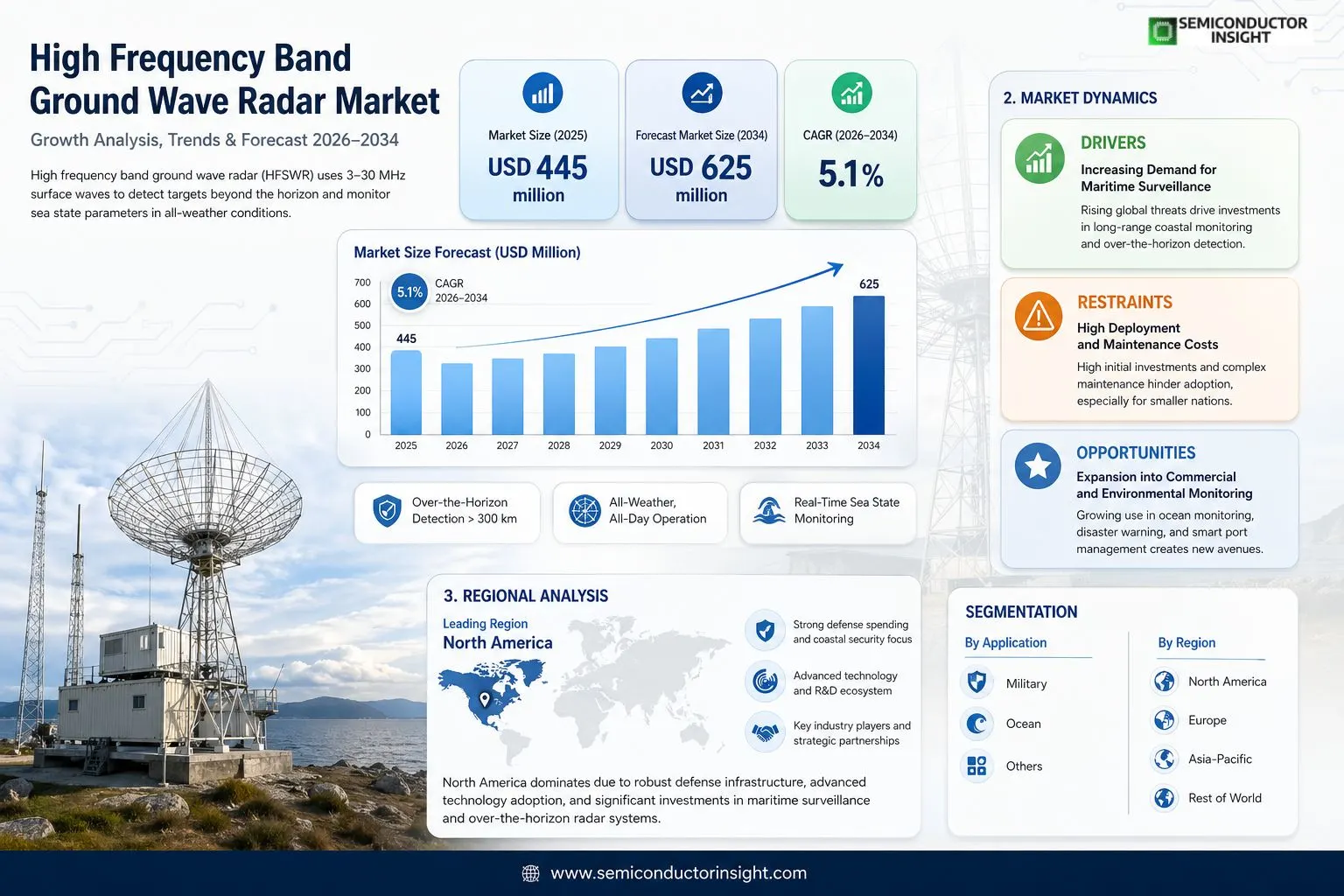
Global High Frequency Band Ground Wave Radar market size was valued at USD 445 million in 2025. The market is projected to reach USD 625 million by 2034, exhibiting a CAGR of 5.1% during the forecast period.
High-frequency surface wave radar (HFSWR) is an emerging ocean monitoring technology that utilizes short waves in the 3-30 MHz band, featuring small diffraction and low propagation attenuation over the conductive ocean surface. Employing vertically polarized antennas, it radiates radio waves to detect targets beyond visual range, including ships, aircraft, icebergs, and missiles below the line of sight, with ranges exceeding 300 km. These systems offer key advantages such as over-the-horizon capability, extensive coverage, all-weather operation, and cost-effectiveness. Additionally, high-frequency ground wave radar leverages first-order and second-order scattering of electromagnetic waves on the sea surface to derive wind fields, wave fields, currents, and other sea state parameters from echoes, enabling real-time marine environmental surveillance.
High Frequency Band Ground Wave Radar Market is experiencing steady growth driven by rising demand for maritime surveillance in defense applications, enhanced needs for oceanographic data amid climate challenges, and geopolitical emphases on coastal security. While military uses dominate for long-range target detection, civilian sectors benefit from reliable sea state monitoring. Key players including CODAR (USA), Thor (USA), Northrop Grumman (USA), Thales Group (France), Lockheed Martin (USA), and ASELSAN (Türkiye) lead with robust portfolios, fostering innovation in radar performance and integration.
MARKET DRIVERS
Increasing Demand for Maritime Surveillance
High Frequency Band Ground Wave Radar Market is propelled by rising global maritime security needs, driven by escalating threats such as piracy, illegal fishing, and territorial disputes. Nations are investing heavily in coastal monitoring systems, with defense budgets allocating approximately 12-15% toward advanced radar technologies for over-the-horizon detection capabilities up to 400 km.
Advancements in Digital Signal Processing
Improvements in digital beamforming and noise suppression algorithms enhance the accuracy and range of High Frequency Band Ground Wave Radar systems, making them indispensable for real-time ocean state monitoring and search-and-rescue operations. Integration with machine learning models has boosted target classification rates by over 25%.
➤ Government initiatives worldwide are channeling funds into indigenous radar development, projecting a market CAGR of 8.5% through 2030.
Furthermore, the synergy with satellite and drone technologies amplifies High Frequency Band Ground Wave Radar Market’s role in persistent surveillance networks, fostering broader adoption across naval forces.
MARKET CHALLENGES
High Initial Deployment and Maintenance Costs
High Frequency Band Ground Wave Radar Market faces hurdles due to substantial upfront investments, often exceeding $5-10 million per installation, coupled with ongoing maintenance for antenna arrays exposed to harsh coastal environments. This deters smaller nations or commercial entities from adoption.
Other Challenges
Spectrum Interference and Regulatory Compliance
High Frequency Band Ground Wave Radar operations in the 3-30 MHz range contend with ionospheric clutter and competing radio services, necessitating complex frequency management. Compliance with international spectrum allocation standards adds layers of approval delays, impacting deployment timelines by up to 18 months.Additionally, skilled workforce shortages for system calibration and data interpretation pose operational bottlenecks, with training programs lagging behind technological evolution in High Frequency Band Ground Wave Radar Market.
MARKET RESTRAINTS
Limitations in Propagation and Environmental Factors
Ground wave propagation in High Frequency Band Ground Wave Radar Market is highly susceptible to atmospheric conditions, leading to signal attenuation during solar flares or geomagnetic storms, which can degrade detection reliability by 30-40%.Moreover, the large footprint required for transmit and receive antennas,spanning hundreds of meters,restricts deployment in densely populated or ecologically sensitive coastal zones, limiting market penetration.Competition from satellite-based alternatives further caps growth, as space assets offer global coverage without terrestrial infrastructure vulnerabilities inherent to ground wave systems.Budget constraints in emerging economies amplify these issues, with only 20% of potential sites equipped with High Frequency Band Ground Wave Radar due to cost-benefit analyses favoring short-range alternatives.
MARKET OPPORTUNITIES
Expansion into Commercial and Environmental Monitoring
High Frequency Band Ground Wave Radar Market holds promise in civilian applications like ocean current mapping and tsunami early warning, where systems provide continuous wave height measurements with 95% accuracy over 200 km ranges.Growing Asia-Pacific investments, particularly in China’s Blue Dragon program and India’s coastal radar networks, signal a regional market surge, potentially capturing 35% global share by 2028.Hybrid integrations with AIS and UAV data create multi-sensor platforms, enhancing vessel tracking precision and opening doors for smart port management solutions.Emerging miniaturization trends and software-defined radar architectures lower barriers, enabling High Frequency Band Ground Wave Radar Market to penetrate disaster response and fisheries management sectors.
High Frequency Band Ground Wave Radar Market Trends
Advancements in Over-the-Horizon Detection Capabilities
High Frequency Band Ground Wave Radar Market continues to evolve with high-frequency surface wave radar (HFSWR) technology leveraging short waves in the 3-30 MHz range for minimal diffraction and propagation attenuation over conductive ocean surfaces. Vertically polarized antennas enable detection of ships, aircraft, icebergs, and missiles beyond the line of sight, extending operational ranges over 300 km. This positions High Frequency Band Ground Wave Radar Market for sustained growth driven by demands for all-weather, cost-effective surveillance solutions that outperform traditional visual-range systems.
Other Trends
Enhanced Sea State Monitoring Integration
Systems in High Frequency Band Ground Wave Radar Market increasingly utilize first-order and second-order scattering mechanisms of high-frequency electromagnetic waves on ocean surfaces to derive real-time wind fields, wave fields, and current fields from radar echoes. This multifunctionality supports comprehensive marine environmental monitoring, appealing to applications in oceanography and maritime safety, where precise sea state data informs navigation and resource management strategies.
Shifts in Product Segments and Applications
High Frequency Band Ground Wave Radar Market witnesses prominence in narrow beam and wide beam configurations, alongside emerging variants, tailored for military reconnaissance and civilian ocean monitoring sectors. Leading participants such as CODAR, Helzel (noted as Thor in some contexts), Northrop Grumman, Thales Group, and Lockheed Martin dominate, with ongoing developments in product types addressing diverse needs from defense to other specialized uses. Regional dynamics highlight North America and Europe as mature hubs, while Asia, including China and Japan, accelerates adoption for strategic maritime security. Industry surveys indicate evolving drivers like policy support for coastal defense and challenges from integration complexities, fostering mergers, acquisitions, and technological refinements among key players.
COMPETITIVE LANDSCAPE
Key Industry Players
Top Manufacturers Dominating High Frequency Band Ground Wave Radar Market
High Frequency Band Ground Wave Radar Market exhibits an oligopolistic structure dominated by a handful of leading defense contractors and specialized radar technology providers, primarily from the United States and Europe. CODAR Ocean Sensors (USA) stands out as a pioneer in high-frequency surface wave radar (HFSWR) systems, capturing significant market share through its advanced ocean monitoring solutions that enable beyond-line-of-sight detection of ships, aircraft, and environmental parameters over 300km. Northrop Grumman (USA) and Lockheed Martin (USA) further solidify U.S. leadership, leveraging their extensive military radar expertise to integrate HFSWR into naval surveillance and missile defense applications. Together, the global top five players, including these firms alongside Thor (USA) and Thales Group (France), accounted for a substantial revenue share in 2025, underscoring concentrated control amid growing demand for all-weather, cost-effective maritime domain awareness.
Beyond the frontrunners, niche players contribute specialized innovations, enhancing market diversity in military, oceanographic, and other applications. Thales Group (France) excels in wide-beam configurations for real-time sea state monitoring, while Saab Defense Group (Sweden) and Terma A/S (Denmark) focus on integrated defense systems with narrow-beam precision. Emerging contributors like ASELSAN (Türkiye), SELEX (Italy), and Exelis (USA) target regional needs, such as Mediterranean and Middle Eastern security, with tailored HFSWR for wind, wave, and current field extraction. MEADS (France) and Rockwell Collins (USA) provide complementary technologies in signal processing and antenna designs, fostering competition through mergers, R&D investments, and partnerships that address challenges like propagation attenuation over conductive ocean surfaces.
List of Key High Frequency Band Ground Wave Radar Companies Profiled
- CODAR Ocean Sensors (USA)
- Thor (USA)
- Northrop Grumman (USA)
- MEADS (France)
- Rockwell Collins (USA)
- Lockheed Martin (USA)
- Thales Group (France)
- Saab Defense Group (Sweden)
- Terma A/S (Denmark)
- ASELSAN (Türkiye)
- SELEX (Italy)
- Exelis (USA)
Segment Analysis:
| Segment Category | Sub-Segments | Key Insights |
| By Type |
|
Narrow Beam Ground Wave Radar leads due to its precision features.
|
| By Application |
|
Military dominates with strategic imperatives.
|
| By End User |
|
Defense Organizations as frontrunners in adoption.
|
| By Range Category |
|
Over-the-Horizon Range holds primacy for expansive coverage.
|
| By Functionality |
|
Target Surveillance and Detection leads with operational criticality.
|
Regional Analysis: High Frequency Band Ground Wave Radar Market
North America
Advanced signal processing and adaptive beamforming define North America’s edge in High Frequency Band Ground Wave Radar Market. Integration of machine learning enhances clutter rejection and target classification, vital for dynamic maritime environments. Collaborative R&D hubs drive compact, high-resolution systems suitable for mobile deployments.
Military focus propels demand, with HF ground wave radars enabling persistent surveillance over exclusive economic zones. Anti-submarine warfare and border protection leverage reliable propagation in ionospheric conditions, strengthening strategic deterrence.
Leading firms specialize in customized HF solutions, partnering with defense primes for turnkey installations. Ecosystem maturity supports rapid prototyping and field testing, sustaining competitive advantages in High Frequency Band Ground Wave Radar Market.
Rising geopolitical tensions and blue economy initiatives fuel expansion. Dual-use potential in search-and-rescue operations diversifies applications, while export controls reinforce domestic leadership.
Europe
Europe exhibits steady growth in High Frequency Band Ground Wave Radar Market, underpinned by NATO commitments and maritime security priorities. Countries like the UK, France, and Norway deploy these systems for North Atlantic patrol and EEZ monitoring. Emphasis on interoperability fosters multinational projects, enhancing collective defense postures. Technological prowess in phased-array designs and low-power operations addresses spectrum congestion challenges. Civilian sectors, including oil spill detection and vessel traffic management, expand market scope. EU funding supports green radar initiatives, minimizing environmental impact. However, fragmented regulations across member states occasionally hinder unified adoption. Collaborative frameworks like the European Defence Agency promote standardization, positioning Europe as a hub for next-generation HF innovations amid evolving threats from hybrid warfare.
Asia-Pacific
Asia-Pacific emerges as a dynamic contender in High Frequency Band Ground Wave Radar Market, propelled by territorial disputes and naval modernization. China and India invest heavily in indigenous capabilities for South China Sea and Indian Ocean surveillance. Japan’s advanced coastal networks integrate HF radars with satellite assets for comprehensive domain awareness. Rapid urbanization along coastlines demands robust traffic monitoring solutions. Local manufacturing hubs reduce dependency on imports, fostering cost-effective deployments. Geopolitical rivalries accelerate R&D in stealth detection and electronic warfare resilience. Environmental applications, such as tsunami early warning, gain traction. Despite infrastructure variances, government incentives and strategic alliances drive market acceleration in this high-stakes region.
South America
South America represents an emerging landscape in High Frequency Band Ground Wave Radar Market, with Brazil and Chile leading coastal defense enhancements. Amazon River basin and Atlantic patrols utilize HF ground wave propagation for inland and offshore coverage. Drug interdiction and illegal fishing enforcement prioritize reliable, all-weather performance. Partnerships with North American firms transfer technology, building local expertise. Resource-rich Exclusive Economic Zones underscore the need for persistent surveillance against poaching. Budget constraints favor modular, scalable systems. Regional blocs like Mercosur explore joint procurement to optimize costs. Gradual maturation promises untapped potential amid rising maritime commerce.
Middle East & Africa
The Middle East & Africa region shows nascent but promising traction in High Frequency Band Ground Wave Radar Market, driven by energy security and piracy concerns. Gulf states deploy systems for oil platform protection and strait monitoring. South Africa’s strategic ports benefit from HF radars in counter-smuggling operations. Harsh desert-ionospheric interactions challenge but spur resilient designs. International aid and defense pacts facilitate initial rollouts. Fisheries management and climate monitoring applications broaden appeal. Fragmented markets evolve through capacity-building programs, setting foundations for sustained growth in critical maritime domains.
Report Scope
This market research report provides a comprehensive analysis of High Frequency Band Ground Wave Radar Market, covering the forecast period 2026–2034. It offers detailed insights into market dynamics, technological advancements, competitive landscape, and key trends shaping the industry.
Key focus areas of the report include:
- Market Overview: The report begins with an overview outlining its current market scenario, key growth indicators, and industry transformation drivers. It discusses macroeconomic factors, demand–supply balance, regulatory landscape, and the strategic role of High Frequency Band Ground Wave Radar in powering advancements across industries such as military, ocean monitoring, maritime surveillance, and environmental research.
- Market Size & Forecast: Historical data and future projections for revenue, unit shipments, and market value across major regions and segments.
- Segmentation Analysis: Detailed breakdown by product type, technology, application, and end-user industry to identify high-growth segments and investment opportunities.
- Regional Insights: Insights into market performance across North America, Europe, Asia-Pacific, Latin America, and the Middle East & Africa, including country-level analysis where relevant.
- Competitive Landscape: Profiles of leading market participants, including their product offerings, R&D focus, manufacturing capacity, pricing strategies, and recent developments such as mergers, acquisitions, and partnerships.
- Technology Trends & Innovation: Assessment of emerging technologies, integration of AI/IoT, semiconductor design trends, fabrication techniques, and evolving industry standards.
- Market Drivers & Restraints: Evaluation of factors driving market growth along with challenges, supply chain constraints, regulatory issues, and market-entry barriers.
- Stakeholder Insights: Insights for component suppliers, OEMs, system integrators, investors, and policymakers regarding the evolving ecosystem and strategic opportunities.
Primary and secondary research methods are employed, including interviews with industry experts, data from verified sources, and real-time market intelligence to ensure the accuracy and reliability of the insights presented.
FREQUENTLY ASKED QUESTIONS:
What is the current market size of High Frequency Band Ground Wave Radar Market?
-> Global High Frequency Band Ground Wave Radar Market was valued at USD 445 million in 2025 and is expected to reach USD 625 million by 2034, at a CAGR of 5.1% during the forecast period.
Which key companies operate in High Frequency Band Ground Wave Radar Market?
-> Key players include CODAR (USA), Thor (USA), Northrop Grumman (USA), MEADS (France), Rockwell Collins (USA), Lockheed Martin (USA), Thales Group (France), Saab Defense Group (Sweden), Terma A/S (Denmark), ASELSAN (Türkiye), among others.
What are the key growth drivers?
-> Key growth drivers include beyond visual range detection, all-weather operation, low cost, and real-time monitoring of marine environment including wind, wave, and flow fields.
Which region dominates the market?
-> North America remains a dominant market, while Asia is the fastest-growing region.
What are the emerging trends?
-> Emerging trends include high-frequency surface wave radar (HFSWR) technology, detection of ships, aircraft, icebergs, and missiles over 300km, and extraction of sea state information from radar echoes.

Get Sample Report PDF for Exclusive Insights
Report Sample Includes
- Table of Contents
- List of Tables & Figures
- Charts, Research Methodology, and more...
 Download Sample Report PDF





