High Flatness Silicon Wafer Market Insights
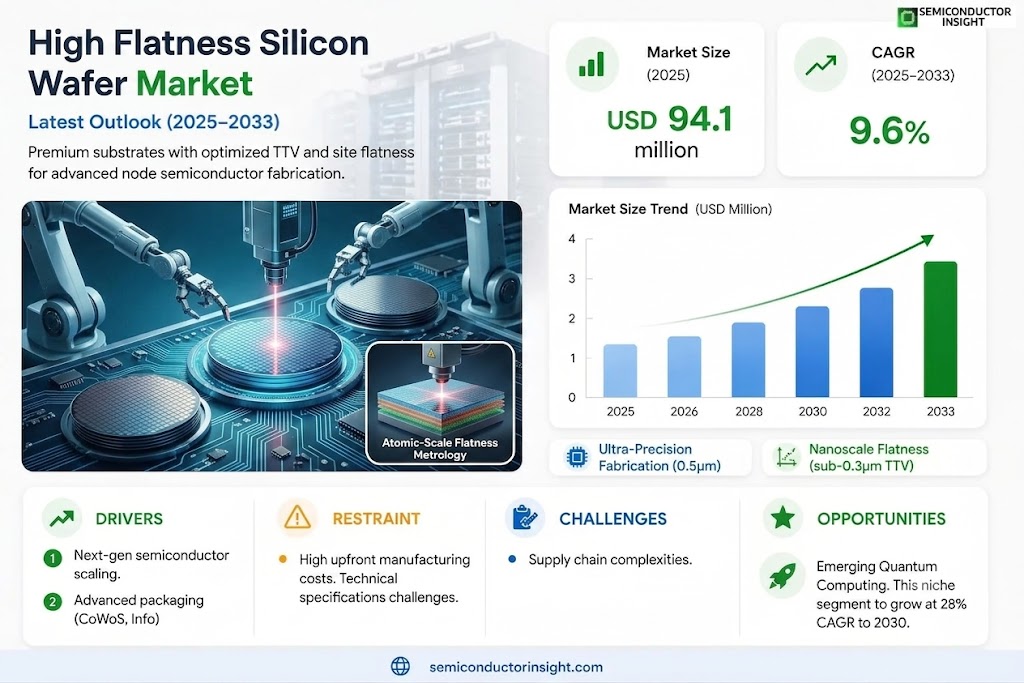
The global High Flatness Silicon Wafer market was valued at USD 94.1 million in 2024 and is projected to reach USD 178 million by 2032, exhibiting a CAGR of 9.6% during the forecast period.
High Flatness Silicon Wafers are ultra-precision substrates with thickness variation (TTV) below 1 micron, critical for semiconductor manufacturing. These wafers enable advanced applications in high-performance computing, AI chips, and 5G communications due to their exceptional surface uniformity achieved through chemical mechanical polishing (CMP) processes.
The market growth is driven by increasing demand for miniaturized electronic components and the expansion of AI infrastructure. While North America leads in technological innovation, Asia-Pacific dominates production with key players like Shin-Etsu Chemical and SUMCO controlling over 60% of the global supply. Emerging Chinese manufacturers are gaining traction through government initiatives like “Made in China 2025,” though quality consistency remains a challenge for new entrants.
MARKET DRIVERS
Growing Demand in Semiconductor Manufacturing
The High Flatness Silicon Wafer Market is experiencing significant growth due to increasing demand from semiconductor manufacturers. The rise in production of advanced ICs and MEMS devices requires ultra-flat wafers to ensure precision in photolithography processes. Market data indicates a CAGR of 7.2% from 2023-2030, driven by the expansion of 5G, IoT, and AI technologies.
Expansion of Photovoltaic Applications
High flatness silicon wafers are critical for photovoltaic cells, where surface uniformity directly impacts energy conversion efficiency. The solar energy sector’s 12% annual growth is creating sustained demand for premium wafers with sub-nanometer flatness specifications.
➤ The 300mm wafer segment currently holds 68% market share, with increasing adoption in foundries for leading-edge nodes.
Technological advancements in wafer production, including improved polishing and metrology systems, are enabling manufacturers to meet these stringent flatness requirements cost-effectively.
MARKET CHALLENGES
High Production Costs
Manufacturing high flatness silicon wafers requires specialized equipment and rigorous quality control, resulting in production costs 35-40% higher than standard wafers. The capital intensity of cleanroom facilities and advanced metrology tools creates barriers for new entrants.
Other Challenges
Supply Chain Complexities
Global semiconductor material shortages and logistical bottlenecks continue to impact wafer availability, with lead times extending to 26 weeks for premium-grade substrates.
Technical Specifications
Achieving sub-0.5μm flatness across 300mm wafers while maintaining crystal perfection presents ongoing engineering challenges for substrate manufacturers.
MARKET RESTRAINTS
Limited Number of Qualified Suppliers
The High Flatness Silicon Wafer Market faces constraints due to the limited supplier base capable of meeting the most stringent specifications. Only five global manufacturers currently produce wafers with sub-0.3μm total thickness variation (TTV), creating supply concentration risks.
MARKET OPPORTUNITIES
Emerging Applications in Quantum Computing
The development of quantum computing systems is creating new demand for ultra-high flatness silicon wafers with atomic-scale precision. This niche segment is projected to grow at 28% CAGR through 2030 as quantum processor fabrication matures.
Advancements in Wafer Bonding Technology
New 3D integration techniques using wafer-level bonding are driving demand for wafers with unparalleled surface perfection. The market for bonding-ready silicon substrates grew 18% in 2023 and shows strong potential for continued expansion.
Global High Flatness Silicon Wafer Market Trends
Market Expansion and Growth Projections
The global High Flatness Silicon Wafer market was valued at $94.1 million in 2024 and is projected to reach $178 million by 2032, growing at a CAGR of 9.6%. This growth is driven by increasing demand from semiconductor manufacturing, 5G communications, and artificial intelligence applications. Ultra-flat silicon wafers with TTV below 1 micron are critical for advanced chip production, with key markets concentrated in North America and Asia.
Other Trends
Technological Advancements in Manufacturing
Leading manufacturers like Shin-Etsu Chemical and SUMCO are investing in nano-level polishing processes to enhance wafer flatness. Chinese firms such as Shanghai Silicon Industry are gaining market share through domestic substitution strategies aligned with policies like “Made in China 2025”. The market for ultra-flat wafers (TTV <1μm) is valued at $500-$600 million in 2024.
Regional Market Dynamics
Asia-Pacific dominates the High Flatness Silicon Wafer market, accounting for over 45% of global demand, primarily due to semiconductor production hubs in China, Japan, and South Korea. North America follows closely, supported by advanced electronics manufacturing and R&D investments.
Segmentation and Competitive Landscape
The market is segmented by TTV specifications (below 0.05μm to 1μm) and applications (semiconductor, optical communication, photovoltaic). GlobalWafers, Okmetic, and Silicon Valley Microelectronics lead the competitive landscape, collectively holding approximately 35% market share.
Future Outlook and Challenges
The High Flatness Silicon Wafer market faces challenges from supply chain disruptions and geopolitical factors affecting tariff policies. However, projected CAGR of 8-10% through 2027 indicates sustained growth, with opportunities in emerging technologies requiring precision wafer substrates.
COMPETITIVE LANDSCAPE
Key Industry Players
Technological Leadership Drives Market Consolidation in High Flatness Silicon Wafer Sector
The high flatness silicon wafer market is dominated by Japanese giants Shin-Etsu Chemical and SUMCO, which collectively hold over 45% global market share through their advanced nano-level polishing technologies. These companies maintain technological leadership through continuous R&D investments exceeding $200 million annually, focusing on sub-0.05μm TTV wafers for 3nm-5nm chip applications. Their vertical integration from polycrystalline silicon production to final polishing gives significant cost advantages in the $500-600 million ultra-flat wafer market.
Emerging Asian manufacturers like China’s Shanghai Silicon Industry and Taiwan’s GlobalWafers are gaining traction through government-backed semiconductor independence initiatives, capturing 18% combined market share in 2024. Specialized Western players such as Silicon Valley Microelectronics and Okmetic lead in niche applications like photonics and MEMS, leveraging their expertise in customized wafer solutions. The competitive landscape is further diversified by technology-driven startups like Platypus Tech, which focus on quantum computing-grade wafers.
List of Key High Flatness Silicon Wafer Companies Profiled
- Shin-Etsu Chemical Co., Ltd.
- SUMCO Corporation
- GlobalWafers Co., Ltd.
- Shanghai Silicon Industry Group
- Siltronic AG
- Okmetic Oy
- Silicon Technology Corporation
- Silicon Valley Microelectronics
- Wafer Works Corporation
- SK Siltron
- Suzhou Resemi Technology Co., Ltd.
- Ted Pella, Inc.
- Platypus Technologies, LLC
- OMDA Ltd.
- UniversityWafer, Inc.
Segment Analysis:
| Segment Category | Sub-Segments | Key Insights |
| By Type |
|
Ultra-flat wafers (TTV below 0.05 μm) dominate the market due to:
|
| By Application |
|
Semiconductor applications lead with strong growth drivers:
|
| By End User |
|
Foundries represent the largest consumption base due to:
|
| By Technology Node |
|
7nm and below creating most demand with:
|
| By Supply Chain Position |
|
Direct Supply agreements dominate high-end market with:
|
Regional Analysis: High Flatness Silicon Wafer Market
Taiwan’s semiconductor foundries maintain stringent specifications for high flatness silicon wafers to support advanced node production. The island’s wafer suppliers have developed proprietary polishing techniques that achieve exceptional surface uniformity required for next-generation chips.
South Korea’s memory chip manufacturers drive demand for specialized high flatness wafers optimized for 3D NAND stacking. Local wafer producers have invested heavily in edge grinding technologies to minimize thickness variations critical for multi-layer memory devices.
Japanese manufacturers lead in high-purity silicon crystal growth and surface finishing technologies. Their expertise in ultra-flat wafer production supports both domestic semiconductor firms and global customers requiring wafers with sub-nanometer flatness tolerances.
China’s rapid fab construction creates new demand centers for high flatness silicon wafers. Domestic wafer producers are upgrading polishing capabilities to meet the specifications of leading-edge logic and power semiconductor manufacturing facilities.
North America
North America remains a key innovation hub for High Flatness Silicon Wafer technologies, particularly for specialized applications in aerospace and quantum computing. The region’s focus on compound semiconductors and silicon-on-insulator (SOI) wafers drives demand for substrates with exceptional flatness characteristics. Leading research institutions collaborate with wafer producers to develop novel surface preparation techniques that enable next-generation chip architectures. Silicon Valley’s ecosystem fosters continuous improvement in wafer metrology systems to verify flatness at atomic scales.
Europe
European semiconductor manufacturers prioritize high flatness silicon wafers for automotive and industrial applications. The region’s strength in power electronics and MEMS sensors creates specialized demand for wafers with ultra-precise thickness control. Collaborative R&D programs between wafer suppliers and equipment makers have advanced polishing technologies that achieve superior surface planarity. Strict quality standards in European fabs necessitate wafer flatness measurements with nanometer precision.
Middle East & Africa
Emerging technology investments in the Middle East are creating new opportunities for high flatness silicon wafer suppliers. Strategic initiatives in Saudi Arabia and the UAE aim to develop localized semiconductor manufacturing capabilities, with wafer flatness becoming a key specification for incoming fab projects. Africa’s growing electronics assembly sector presents potential for future wafer demand as regional capabilities mature.
South America
South America’s High Flatness Silicon Wafer market focuses primarily on industrial and renewable energy applications. Brazil’s growing electronics manufacturing sector shows increasing demand for precision wafers, particularly for power devices. Regional economic development programs aim to strengthen technical capabilities in semiconductor materials preparation and characterization.
Report Scope
This market research report provides a comprehensive analysis of the High Flatness Silicon Wafer Market, covering the forecast period 2025–2032. It offers detailed insights into market dynamics, technological advancements, competitive landscape, and key trends shaping the industry.
Key focus areas of the report include:
-
Market Overview: The report begins with an overview outlining its current market scenario, key growth indicators, and industry transformation drivers. It discusses macroeconomic factors, demand–supply balance, regulatory landscape, and the strategic role of semiconductors in powering advancements across industries such as automotive, telecommunications, consumer electronics, and industrial automation.
- Market Size & Forecast: Historical data and future projections for revenue, unit shipments, and market value across major regions and segments.
- Segmentation Analysis: Detailed breakdown by product type, technology, application, and end-user industry to identify high-growth segments and investment opportunities.
- Regional Insights: Insights into market performance across North America, Europe, Asia-Pacific, Latin America, and the Middle East & Africa, including country-level analysis where relevant.
- Competitive Landscape: Profiles of leading market participants, including their product offerings, R&D focus, manufacturing capacity, pricing strategies, and recent developments such as mergers, acquisitions, and partnerships.
- Technology Trends & Innovation: Assessment of emerging technologies, integration of AI/IoT, semiconductor design trends, fabrication techniques, and evolving industry standards.
- Market Drivers & Restraints: Evaluation of factors driving market growth along with challenges, supply chain constraints, regulatory issues, and market-entry barriers.
- Stakeholder Insights: Insights for component suppliers, OEMs, system integrators, investors, and policymakers regarding the evolving ecosystem and strategic opportunities.
Primary and secondary research methods are employed, including interviews with industry experts, data from verified sources, and real-time market intelligence to ensure the accuracy and reliability of the insights presented.
FREQUENTLY ASKED QUESTIONS:
What is the current market size of High Flatness Silicon Wafer Market?
-> The High Flatness Silicon Wafer Market was valued at USD 94.1 million in 2024 and is expected to reach USD 178 million by 2032, growing at a CAGR of 9.6% during the forecast period.
Which key companies operate in High Flatness Silicon Wafer Market?
-> Key players include Silicon Technology Corporation, GlobalWafers, Okmetic, Silicon Valley Microelectronics (SVM), Ted Pella, Platypus Tech, Omda, and Suzhou Resemi.
What are the key growth drivers?
-> Key growth drivers include 5G communications, artificial intelligence chips, high-performance computing, and increasing demand for advanced semiconductor manufacturing.
Which region dominates the market?
-> Asia-Pacific (especially China) is the fastest-growing region, while North America remains a key market.
What are the emerging trends?
-> Emerging trends include nano-level polishing processes, domestic substitution initiatives, and precision manufacturing techniques like chemical mechanical polishing (CMP).

Get Sample Report PDF for Exclusive Insights
Report Sample Includes
- Table of Contents
- List of Tables & Figures
- Charts, Research Methodology, and more...
 Download Sample Report PDF