
MARKET INSIGHTS
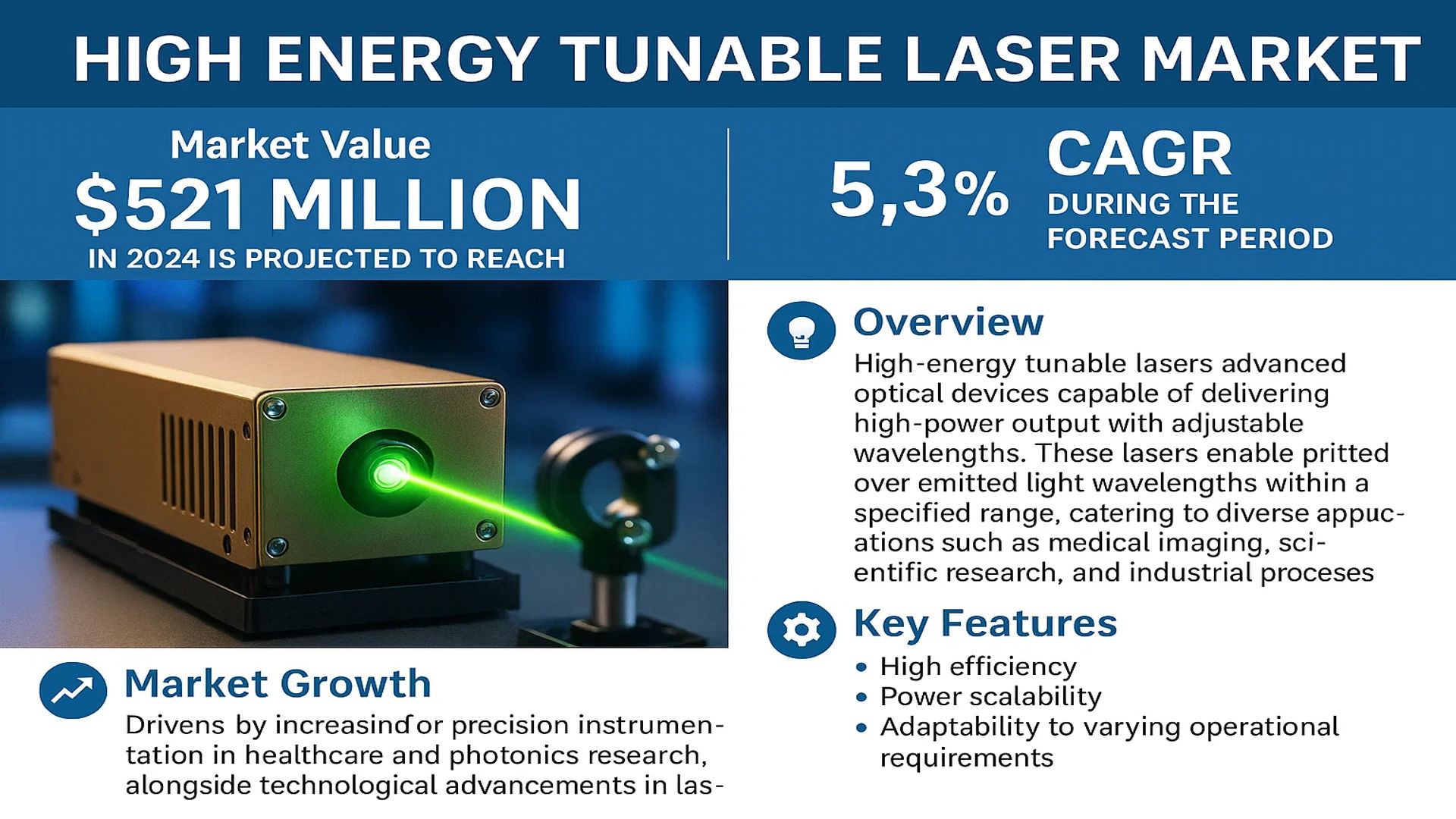
The global High Energy Tunable Laser Market was valued at 521 million in 2024 and is projected to reach US$ 745 million by 2032, at a CAGR of 5.3% during the forecast period.
High-energy tunable lasers are advanced optical devices capable of delivering high-power output with adjustable wavelengths. These lasers enable precise control over emitted light wavelengths within a specified range, catering to diverse applications such as medical imaging, scientific research, and industrial processes. Key features include high efficiency, power scalability, and adaptability to varying operational requirements.
Market growth is driven by increasing demand for precision instrumentation in healthcare and photonics research, alongside technological advancements in laser-based diagnostics. The wavelength 765-800nm segment is anticipated to demonstrate significant growth, supported by its adoption in photoacoustic imaging and vibrational spectroscopy. Leading manufacturers such as CNI Laser, Ekspla, and Santec are expanding their product portfolios through R&D investments and strategic partnerships, further propelling market expansion.
MARKET DYNAMICS
MARKET DRIVERS
Advancements in Medical and Scientific Research Fueling Demand for High Energy Tunable Lasers
The global high energy tunable laser market is experiencing robust growth, largely driven by increasing applications in medical treatments and scientific research. Tunable lasers enable precise wavelength adjustments, making them invaluable tools in procedures like photoacoustic imaging and laser surgery. The medical lasers market is projected to grow substantially, with tunable lasers playing a increasingly critical role in minimally invasive surgeries and diagnostic applications. Their ability to deliver high energy at specific wavelengths while minimizing tissue damage has made them particularly valuable in ophthalmology and dermatology treatments.
Expansion of Industrial Applications Accelerating Market Growth
Beyond healthcare, industrial applications are significantly contributing to market expansion. High energy tunable lasers are becoming essential in material processing, particularly for precision cutting and welding of advanced materials. The manufacturing sector’s growing adoption of laser-based technologies for quality control and material analysis has created substantial demand. Furthermore, their use in thin-film inspection and semiconductor manufacturing has increased as industries seek more precise and efficient production methods. The superior beam quality and flexibility of tunable lasers make them particularly suitable for these industrial applications.
Government Investments in Defense and Aerospace Supporting Market Development
The defense and aerospace sectors represent another significant growth area, with governments worldwide increasing investments in laser-based systems. High energy tunable lasers are crucial components in lidar systems for target acquisition, range finding, and situational awareness. Military applications particularly benefit from the ability to tune laser wavelengths for optimal atmospheric penetration and target interaction. These factors, combined with the development of directed energy weapons, are creating substantial opportunities for high energy tunable laser manufacturers.
➤ The growing adoption of quantum technologies in communication and computing is expected to further expand the application scope of high energy tunable lasers in coming years.
MARKET RESTRAINTS
High Initial and Maintenance Costs Limiting Market Penetration
While the high energy tunable laser market shows strong growth potential, the substantial costs associated with these systems present significant barriers. The sophisticated optics, precision components, and advanced control systems required for high performance contribute to elevated price points. Additionally, maintenance and calibration of these systems require specialized expertise, further increasing the total cost of ownership. These factors can be particularly prohibitive for smaller research institutions and manufacturing facilities with limited budgets.
Other Constraints
Regulatory Challenges
Stringent safety regulations governing laser use in industrial and medical applications create compliance challenges for manufacturers. Different countries maintain varying classification systems and safety standards, requiring manufacturers to navigate complex regulatory landscapes. These variations can delay product launches and increase development costs.
Technical Limitations
Despite significant advancements, high energy tunable lasers still face technical constraints related to power efficiency and thermal management. Achieving both high output power and wide tunability often requires trade-offs in performance parameters, which can limit application potential. The development of more efficient cooling systems and optical components remains an ongoing challenge for the industry.
MARKET CHALLENGES
Intense Competition and Rapid Technological Obsolescence Creating Market Pressures
The high energy tunable laser market faces significant challenges from rapid technological evolution and intense competition. Manufacturers must continually innovate to maintain market position, as product differentiators become obsolete quickly in this fast-moving sector. The emergence of new laser technologies and alternative approaches to achieving similar results creates constant pressure on established players. This dynamic environment requires substantial investment in research and development to stay competitive.
Other Challenges
Supply Chain Vulnerabilities
The specialized components required for high energy tunable lasers, particularly rare earth elements and precision optical components, face supply chain vulnerabilities. Geopolitical tensions, trade restrictions, and production bottlenecks can significantly impact manufacturing capabilities and timelines.
Skill Shortages
The industry is experiencing a shortage of qualified personnel with expertise in laser physics and optical engineering. This skills gap affects both manufacturers and end-users, potentially slowing adoption rates as organizations struggle to implement and maintain these sophisticated systems.
MARKET OPPORTUNITIES
Expanding Applications in Emerging Technologies Creating Growth Potential
Emerging technologies such as quantum computing, advanced spectroscopy, and next-generation telecommunications present significant opportunities for high energy tunable lasers. These applications require precisely controlled, high-performance laser systems with excellent wavelength stability and tuning capabilities. The development of these technologies is driving demand for specialized laser solutions capable of meeting stringent performance requirements.
Development of Compact and Portable Systems Opening New Markets
The trend toward miniaturization and portability in laser systems creates exciting opportunities for market expansion. Compact high energy tunable lasers that maintain performance standards could penetrate new application areas including field-deployable medical devices and portable industrial inspection systems. Advances in semiconductor laser technology and integrated photonics are enabling this transition toward more compact form factors.
Growing Demand for Custom Solutions in Research and Industry
There is increasing demand for customized high energy tunable laser solutions tailored to specific research or industrial applications. Manufacturers capable of providing flexible, application-specific configurations stand to benefit from this trend. The ability to offer modular designs that can be adapted for different wavelength ranges or power requirements is becoming an important differentiator in the market.
HIGH ENERGY TUNABLE LASER MARKET TRENDS
Advancements in Laser Technology Driving Market Expansion
The global high-energy tunable laser market is experiencing significant growth due to advancements in laser technology, particularly in wavelength flexibility and output power. Recent innovations such as optical parametric oscillators (OPOs) and solid-state tunable lasers have enabled precise wavelength adjustments within the 710–810 nm range, making them indispensable in medical and scientific applications. The demand for these lasers is further amplified by their integration into high-precision medical devices, where they are used for procedures such as dermatology treatments and ophthalmic surgeries. The increasing adoption of tunable lasers in spectroscopy and defense applications is also contributing to the market’s upward trajectory, with the sector projected to grow at a CAGR of 5.3% from 2024 to 2032.
Other Trends
Growing Demand in Biomedical Applications
The healthcare sector is emerging as a key driver for the high-energy tunable laser market, particularly in applications such as photoacoustic imaging and laser-induced breakdown spectroscopy (LIBS). These lasers provide high-resolution imaging capabilities, enabling early disease detection and tissue analysis. The U.S. market, estimated at over $150 million in 2024, is leading due to its strong R&D focus, while China is rapidly catching up with increasing investments in medical laser technologies. Additionally, vibrational spectroscopy applications in pharmaceutical research are boosting demand, as these lasers enhance molecular analysis and drug development processes.
Expansion of Industrial and Scientific Research Applications
Industrial and scientific research sectors are rapidly adopting high-energy tunable lasers for precision material processing, ranging from semiconductor manufacturing to defense applications. The ability of these lasers to provide adjustable wavelengths and high-power output makes them ideal for cutting-edge innovations in quantum computing and LiDAR systems. In Europe, increased government funding for photonics research is accelerating market growth, with Germany and France spearheading advancements in laser-based measurement systems. Furthermore, collaborations between academic institutions and key market players, such as Ekspla and Santec, are fostering innovation, leading to the development of next-generation tunable lasers with enhanced efficiency and scalability.
COMPETITIVE LANDSCAPE
Key Industry Players
Technological Innovation Drives Competition in High Energy Tunable Laser Market
The global High Energy Tunable Laser market features a dynamic competitive environment with a mix of established players and emerging competitors. Rayscience and CNI Laser have emerged as leading manufacturers, holding a significant share of the market in 2024. These companies dominate owing to their extensive R&D investments and broad application coverage, including medical and scientific research sectors.
While Ekspla and Santec maintain strong positions with their specialized tunable laser solutions, they face increasing competition from regional players like CNRood and Crylink, which are expanding their global footprint. The market growth of these companies is further propelled by strategic collaborations and continuous product enhancements.
In addition, Time-Tech Spectra and Yi-Laser are gaining traction through cost-effective solutions tailored for emerging markets. Their ability to offer competitive pricing without compromising on performance makes them formidable players in price-sensitive regions.
Meanwhile, companies such as Fingqi and Pacific Lasertec are strengthening their market presence through acquisitions and partnerships, particularly focusing on the Asia-Pacific sector where demand is rapidly growing. The continuous introduction of advanced wavelength-adjustable lasers ensures their sustained competitiveness.
List of Key High Energy Tunable Laser Companies Profiled
- Rayscience (China)
- CNI Laser (China)
- Ekspla (Lithuania)
- Santec (Japan)
- CNRood (China)
- Crylink (China)
- Time-Tech Spectra (China)
- Teo (Japan)
- Yi-Laser (China)
- Fingqi (China)
- Pacific Lasertec (China)
- Oplanchina (China)
Segment Analysis:
By Type
Wavelength 765-800nm Segment Holds Significant Market Share Due to Precision in Medical Applications
The market is segmented based on type into:
- Wavelength 765-800nm
- Wavelength 710-810nm
By Application
Medical Applications Segment Leads with Growing Adoption in Minimally Invasive Procedures
The market is segmented based on application into:
- Photoacoustic Imaging
- Medical Applications
- Biology
- Vibrational Spectroscopy
- Scientific Research
By End User
Healthcare Sector Dominates with Rising Demand for Laser-Based Therapeutics
The market is segmented based on end user into:
- Hospitals & Clinics
- Pharmaceutical Companies
- Research Laboratories
- Industrial Manufacturing
By Technology
Solid-State Lasers Maintain Preference Due to High Reliability and Efficiency
The market is segmented based on technology into:
- Solid-State Lasers
- Dye Lasers
- Diode-Pumped Lasers
- Others
Regional Analysis: High Energy Tunable Laser Market
Asia-Pacific
The Asia-Pacific region dominates the global High Energy Tunable Laser market, driven by strong industrial and research investments in countries like China, Japan, and South Korea. China leads with an aggressive push in photonics and laser technology, supported by government initiatives for advanced manufacturing and defense applications. The presence of major manufacturers such as CNI Laser and Yi-Laser further strengthens regional production capabilities. Japan focuses on precision applications in semiconductor and medical industries, while India shows increasing demand for scientific research instruments. The region’s growth is further accelerated by expanding telecommunications infrastructure requiring wavelength-flexible laser solutions.
North America
North America maintains technological leadership in High Energy Tunable Lasers, particularly in specialized medical and defense applications. The U.S. accounts for the largest regional market share, with key players like Santec benefiting from substantial R&D investments in photonics ($1.5 billion allocated through the CHIPS and Science Act). Demand stems from advanced healthcare systems adopting laser-based imaging techniques and military programs requiring robust laser systems. Canada shows growing adoption in environmental sensing, while Mexico serves primarily as a manufacturing hub for cost-sensitive components. Stringent FDA regulations continue to drive innovation in medical-grade laser products across the region.
Europe
Europe’s market thrives on academic-industrial collaborations in photonics, with Germany and the UK leading in scientific research applications. EU Horizon Europe funding supports tunable laser development for quantum technologies and industrial metrology. The region exhibits strong demand for wavelength-stable lasers in automotive LIDAR and precision manufacturing. Environmental regulations promote energy-efficient laser designs, particularly in Nordic countries. While the market grows steadily, high production costs limit wider adoption compared to Asian counterparts, pushing European firms toward high-value niche applications where performance justifies premium pricing.
Middle East & Africa
This emerging market shows concentrated growth in oil-rich Gulf states, where tunable lasers find applications in geological surveying and energy infrastructure monitoring. The UAE and Saudi Arabia drive regional adoption through smart city initiatives and healthcare modernization projects. Turkey demonstrates potential as a manufacturing base for European markets. However, limited local technical expertise and reliance on imports constrain market expansion. Recent investments in academic research facilities signal long-term growth potential, particularly for spectroscopy and material analysis applications in mining industries across Africa.
South America
The region presents nascent opportunities, with Brazil and Argentina showing increasing demand in biomedical research and agricultural sensing applications. Economic instability and currency fluctuations hinder large-scale investments, maintaining reliance on imported laser systems. Local manufacturers focus on servicing industrial maintenance applications rather than cutting-edge research. However, growing telecom infrastructure projects and mining operations create steady demand for durable laser measurement systems, with Chile emerging as a regional hub for laser-based mineral analysis technologies.
Report Scope
This market research report provides a comprehensive analysis of the Global High Energy Tunable Laser Market, covering the forecast period 2024–2032. It offers detailed insights into market dynamics, technological advancements, competitive landscape, and key trends shaping the industry.
Key focus areas of the report include:
- Market Size & Forecast: Historical data and future projections for revenue, unit shipments, and market value across major regions and segments. The Global High Energy Tunable Laser Market was valued at USD 521 million in 2024 and is projected to reach USD 745 million by 2032, growing at a CAGR of 5.3%.
- Segmentation Analysis: Detailed breakdown by product type (Wavelength 765-800nm, Wavelength 710-810nm) and application (Photoacoustic Imaging, Medical Applications, Biology, Vibrational Spectroscopy, Scientific Research) to identify high-growth segments and investment opportunities.
- Regional Outlook: Insights into market performance across North America, Europe, Asia-Pacific, Latin America, and the Middle East & Africa, including country-level analysis. The U.S. market is a key contributor, while China shows significant growth potential.
- Competitive Landscape: Profiles of leading market participants, including their product offerings, R&D focus, manufacturing capacity, pricing strategies, and recent developments such as mergers, acquisitions, and partnerships. Key players include Rayscience, CNI Laser, Ekspla, Santec, CNRood, Crylink, Time-Tech Spectra, Teo, Yi-Laser, and Fingqi.
- Technology Trends & Innovation: Assessment of emerging technologies, integration of AI/IoT, and evolving industry standards in high-energy tunable laser systems.
- Market Drivers & Restraints: Evaluation of factors driving market growth, such as increasing demand in medical and scientific research applications, along with challenges like high costs and technical complexities.
- Stakeholder Analysis: Insights for component suppliers, OEMs, system integrators, investors, and policymakers regarding the evolving ecosystem and strategic opportunities.
Primary and secondary research methods are employed, including interviews with industry experts, data from verified sources, and real-time market intelligence to ensure the accuracy and reliability of the insights presented.
FREQUENTLY ASKED QUESTIONS:
What is the current market size of the Global High Energy Tunable Laser Market?
-> High Energy Tunable Laser Market was valued at 521 million in 2024 and is projected to reach US$ 745 million by 2032, at a CAGR of 5.3% during the forecast period.
Which key companies operate in the Global High Energy Tunable Laser Market?
-> Key players include Rayscience, CNI Laser, Ekspla, Santec, CNRood, Crylink, Time-Tech Spectra, Teo, Yi-Laser, and Fingqi, among others.
What are the key growth drivers?
-> Key growth drivers include increasing demand in medical applications, scientific research advancements, and expanding use in photoacoustic imaging and vibrational spectroscopy.
Which region dominates the market?
-> North America currently leads the market, while Asia-Pacific is expected to witness the highest growth rate.
What are the emerging trends?
-> Emerging trends include integration of AI for precise wavelength control, development of compact tunable laser systems, and increasing adoption in biomedical research.

Get Sample Report PDF for Exclusive Insights
Report Sample Includes
- Table of Contents
- List of Tables & Figures
- Charts, Research Methodology, and more...
 Download Sample Report PDF




