Heterogeneous Integration Semiconductor Market Insights
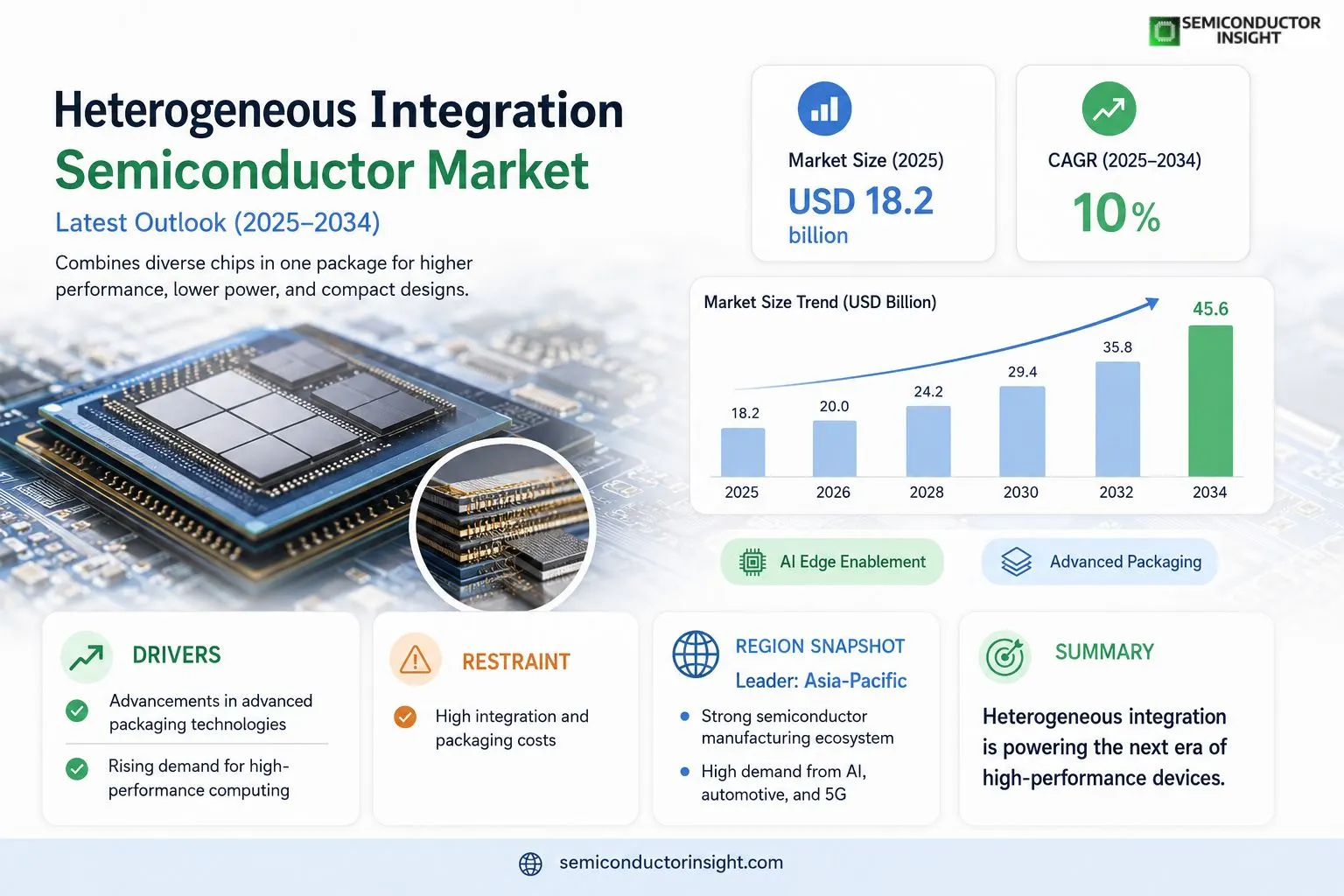
Global heterogeneous integration semiconductor market size was valued at USD 18.2 billion in 2025. The market is projected to grow from USD 19 billion in 2025 to USD 45.6 billion by 2034, exhibiting a CAGR of approximately 10 % during the forecast period.
Heterogeneous integration semiconductors combine diverse functional blockssuch as logic cores, high‑performance memory, RF front‑ends, power devices and sensorsinto a single package using advanced packaging techniques like chip‑on‑wafer‑level‑integration (CoW), silicon interposers and full‑die‑stacking (3D). This architecture delivers higher bandwidth, reduced footprint and lower power consumption compared with traditional monolithic ICs, enabling new form factors for automotive ADAS, AI edge computing and mobile devices.
MARKET DRIVERS
Advancements in Packaging Technologies
Heterogeneous Integration Semiconductor Market is being propelled by rapid innovations in advanced packaging, such as fan‑out wafer‑level packaging and silicon interposers, which enable the stacking of diverse dies within a single package. These technologies reduce interconnect length, improve signal integrity, and support higher bandwidth, making them essential for next‑generation smartphones and data‑center processors.
Demand for High‑Performance Computing
Enterprises are upgrading to AI‑driven workloads that require compute‑dense solutions. By integrating processors, memory, and passive components in a heterogeneous stack, designers achieve significant performance gains while keeping power consumption under control. This demand is driving a double‑digit CAGR in the market over the next five years.
➤ “Heterogeneous integration reduces system‑level cost by up to 30 % compared with traditional multi‑chip modules, according to recent industry surveys.”
These drivers collectively reinforce the strategic shift toward monolithic system‑in‑package (SiP) solutions, positioning Heterogeneous Integration Semiconductor Market for robust expansion across communications, automotive, and consumer electronics segments.
MARKET CHALLENGES
Manufacturing Complexity
Integrating dissimilar materials and processes increases fab‑line variability, requiring specialized equipment and tighter process controls. The steep learning curve can lead to yield losses, especially for firms transitioning from traditional planar ASIC production.
Other Challenges
Supply Chain Constraints
The reliance on rare‑earth substrates and high‑purity silicon interposers creates bottlenecks. Limited supplier capacity often results in lead‑time extensions that impede fast‑track product launches.
MARKET RESTRAINTS
Cost Sensitivity
While heterogeneous solutions deliver performance advantages, the up‑front investment for redesign and new packaging tooling remains high. Mid‑tier manufacturers, which dominate Global semiconductor landscape, may defer adoption until economies of scale materialize.Additionally, the incremental cost per wafer for multi‑die stacking can be 15‑20 % higher than conventional processes, challenging price‑competitive markets such as consumer electronics.Regulatory scrutiny over material usage and recycling also adds compliance expenses, further restraining rapid market penetration in cost‑driven regions.
MARKET OPPORTUNITIES
Emerging Applications in AI Edge
The rise of edge AI for industrial IoT, autonomous vehicles, and smart cameras creates a lucrative niche for heterogeneous integration. By co‑locating AI accelerators with memory and sensors, manufacturers can deliver low‑latency, power‑efficient solutions that meet stringent on‑device processing requirements.Furthermore, 5G rollout and the anticipated 6G evolution demand high‑frequency RF front‑ends integrated with digital baseband processors. Heterogeneous stacks enable these functions to coexist within compact footprints, opening new revenue streams for OEMs.Investments from major foundries in dedicated heterogeneous integration platforms are expected to lower entry barriers, fostering broader ecosystem participation and expanding the addressable market size.
Heterogeneous Integration Semiconductor Market Trends
AI‑Driven Edge Computing Integration
Heterogeneous Integration Semiconductor Market is increasingly shaped by the need for high‑performance edge processors that can run artificial‑intelligence workloads with minimal latency. By embedding logic cores, high‑bandwidth memory, and specialized AI accelerators within a single package, manufacturers achieve a superior power‑to‑performance ratio compared with discrete solutions. Advanced packaging methods such as chip‑on‑wafer‑level‑integration (CoW) and full‑die‑stacking enable bandwidths that support real‑time inference in smart cameras, industrial IoT gateways, and portable devices. This trend reduces board‑level complexity, shortens time‑to‑market, and aligns with the broader industry shift toward distributed intelligence.
Other Trends
Chiplet Architecture Expansion
Chiplet‑based designs are becoming a cornerstone of Heterogeneous Integration Semiconductor Market, allowing designers to mix and match proven building blocks from multiple vendors. Silicon interposers act as high‑density routing platforms, connecting heterogeneous dies while preserving signal integrity. The modular nature of chiplets shortens development cycles and spreads risk, as each block can be qualified independently before system assembly. In data‑center accelerators, for example, the combination of a high‑speed networking chiplet with a compute‑heavy AI chiplet delivers throughput levels previously achievable only with monolithic ASICs. The economic advantage stems from reusing mature chiplets, which lowers non‑recurring engineering costs and facilitates rapid scaling of product families.
Automotive ADAS and Sensor Fusion
In automotive applications, Heterogeneous Integration Semiconductor Market is responding to stricter safety regulations and the demand for advanced driver‑assistance systems (ADAS). By integrating radar, lidar, and high‑resolution imaging sensors with powerful central processors, manufacturers create compact modules that support sensor fusion algorithms essential for autonomous driving. The reduced footprint and lower power draw help vehicle designers meet weight and efficiency targets, while the unified package improves thermal management. As OEMs transition from driver‑aid features to higher levels of autonomy, the ability to deliver multifunctional semiconductor solutions will be a key competitive differentiator.
COMPETITIVE LANDSCAPEKey Industry Players
Heterogeneous Integration Semiconductor Market is moderately consolidated, with a handful of dominant global semiconductor giants commanding significant market share alongside a growing number of specialized packaging and foundry players expanding their advanced integration capabilities.
Global heterogeneous integration semiconductor market is led by a cluster of technologically advanced companies that have made substantial investments in advanced packaging infrastructures, including 2.5D and 3D IC technologies, silicon interposers, chip-on-wafer-on-substrate (CoWoS), and fan-out wafer-level packaging (FOWLP). Intel Corporation remains one of the most prominent players in this space, having pioneered its EMIB (Embedded Multi-die Interconnect Bridge) and Foveros 3D stacking technologies to enable high-performance heterogeneous integration across compute, memory, and I/O dies. Taiwan Semiconductor Manufacturing Company (TSMC) holds a commanding position through its industry-leading CoWoS and SoIC (System on Integrated Chips) packaging platforms, which are widely adopted for AI accelerators and high-performance computing applications. Samsung Electronics and SK Hynix contribute significantly through their advanced memory packaging technologies, including High Bandwidth Memory (HBM), which is a critical component within heterogeneous integrated systems. The competitive intensity has grown considerably as the market is projected to expand from USD 19 billion in 2025 to USD 45.6 billion by 2034, at a CAGR of approximately 10%, attracting increased R&D commitments across the semiconductor value chain.Beyond the dominant foundry and IDM leaders, several niche and specialized players are shaping the heterogeneous integration semiconductor landscape across distinct application verticals. Advanced Micro Devices (AMD) has strategically deployed chiplet-based architectures in its EPYC and Ryzen processor families, establishing a compelling design methodology for heterogeneous integration at scale. NVIDIA leverages heterogeneous packaging through its NVLink and multi-chip module designs deployed in AI data center GPUs. ASE Technology Holding and Amkor Technology are pivotal OSATs (Outsourced Semiconductor Assembly and Test providers) that deliver advanced packaging services enabling heterogeneous integration for fabless companies. Qualcomm and Broadcom are also notable participants, integrating heterogeneous architectures into their RF front-end and networking silicon portfolios to serve mobile and data center markets. Additionally, companies such as Marvell Technology, Micron Technology, and Onto Innovation are reinforcing the ecosystem through memory integration solutions and process inspection tools tailored for heterogeneous packages, collectively supporting the market’s robust expansion trajectory through 2034.
List of Key Heterogeneous Integration Semiconductor Companies Profiled
- Intel Corporation
- Taiwan Semiconductor Manufacturing Company (TSMC)
- Samsung Electronics
- SK Hynix
- Advanced Micro Devices (AMD)
- NVIDIA Corporation
- ASE Technology Holding Co., Ltd.
- Amkor Technology
- Qualcomm Incorporated
- Broadcom Inc.
- Marvell Technology, Inc.
- Micron Technology, Inc.
- Onto Innovation Inc.
- STMicroelectronics N.V.
- Texas Instruments Incorporated
Segment Analysis:
| Segment Category | Sub-Segments | Key Insights |
| By Type |
|
Logic Integrated
|
| By Application |
|
Automotive ADAS
|
| By End User |
|
OEMs
|
| By Technology |
|
Silicon Interposer
|
| By Industry |
|
Automotive
|
Regional Analysis: Asia-Pacific
Asia-Pacific
China’s aggressive investment in the semiconductor industry is driving significant advancements in heterogeneous integration. The government’s “Made in China 2025” initiative has provided substantial funding for domestic chip manufacturers and fostered innovation in advanced packaging technologies.
Taiwan remains a global leader in semiconductor manufacturing, possessing a well-established ecosystem and advanced technological capabilities crucial for heterogeneous integration. Key players in Taiwan are actively developing and implementing advanced packaging techniques.
South Korea’s strong presence in memory chips and its commitment to research and development are contributing to the growth of the heterogeneous integration market. Companies in South Korea are focusing on developing advanced packaging solutions for high-performance computing and AI applications.
Japan’s expertise in materials science and precision manufacturing is well-suited for the development of advanced heterogeneous integration technologies. Japanese companies are actively involved in developing novel packaging materials and interconnect technologies.
North America
North America presents a mature market for heterogeneous integration semiconductors, driven by strong demand from aerospace, defense, and high-performance computing sectors. Investment in R&D and a robust innovation ecosystem are key strengths. The region is focused on developing advanced packaging solutions for specialized applications.
Europe
Europe is witnessing increasing adoption of heterogeneous integration in automotive, industrial automation, and IoT applications. Government initiatives promoting semiconductor manufacturing and a focus on sustainable technologies are fostering growth. The region is actively collaborating on research projects to advance heterogeneous integration capabilities.
South America
South America represents an emerging market with growing demand for electronics and telecommunications. While the adoption of heterogeneous integration is still in its early stages, the region offers significant potential for future growth. Focus areas include connectivity and industrial automation.
Middle East & Africa
The Middle East & Africa region is experiencing increasing investment in infrastructure and technology, driving demand for semiconductors. The adoption of heterogeneous integration is expected to grow in sectors like telecommunications, defense, and energy. Strategic initiatives to promote local manufacturing are also gaining traction.
Report Scope
This market research report provides a comprehensive analysis of the Heterogeneous Integration Semiconductor Market , covering the forecast period 2026–2034. It offers detailed insights into market dynamics, technological advancements, competitive landscape, and key trends shaping the industry.
Key focus areas of the report include:
- Market Overview: The report begins with an overview outlining its current market scenario, key growth indicators, and industry transformation drivers. It discusses macroeconomic factors, demand–supply balance, regulatory landscape, and the strategic role of semiconductors in powering advancements across industries such as automotive, telecommunications, consumer electronics, and industrial automation.
- Market Size & Forecast: Historical data and future projections for revenue, unit shipments, and market value across major regions and segments.
- Segmentation Analysis: Detailed breakdown by product type, technology, application, and end-user industry to identify high-growth segments and investment opportunities.
- Regional Insights: Insights into market performance across North America, Europe, Asia-Pacific, Latin America, and the Middle East & Africa, including country-level analysis where relevant.
- Competitive Landscape: Profiles of leading market participants, including their product offerings, R&D focus, manufacturing capacity, pricing strategies, and recent developments such as mergers, acquisitions, and partnerships.
- Technology Trends & Innovation: Assessment of emerging technologies, integration of AI/IoT, semiconductor design trends, fabrication techniques, and evolving industry standards.
- Market Drivers & Restraints: Evaluation of factors driving market growth along with challenges, supply chain constraints, regulatory issues, and market-entry barriers.
- Stakeholder Insights: Insights for component suppliers, OEMs, system integrators, investors, and policymakers regarding the evolving ecosystem and strategic opportunities.
Primary and secondary research methods are employed, including interviews with industry experts, data from verified sources, and real-time market intelligence to ensure the accuracy and reliability of the insights presented.
FREQUENTLY ASKED QUESTIONS:
What is the current market size of Heterogeneous Integration Semiconductor Market?
-> Heterogeneous Integration Semiconductor Market was valued at USD 18.2 billion in 2025 and is expected to reach USD 45.6 billion by 2034.
Which key companies operate in Heterogeneous Integration Semiconductor Market?
-> Key players include Axalta Coating Systems, AkzoNobel, BASF SE, PPG, Sherwin-Williams, and 3M, among others.
What are the key growth drivers?
-> Key growth drivers include railway infrastructure investments, urbanization, and demand for durable coatings.
Which region dominates the market?
-> Asia-Pacific is the fastest-growing region, while Europe remains a dominant market.
What are the emerging trends?
-> Emerging trends include bio-based coatings, smart coatings, and sustainable rail solutions.
Get Sample Report PDF for Exclusive Insights
Report Sample Includes
- Table of Contents
- List of Tables & Figures
- Charts, Research Methodology, and more...
 Download Sample Report PDF