Health Care Millimeter Wave Radar Market Insights
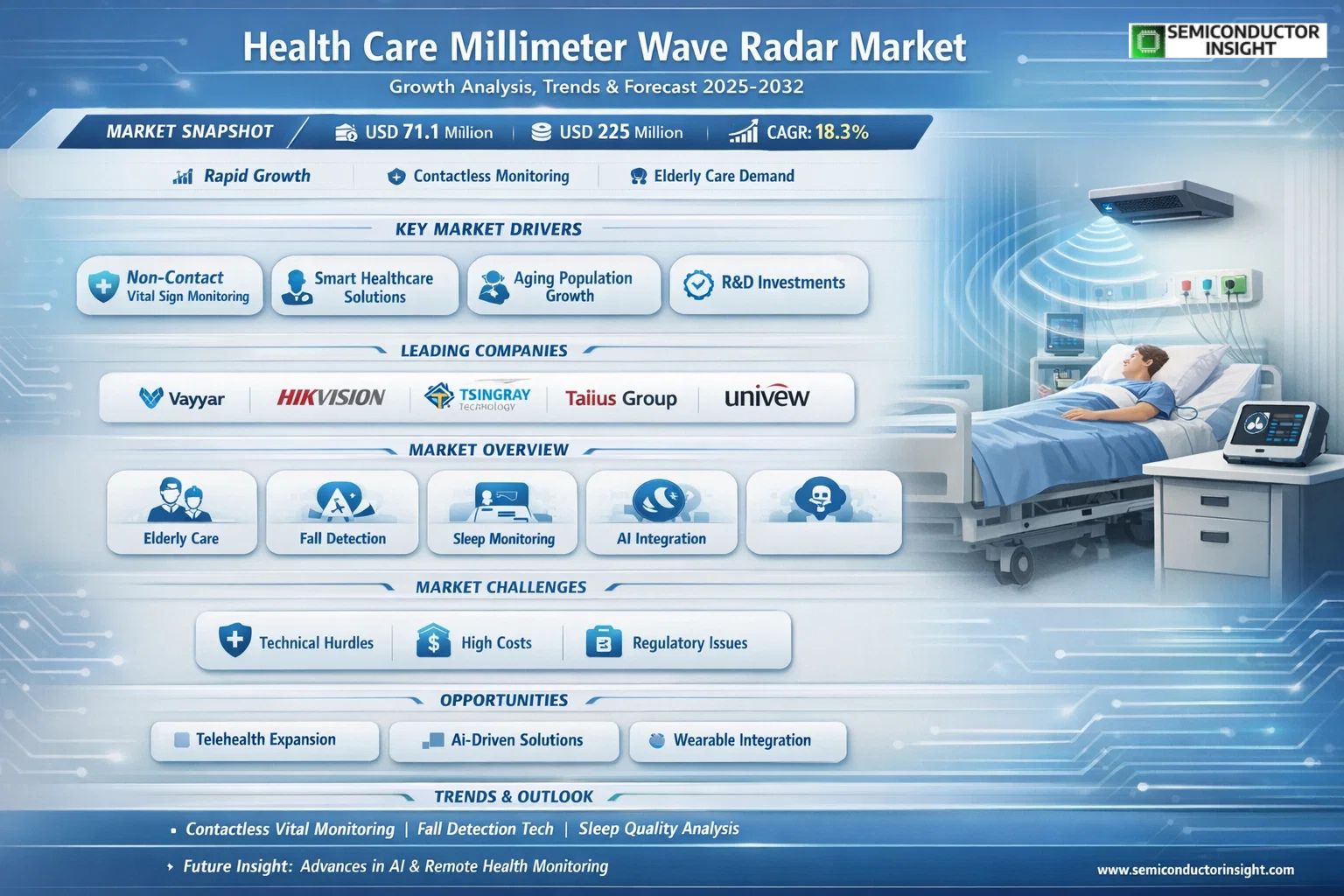
Global Health Care Millimeter Wave Radar market size was valued at USD 71.1 million in 2025. The market is projected to reach USD 225 million by 2032, exhibiting a CAGR of 18.3% during the forecast period.
Health Care Millimeter Wave Radar is a high-frequency radar technology, typically operating in the millimeter wave range (30 GHz to 300 GHz), used in healthcare applications to monitor vital signs, detect motion, and provide non-contact health diagnostics. This technology enables precise, continuous measurement of vital parameters like heart rate, respiration, and body movement, without the need for direct contact with the patient. Its non-invasive nature and high accuracy make it valuable in areas like elderly care, home health monitoring, and remote patient observation. Primary frequency bands include 60GHz, 24GHz, and others.
The market is experiencing rapid growth due to several factors, including the expanding global elderly population, rising demand for contactless monitoring amid heightened hygiene awareness post-COVID, and advancements in AI integration for enhanced accuracy in fall detection and sleep analysis. Furthermore, increasing adoption in nursing homes, hospitals, and home settings is propelling expansion. Initiatives by key players are fueling further development. For instance, bitsensing has introduced mmWave radar solutions for real-time vital signs detection, showcasing innovation in this space. Vayyar, Hikvision, bitsensing, Tsingray Technology, Talius Group, and Uniview are among the key players operating with diverse portfolios.
MARKET DRIVERS
Rising Demand for Non-Contact Monitoring
Health Care Millimeter Wave Radar Market is propelled by the increasing need for contactless vital signs detection in hospitals and home care settings. Technologies enabling remote monitoring of heart rate, respiration, and movement without physical sensors address privacy concerns and reduce infection risks, especially post-pandemic. With an aging global population projected to reach 1.5 billion people over 65 by 2050, demand for such solutions surges in elder care facilities.
Integration with Smart Healthcare Ecosystems
Advancements in IoT and AI integration enhance millimeter wave radar’s role in smart hospitals, where real-time data analytics improve patient outcomes. The market benefits from a 25% annual growth in telemedicine adoption, driving deployments for fall detection and sleep monitoring. Healthcare providers increasingly favor these systems for their high accuracy in cluttered environments.
➤ Key Driver: Regulatory Support and R&D Investments
Government initiatives and private funding, exceeding $2 billion globally in 2023, accelerate innovation in Health Care Millimeter Wave Radar Market, fostering widespread adoption across ambulatory and inpatient care.
MARKET CHALLENGES
Technical and Integration Hurdles
Health Care Millimeter Wave Radar Market faces challenges from signal interference in multi-path environments like crowded wards, impacting detection precision for subtle vital signs. Calibration complexities and the need for multi-sensor fusion with cameras or wearables add deployment difficulties, slowing market penetration despite proven efficacy.
Other Challenges
High development costs, averaging $500,000 per customized system, strain smaller healthcare providers, while spectrum allocation disputes limit bandwidth availability for radar operations.
Regulatory Compliance Barriers
Navigating FDA and CE approvals demands extensive clinical trials, often delaying launches by 18-24 months and increasing expenses by up to 30%.
MARKET RESTRAINTS
Cost and Scalability Limitations
Premium pricing of millimeter wave radar systems, 40-50% higher than ultrasonic alternatives, restrains adoption in budget-constrained emerging markets. Limited manufacturing scale keeps unit costs elevated, hindering mass deployment in primary care networks.
Accuracy constraints in adverse conditions, such as high humidity or metallic obstructions common in medical facilities, undermine reliability perceptions. Competition from optical sensors offering similar non-contact capabilities at lower power consumption further caps growth.
Skill gaps among healthcare staff for operating advanced radar analytics tools persist, with only 35% of facilities reporting adequate training programs as of 2024.
MARKET OPPORTUNITIES
Expansion in Telehealth and Wearable Integration
Health Care Millimeter Wave Radar Market holds strong potential in telehealth platforms, where embedded radar modules enable continuous remote monitoring, projected to capture 30% of the segment by 2030. Partnerships with wearable tech firms enhance portability for ambulatory patients.
AI-driven enhancements promise 95% accuracy in multi-vital detection, opening doors in chronic disease management for diabetes and cardiovascular patients. Growth in Asia-Pacific, with a 28% CAGR, stems from rising healthcare digitization.
Opportunities in post-acute care settings, like rehab centers, leverage radar for gait analysis and fall prevention, supported by insurance reimbursements expanding globally.
Health Care Millimeter Wave Radar Market Trends
Contactless Vital Signs Monitoring in Elderly Care
Health Care Millimeter Wave Radar Market is witnessing significant growth driven by the demand for non-invasive health monitoring solutions, particularly in elderly care settings. Operating in the 30 GHz to 300 GHz frequency range, this technology enables precise, continuous tracking of vital signs such as heart rate, respiration, and body movements without physical contact. Its adoption is accelerating in nursing homes and home healthcare environments, where traditional wearables often face compliance issues due to discomfort among seniors. Key players like Vayyar and bitsensing are advancing radar modules that integrate seamlessly into smart home systems, enhancing patient safety and caregiver efficiency.
Other Trends
Fall Detection and Emergency Alerts
In Health Care Millimeter Wave Radar Market, fall detection represents a critical trend, addressing one of the primary risks for the elderly population. Millimeter wave radar distinguishes falls from normal activities through advanced signal processing, triggering real-time alerts to caregivers. This capability is particularly valuable in hospitals and independent living facilities, reducing response times and preventing secondary injuries. Manufacturers such as Hikvision and Talius Group are incorporating AI algorithms to minimize false positives, improving reliability in diverse lighting and environmental conditions.
Sleep Quality Analysis
Another prominent development in Health Care Millimeter Wave Radar Market involves sleep monitoring applications. Devices using 60GHz and 24GHz bands track sleep patterns, breathing irregularities, and movement, offering insights into conditions like sleep apnea. This non-intrusive method outperforms camera-based systems by preserving privacy and functioning effectively in low-light scenarios, making it suitable for long-term use in home and nursing home settings.
AI Integration and Multi-Sensor Fusion
Health Care Millimeter Wave Radar Market is evolving through AI-driven enhancements and integration with complementary sensors like infrared for superior accuracy. Challenges such as signal interference and data privacy are being mitigated via sophisticated data fusion techniques, paving the way for broader deployment in remote patient monitoring. Companies including Tsingray Technology and Micradar are focusing on cost reductions to expand accessibility in community healthcare, fostering a shift toward smart aging solutions across North America, Europe, and Asia regions.
COMPETITIVE LANDSCAPE
Key Industry Players
Leading Innovators in Contactless Health Monitoring Radar Technology
Health Care Millimeter Wave Radar Market exhibits a moderately fragmented competitive landscape, characterized by a mix of established technology firms and specialized innovators focusing on non-contact vital signs monitoring, fall detection, and sleep analysis. Leading players such as Vayyar and bitsensing command significant market shares, leveraging advanced 60GHz and 24GHz radar systems for precise heart rate, respiration, and motion detection in elderly care and remote monitoring applications. These frontrunners benefit from strong R&D investments, enabling high-accuracy, privacy-friendly solutions that outperform traditional wearables. The market structure is driven by rapid adoption in nursing homes, hospitals, and home settings, with top global companies capturing over 50% of revenues in 2025 through integrated AI enhancements and multi-sensor fusions to mitigate challenges like signal interference.
Beyond the market leaders, a robust ecosystem of niche players contributes specialized offerings, including Hikvision and Uniview, which adapt surveillance expertise for healthcare radar deployments, and emerging firms like Tsingray Technology, Talius Group, and Miaomi Technology focusing on cost-effective solutions for Asian markets. Companies such as CQ-S Net, Fusion, Livy Care, Quanthium, Microbrain Intelligent Technology, ifLabe, and Micradar address specific segments like home-based elderly monitoring and hospital integrations, fostering innovation in 24/7 contactless diagnostics. This diverse competition spurs advancements in affordability and reliability, positioning the sector for sustained growth amid rising demand for smart aging solutions.
List of Key Health Care Millimeter Wave Radar Companies Profiled
- Vayyar
- bitsensing
- Tsingray Technology
- Hikvision
- Uniview
- CQ-S Net
- Miaomi Technology
- Fusion
- Livy Care
- Quanthium
- Microbrain Intelligent Technology
- ifLabe
- Micradar
- Talius Group
Segment Analysis:
| Segment Category | Sub-Segments | Key Insights |
| By Type |
|
60GHz
|
| By Application |
|
Nursing Home
|
| By End User |
|
Elderly Care Facilities
|
| By Functionality |
|
Vital Signs Monitoring
|
| By Deployment |
|
Fixed Installation
|
Regional Analysis: Health Care Millimeter Wave Radar Market
North America
North America’s tech hubs drive millimeter wave radar evolution in healthcare, with high-resolution sensors enabling accurate vital sign detection amid interference. Innovations in AI integration enhance real-time analytics for early anomaly detection, supporting proactive care models.
Primary uses include contactless monitoring in ICUs and eldercare facilities, fall prevention through motion tracking, and sleep analysis. These applications reduce infection risks and improve response times in diverse clinical settings.
Streamlined FDA approvals and substantial funding from health agencies bolster deployment. Public-private initiatives fund pilot programs, accelerating commercialization of Health Care Millimeter Wave Radar solutions.
Rapid uptake in hospitals and homecare reflects maturity in digital health infrastructure. Customization for telemedicine expands reach, addressing urban healthcare demands effectively.
Europe
Europe exhibits strong growth in Health Care Millimeter Wave Radar Market, underpinned by stringent data privacy regulations like GDPR that build trust in sensor deployments. The continent’s aging demographic fuels demand for non-invasive monitoring in long-term care facilities and ambulatory services. Countries with advanced welfare systems prioritize radar tech for respiratory tracking and mobility assessment, integrating it into national health strategies. Collaborative EU-funded projects advance interoperability with existing medical devices, enhancing cross-border applicability. Focus on sustainable healthcare drives eco-friendly radar designs, while partnerships with automotive sensor firms adapt technologies for medical use. Challenges like fragmented regulations are offset by harmonization efforts, positioning Europe as a key innovator in privacy-centric Health Care Millimeter Wave Radar applications.
Asia-Pacific
Asia-Pacific emerges as a dynamic force in Health Care Millimeter Wave Radar Market, propelled by rapid urbanization and expanding middle-class healthcare access. Manufacturing prowess in electronics supports cost-effective radar production, enabling widespread adoption in densely populated smart hospitals. Government initiatives in digital health promote radar for crowd monitoring in public facilities and remote diagnostics in rural areas. Rising chronic conditions drive integration into consumer wellness devices, blending radar with IoT ecosystems. Regional tech giants invest heavily in R&D, customizing solutions for diverse climates and infrastructures, fostering scalable Health Care Millimeter Wave Radar Market expansion.
South America
South America shows promising potential in Health Care Millimeter Wave Radar Market amid improving healthcare infrastructures. Urban centers adopt radar for efficient patient triage and vital monitoring in resource-limited settings, addressing overcrowding in public hospitals. Growing private sector involvement accelerates tech imports and local adaptations for tropical environments. Awareness campaigns highlight benefits in maternal and neonatal care, spurring pilot implementations. Economic recovery supports investments, though infrastructure gaps challenge rural penetration, gradually strengthening regional Health Care Millimeter Wave Radar dynamics.
Middle East & Africa
The Middle East & Africa region navigates unique opportunities in Health Care Millimeter Wave Radar Market, leveraging oil revenues for smart hospital upgrades in Gulf states. Arid climate suitability enhances radar reliability for outdoor elderly monitoring and border health posts. Pan-African health initiatives promote affordable radar kits for disease surveillance, bridging urban-rural divides. Capacity building through international aid fosters local expertise, with emphasis on heat-resilient designs. Investment in vision 2030 plans positions the area for accelerated Health Care Millimeter Wave Radar integration.
Report Scope
This market research report provides a comprehensive analysis of Health Care Millimeter Wave Radar Market, covering the forecast period 2025–2032. It offers detailed insights into market dynamics, technological advancements, competitive landscape, and key trends shaping the industry.
Key focus areas of the report include:
- Market Overview: The report begins with an overview outlining its current market scenario, key growth indicators, and industry transformation drivers. It discusses macroeconomic factors, demand–supply balance, regulatory landscape, and the strategic role of millimeter wave radar in powering advancements across industries such as elderly care, home health monitoring, nursing homes, hospitals, and remote patient observation.
- Market Size & Forecast: Historical data and future projections for revenue, unit shipments, and market value across major regions and segments.
- Segmentation Analysis: Detailed breakdown by product type, technology, application, and end-user industry to identify high-growth segments and investment opportunities.
- Regional Insights: Insights into market performance across North America, Europe, Asia-Pacific, Latin America, and the Middle East & Africa, including country-level analysis where relevant.
- Competitive Landscape: Profiles of leading market participants, including their product offerings, R&D focus, manufacturing capacity, pricing strategies, and recent developments such as mergers, acquisitions, and partnerships.
- Technology Trends & Innovation: Assessment of emerging technologies, integration of AI/IoT, semiconductor design trends, fabrication techniques, and evolving industry standards.
- Market Drivers & Restraints: Evaluation of factors driving market growth along with challenges, supply chain constraints, regulatory issues, and market-entry barriers.
- Stakeholder Insights: Insights for component suppliers, OEMs, system integrators, investors, and policymakers regarding the evolving ecosystem and strategic opportunities.
Primary and secondary research methods are employed, including interviews with industry experts, data from verified sources, and real-time market intelligence to ensure the accuracy and reliability of the insights presented.
FREQUENTLY ASKED QUESTIONS:
What is the current market size of Health Care Millimeter Wave Radar Market?
-> Health Care Millimeter Wave Radar Market was valued at USD 71.1 million in 2025 and is expected to reach USD 225 million by 2032, at a CAGR of 18.3% during the forecast period.
Which key companies operate in Health Care Millimeter Wave Radar Market?
-> Key players include Vayyar, Tsingray Technology, Talius Group, Hikvision, Uniview, CQ-S Net, bitsensing, Miaomi Technology, Fusion, Livy Care, among others.
What are the key growth drivers?
-> Key growth drivers include demand for contactless vital signs monitoring, elderly care applications, fall detection, and sleep analysis in nursing homes, hospitals, and homes.
Which region dominates the market?
-> Asia is the fastest-growing region, while North America remains a dominant market.
What are the emerging trends?
-> Emerging trends include AI-based data fusion, multi-sensor integration with infrared and cameras, and cost reductions for home-based elderly care.
Get Sample Report PDF for Exclusive Insights
Report Sample Includes
- Table of Contents
- List of Tables & Figures
- Charts, Research Methodology, and more...
 Download Sample Report PDF