
MARKET INSIGHTS
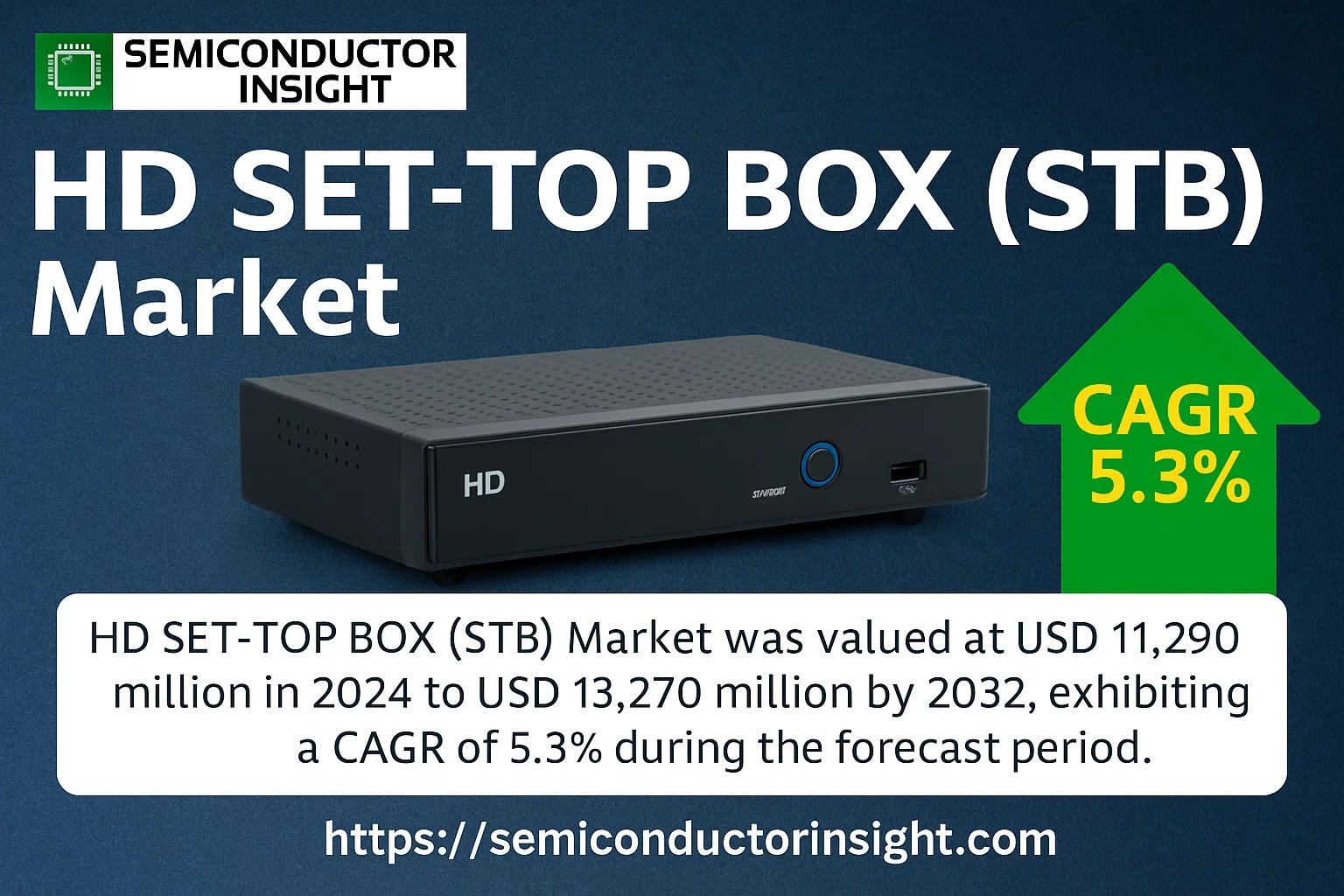
Global HD SET-TOP BOX (STB) Market was valued at USD 11,290 million in 2024 to USD 13,270 million by 2032, exhibiting a CAGR of 5.3% during the forecast period.
A set-top box (STB) is an information appliance device that contains a TV-tuner input and displays output to a television set, converting external signal sources into viewable content on television screens or other display devices. These devices are used across cable television, satellite television, and over-the-air television systems. This report focuses exclusively on HD set-top boxes and does not include standard-definition (SD) STBs.
The Market is experiencing steady growth driven by several key factors, including the ongoing transition from analog to digital broadcasting worldwide and increasing consumer demand for high-definition content. Furthermore, technological advancements such as the integration of smart features and support for higher resolutions like 4K and 8K are contributing to Market expansion. Initiatives by key industry players are also expected to fuel Market growth. For instance, major manufacturers continue to develop advanced STBs with enhanced processing power, expanded storage capacity, and improved user interfaces. CommScope, Technicolor, Skyworth Digital, Huawei, and Xiaomi are among the key players operating in this Market with diverse product portfolios.
MARKET DRIVERS
Accelerated Global Transition to High-Definition Broadcasting
Global push by broadcasters and platform providers to phase out standard-definition services in favor of high-definition (HD) content is a primary Market driver. Government mandates, particularly in regions like Europe and parts of Asia, are accelerating the digital switchover, compelling consumers to adopt HD-enabled Set-Top Boxes (STBs) to continue accessing television services. This regulatory push ensures a steady, long-term demand base.
Rising Consumer Demand for Enhanced Viewing Experiences
Consumer expectation for superior picture and sound quality is a significant driver. The proliferation of large-screen 4K/Ultra HD televisions has created a complementary need for HD STBs that can deliver high-quality content to maximize the capabilities of modern displays. The demand for features like video-on-demand (VOD), catch-up TV, and interactive services further fuels the replacement cycle of older equipment.
Furthermore, the expansion of pay-TV services in emerging Markets, where subscriber bases are growing, represents a substantial driver. Service providers bundle HD STBs with new subscriptions, creating consistent volume demand for basic and mid-range HD receiver hardware.
MARKET CHALLENGES
Intense Competition from Alternative Content Delivery Platforms
HD STB Market faces significant disruption from the rapid growth of internet-based streaming services and connected Smart TVs. Many consumers, especially in developed Markets, are opting for all-in-one Smart TV solutions or low-cost streaming sticks, which reduce the need for a standalone set-top box. This trend pressures traditional pay-TV operators and, consequently, STB manufacturers.
Other Challenges
Price Sensitivity and Margin Pressure
The Market is highly competitive, leading to intense price pressure. Manufacturers operate on thin margins, particularly for basic HD models, making profitability a constant challenge. The cost of components and global supply chain fluctuations further squeeze margins.
Rapid Technological Obsolescence
The pace of technological advancement is a double-edged sword. While it drives upgrades, it also shortens product lifecycles. The shift in focus towards 4K/UHD, HDR, and IP-driven devices risks making standard HD STBs seem outdated, requiring continuous investment in R&D to stay relevant.
MARKET RESTRAINTS
Market Saturation in Developed Regions
In many developed economies, the HD STB Market is reaching a point of saturation. The initial wave of digital television transitions is largely complete, and household penetration rates for basic pay-TV services are high. This leads to a Market dependent primarily on replacement cycles and occasional upgrades, resulting in slower growth rates compared to emerging Markets.
Increasing Shift to Software and Cloud-Based Solutions
A key restraint is the growing trend among service providers to adopt software-centric and cloud-based video solutions. Technologies like Cloud DVR and “set-top box-less” architectures, where the decoding functionality is integrated into the TV or a simple app, threaten to reduce the volume of physical hardware units required per subscriber over the long term.
MARKET OPPORTUNITIES
Expansion in Emerging Economies
Significant growth opportunities remain in emerging Markets across Asia-Pacific, Latin America, and Africa. As digital infrastructure improves and disposable incomes rise, millions of new households are entering the pay-TV ecosystem. This creates a substantial and sustained demand for affordable HD STBs, often as part of a new subscription package.
Innovation in Hybrid and Advanced HD STBs
There is a strong opportunity for value-added HD STBs that integrate broadband and broadcast functionalities. Hybrid STBs that seamlessly combine traditional broadcast TV with popular OTT apps offer a compelling proposition, helping pay-TV operators reduce churn. Developing energy-efficient models with smaller form factors and advanced user interfaces also presents a competitive edge.
Adoption in Hospitality and Commercial Sectors
The hospitality industry (hotels, hospitals, multi-dwelling units) represents a specialized but lucrative segment. There is a consistent demand for robust, managed HD STB solutions tailored for commercial use, offering features like customized channel line-ups, integrated billing, and centralized content management.
HD SET-TOP BOX (STB) Market Trends
Shift Towards Smart and Multifunctional Platforms
The evolution of the HD Set-Top Box (STB) Market is characterized by a definitive shift from traditional signal decoding devices to intelligent, multifunctional entertainment hubs. Driven by consumer demand for integrated experiences, modern STBs now incorporate capabilities such as streaming media playback, application downloads, internet browsing, and gaming functionalities. This transition transforms the STB into a central platform within the home entertainment ecosystem, allowing users to access a wide array of personalized content and services from a single device. This trend is a primary driver for Market growth as consumers seek more value and convenience from their hardware investments.
Other Trends
Adoption of 4K and 8K Ultra-High Definition
The advancement of television display technology is a significant force shaping the STB Market. As 4K and, increasingly, 8K Ultra-High-Definition televisions become more mainstream, there is a corresponding demand for set-top boxes capable of processing and delivering content at these superior resolutions. The increasing availability of native 4K and 8K content from broadcasters and streaming services is compelling consumers to upgrade their STBs to fully leverage their TV’s capabilities, driving a steady refresh cycle and supporting the Market’s projected growth to USD 13,270 million by 2032.
Integration with Over-The-Top (OTT) Services
The dominance of streaming platforms like Netflix, Disney+, and Amazon Prime Video has fundamentally altered content consumption habits. This has led to a critical trend where HD STBs are increasingly designed to natively support a wide range of OTT applications. Consumers now expect seamless access to both linear broadcast channels and on-demand streaming libraries from a single interface. This convergence forces manufacturers and service operators to ensure their STB offerings are compatible with popular streaming services, making OTT integration a standard feature rather than a premium add-on.
Market Consolidation and Competitive Landscape
Global HD STB Market features a competitive landscape with key players including CommScope, Technicolor, Huawei, and Skyworth Digital, where the top five manufacturers collectively hold over 35% Market share. This concentration indicates a trend towards consolidation, where scale and technological innovation are critical for maintaining competitiveness. The Market is further segmented by technology type such as IPTV, Satellite Digital, and Digital Cable and by application across residential, commercial, and operator use cases. This segmentation reveals diverse growth opportunities in different regional Markets and technology platforms, influencing strategic developments and partnerships within the industry.
COMPETITIVE LANDSCAPE
Key Industry Players
Dynamic Market Driven by Innovation and Strategic Consolidation
Global HD Set-Top Box (STB) Market exhibits a moderately concentrated competitive structure, with the top five manufacturers collectively holding over 35% of the Market share as of 2024. CommScope and Technicolor are established leaders, possessing significant Market presence through long-standing relationships with major cable and satellite operators worldwide. Their strength lies in providing robust, high-volume solutions for traditional pay-TV services. The competitive landscape is intensifying with the rapid integration of smart features and Over-The-Top (OTT) streaming capabilities. Companies like Apple and Roku have successfully carved out substantial niches by focusing on user-friendly interfaces and direct-to-consumer streaming platforms, challenging the dominance of traditional STB suppliers. This has pushed the entire industry towards greater innovation in hardware and software to meet evolving consumer demands for a unified entertainment experience.
Beyond the top tier, a diverse range of players competes in specific segments and regional Markets. Chinese manufacturers such as Huawei, Skyworth Digital, and ZTE hold strong positions, particularly in the Asia-Pacific region, offering cost-competitive solutions for both IPTV and digital cable platforms. Specialized companies like Humax and Sagemcom are recognized for their reliable hardware supplied to telecom and satellite operators across Europe and other regions. Meanwhile, consumer electronics giants like Samsung, Xiaomi, and Hisense leverage their brand strength and vertical integration to offer integrated smart TV solutions that often include or compete with standalone STBs. Emerging domestic players, including Sichuan Jiuzhou and Unionman Technology, focus on serving local operator needs, indicating a fragmented yet dynamic lower tier of the Market that contributes to overall competitive pressure.
List of Key HD Set-Top Box (STB) Companies Profiled
- CommScope
- Technicolor
- Apple
- Echostar (DISH)
- Humax
- Sagemcom
- Samsung
- Roku
- Skyworth Digital
- Huawei
- Sichuan Jiuzhou
- Shenzhen Coship
- Sichuan Changhong
- Unionman Technology
- Jiangsu Yinhe
- ZTE
- Hisense
- FiberHome
- Xiaomi
- Tencent
- Hangzhou Dangbei
Segment Analysis:
| Segment Category | Sub-Segments | Key Insights |
| By Type |
|
IPTV is demonstrating strong growth momentum as it directly capitalizes on the expansion of high-speed broadband infrastructure globally. This segment benefits from the integration of traditional broadcast with internet-based streaming, offering superior video-on-demand services and interactive features. The technological evolution towards fiber-optic networks further enhances the quality and reliability of IPTV, making it highly attractive for service providers aiming to offer bundled services. |
| By Application |
|
Residential application remains the dominant force in the Market, driven by the universal demand for in-home entertainment solutions. The proliferation of smart homes and the consumer trend towards personalized, on-demand content consumption fuel the need for advanced set-top boxes. These devices are increasingly becoming central hubs for managing streaming services, live TV, and smart home integrations, ensuring sustained demand from households worldwide. |
| By End User |
|
Pay-TV Operators represent the most influential end-user segment, as they are the primary channel for deploying set-top boxes to subscribers. Their strategic focus on reducing churn and enhancing average revenue per user through value-added services like 4K content, integrated OTT apps, and whole-home DVR capabilities creates consistent demand for advanced HD STBs. Their purchasing power and large-scale deployments significantly shape Market dynamics and innovation cycles. |
| By Technology |
|
4K/Ultra HD technology is the current growth engine for the Market, as it aligns with the rapid adoption of 4K televisions and the increasing availability of high-resolution content from major broadcasters and streaming platforms. This segment benefits from consumer desire for a superior viewing experience with enhanced clarity and detail. The ongoing transition from standard HD to 4K represents a significant upgrade cycle for both consumers and operators, driving replacement demand. |
| By Distribution Channel |
|
Direct Sales (Operator-led) continues to be the dominant channel, as set-top boxes are predominantly bundled with subscription services. This model ensures product standardization, technical support, and seamless integration with the operator’s network. It also allows operators to lock in customers and manage the entire user experience. The retail and e-commerce channels are gaining traction for standalone, multi-service devices that offer consumers more flexibility and choice beyond traditional pay-TV bundles. |
Regional Analysis: HD Set-Top Box (STB) Market
Government-mandated digital switchover programs are a primary driver. Countries like India and Indonesia have undertaken large-scale digitization projects, creating sustained, high-volume demand for HD STBs as consumers upgrade their equipment to access digital terrestrial and satellite television services, ensuring Market vitality.
The fierce competition among cable, satellite, and IPTV operators, coupled with the explosive growth of regional Over-The-Top (OTT) platforms, necessitates advanced STBs. Providers bundle sophisticated boxes to differentiate offerings, supporting video-on-demand, interactive services, and multi-screen viewing, which consistently refreshes demand.
Asia-Pacific’s strength as a global electronics manufacturing hub, especially in China, Vietnam, and Malaysia, provides a significant advantage. This results in competitive pricing, rapid production scaling to meet demand spikes, and a steady flow of innovation as manufacturers develop cost-effective, feature-rich models for both domestic and export Markets.
The Market is increasingly shifting towards hybrid STBs that combine broadcast signals with broadband internet capabilities. This allows for a seamless blend of live TV and streaming apps. Development is also focused on supporting higher-resolution formats like 4K and 8K, catering to the premium segment and next-generation displays.
North America
North America represents a mature yet technologically advanced Market for HD STBs, characterized by a high penetration of pay-TV services and a strong shift towards integrated entertainment solutions. The Market dynamics are shaped by the transition of traditional cable and satellite providers into integrators of live TV and streaming apps, necessitating sophisticated hybrid STBs. Consumer demand is focused on user experience, with expectations for seamless interfaces, voice control, and whole-home DVR capabilities. While the Market is saturated in terms of subscriber growth, replacement cycles and upgrades to 4K/HDR-capable devices provide a steady stream of demand. The competitive pressure from pure-play streaming devices forces incumbent providers to continually enhance their hardware offerings to retain subscribers, ensuring ongoing innovation in this region.
Europe
The European HD STB Market is diverse, reflecting the region’s fragmented regulatory landscape and varying levels of digital infrastructure development. Western European nations are mature Markets where growth is primarily driven by upgrades to ultra-high-definition boxes and the integration of broadband-based features into hybrid models. In contrast, Eastern Europe still presents growth opportunities linked to ongoing digitalization projects and increasing pay-TV penetration. A strong regulatory focus on interoperability and standards, such as the widespread adoption of HbbTV, influences STB design, encouraging feature-rich yet compliant devices. The Market is also seeing a trend towards minimalist, operator-agnostic boxes that can work across different service providers, reflecting consumer desire for flexibility.
South America
The South American Market for HD Set-Top Boxes is in a growth phase, primarily fueled by the expansion of pay-TV services and the gradual completion of digital terrestrial television transitions in major countries like Brazil and Argentina. Economic factors play a significant role, with demand concentrated on affordable, reliable HD boxes that provide access to a wide range of channels and basic interactive services. The Market is highly competitive among service providers, leading to bundled offerings that include STBs as part of subscription packages. While adoption of advanced features like 4K is slower compared to more developed regions, the large population base and improving economic conditions provide a solid foundation for steady Market expansion in the medium term.
Middle East & Africa
The Middle East and Africa region exhibits a dualistic Market structure. The Gulf Cooperation Council (GCC) countries represent a high-value segment with strong demand for premium, feature-rich HD and 4K STBs, driven by high disposable incomes and a competitive pay-TV landscape. In contrast, the broader African Market is largely growth-oriented, with demand stemming from the initial rollout of digital broadcasting infrastructure and expanding pay-TV services. Affordability and reliability are key purchasing criteria in these emerging Markets. The region also shows potential for satellite STBs, which bypass the need for extensive terrestrial infrastructure, making them a popular choice for reaching dispersed populations. Political and economic stability in various sub-regions remains a key factor influencing Market dynamics.
Report Scope
This Market research report provides a comprehensive analysis of the HD SET-TOP BOX (STB) Market , covering the forecast period 2025–2032. It offers detailed insights into Market dynamics, technological advancements, competitive landscape, and key trends shaping the industry.
Key focus areas of the report include:
- Market Overview: The report begins with an overview outlining its current Market scenario, key growth indicators, and industry transformation drivers. It discusses macroeconomic factors, demand–supply balance, regulatory landscape, and the strategic role of semiconductors in powering advancements across industries such as automotive, telecommunications, consumer electronics, and industrial automation.
- Market Size & Forecast: Historical data and future projections for revenue, unit shipments, and Market value across major regions and segments.
- Segmentation Analysis: Detailed breakdown by product type, technology, application, and end-user industry to identify high-growth segments and investment opportunities.
- Regional Insights: Insights into Market performance across North America, Europe, Asia-Pacific, Latin America, and the Middle East & Africa, including country-level analysis where relevant.
- Competitive Landscape: Profiles of leading Market participants, including their product offerings, R&D focus, manufacturing capacity, pricing strategies, and recent developments such as mergers, acquisitions, and partnerships.
- Technology Trends & Innovation: Assessment of emerging technologies, integration of AI/IoT, semiconductor design trends, fabrication techniques, and evolving industry standards.
- Market Drivers & Restraints: Evaluation of factors driving Market growth along with challenges, supply chain constraints, regulatory issues, and Market-entry barriers.
- Stakeholder Insights: Insights for component suppliers, OEMs, system integrators, investors, and policymakers regarding the evolving ecosystem and strategic opportunities.
Primary and secondary research methods are employed, including interviews with industry experts, data from verified sources, and real-time Market intelligence to ensure the accuracy and reliability of the insights presented.
FREQUENTLY ASKED QUESTIONS:
What is the current Market size of HD SET-TOP BOX (STB) Market?
-> HD SET-TOP BOX (STB) Market was valued at USD 11,290 million in 2024 to USD 13,270 million by 2032, exhibiting a CAGR of 5.3% during the forecast period.
Which key companies operate in HD SET-TOP BOX (STB) Market?
-> Key players include CommScope, Technicolor, Skyworth Digital, Huawei, Xiaomi, among others. Global top five manufacturers hold a share over 35%.
What are the key growth drivers?
-> Key growth drivers include the adoption of 4K and 8K high-definition resolutions, demand for smart multifunctional devices, and the rise of Over-The-Top (OTT) content from streaming platforms.
Which region dominates the Market?
-> Asia is a significant Market, with detailed analysis provided for countries including China, Japan, South Korea, Southeast Asia, and India.
What are the emerging trends?
-> Emerging trends include increased intelligence and multifunctionality in STBs, support for higher resolutions (4K/8K), and integration with major streaming services like Netflix, Disney+, and Amazon Prime Video.

Get Sample Report PDF for Exclusive Insights
Report Sample Includes
- Table of Contents
- List of Tables & Figures
- Charts, Research Methodology, and more...
 Download Sample Report PDF


