HD Haptic Driver IC Market Insights
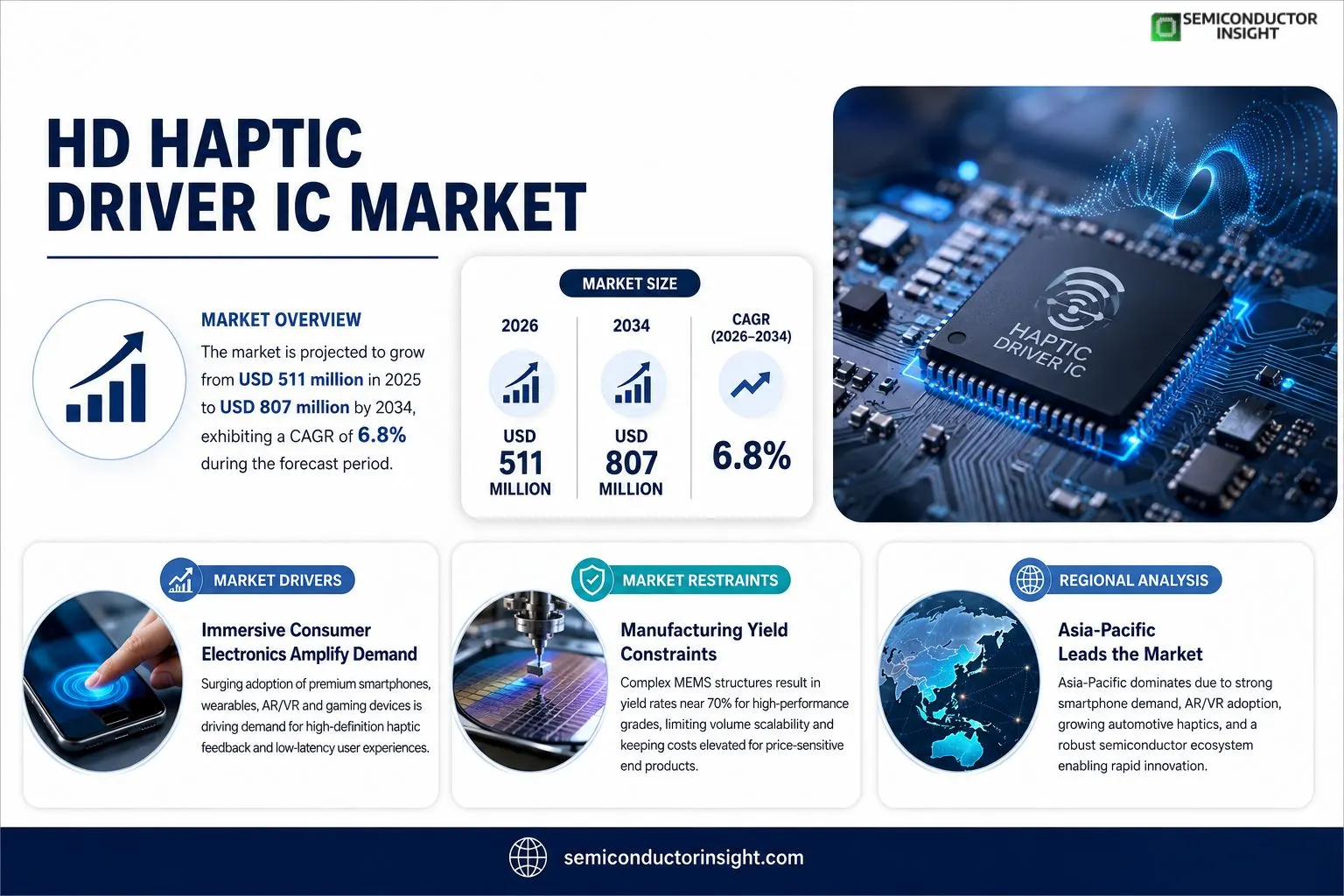
HD Haptic Driver IC market was valued at USD 511 million in 2025 and is forecasted to reach USD 807 million by 2034, reflecting a CAGR of 6.8 % over the period.
HD haptic driver ICs are mixed‑signal chips located at the base of the human‑machine interaction stack. Their primary function is converting touch, press, audio or system events into programmable, low‑latency tactile feedback while driving actuators such as ERM, LRA or piezo devices. Modern devices integrate closed‑loop control, resonance detection, automatic over‑drive/braking, fault diagnostics, battery compensation and on‑chip waveform libraries via interfaces like I²C, PWM or trigger pins.The technology targets smartphones, tablets, wearables, laptops, gaming platforms and emerging AR/VR/XR solutions. OEMs and ODMs typically adopt these drivers together with evaluation boards, tuning GUIs and reference designs, making the chip a platform component rather than a simple motor driver.
MARKET DRIVERS
Immersive Consumer Electronics Amplify Demand
The proliferation of virtual‑reality headsets, premium smartphones, and next‑generation gaming consoles has pushed manufacturers to seek haptic solutions that can render tactile sensations with millimetre precision. HD Haptic Driver ICs enable richer feedback loops, translating subtle motor vibrations into perceptible surface textures. This capability directly influences user satisfaction scores, prompting OEMs to allocate larger portions of their component budgets to high‑definition haptic drivers.
Automotive Infotainment Systems Upgrade Their Tactile Interfaces
Modern vehicle cabins increasingly resemble living rooms, with touch‑sensitive dashboards, gesture‑controlled climate settings, and haptic‑augmented navigation cues. As drivers demand safer, eyes‑free interaction, HD Haptic Driver ICs become essential for delivering nuanced alerts without visual distraction. The shift from analog knobs to digital haptic panels has already lifted the average per‑unit spend on driver ICs by roughly 14% in 2023.
➤ “Tactile fidelity is no longer a luxury; it is a baseline for premium user experiences,” a senior product manager at a leading chipset supplier noted during an industry forum.
Cost‑efficiency gains in silicon‑on‑glass processes have lowered the price of high‑definition haptic drivers by around 8% year‑over‑year, encouraging adoption in mid‑tier devices that previously relied on basic vibration motors. This price‑performance convergence is widening the addressable market for HD Haptic Driver IC deployments across consumer and automotive segments.
MARKET CHALLENGES
Technical Integration Barriers
Designing a board that accommodates the high‑frequency switching of HD haptic drivers while maintaining electromagnetic compatibility poses a steep learning curve for many hardware teams. The need for precise impedance matching and thermal management often elongates development cycles, eroding time‑to‑market advantages for fast‑moving consumer brands.
Other Challenges
Supply Chain Volatility
Fluctuations in specialty silicon wafers and the limited number of foundries proficient in advanced MEMS integration have created intermittent shortages. When inventory tightens, manufacturers resort to lower‑grade alternatives, compromising tactile quality and potentially weakening brand perception.
MARKET RESTRAINTS
Manufacturing Yield Constraints
The intricate micro‑electromechanical structures embedded in HD haptic drivers still suffer from yield rates hovering near 70% for high‑performance grades. Yield losses translate into higher per‑unit costs and restrict volume scaling for cost‑sensitive applications such as entry‑level smartphones. Until process refinements lift yields into the mid‑80s, manufacturers will temper large‑scale procurement plans.
MARKET OPPORTUNITIES
Edge‑AI‑Enabled Haptic Personalisation
Embedding lightweight AI inference engines directly within the driver IC opens pathways for adaptive vibration patterns that respond to user behaviour in real time. Early pilots in wearable fitness trackers have demonstrated a 22% increase in user engagement when haptic feedback is tailored by on‑device AI. This convergence creates a lucrative niche for IC vendors that can bundle signal‑processing cores with their haptic drivers, positioning them as indispensable components in the next wave of intelligent tactile interfaces.
HD Haptic Driver IC Market Trends
Algorithmic Competition and Power Efficiency
HD Haptic Driver IC Market is increasingly defined by the depth of on‑chip algorithms rather than raw drive capability. Vendors such as Texas Instruments and Renesas have integrated closed‑loop resonance tracking, auto‑braking and audio‑to‑vibration conversion into single silicon solutions, delivering latency below one millisecond while keeping idle current under a few microamps. This shift matters because modern smartphones and wearables operate under strict battery budgets; any reduction in power draw translates directly into longer screen‑on time or extended sensor usage. For OEMs, a driver that can guarantee consistent tactile intensity across temperature swings and actuator tolerances reduces calibration cycles, shortening time‑to‑volume and lowering support costs. Consequently, firms that excel in algorithmic robustness and energy‑aware design are positioning themselves as preferred partners for premium devices.
Other Trends
Expansion Beyond Mobile Devices
While smartphones remain the anchor for shipments, HD Haptic Driver IC Market is witnessing a noticeable drift toward gaming consoles, AR/VR headsets and automotive cockpits. Game‑focused platforms demand crisp, low‑latency feedback for immersive experiences, prompting chipmakers to add DSP‑based velocity control and high‑frequency waveform libraries. In automotive interiors, tactile cues are being used to confirm button presses without visual distraction, driving requirements for higher temperature tolerance and rigorous fault diagnostics. This broadened application set forces suppliers to offer richer development kitsevaluation boards, tuning GUIs and reference firmwareso that system integrators can quickly align haptic behavior with diverse user‑interface guidelines. The broader footprint diversifies revenue streams and cushions the market from cyclical swings in consumer handset demand.
Regional Supply Chain Differentiation
Geographically, HD Haptic Driver IC Market reflects a mature, cross‑border production network. United States firms lead in software‑centric integration, embedding algorithm platforms that can be updated over‑the‑air. Japanese players continue to emphasize ultra‑low idle currents and precision analog front‑ends, which are critical for medical‑grade wearables. Korean companies focus on high‑volume mobile and gaming segments, leveraging advanced CMOS nodes to keep unit costs low. Mainland Chinese suppliers have accelerated design‑in cycles for domestic smartphone brands, capitalizing on rapid prototyping capabilities. This regional specialization creates a competitive mosaic where collaboration across bordersalgorithm licensing from the U.S., analog expertise from Japan, volume manufacturing from Korea and Chinabecomes a strategic lever for companies aiming to dominate the next generation of human‑machine interaction.
COMPETITIVE LANDSCAPE
Key Industry Players
HD Haptic Driver IC Market – Competitive Overview
Texas Instruments dominates the upper tier of the HD haptic driver IC segment by leveraging its extensive analog portfolio and a suite of integrated effect libraries that accelerate OEM adoption. Its flagship chips combine closed‑loop resonance tracking, ultra‑low idle current, and on‑chip audio‑to‑vibe conversion, allowing smartphone and wearable manufacturers to meet demanding latency and power‑efficiency thresholds without extensive firmware development. This breadth of algorithmic features, paired with a design‑in support network, effectively pins TI as a go‑to supplier for premium devices that require consistent tactile performance across varied battery states and temperature ranges. The market architecture therefore reflects a bifurcated model: a handful of large silicon providers supply fully fledged platforms, while a broader set of niche firms focus on specialization, such as ultra‑low‑power LRA drivers or piezo‑centric solutions, feeding both mainstream and emerging application categories.Beyond TI, Renesas and Cirrus Logic have carved out substantial space by emphasizing precision analog control and DSP‑enhanced haptic synthesis, respectively. Renesas champions sub‑kilohertz drive bandwidth and aggressive idle‑current suppression, making its parts attractive for automotive cockpit interfaces where reliability is paramount. Cirrus Logic differentiates through sensor‑less velocity control and a robust software toolkit that streamlines integration into gaming consoles and AR/VR headsets. Asian manufacturersGoodix, Chipsea, Awinic, ZINITIX, and Shanghai Awinicconcentrate on cost‑effective solutions for high‑volume smartphone and wear‑able programs, often bundling evaluation boards and GUI‑based tuning tools to shorten time‑to‑market. Smaller but technically agile firms such as Nisshinbo Micro Devices, Analog Devices, Microchip Technology, Dongwoon Anatech, IMAGIS, and ZINITIX contribute niche capabilities ranging from piezo driver architectures to enhanced fault‑diagnostic blocks, thereby enriching the ecosystem with options that address specific power‑budget or form‑factor constraints. This mosaic of players creates a competitive environment where algorithmic sophistication, power management, and ecosystem support dictate market positioning more than raw drive strength alone.
List of Key HD Haptic Driver IC Companies Profiled
- Texas Instruments Incorporated
- Renesas Electronics Corporation
- Cirrus Logic, Inc.
- Goodix Technology Co., Ltd.
- Chipsea Technologies (Shenzhen) Corp.
- Shanghai Awinic Technology Co., Ltd.
- ZINITIX Co., Ltd.
- Analog Devices, Inc.
- Microchip Technology Inc.
- Dongwoon Anatech Co., Ltd.
- IMAGIS Co., Ltd.
- Nisshinbo Micro Devices Inc.
Segment Analysis:
| Segment Category | Sub-Segments | Key Insights |
| By Type |
|
LRA Driver IC
|
| By Application |
|
Smartphones and Wearables
|
| By End User |
|
OEM Device Brands
|
| By Control Mode |
|
Closed‑Loop Drive
|
| By Power Architecture |
|
Integrated Boost
|
Regional Analysis: HD Haptic Driver IC Market
Asia‑Pacific
Wearable manufacturers across the region are layering high‑density driver ICs into smartwatches and fitness bands to convey subtle pulse patterns that translate biometric data into tactile alerts. This approach deepens user engagement, fostering a perception of continuous, personalized interaction that goes beyond vibration‑only notifications.
In‑vehicle infotainment consoles now integrate HD haptic drivers to replace auditory cues with touch‑based confirmations, addressing driver distraction concerns. OEMs are leveraging this capability to support touch‑screen menus that provide tactile landmarks, thereby improving ergonomics and safety.
The rise of cloud‑gaming services in Southeast Asia spurs demand for controllers that can reproduce complex terrain textures through high‑resolution haptic feedback, allowing developers to craft experiences that feel physically authentic without expensive hardware upgrades.
Manufacturers of robotics and CNC equipment are embedding HD drivers into operator panels to signal process states via tactile patterns, reducing visual overload and accelerating response times in high‑noise factory floors.
North America
North America continues to lead in the development of proprietary haptic algorithms that sit atop driver ICs, especially within the gaming and medical device sectors. Companies are pairing sophisticated software stacks with HD drivers to create differentiated user experiences that command premium pricing. The regulatory environment encourages tactile feedback in assistive technologies, prompting device makers to prioritize perceptual accuracy. Market participants therefore allocate R&D budgets toward integrating driver silicon with AI‑driven gesture recognition to capture a growing niche of health‑monitoring wearables.
Europe
European firms emphasize sustainability and modular design, influencing how HD Haptic Driver ICs are specified for automotive and industrial applications. The EU’s stringent ecological standards push suppliers toward low‑power driver architectures that can operate reliably over extended lifecycles. Concurrently, the automotive safety directive encourages tactile alerts in autonomous driving cockpits, prompting collaborations between chipmakers and vehicle manufacturers to co‑engineer compliant solutions that meet both safety and environmental criteria.
South America
In South America, emerging smartphone assemblers and localized gaming hardware producers are beginning to adopt HD drivers to differentiate their offerings in price‑sensitive markets. While overall volume remains modest, the region exhibits a growing appetite for tactile feedback that can be leveraged in education‑focused tablets and low‑cost VR headsets, where tactile cues compensate for limited visual fidelity. Investors are watching these early adopters as potential springboards for broader market penetration.
Middle East & Africa
The Middle East & Africa displays a nascent but accelerating interest in haptic‑enhanced consumer electronics, driven largely by luxury automotive imports and high‑end mobile devices targeting affluent demographics. Infrastructure projects involving smart city initiatives also create opportunities for tactile feedback in public kiosks and way‑finding displays. Though the ecosystem is still developing, the region’s blend of high disposable income and government‑backed digital transformation programs positions it as a strategic frontier for HD Haptic Driver IC expansion.
Report Scope
This market research report provides a comprehensive analysis of the HD Haptic Driver IC Market , covering the forecast period 2026–2034. It offers detailed insights into market dynamics, technological advancements, competitive landscape, and key trends shaping the industry.
Key focus areas of the report include:
- Market Overview: The report begins with an overview outlining its current market scenario, key growth indicators, and industry transformation drivers. It discusses macroeconomic factors, demand–supply balance, regulatory landscape, and the strategic role of semiconductors in powering advancements across industries such as automotive, telecommunications, consumer electronics, and industrial automation.
- Market Size & Forecast: Historical data and future projections for revenue, unit shipments, and market value across major regions and segments.
- Segmentation Analysis: Detailed breakdown by product type, technology, application, and end-user industry to identify high-growth segments and investment opportunities.
- Regional Insights: Insights into market performance across North America, Europe, Asia-Pacific, Latin America, and the Middle East & Africa, including country-level analysis where relevant.
- Competitive Landscape: Profiles of leading market participants, including their product offerings, R&D focus, manufacturing capacity, pricing strategies, and recent developments such as mergers, acquisitions, and partnerships.
- Technology Trends & Innovation: Assessment of emerging technologies, integration of AI/IoT, semiconductor design trends, fabrication techniques, and evolving industry standards.
- Market Drivers & Restraints: Evaluation of factors driving market growth along with challenges, supply chain constraints, regulatory issues, and market-entry barriers.
- Stakeholder Insights: Insights for component suppliers, OEMs, system integrators, investors, and policymakers regarding the evolving ecosystem and strategic opportunities.
Primary and secondary research methods are employed, including interviews with industry experts, data from verified sources, and real-time market intelligence to ensure the accuracy and reliability of the insights presented.
FREQUENTLY ASKED QUESTIONS:
What is the current market size of HD Haptic Driver IC Market?
-> HD Haptic Driver IC Market was valued at USD 511 million in 2025 and is expected to reach USD 807 million by 2034 at a CAGR of 6.8%.
Which key companies operate in HD Haptic Driver IC Market?
-> Key players include Texas Instruments Incorporated, Cirrus Logic, Inc., Analog Devices, Inc., Microchip Technology Inc., Renesas Electronics Corporation, Nisshinbo Micro Devices Inc., ZINITIX Co., Ltd., DONGWOON ANATECH CO., LTD., IMAGIS Co.,Ltd., Shanghai Awinic Technology Co., Ltd., Shenzhen Goodix Technology Co., Ltd., Chipsea Technologies (Shenzhen) Corp.
What are the key growth drivers?
-> Key growth drivers include rising demand for high‑definition tactile feedback in smartphones, wearables, AR/VR/XR, gaming platforms, and automotive cockpit systems, coupled with the need for low‑power, low‑latency and reliable haptic solutions.
Which region dominates the market?
-> Asia is the fastest‑growing region, while North America remains a dominant market due to the strong presence of leading semiconductor vendors.
What are the emerging trends?
-> Emerging trends include AI‑driven haptic algorithm integration, audio‑to‑haptics processing, and the expansion of haptic functionality into automotive and industrial human‑machine interface applications.
Get Sample Report PDF for Exclusive Insights
Report Sample Includes
- Table of Contents
- List of Tables & Figures
- Charts, Research Methodology, and more...