Harsh Environment Transistor Arrays Market Insights
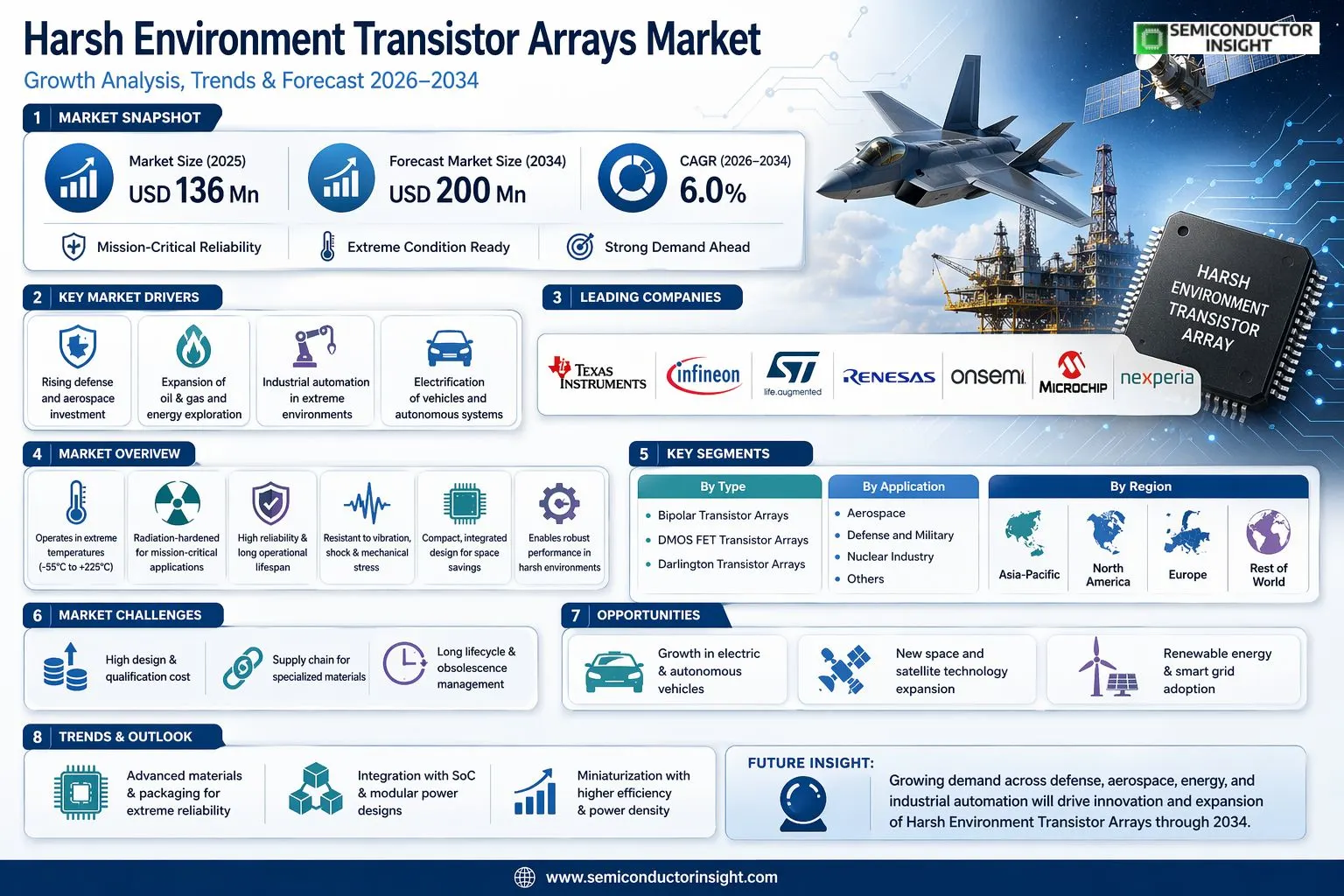
Global Harsh Environment Transistor Arrays Market size was valued at USD 136 million in 2025. The market is projected to grow from USD 144.2 million in 2026 to USD 200 million by 2034, exhibiting a CAGR of 6.0% during the forecast period.
Harsh environment transistor arrays are specialized integrated circuits composed of multiple transistors designed and optimized to operate reliably under extreme conditions. These components are engineered to withstand factors such as high temperatures, extreme cold, intense radiation, and significant mechanical stress, which would degrade or destroy standard semiconductor devices. Common types include high-temperature transistor arrays, low-temperature transistor arrays, and radiation-hardened (rad-hard) transistor arrays.
The market is experiencing steady growth driven by several key factors, including increased defense spending globally, the expansion of space exploration programs, and the modernization of nuclear power infrastructure. Furthermore, the push for industrial automation in sectors like oil & gas and automotive is creating demand for robust electronics that can endure harsh operational environments. Initiatives by leading semiconductor manufacturers are also propelling the market forward. For instance, companies like Texas Instruments and Infineon continuously develop advanced packaging and silicon-on-insulator (SOI) technologies to enhance the performance and reliability of their rad-hard and high-temperature product lines. Other key players operating in this market with extensive portfolios include STMicroelectronics, Onsemi, Renesas Electronics, and Nexperia.
MARKET DRIVERS
Accelerated Industrial Automation in Extreme Conditions
Global push for Industry 4.0 and smart manufacturing is a primary driver for Harsh Environment Transistor Arrays Market. These arrays are fundamental for motor control, power switching, and signal conditioning in robotics and automated machinery deployed in settings with extreme temperatures, vibration, and chemical exposure. Their integrated design improves reliability and reduces system footprint, accelerating adoption in sectors like automotive manufacturing and heavy machinery where operational uptime is critical.
Expansion of Downhole Drilling and Energy Exploration
Demand from the oil & gas and geothermal energy sectors for sophisticated electronic controls is significantly boosting the market. Harsh Environment Transistor Arrays are essential for downhole telemetry, drilling instrumentation, and pipeline monitoring systems that must withstand high pressures, corrosive environments, and temperatures exceeding 150°C. This reliability enables more precise and deeper resource extraction, directly linking market growth to global energy exploration activities.
➤ The electrification of vehicles, including off-road, agricultural, and aerospace applications, creates a robust demand stream for durable, high-temperature capable power electronics where Harsh Environment Transistor Arrays are a key enabling technology.
Lastly, stringent safety and reliability regulations across automotive, aerospace, and industrial equipment compel manufacturers to adopt components with proven performance under duress. This regulatory environment favors certified Harsh Environment Transistor Arrays over standard commercial-grade parts, ensuring sustained market demand from quality-conscious and compliance-driven end-users.
MARKET CHALLENGES
High Design-and-Test Complexity and Cost
Designing and qualifying components for Harsh Environment Transistor Arrays Market involves significant technical and financial hurdles. Achieving guaranteed performance across military-grade temperature ranges (-55°C to +225°C) and under intense mechanical stress requires specialized materials, packaging, and fabrication processes. This increases unit costs and extends development cycles, posing a challenge for price-sensitive applications and creating a high barrier to entry for new market participants.
Other Challenges
Supply Chain for Specialized Materials
The production of these arrays depends on a stable supply of high-purity silicon carbide (SiC) or gallium nitride (GaN) substrates and advanced ceramic packaging, which are subject to geopolitical and manufacturing bottlenecks, affecting market stability.
Integration and Obsolescence Management
Integrating these specialized arrays into broader system-on-chip designs is complex. Furthermore, the long lifecycle of industrial and defense systems conflicts with the faster obsolescence cycles of semiconductor technology, forcing difficult and costly lifetime buy decisions.
MARKET RESTRAINTS
Economic Sensitivity of Key End-User Industries
A major restraint for Harsh Environment Transistor Arrays Market is its direct correlation to capital expenditure cycles in core industries like oil & gas, mining, and heavy manufacturing. During economic downturns or periods of low commodity prices, investment in new equipment and technology upgrades is deferred or canceled. This cyclicality can lead to volatile demand, as these high-reliability components are often specified for new capital projects rather than for aftermarket replacement.
MARKET OPPORTUNITIES
Growth in Electric and Autonomous Vehicles
The rapid advancement of electric and autonomous vehicles presents a substantial opportunity. Harsh Environment Transistor Arrays are critical for battery management systems, onboard chargers, and traction inverters that require efficient power handling under the hood’s high-temperature conditions. The development of autonomous driving systems for agriculture, mining, and logistics further expands the application scope into environments where durability is non-negotiable.
Adoption in New Space and Sustainable Energy
The commercialization of space (New Space) and growth in renewable energy infrastructure open new frontiers. Small satellites and launch vehicles require radiation-hardened, thermally resilient electronics. Simultaneously, next-generation solar inverters and wind turbine converters positioned in remote, exposed locations benefit from the robustness of Harsh Environment Transistor Arrays, creating parallel growth channels beyond traditional industrial markets.
Harsh Environment Transistor Arrays Market Trends
Advancements in Semiconductor Reliability for Extreme Conditions
A dominant trend Harsh Environment Transistor Arrays Market is the intensifying focus on enhancing semiconductor reliability and longevity under extreme operational stresses. Manufacturers are innovating with new materials and packaging technologies to improve performance in high-temperature, high-radiation, and cryogenic environments. This drive is critical for applications in aerospace, defense, and nuclear industries, where component failure is not an option. The market is seeing a shift toward specialized transistor arrays, such as radiation-hardened and high-temperature variants, designed to withstand specific environmental challenges beyond standard industrial specifications.
Other Trends
Consolidation and Specialization Among Key Players
The competitive landscape is characterized by strategic consolidation as leading semiconductor firms acquire specialized capabilities to strengthen their harsh environment portfolios. Simultaneously, there is a clear trend toward product specialization, with companies developing tailored Harsh Environment Transistor Arrays solutions for distinct vertical markets. For instance, arrays optimized for satellite power systems differ significantly from those designed for downhole drilling equipment or military vehicle electronics, pushing R&D in multiple parallel directions.
Integration with System-on-Chip (SoC) and Modular Designs
There is growing integration of transistor arrays into more complex, modular power management units and system-on-chip designs. This trend addresses the need for compact, highly efficient electronics that can perform reliably in constrained spaces subject to harsh conditions. The development of standardized, yet ruggedized, array modules allows for faster system design and improved scalability in critical infrastructure projects. This evolution supports the broader industry movement towards smarter, more resilient electronic systems capable of operating autonomously in remote or severe environments.
COMPETITIVE LANDSCAPE
Key Industry Players
A Market Driven by Reliability in Extreme Conditions
Global Harsh Environment Transistor Arrays market is characterized by the dominance of established semiconductor giants with specialized divisions catering to high-reliability sectors. Texas Instruments and Infineon Technologies lead the competitive landscape, leveraging their extensive portfolios in analog and power semiconductors to provide robust solutions for aerospace, defense, and industrial applications. The market structure is consolidated, with the top five players holding a significant revenue share. Competition is intense, driven by technological innovation in radiation-hardening, high-temperature operation, and packaging that ensures performance under extreme stressors like thermal cycling and vibration.
Beyond the leading conglomerates, several significant players command strong positions in niche segments. Companies like Microchip Technology (through its Microsemi brand) and Nexperia are pivotal in providing radiation-tolerant and high-reliability discrete and array solutions for the nuclear and space industries. Similarly, STMicroelectronics and Renesas Electronics offer comprehensive product lines that integrate transistor arrays into larger system solutions for automotive and industrial harsh environments. The competitive dynamic is further shaped by stringent qualification standards and long product lifecycles, creating high barriers to entry and favoring incumbents with proven reliability records and deep customer relationships in mission-critical fields.
List of Key Harsh Environment Transistor Arrays Companies Profiled
- Texas Instruments
- Infineon Technologies AG
- STMicroelectronics N.V.
- Renesas Electronics Corporation
- onsemi
- Toshiba Electronic Devices & Storage Corporation
- Microchip Technology Inc. (Microsemi)
- Nexperia B.V.
- Analog Devices, Inc.
- Vishay Intertechnology, Inc.
- Diodes Incorporated
- ROHM Semiconductor
- NXP Semiconductors N.V.
- Allegro MicroSystems
- Littelfuse, Inc.
Segment Analysis:
| Segment Category | Sub-Segments | Key Insights |
| By Type |
|
Bipolar Transistor Arrays represent a foundational and mature technology segment, widely adopted due to their proven reliability in demanding operational contexts. They are favored for applications requiring precise analog signal processing and robust performance under thermal stress. Manufacturers continue to innovate within this segment, focusing on enhancing power efficiency and packaging to mitigate thermal management challenges, which ensures their sustained relevance in legacy and new system designs. |
| By Application |
|
Aerospace is a critical and leading application area, driven by the extreme reliability mandates for avionics, satellite systems, and deep-space exploration equipment. The segment demands components that can withstand significant temperature fluctuations, radiation, and mechanical vibration over extended operational lifetimes. This continuous push for miniaturization and enhanced performance in next-generation aircraft and spacecraft fuels focused R&D, creating a strong pipeline for advanced transistor array solutions tailored to specific mission profiles. |
| By End User |
|
Government & Defense Agencies constitute the most influential end-user segment, characterized by stringent qualification standards and long product lifecycles. Procurement is heavily driven by national security priorities, leading to sustained investment in ruggedized electronics for platforms ranging from ground vehicles to unmanned systems. This segment’s demand is less sensitive to short-term economic cycles but highly sensitive to geopolitical developments and technological superiority initiatives, which guide product development roadmaps for key suppliers in the market. |
| By Environmental Tolerance |
|
Radiation-Hardened arrays are a leading and highly specialized segment, essential for space, nuclear, and high-altitude applications. The design focus extends beyond mere component survival to ensuring predictable performance and data integrity in ionizing radiation environments. This necessitates specialized semiconductor processes and materials, creating significant barriers to entry and fostering a concentrated, innovation-driven supplier ecosystem focused on mitigating single-event effects and total ionizing dose damage. |
| By Integration Level |
|
Hybrid / Multi-Chip Modules are increasingly pivotal, offering a balanced approach to system integration for harsh environments. This architecture allows designers to combine optimized transistor arrays with other specialized components, like sensors or drivers, within a single, robust package. It provides superior thermal management and reliability over purely discrete solutions while offering more design flexibility and easier component replacement or testing compared to fully monolithic systems, making it a strategic choice for complex, high-value military and aerospace subsystems. |
Regional Analysis: Global Harsh Environment Transistor Arrays Market
North America
The region’s leadership is deeply tied to its formidable defense and aerospace industries, which require Harsh Environment Transistor Arrays for mission-critical applications in radar systems, unmanned vehicles, and space-grade electronics, fostering a closed-loop ecosystem of specialized suppliers and integrators.
Strict certification processes and performance standards mandated by bodies like the FAA and DoD in North America compel manufacturers to produce Harsh Environment Transistor Arrays with exceptional durability and reliability, creating a high barrier to entry that favors established, quality-focused players.
Concentrated R&D efforts in semiconductor materials and packaging technologies, particularly in U.S. tech corridors, are focused on enhancing the thermal management and radiation hardening of Harsh Environment Transistor Arrays, directly addressing the needs of extreme-condition applications.
The expansion of offshore drilling and smart manufacturing in the region sustains demand for these components in downhole instrumentation and ruggedized control systems, where Harsh Environment Transistor Arrays ensure operational integrity in volatile and physically demanding settings.
Europe
Europe represents a sophisticated and steadily growing segment of Harsh Environment Transistor Arrays Market, characterized by its strong automotive engineering heritage and burgeoning space sector through agencies like ESA. The regional focus on premium automotive electrification, particularly for high-performance and luxury vehicles operating in diverse climates, drives the need for reliable power electronics. Furthermore, a well-established industrial automation sector across Germany, Italy, and France integrates these arrays into machinery designed for harsh factory environments. Collaborative defense projects and a push for energy independence, including investments in subsea infrastructure for renewable energy, provide additional, stable demand vectors for durable semiconductor solutions.
Asia-Pacific
The Asia-Pacific region is the fastest-evolving market for Harsh Environment Transistor Arrays, fueled by massive industrial expansion and strategic government initiatives in electronics manufacturing. Countries like Japan, South Korea, and China are rapidly advancing their automotive, consumer electronics, and telecommunications infrastructure, which increasingly requires components resilient to high humidity, temperature fluctuations, and pollution. The growth of domestic aerospace ambitions and the expansion of manufacturing facilities into challenging environments create localized demand. While cost competitiveness is a key regional trait, there is a clear upward trend in investment towards higher-reliability components to support more advanced industrial and technological applications.
South America
South America’s engagement with Harsh Environment Transistor Arrays Market is primarily driven by its extensive mining, oil, and agricultural sectors. The operational environments in these industries,such as deep-pit mines, offshore platforms, and expansive farmlands,subject electronic equipment to dust, moisture, and vibration, necessitating robust components. Market growth is tied to regional investments in modernizing extractive and agricultural machinery to improve efficiency and yield. Although the adoption rate is more measured compared to leading regions, there is a recognizable trend towards upgrading industrial electronics to enhance durability and reduce downtime in these capital-intensive operations.
Middle East & Africa
The Middle East & Africa region presents a unique demand profile centered on extreme temperature operations and resource extraction. The pervasive harsh desert climates across the Gulf Cooperation Council countries necessitate electronics that can withstand prolonged exposure to heat and sand, relevant for infrastructure, telecommunications, and oil field operations. In Africa, growth Harsh Environment Transistor Arrays Market is linked to mining activities and gradual infrastructure development in challenging terrains. The market is characterized by project-based demand, often connected to large-scale industrial and energy projects that require specialized electronic components to guarantee long-term functionality.
Report Scope
This market research report provides a comprehensive analysis of the Harsh Environment Transistor Arrays Market , covering the forecast period 2026–2034. It offers detailed insights into market dynamics, technological advancements, competitive landscape, and key trends shaping the industry.
Key focus areas of the report include:
- Market Overview: The report begins with an overview outlining its current market scenario, key growth indicators, and industry transformation drivers. It discusses macroeconomic factors, demand–supply balance, regulatory landscape, and the strategic role of semiconductors in powering advancements across industries such as aerospace, defense, and nuclear power.
- Market Size & Forecast: Historical data and future projections for revenue, unit shipments, and market value across major regions and segments.
- Segmentation Analysis: Detailed breakdown by product type, technology, application, and end-user industry to identify high-growth segments and investment opportunities.
- Regional Insights: Insights into market performance across North America, Europe, Asia-Pacific, Latin America, and the Middle East & Africa, including country-level analysis where relevant.
- Competitive Landscape: Profiles of leading market participants, including their product offerings, R&D focus, manufacturing capacity, pricing strategies, and recent developments such as mergers, acquisitions, and partnerships.
- Technology Trends & Innovation: Assessment of emerging technologies, integration of AI/IoT, semiconductor design trends, fabrication techniques, and evolving industry standards.
- Market Drivers & Restraints: Evaluation of factors driving market growth along with challenges, supply chain constraints, regulatory issues, and market-entry barriers.
- Stakeholder Insights: Insights for component suppliers, OEMs, system integrators, investors, and policymakers regarding the evolving ecosystem and strategic opportunities.
Primary and secondary research methods are employed, including interviews with industry experts, data from verified sources, and real-time market intelligence to ensure the accuracy and reliability of the insights presented.
FREQUENTLY ASKED QUESTIONS:
What is the current market size of Harsh Environment Transistor Arrays Market?
->Global Harsh Environment Transistor Arrays Market was valued at USD 136 million in 2025 and is projected to reach USD 200 million by 2034, growing at a CAGR of 6.0% during the forecast period.
Which key companies operate Harsh Environment Transistor Arrays Market?
-> Key players include Toshiba, Intersil, Texas Instruments, Renesas Electronics, Onsemi, STMicroelectronics, Nexperia, Microsemi, and Infineon, among others.
What are the key growth drivers?
-> Key growth drivers include increasing demand from critical applications in aerospace, defense and military, and the nuclear industry requiring reliable electronics for harsh conditions.
Which region dominates the market?
-> The United States is a significant market, while China is anticipated to be a major growing region. Asia, North America, and Europe are key markets analyzed in the report.
What are the emerging trends?
-> Emerging trends include the development of specialized transistor arrays for high-temperature, low-temperature, and radiation-resistant applications, along with continuous innovation in semiconductor materials and packaging.

Get Sample Report PDF for Exclusive Insights
Report Sample Includes
- Table of Contents
- List of Tables & Figures
- Charts, Research Methodology, and more...
 Download Sample Report PDF