Key Statistics
Key Takeaways
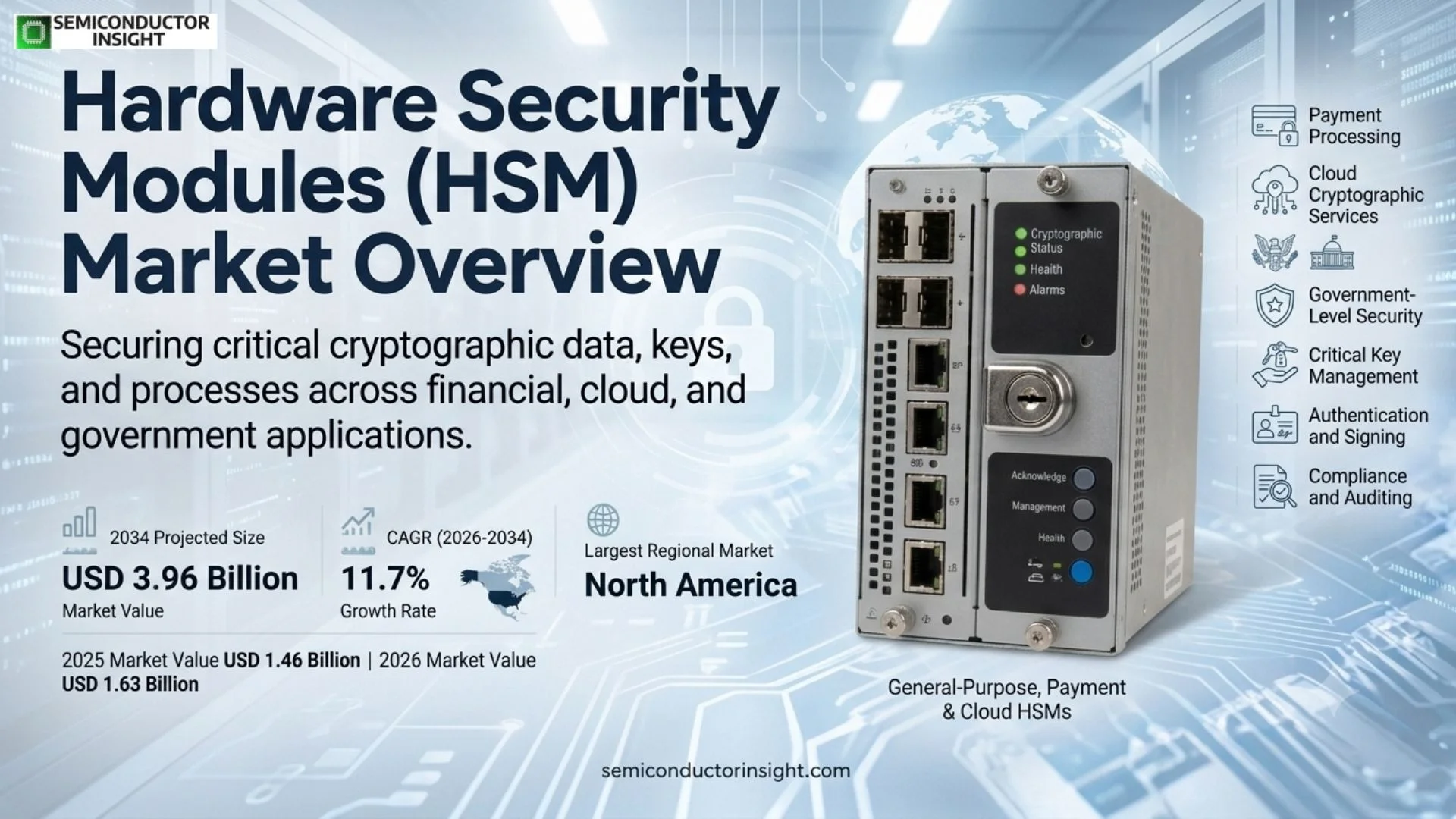
- Market size: The market is valued at USD 1.46 billion in 2025 and is projected to reach USD 3.96 billion by 2034, representing a 11.7% CAGR during 2026–2034.
- General-purpose and network-attached HSMs remain the core enterprise segment, while cloud HSM and HSM-as-a-Service are expanding as cryptographic workloads move into hybrid infrastructure.
- North America holds the leading market position because financial services, cloud platforms and government agencies have mature key-management and compliance requirements.
- Post-quantum cryptography is becoming a product differentiator, with major vendors adding ML-KEM, ML-DSA and SLH-DSA support to future-proof high-assurance key infrastructure.
- FIPS 140-3, Common Criteria and payment certifications remain critical buying criteria, making certified firmware, lifecycle support and migration planning central to enterprise purchasing.
Hardware Security Modules (HSM) Market Overview
Hardware Security Modules Market is valued at USD 1.46 billion in 2025 and is projected to reach USD 3.96 billion by 2034, expanding at a 11.7% CAGR during 2026–2034. The 2026 market level is USD 1.63 billion. North America leads the market through mature financial, cloud and government cryptographic infrastructure, while Asia Pacific is expanding quickly with digital payments, cloud adoption and national cybersecurity programs. Demand is moving from appliance-only deployments toward hybrid and cloud-managed architectures without reducing the need for tamper-resistant hardware roots of trust.
Hardware security modules are dedicated, tamper-resistant devices used to generate, store and process cryptographic keys. They support encryption, digital signatures, code signing, payment authorization, public-key infrastructure and identity systems while keeping sensitive key material isolated from general-purpose servers. Commercial HSMs are differentiated by certification level, transaction throughput, network architecture, key-management features, high-availability design, remote administration and integration with enterprise or cloud platforms.
The market is undergoing a major lifecycle transition as vendors prepare for post-quantum cryptography and new certification requirements. Thales launched Luna 8 in August 2026 with support for emerging PQC algorithms, while Entrust has added production-ready ML-KEM, ML-DSA and SLH-DSA support to the nShield platform. These changes increase upgrade demand because cryptographic infrastructure must remain interoperable with applications while adopting new algorithms over several years.
Cloud delivery is expanding the addressable market by allowing customers to consume HSM-backed cryptographic capacity without owning every appliance. AWS CloudHSM combines dedicated HSM instances with cloud management, while enterprise vendors offer remote, managed and hybrid models. Customers still require strong tenancy, auditability and compliance, so cloud adoption does not eliminate hardware; it changes where the certified root of trust is operated and who manages its lifecycle.
Segment Analysis: By Type
By type, the market is segmented into General Purpose HSMs, Payment HSMs and HSMaaS. General-purpose HSMs protect enterprise PKI, code signing, database encryption and application keys. Payment HSMs are optimized for card issuance, PIN translation and transaction processing. HSMaaS provides managed cryptographic capacity through cloud or service-provider infrastructure, reducing direct appliance ownership while retaining certified hardware protection.
| Type | Commercial role |
|---|---|
| General Purpose HSMs | Enterprise key management, PKI, code signing, database encryption, identity and application cryptography. |
| Payment HSMs | Card issuance, PIN processing, payment tokenization and transaction authorization under payment-industry standards. |
| HSMaaS | Managed or cloud-delivered HSM capacity for scalable cryptographic workloads and hybrid infrastructure. |
Additional Segmentation: By Deployment Model
Deployment models include on-premise appliances, cloud-based HSM and hybrid architectures. On-premise systems provide maximum operational control and remain common in regulated environments. Cloud-based HSM reduces infrastructure management and supports elastic applications, while hybrid deployments allow organizations to maintain critical root keys locally and extend cryptographic services to multiple clouds or remote environments. Migration decisions depend on latency, sovereignty, compliance and operational ownership.
| Deployment Model | Demand characteristics |
|---|---|
| On-Premise HSM | Customer-operated appliances for regulated, low-latency and highly controlled environments. |
| Cloud-Based HSM | Managed or cloud-hosted dedicated HSM infrastructure integrated with cloud applications and services. |
| Hybrid HSM | Combined on-premise and cloud key infrastructure supporting sovereignty, resilience and multi-cloud operations. |
Segment Analysis: By Application
By application, BFSI remains the largest demand segment because banks, payment processors and fintech platforms protect high-value transaction keys and must meet strict regulatory standards. Industrial and manufacturing customers use HSMs for device identity, firmware signing and operational-technology security, while government agencies rely on certified cryptographic modules for PKI, secure communications and classified or sensitive workloads. Other applications include healthcare, telecom and enterprise software.
| Application | Demand characteristics |
|---|---|
| BFSI | Payment processing, digital banking, tokenization, card issuance, PKI and transaction-key protection. |
| Industrial and Manufacturing | Device identity, firmware signing, machine authentication and industrial IoT security. |
| Government | PKI, secure communications, classified workloads, document signing and sovereign key management. |
| Others | Healthcare, telecom, software, cloud and enterprise applications requiring protected cryptographic keys. |
Additional Segmentation: By Security Level
Security level separates standard-assurance modules from high-assurance and ultra-secure certified systems. The distinction reflects physical tamper resistance, firmware controls, key-handling policy and formal certification. Financial institutions, government agencies and critical infrastructure commonly require FIPS 140-3 or Common Criteria evidence, while general enterprise applications may accept lower assurance if integration simplicity and cloud scalability are the primary buying criteria.
| Security Level | Commercial relevance |
|---|---|
| Standard Assurance HSM | Enterprise cryptography where physical protection and key isolation are required without the highest formal certification tier. |
| High Assurance HSM | Certified enterprise and regulated-industry systems with stronger tamper resistance and controlled key operations. |
| Ultra-Secure & Certified HSM | Government, payment and critical-infrastructure deployments requiring strict certification, policy and operational controls. |
Regional Analysis
North America leads because the United States has a large banking, cloud, software and federal-government cybersecurity market. Europe is a mature HSM region with strict data-protection and financial regulation, while Asia Pacific is the fastest growth area through digital payments, sovereign cloud and expanding cybersecurity budgets. South America and the Middle East & Africa are smaller but benefit from banking modernization and government digitization.
Why does regional demand differ across the Hardware Security Modules (HSM) market?
Regional demand depends on regulation, payment infrastructure, cloud maturity and cryptographic sovereignty. North America has the largest installed enterprise and cloud base, Europe places strong emphasis on certification and privacy, and Asia Pacific combines fast digital-payment growth with national cybersecurity programs. HSM vendors therefore compete not only on performance but also on local certification, support coverage and the ability to integrate with regional cloud and payment ecosystems.
| Region | Position | Demand profile | Key commercial factor |
|---|---|---|---|
| North America | Largest | Cloud, BFSI, government | Certification and ecosystem integration |
| Asia Pacific | Fastest growth | Payments, cloud, sovereign security | Scale and regional compliance |
| Europe | Mature / strategic | BFSI, government, enterprise | Certification and data protection |
| South America | Emerging | Banking and government | Cost and support |
| Middle East & Africa | Emerging | Banking, government, cloud | Sovereignty and local service |
Competitive Landscape
Thales, Entrust, Utimaco, IBM, Futurex, Eviden, Securosys, Fortanix and other specialists compete across general-purpose, payment and cloud HSM categories. Competitive advantage depends on certification, cryptographic throughput, integration libraries, high availability, remote management and lifecycle support. Large customers also evaluate vendor track record because HSM replacement can affect many downstream applications.
Post-quantum readiness is becoming a visible differentiator. Thales launched Luna 8 with quantum-resistant capabilities in 2026, while Entrust achieved NIST CAVP validation for three standardized PQC algorithms in 2025. These milestones matter because enterprises need a migration path that lets existing RSA and ECC infrastructure coexist with new algorithms during a multi-year transition.
Cloud platforms add another competitive layer. AWS CloudHSM provides dedicated HSM capacity integrated with cloud workloads, while appliance vendors increasingly support managed or hosted delivery. The most defensible positions combine certified hardware, mature client software and broad interoperability with PKCS#11, JCE, Microsoft and cloud-native cryptographic APIs. For commercial buyers in the Hardware Security Modules (HSM) market, purchasing decisions also depend on qualification history, integration effort, supply continuity, lifecycle support, operating reliability and measurable system-level value.
| Competitive tier | Representative companies | Primary differentiation |
|---|---|---|
| Global HSM leaders | Thales, Entrust, Utimaco | Certified appliances, payment HSMs, broad integrations and global enterprise support. |
| Cloud / managed cryptography | AWS CloudHSM, IBM, Fortanix | Managed or cloud-integrated HSM services and key-management platforms. |
| Specialist / regional providers | Futurex, Securosys, Eviden | High-assurance, payment and niche enterprise cryptographic solutions. |
Key companies profiled
Thales Group, Entrust, Utimaco, IBM, Futurex, Eviden, Infineon, Securosys, Yubico, Microchip Technology, Fortanix, Swift and STMicroelectronics are included in the competitive scope. Their roles vary across full HSM appliances, secure elements, cloud key services and payment infrastructure, so direct comparisons should distinguish dedicated HSM products from adjacent cryptographic hardware. For commercial buyers in the Hardware Security Modules (HSM) market, purchasing decisions also depend on qualification history, integration effort, supply continuity, lifecycle support, operating reliability and measurable system-level value.
Production Capacity Analysis
HSM capacity is determined by secure-hardware production, cryptographic processor availability, certified firmware, appliance assembly and formal validation. Performance is measured through keys, signing operations or payment transactions per second rather than unit shipments alone. A single high-end appliance can support many applications, so market growth is influenced by cryptographic workload intensity and redundancy requirements as much as device count.
Software lifecycle capacity is equally important. Vendors maintain client SDKs, firmware, drivers, high-availability clusters and certification across many operating systems and application stacks. AWS, Entrust and Thales all continue active 2026 platform updates. Customers prefer long support windows because changing HSM firmware or client software can require regression testing across critical applications.
Market Dynamics
The HSM market is growing through cloud migration, digital payments, code signing, zero-trust architecture and post-quantum preparation. Demand is reinforced by regulation because cryptographic keys are increasingly treated as critical infrastructure assets. Growth is restrained by implementation complexity, certification cost and the difficulty of migrating legacy applications. Cloud-delivered HSM and automated key orchestration create the strongest expansion opportunities.
Market Drivers
| Driver | Impact | Commercial mechanism |
|---|---|---|
| Post-quantum migration | High | Enterprises need hardware roots of trust that support new standardized algorithms. |
| Digital payments | High | Payment growth increases transaction-key and PIN-security workloads. |
| Cloud adoption | Medium-High | Cloud applications need scalable HSM-backed key protection. |
| Code signing and software supply chain | Medium | More software and devices require protected signing keys. |
Post-quantum migration
Organizations are beginning to inventory cryptography and prepare for migration from RSA and ECC to NIST-standardized post-quantum schemes. HSM vendors that support ML-KEM, ML-DSA and SLH-DSA can help customers protect root keys and signing infrastructure without abandoning certified hardware. For commercial buyers in the Hardware Security Modules (HSM) market, purchasing decisions also depend on qualification history, integration effort, supply continuity, lifecycle support, operating reliability and measurable system-level value.
Digital payments
Card issuance, tokenization, PIN translation and payment authorization require highly controlled cryptographic keys. Expansion of digital banking and fintech increases both transaction volume and the number of applications relying on payment HSMs, especially in markets with strict PCI requirements. For commercial buyers in the Hardware Security Modules (HSM) market, purchasing decisions also depend on qualification history, integration effort, supply continuity, lifecycle support, operating reliability and measurable system-level value.
Cloud adoption
Enterprises increasingly deploy applications across public cloud, private cloud and on-premise systems. Managed HSM services reduce appliance ownership while preserving dedicated hardware protection. Hybrid architectures are especially attractive when organizations want cloud scalability without moving every root key off-premise. For commercial buyers in the Hardware Security Modules (HSM) market, purchasing decisions also depend on qualification history, integration effort, supply continuity, lifecycle support, operating reliability and measurable system-level value.
Code signing and software supply chain
Firmware, containers, applications and connected devices all rely on digital signatures for authenticity. Compromise of a signing key can create a large supply-chain incident, so organizations increasingly place code-signing keys inside HSMs and automate signing workflows around protected hardware. For commercial buyers in the Hardware Security Modules (HSM) market, purchasing decisions also depend on qualification history, integration effort, supply continuity, lifecycle support, operating reliability and measurable system-level value.
Market Restraints
| Restraint | Impact | Commercial consequence |
|---|---|---|
| Integration complexity | High | HSMs must connect to many legacy and modern applications. |
| Certification cost | Medium-High | Formal security validation adds time and expense to product cycles. |
| Legacy cryptography | Medium-High | Older applications may not support modern algorithms or interfaces. |
| Operational ownership | Medium | Customers must manage quorum, backup, access control and disaster recovery. |
Integration complexity
Organizations often use multiple cryptographic APIs, operating systems and certificate systems. Migrating keys or replacing a device can require extensive testing because an outage may affect authentication, payment or signing services. This increases professional-services cost and slows upgrades. For commercial buyers in the Hardware Security Modules (HSM) market, purchasing decisions also depend on qualification history, integration effort, supply continuity, lifecycle support, operating reliability and measurable system-level value.
Certification cost
FIPS, Common Criteria and payment certifications require controlled hardware and firmware configurations. New features or algorithms can trigger additional validation work, which slows vendor release cycles and increases product cost. Customers accept the burden because certification provides assurance in regulated environments. For commercial buyers in the Hardware Security Modules (HSM) market, purchasing decisions also depend on qualification history, integration effort, supply continuity, lifecycle support, operating reliability and measurable system-level value.
Legacy cryptography
Many enterprise systems still depend on older RSA, ECC or proprietary cryptographic libraries. HSMs can provide new algorithms, but applications must also be updated to use them. This creates a migration bottleneck during post-quantum transition and cloud modernization. For commercial buyers in the Hardware Security Modules (HSM) market, purchasing decisions also depend on qualification history, integration effort, supply continuity, lifecycle support, operating reliability and measurable system-level value.
Operational ownership
An HSM protects keys only if operational procedures are sound. Organizations need secure administrator roles, backup strategies, cluster design and audit controls. Skills shortages and operational complexity can push smaller customers toward managed HSM services instead of appliance ownership. For commercial buyers in the Hardware Security Modules (HSM) market, purchasing decisions also depend on qualification history, integration effort, supply continuity, lifecycle support, operating reliability and measurable system-level value.
Market Opportunities
PQC-ready HSM refresh
Organizations replacing older appliances can standardize on platforms that support both current and post-quantum algorithms, creating a multi-year refresh cycle across enterprise and government infrastructure. For commercial buyers in the Hardware Security Modules (HSM) market, purchasing decisions also depend on qualification history, integration effort, supply continuity, lifecycle support, operating reliability and measurable system-level value.
HSM-as-a-Service
Managed cryptographic capacity can expand adoption among mid-sized customers and software companies that need certified hardware protection but do not want to operate appliances directly. For commercial buyers in the Hardware Security Modules (HSM) market, purchasing decisions also depend on qualification history, integration effort, supply continuity, lifecycle support, operating reliability and measurable system-level value.
Multi-cloud key control
Enterprises want one governance layer across AWS, Azure, private cloud and on-premise systems. Hybrid HSM architectures can become the trusted root for centralized key policy and signing workflows. For commercial buyers in the Hardware Security Modules (HSM) market, purchasing decisions also depend on qualification history, integration effort, supply continuity, lifecycle support, operating reliability and measurable system-level value.
AI model and software signing
AI models, containers, firmware and data pipelines increasingly require provenance and integrity. HSM-backed signing can extend from traditional code-signing use cases into model distribution and secure AI infrastructure. For commercial buyers in the Hardware Security Modules (HSM) market, purchasing decisions also depend on qualification history, integration effort, supply continuity, lifecycle support, operating reliability and measurable system-level value.
Supply Chain Analysis
Hardware. HSM appliances combine secure processors, tamper sensors, secure memory, entropy sources, networking and redundant power or storage. Physical architecture is designed to resist extraction of key material even when an attacker has physical access. Certified manufacturing and component traceability are therefore central to product assurance. For commercial buyers in the Hardware Security Modules (HSM) market, purchasing decisions also depend on qualification history, integration effort, supply continuity, lifecycle support, operating reliability and measurable system-level value.
Firmware and software. HSM firmware implements cryptographic algorithms, access controls, partitioning and audit functions. Client SDKs expose interfaces such as PKCS#11, Java and Microsoft APIs. Compatibility across operating systems and applications is a major part of the product because most customers integrate HSMs into existing infrastructure rather than isolated environments.
Deployment. Integrators configure clusters, roles, key backup, network connectivity and application libraries. Key migration must preserve availability and auditability. Payment or government deployments may require formal ceremonies and dual-control procedures, while cloud services automate more of the underlying hardware management. For commercial buyers in the Hardware Security Modules (HSM) market, purchasing decisions also depend on qualification history, integration effort, supply continuity, lifecycle support, operating reliability and measurable system-level value.
Operations. HSMs protect signing, encryption and authentication workloads for years. Customers monitor capacity, rotate keys, update firmware and maintain disaster-recovery clusters. Long-term support contracts and certification continuity create recurring revenue after the initial hardware purchase. For commercial buyers in the Hardware Security Modules (HSM) market, purchasing decisions also depend on qualification history, integration effort, supply continuity, lifecycle support, operating reliability and measurable system-level value.
Recent Developments in the Hardware Security Modules (HSM) Market
Developments tracked through September 2026 and limited to events that materially affect technology, capacity, adoption or competition.
- 4 August 2026
Thales launched Luna 8, a next-generation HSM designed for AI-era and post-quantum cryptography, with a Thales-designed cryptographic processor and support for emerging quantum-resistant security requirements. Source - 12 June 2026
Entrust updated documentation for the nShield 5c 10G, its high-performance network HSM with 10G connectivity, redundant components and remote management for demanding data-center environments. Source - 10 September 2025
Entrust announced NIST CAVP validation of ML-KEM, ML-DSA and SLH-DSA implementations in nShield HSM firmware, providing a production-ready path for post-quantum cryptography adoption. Source
Report Scope & Segmentation
| Attribute | Scope |
|---|---|
| Base year | 2025 |
| Estimated year | 2026 |
| Forecast period | 2026–2034 |
| 2025 market size | USD 1.46 billion |
| 2026 estimated size | USD 1.63 billion |
| 2034 projected size | USD 3.96 billion |
| CAGR (2026–2034) | 11.7% |
| Largest market in 2025 | North America |
| By Type | General Purpose HSMs; Payment HSMs; HSMaaS |
| By Application | BFSI; Industrial and Manufacturing; Government; Others |
| By Deployment Model | On-Premise HSM; Cloud-Based HSM; Hybrid HSM |
| By Security Level | Standard Assurance HSM; High Assurance HSM; Ultra-Secure & Certified HSM |
| Companies profiled | Thales; Entrust; Utimaco; IBM; Futurex; Eviden; Securosys; Fortanix and other HSM providers |
Frequently Asked Questions
What is the Hardware Security Modules market size in 2025?
The global HSM market is valued at USD 1.46 billion in 2025 across general-purpose, payment and managed HSM services.
What is the market forecast for 2034?
The market is projected to reach USD 3.96 billion by 2034, representing an 11.7% CAGR during 2026–2034. The corresponding 2026 market level is USD 1.63 billion.
Which region leads the HSM market?
North America leads because of its large banking, cloud, software and government cybersecurity infrastructure.
What are the main HSM types?
General-purpose HSMs, payment HSMs and HSM-as-a-Service are the principal commercial categories.
Why are HSMs important for post-quantum cryptography?
HSMs protect root keys and signing operations, allowing organizations to introduce new PQC algorithms while maintaining strong hardware isolation and audit controls.
How does cloud HSM differ from on-premise HSM?
Cloud HSM provides dedicated or managed hardware protection through cloud infrastructure, while on-premise HSM gives the customer direct appliance ownership and operational control.
Which industries use HSMs most heavily?
BFSI, government, cloud, software, telecom, manufacturing and payment processing are major HSM users.
Who are the leading vendors?
Major vendors include Thales, Entrust, Utimaco, IBM, Futurex, Eviden, Securosys and Fortanix.
What limits HSM adoption?
Integration complexity, certification cost, legacy cryptography and operational skills requirements can slow adoption and migration.
What will drive growth through 2034?
PQC migration, digital payments, cloud adoption, code signing and multi-cloud key governance will drive market expansion.
Research Sources & Evidence Base
View research sources used in this market overview
- Thales – Luna 8 HSM launch. 2026 PQC-ready HSM platform evidence.
- Entrust – nShield 5c 10G Release Notes. 2025-2026 high-performance HSM product evidence.
- Entrust – PQC validation from NIST CAVP. Validated post-quantum algorithm support in 2025.
- AWS – AWS CloudHSM documentation. Cloud HSM architecture, FIPS modes and operational context.

Get Sample Report PDF for Exclusive Insights
Report Sample Includes
- Table of Contents
- List of Tables & Figures
- Charts, Research Methodology, and more...
 Download Sample Report PDF