MARKET INSIGHTS
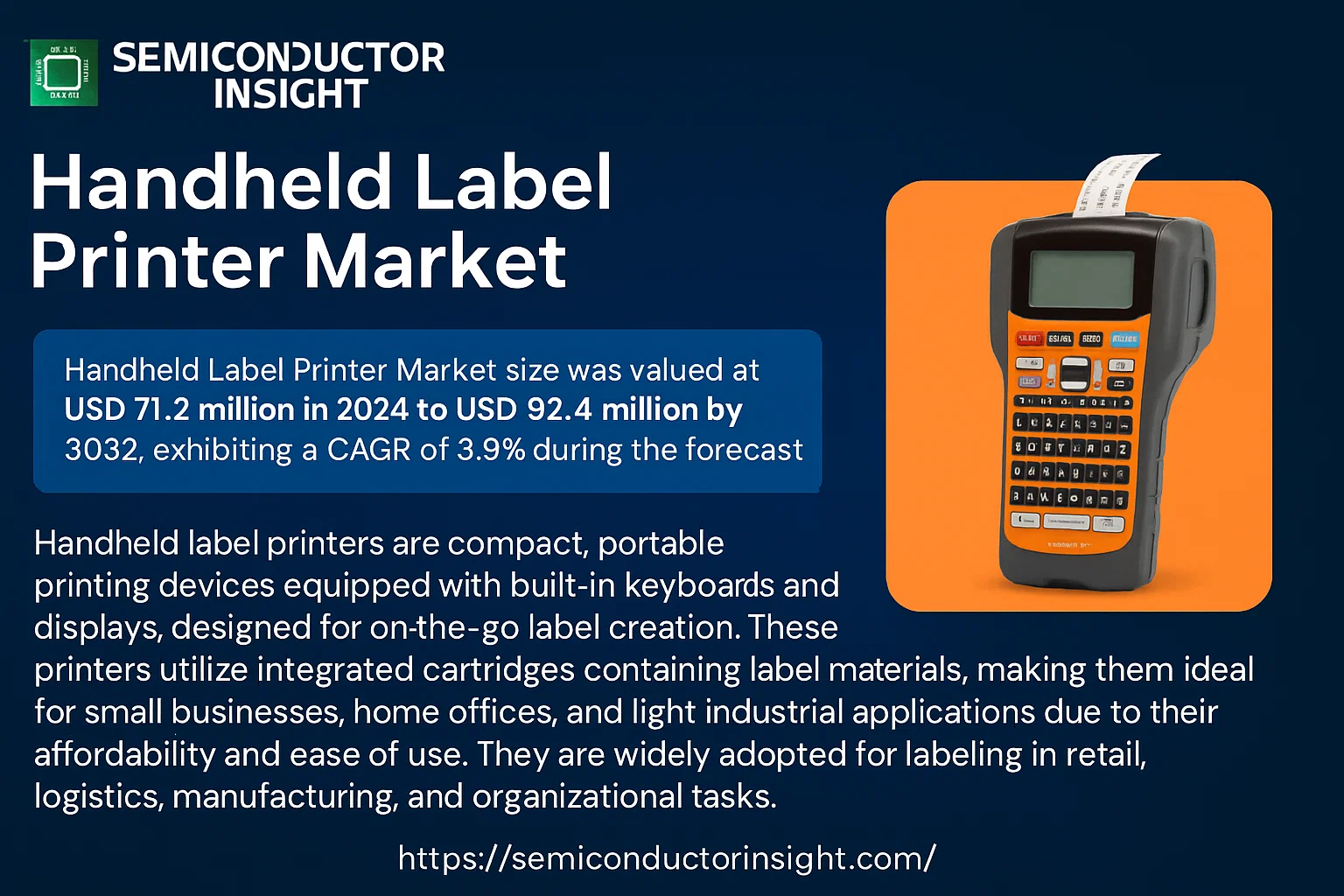
Global Handheld Label Printer Market size was valued at USD 71.2 million in 2024 to USD 92.4 million by 2032, exhibiting a CAGR of 3.9% during the forecast period.
Handheld label printers are compact, portable printing devices equipped with built-in keyboards and displays, designed for on-the-go label creation. These printers utilize integrated cartridges containing label materials, making them ideal for small businesses, home offices, and light industrial applications due to their affordability and ease of use. They are widely adopted for labeling in retail, logistics, manufacturing, and organizational tasks.
The market growth is driven by increasing demand for efficient labeling solutions in supply chain management and retail sectors, coupled with the rising trend of small businesses adopting cost-effective labeling tools. Key players such as Brother, DYMO, and KINGJIM dominate the market, with Brother holding a significant 39% revenue share in 2024. Additionally, advancements in wireless connectivity and compact designs are further accelerating market adoption.
MARKET DRIVERS
Rising Demand for On-Demand Labeling Solutions
The global expansion of e-commerce and logistics sectors has significantly increased the need for portable labeling solutions, with handheld label printers enabling real-time inventory management and shipping label creation directly in warehouses and distribution centers.
Growth in Field Service and Mobile Workforce Applications
Technicians, delivery personnel, and field service operators increasingly require immediate label printing capabilities for asset tagging, compliance documentation, and service verification, driving adoption across multiple industries.
➤ Healthcare and Laboratory Labeling Requirements
Stringent regulations for patient identification and specimen handling in healthcare facilities are mandating improved labeling systems, with handheld printers offering portability for bedside and point-of-care labeling applications.
Advancements in Connectivity and Integration Capabilities
Integration with IoT devices and cloud-based inventory systems allows handheld label printers to operate within larger automated ecosystems, providing real-time data capture and reducing manual entry errors through Bluetooth and Wi-Fi enabled devices.
Final paragraph…
MARKET CHALLENGES
High Initial Investment and Total Cost of Ownership
Advanced handheld label printers with RFID and barcode capabilities require significant upfront investment, while ongoing costs of specialized labels and maintenance create barriers for small and medium enterprises adopting the technology.
Other Challenges
Battery Life and Performance Limitations
Current battery technology limits continuous operation time, requiring frequent recharging that disrupts workflow in field applications where power sources may be unavailable.
Compatibility and Standardization Issues
Fragmented market with multiple communication protocols (Bluetooth, Wi-Fi, proprietary) and label format requirements creates integration challenges, particularly in multi-vendor environments common in industrial and healthcare settings.
MARKET RESTRAINTS
Economic Downturn Impact on Capital Expenditure
Economic uncertainty and reduced capital expenditure budgets across industries have caused delays in upgrading labeling equipment, with many organizations extending the lifecycle of existing equipment rather than investing in new handheld label printer technologies.
MARKET OPPORTUNITIES
Emerging Markets and Infrastructure Development
Rapid infrastructure development in emerging economies is creating new demand for portable labeling solutions, particularly in construction, transportation, and emerging retail markets where traditional fixed infrastructure is insufficient.
Integration with Automated and Robotic Systems
Growing adoption of warehouse robotics and automated inventory systems creates new opportunities for integrated handheld label printers that can communicate directly with automated systems and provide real-time labeling within automated workflows.
Specialized Industry Applications Expansion
New applications in healthcare (patient ID, lab samples), aerospace (component tracking), and event management (attendee tracking) are creating specialized niches that drive demand for specialized handheld label printing solutions with specific feature requirements.
Handheld Label Printer Market Trends
Rising Demand in Logistics and E-commerce Drives Market Growth
The handheld label printer market is experiencing significant growth driven by the expansion of e-commerce and logistics sectors. With the global e-commerce market projected to reach $6.3 trillion by 2024, the need for efficient labeling solutions in warehouses and distribution centers has become paramount. Major logistics companies are increasingly adopting handheld label printers to improve inventory management accuracy and reduce processing times by up to 35% compared to traditional methods.
Other Trends
Integration with IoT and Cloud-Based Systems
Modern handheld label printers are increasingly integrating with IoT devices and cloud-based inventory management systems. This integration allows for real-time data synchronization, remote monitoring of inventory levels, and automated replenishment alerts. Companies report up to 40% improvement in inventory counting efficiency when using integrated systems compared to traditional methods.
Shift Towards Wireless and Mobile Connectivity
The latest market trend shows strong adoption of Bluetooth-enabled and Wi-Fi-connected handheld label printers, particularly in retail and warehouse environments. These devices now seamlessly integrate with mobile devices and enterprise resource planning (ERP) systems, enabling real-time label printing from anywhere in the facility. Industry reports indicate that wireless capable handheld printers now constitute over 60% of new installations in 2024.
Enhanced Durability and Rugged Design
Manufacturers are focusing on developing more ruggedized handheld label printers capable of withstanding harsh warehouse environments. Recent models feature improved drop resistance (up to 2 meters on concrete), enhanced dust and moisture protection (IP54 and higher ratings), and extended battery life (up to 24 hours of continuous printing). These features are particularly crucial for logistics and manufacturing applications where equipment undergoes heavy daily use.
Sustainability and Environmental Considerations
Growing emphasis on sustainability has driven manufacturers to develop more eco-friendly handheld label printers. Recent models consume up to 30% less energy than previous generations and use recyclable materials in their construction. Additionally, manufacturers are implementing take-back programs for used devices and cartridges, with industry leaders reporting up to 85% recycling rate for returned materials.
COMPETITIVE LANDSCAPE
Key Industry Players
[Handheld Label Printer Market Analysis]
The handheld label printer market is characterized by the dominance of established players with Brother Industries leading the market with approximately 39% market share. Dymo (now part of Brother Industries) follows with 19% market share, leveraging its brand recognition in office and home labeling solutions. Japanese manufacturer KINGJIM holds approximately 6% market share with its focus on compact and portable labeling solutions. Other significant players include CASIO, Epson, and 3M, which have expanded their product portfolios to include industrial-grade handheld labeling solutions alongside their traditional product lines.
Emerging competitors from Asia, particularly China-based manufacturers like WEWIN and GAINSCHA, are gaining market share through competitive pricing and improved technology. These companies offer a range of handheld label printers from basic models to advanced systems with connectivity features. Specialized industrial labeling solution providers like Brady Corporation also maintain a strong presence in specific market segments requiring durable and specialized labeling solutions.
List of Key Handheld Label Printer Manufacturers
- Brother Industries Ltd.
- DYMO (subsidiary of Brother Industries)
- KINGJIM Co. Ltd.
- CASIO Computer Co. Ltd.
- Epson America Inc.
- 3M Company
- Brady Corporation
- WEWIN Electronics Co. Ltd.
- GAINSCHA Group Ltd.
- SATO Holdings Corporation
- Honeywell International Inc.
- Zebra Technologies Corporation
- TSC Auto ID Technology Co. Ltd.
- Godex International Co. Ltd.
Segment Analysis:
| Segment Category | Sub-Segments | Key Insights |
| By Type |
|
Thermal Transfer Printers dominate due to their versatility across various materials and environments, while direct thermal options offer simplicity for quick-labeling applications. |
| By Application |
|
Retail & Logistics application leads due to high demand for on-demand labeling in warehouses, shipping, and retail inventory management, offering significant efficiency improvements. |
| By End User |
|
Small & Medium Enterprises lead adoption as they require flexible, cost-effective labeling solutions that integrate easily with existing workflows without significant infrastructure investment. |
| By Connectivity |
|
Wireless connectivity options are increasingly preferred for mobility and cable-free operation in warehouses and field services, though wired options maintain importance in fixed station applications. |
| By Distribution Channel |
|
Online retailers have become the dominant channel due to convenience, competitive pricing, and the ability to compare products, though specialty stores offer valuable expert advice for specific use cases. |
Regional Analysis: Handheld Label Printer Market
North American healthcare facilities extensively utilize handheld label printers for patient identification, medication labeling, and specimen tracking. Strict FDA regulations mandate clear labeling on all medical items, driving consistent demand. Hospitals and clinics maintain large fleets of handheld printers for real-time labeling at patient bedside and during procedures.
The booming e-commerce sector drives demand for handheld label printers in North American warehouses and distribution centers. Workers use them for real-time inventory management, shipping label creation, and package tracking. The technology integrates seamlessly with warehouse management systems, enabling real-time inventory updates and reducing errors in large fulfillment centers.
Retail chains across North America utilize handheld label printers for price marking, shelf labeling, and inventory management. The hospitality industry uses them for event ticketing, room labeling, and asset tracking. The technology supports multilingual labeling needs in diverse North American markets and enables rapid price changes during sales events.
Manufacturing and industrial sectors in North America use handheld label printers for equipment identification, safety labeling, and maintenance tracking. The durability of industrial-grade handheld printers withstands harsh environments while providing instant labeling solutions. Facilities managing hazardous materials particularly benefit from on-the-spot labeling capabilities that improve safety compliance.
Europe
Europe represents the second largest market for handheld label printers, driven by strong industrial and healthcare sectors. The region’s emphasis on sustainability and waste reduction encourages businesses to adopt efficient labeling systems that reduce errors and material waste. Strict EU regulations on product labeling and traceability, particularly in pharmaceuticals and chemicals, drive adoption. The market benefits from high manufacturing standards and widespread digitalization across European industries.
Asia-Pacific
The Asia-Pacific region shows the fastest growth rate for handheld label printers, fueled by rapid industrialization and expanding e-commerce. Developing economies are investing heavily in supply chain modernization, creating demand for efficient labeling solutions. The manufacturing boom across Southeast Asia particularly drives demand for industrial-grade handheld printers. Government initiatives toward digitalization and Industry 4.0 further accelerate adoption across manufacturing and logistics sectors.
Latin America
Latin America demonstrates steady growth in handheld label printer adoption, particularly in Brazil and Mexico where manufacturing and agriculture sectors modernize their operations. The region’s growing e-commerce market creates demand for warehouse and logistics labeling solutions. Economic development projects and infrastructure improvements gradually increase adoption rates, though distribution networks remain less developed than in North America or Europe.
Middle East & Africa
The Middle East and Africa represent emerging markets for handheld label printers, with growth concentrated in major urban centers and industrial zones. Oil and gas industries drive initial adoption for equipment labeling and safety compliance. The region shows potential for rapid growth as supply chains develop and manufacturing sectors expand, though distribution channels remain less mature compared to other regions.
Report Scope
This market research report provides a comprehensive analysis of the Handheld Label Printer Market, covering the forecast period 2025–2032. It offers detailed insights into market dynamics, technological advancements, competitive landscape, and key trends shaping the industry.
Key focus areas of the report include:
- Market Overview: The report begins with an overview outlining its current market scenario, key growth indicators, and industry transformation drivers. It discusses macroeconomic factors, demand–supply balance, regulatory landscape, and the strategic role of semiconductors in powering advancements across industries such as automotive, telecommunications, consumer electronics, and industrial automation.
- Market Size & Forecast: Historical data and future projections for revenue, unit shipments, and market value across major regions and segments.
- Segmentation Analysis: Detailed breakdown by product type, technology, application, and end-user industry to identify high-growth segments and investment opportunities.
- Regional Insights: Insights into market performance across North America, Europe, Asia-Pacific, Latin America, and the Middle East & Africa, including country-level analysis where relevant.
- Competitive Landscape: Profiles of leading market participants, including their product offerings, R&D focus, manufacturing capacity, pricing strategies, and recent developments such as mergers, acquisitions, and partnerships.
- Technology Trends & Innovation: Assessment of emerging technologies, integration of AI/IoT, semiconductor design trends, fabrication techniques, and evolving industry standards.
- Market Drivers & Restraints: Evaluation of factors driving market growth along with challenges, supply chain constraints, regulatory issues, and market-entry barriers.
- Stakeholder Insights: Insights for component suppliers, OEMs, system integrators, investors, and policymakers regarding the evolving ecosystem and strategic opportunities.
Primary and secondary research methods are employed, including interviews with industry experts, data from verified sources, and real-time market intelligence to ensure the accuracy and reliability of the insights presented.
FREQUENTLY ASKED QUESTIONS:
What is the current market size of Handheld Label Printer Market?
-> Handheld Label Printer Market size was valued at USD 71.2 million in 2024 to USD 92.4 million by 2032, exhibiting a CAGR of 3.9% during the forecast period.
Which key companies operate in Handheld Label Printer Market?
-> Key players include Brother, DYMO, KINGJIM, CASIO, Epson, 3M, Brady, WEWIN, and GAINSCHA, among others.
What are the key growth drivers?
-> Key growth drivers include increased demand for portable labeling solutions, growth in e-commerce and logistics, and adoption of RFID technology.
Which region dominates the market?
-> Asia-Pacific is the fastest-growing region, while North America remains a dominant market due to high adoption of advanced labeling technologies.
What are the emerging trends?
-> Emerging trends include integration of NFC and RFID technologies, development of eco-friendly label materials, and increased use of cloud-based label management systems.

Get Sample Report PDF for Exclusive Insights
Report Sample Includes
- Table of Contents
- List of Tables & Figures
- Charts, Research Methodology, and more...
 Download Sample Report PDF