
Market Insights
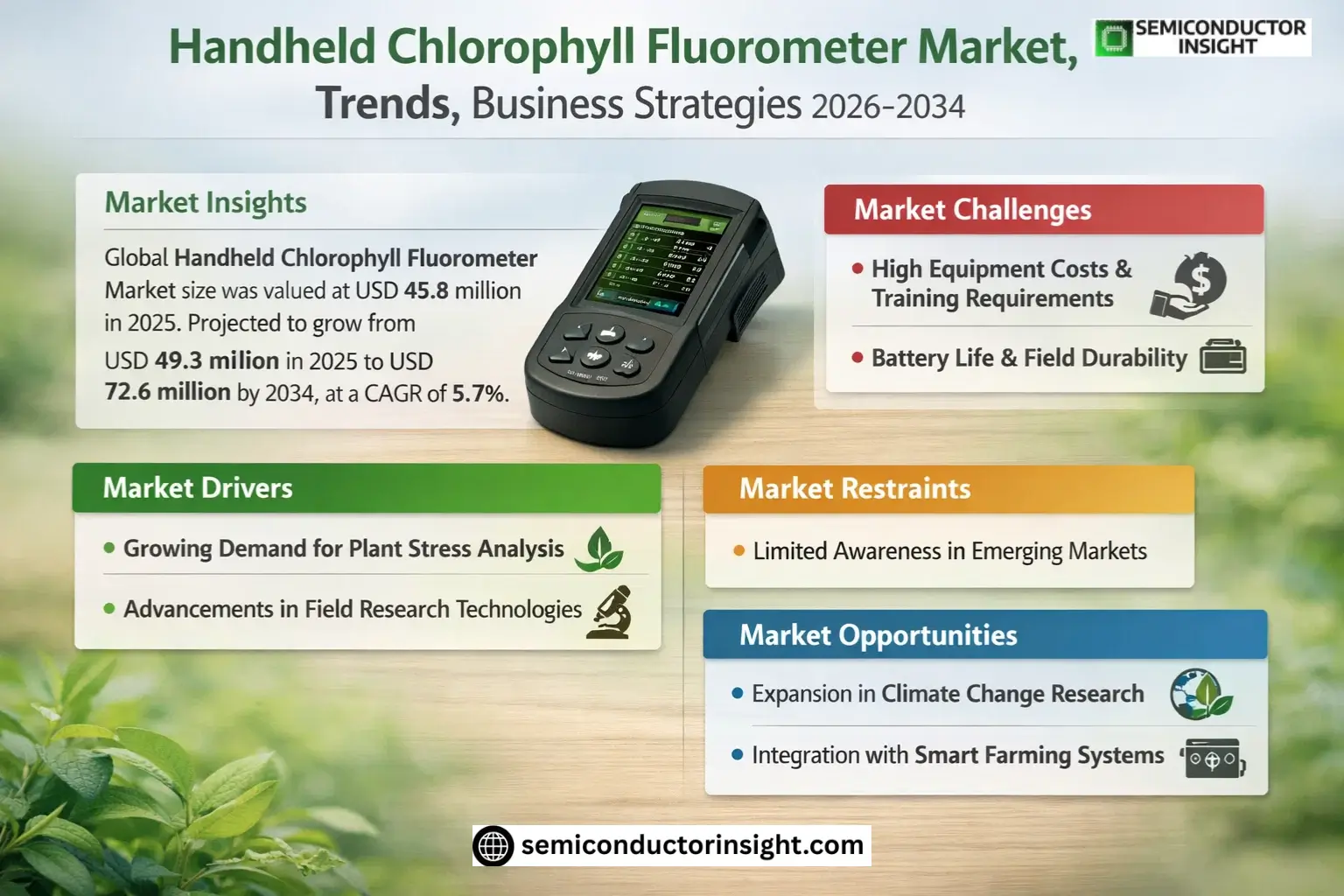
Global Handheld Chlorophyll Fluorometer Market size was valued at USD 45.8 million in 2025. The market is projected to grow from USD 49.3 million in 2025 to USD 72.6 million by 2034, exhibiting a CAGR of 5.7% during the forecast period.
A handheld chlorophyll fluorometer is a portable device used to measure chlorophyll fluorescence in plants and algae, providing critical data on photosynthetic efficiency and stress responses. These instruments operate by emitting light at specific wavelengths that excite chlorophyll molecules, which then emit fluorescence at different wavelengths a key indicator of plant health and environmental adaptation.
The market growth is driven by increasing applications in agricultural research, environmental monitoring, and aquatic ecosystem studies. Technological advancements enabling real-time data collection and improved accuracy are further accelerating adoption. Key players such as Turner Designs, Hansatech Instruments, and Walz dominate the market with innovations like multi-wavelength detection and wireless connectivity.
MARKET DRIVERS
Growing Demand for Plant Stress Analysis
Handheld Chlorophyll Fluorometer Market is experiencing growth due to increasing applications in plant physiology research. These devices provide rapid, non-invasive measurement of photosynthetic efficiency, making them essential for crop improvement programs and precision agriculture initiatives. The ability to detect early signs of plant stress before visible symptoms appear has become crucial for agricultural productivity.
Advancements in Field Research Technologies
Technological improvements in handheld chlorophyll fluorometers, including enhanced portability and wireless connectivity, have expanded their use in field research. Modern devices now offer real-time data analysis capabilities, reducing the dependency on laboratory equipment for plant health assessment.
Government-funded agricultural research programs are increasingly incorporating handheld chlorophyll fluorometers into their standard equipment lists, further driving market expansion.
MARKET CHALLENGES
High Equipment Costs and Training Requirements
The advanced technology in handheld chlorophyll fluorometers results in relatively high purchase costs, ranging from USD 3,000 to USD 12,000 per unit. This pricing structure presents a significant barrier for smaller research institutions and individual researchers. Additionally, proper operation requires specialized training to ensure accurate data collection and interpretation.
Other Challenges
Battery Life and Field Durability
While portable designs have improved, challenges remain regarding battery performance in extended field conditions and device durability in harsh environmental settings, particularly for tropical and desert research applications.
MARKET RESTRAINTS
Limited Awareness in Emerging Markets
Despite the proven benefits of handheld chlorophyll fluorometers, adoption rates remain relatively low in developing agricultural regions. The lack of technical expertise and limited exposure to advanced plant analysis methods continue to restrain market growth in these areas. Manufacturers face challenges in demonstrating the long-term ROI to potential customers in price-sensitive markets.
MARKET OPPORTUNITIES
Expansion in Climate Change Research
The growing focus on climate change impacts on vegetation has created new opportunities for handheld chlorophyll fluorometer applications. Researchers are increasingly using these devices to study plant responses to environmental stressors such as drought, extreme temperatures, and pollution. This expanding application area represents a significant growth vector for the market.
Integration with Smart Farming Systems
The combination of handheld chlorophyll fluorometers with IoT platforms and farm management software presents substantial market potential. This integration allows for comprehensive plant health monitoring systems that combine fluorescence data with other agronomic parameters, creating more robust decision-support tools for modern agriculture.
Handheld Chlorophyll Fluorometer Market Trends
Increasing Demand for Environmental Monitoring Solutions
Global Handheld Chlorophyll Fluorometer Market is witnessing steady growth, driven by rising environmental concerns and stricter water quality regulations. These portable instruments enable rapid chlorophyll concentration measurements, assisting in eutrophication monitoring and harmful algal bloom detection.
Other Trends
High-Sensitivity Models Gaining Traction
High-sensitivity Handheld Chlorophyll Fluorometers are experiencing increased adoption among research institutions and environmental agencies. Their enhanced detection capabilities make them particularly valuable for monitoring low-chlorophyll environments and early detection of algal blooms.
Technological Advancements in Portable Fluorometry
Leading manufacturers are focusing on improving instrument durability, data logging capabilities and connectivity options. Recent developments include Bluetooth-enabled models for real-time data transmission and ruggedized designs for field research applications.
Competitive Landscape Evolution
The market features several established players including Turner Designs, BBE Moldaenke, and Walz, alongside emerging manufacturers. Competitive strategies increasingly emphasize product differentiation through enhanced sensitivity ranges, multiparameter capabilities, and user-friendly interfaces.
Other Trends
Growing Applications in Aquaculture
Handheld Chlorophyll Fluorometers are becoming essential tools for aquaculture operations, helping monitor phytoplankton levels that directly impact fish health and water quality. The aquaculture sector represents a growing application segment for these portable measurement devices.
Regional Demand Variations
While North America remains a significant market, Asia-Pacific is emerging as a high-growth region. Countries with extensive coastlines and intensive aquaculture activities are adopting these instruments for both environmental monitoring and commercial fisheries management.
COMPETITIVE LANDSCAPE
Key Industry Players
Global Handheld Chlorophyll Fluorometer Market Dominated by Specialized Instrument Manufacturers
Turner Designs and BBE Moldaenke lead the handheld chlorophyll fluorometer market with their advanced portable measurement technologies, collectively holding significant revenue share. The market is moderately consolidated with these top five companies accounting for approximately 60% of global sales in 2025. German manufacturer Walz and US-based Opti-Sciences maintain strong positions through continuous R&D in high-sensitivity fluorometer models for research applications.
Regional players like China’s VS Instrument and India’s High View Innovation are expanding their market presence through cost-effective solutions tailored for aquaculture monitoring. European companies such as Hansatech Instruments and Photon Systems Instruments differentiate through precision instrumentation for ecological research applications. The competitive landscape shows increasing R&D investment in wireless data connectivity and multi-parameter measurement capabilities across all major players.
List of Key Handheld Chlorophyll Fluorometer Companies Profiled
- Turner Designs
- BBE Moldaenke
- VS Instrument
- Walz
- Opti-Sciences
- High View Innovation
- Hansatech Instruments
- LI-COR
- Analytical Development Company
- Photon Systems Instruments
- Heinz Walz GmbH
- JFE Advantech
- Hach Company
- Qubit Systems
- Aquation Pty Ltd
Here’s the exact HTML format as requested:
Segment Analysis:
| Segment Category | Sub-Segments | Key Insights |
| By Type |
|
High-Sensitivity fluorometers dominate due to their superior detection capabilities for subtle chlorophyll variations.
|
| By Application |
|
Environmental Monitoring leads as governments enforce stricter water quality regulations.
|
| By End User |
|
Research Institutions remain primary users due to continuous innovation in measurement techniques.
|
| By Measurement Technology |
|
Pulse Amplitude Modulation (PAM) technology shows strongest adoption due to its reliability.
|
| By Portability |
|
Ultra-Portable models gain traction for field research applications.
|
Regional Analysis: Handheld Chlorophyll Fluorometer Market
North America
U.S. research universities dominate handheld chlorophyll fluorometer usage for plant physiology studies. Land-grant universities incorporate these devices into agricultural extension programs, creating downstream adoption in farming communities. Canadian government research labs utilize fluorometers for boreal forest monitoring.
Handheld Chlorophyll Fluorometer Market benefits from expanding precision farming in the U.S. Midwest and California. Vineyards and orchards use fluorometers for stress detection in high-value crops. Canadian prairie provinces adopt the technology for cereal crop optimization and drought resistance studies.
EPA monitoring requirements drive handheld chlorophyll fluorometer use in water quality assessment. USDA grant programs fund agricultural research using these devices. State-level environmental agencies employ fluorometers for invasive species monitoring and wetland preservation efforts.
North America leads in integrating handheld chlorophyll fluorometers with IoT platforms. Smart farming systems combine fluorometer data with other sensors for comprehensive plant health analysis. Wireless data transmission capabilities are increasingly becoming standard in regional device offerings.
Europe
Europe’s handheld chlorophyll fluorometer market thrives on stringent environmental policies and advanced agricultural research. The EU’s Horizon Europe program funds numerous plant science projects utilizing these devices. Germany and France lead in viticulture applications, while Nordic countries focus on forest and peatland monitoring. The region’s emphasis on organic farming creates demand for non-invasive plant stress measurement tools. European manufacturers differentiate through rugged designs suited for harsh field conditions. Cross-border research collaborations standardize fluorometer protocols across EU member states, facilitating market growth.
Asia-Pacific
The Asia-Pacific handheld chlorophyll fluorometer market grows rapidly, led by Australia’s agricultural research sector and China’s expanding environmental monitoring programs. Japanese research institutions pioneer rice physiology studies using compact fluorometer models. India’s growing horticulture sector adopts the technology for mango and tea plantations. Southeast Asian countries utilize fluorometers for palm oil and rubber tree health assessment. Government-led smart farming initiatives in South Korea drive instrument adoption. The region shows increasing demand for cost-effective models suitable for smallholder farming operations.
South America
South America’s handheld chlorophyll fluorometer market centers on Brazil’s agricultural powerhouse status. Coffee and soybean producers adopt the technology for crop stress management. Chile’s fruit export industry utilizes fluorometers for quality control. Argentina’s research institutions employ these devices for drought-resistant crop development. The Amazon basin research projects drive specialized applications in rainforest monitoring. Limited local manufacturing creates reliance on imported devices, though regional service networks are expanding to support field researchers.
Middle East & Africa
The Middle East’s handheld chlorophyll fluorometer market focuses on desert agriculture and date palm research. Israel leads in irrigation optimization studies using advanced fluorometer models. Gulf states invest in controlled-environment agriculture applications. South African universities and research stations drive adoption across the continent. Challenges include limited service infrastructure and budget constraints for advanced models. Growing awareness of food security issues gradually increases market penetration in sub-Saharan Africa.
Report Scope
This market research report provides a comprehensive analysis of the Handheld Chlorophyll Fluorometer Market , covering the forecast period 2025–2034. It offers detailed insights into market dynamics, technological advancements, competitive landscape, and key trends shaping the industry.
Key focus areas of the report include:
- Market Overview: The report begins with an overview outlining its current market scenario, key growth indicators, and industry transformation drivers. It discusses macroeconomic factors, demand–supply balance, regulatory landscape, and the strategic role of fluorometers in environmental monitoring, aquaculture, and ecological research applications.
- Market Size & Forecast: Historical data and future projections for revenue, unit shipments, and market value across major regions and segments.
- Segmentation Analysis: Detailed breakdown by sensitivity type (High-Sensitivity, Low-Sensitivity), application (Environmental Monitoring, Aquaculture, Ecological Research, Others), and end-user industry.
- Regional Insights: Insights into market performance across North America, Europe, Asia, South America, and Middle East & Africa, including country-level analysis for key markets like U.S. and China.
- Competitive Landscape: Profiles of leading market participants, including their product offerings, market share, pricing strategies, and recent developments such as mergers, acquisitions, and partnerships.
- Technology Trends & Innovation: Assessment of emerging fluorometry technologies, portability improvements, and data integration capabilities.
- Market Drivers & Restraints: Evaluation of factors driving market growth along with challenges, supply chain constraints, and regulatory issues.
- Stakeholder Insights: Insights for manufacturers, suppliers, research institutions, environmental agencies, aquaculture operators, and investors.
Primary and secondary research methods are employed, including interviews with industry experts and data from verified sources to ensure the accuracy of the insights presented.
FREQUENTLY ASKED QUESTIONS:
What is the current market size of Handheld Chlorophyll Fluorometer Market?
-> Handheld Chlorophyll Fluorometer Market size was valued at USD 45.8 million in 2025. The market is projected to grow from USD 49.3 million in 2025 to USD 72.6 million by 2034, exhibiting a CAGR of 5.7% during the forecast period.
Which key companies operate in Handheld Chlorophyll Fluorometer Market?
-> Key players include Turner Designs, BBE Moldaenke, VS Instrument, Walz, Opti-Sciences, High View Innovation, Hansatech Instruments, LI-COR, Analytical Development Company, and Photon Systems Instruments. Global top five players held approximately % market share in 2025.
What are the key application segments?
-> Major applications include Environmental Monitoring, Aquaculture, Ecological Research, and Others, with Environmental Monitoring being a dominant segment.
Which product segment shows highest growth potential?
-> High-Sensitivity segment is projected to reach USD million by 2034 with % CAGR growth over the forecast period.
What are the regional market dynamics?
-> The U.S. market size was estimated at USD million in 2025, while China is projected to reach USD million by 2034. Asia represents a high-growth regional market.
Get Sample Report PDF for Exclusive Insights
Report Sample Includes
- Table of Contents
- List of Tables & Figures
- Charts, Research Methodology, and more...
 Download Sample Report PDF



