MARKET INSIGHTS
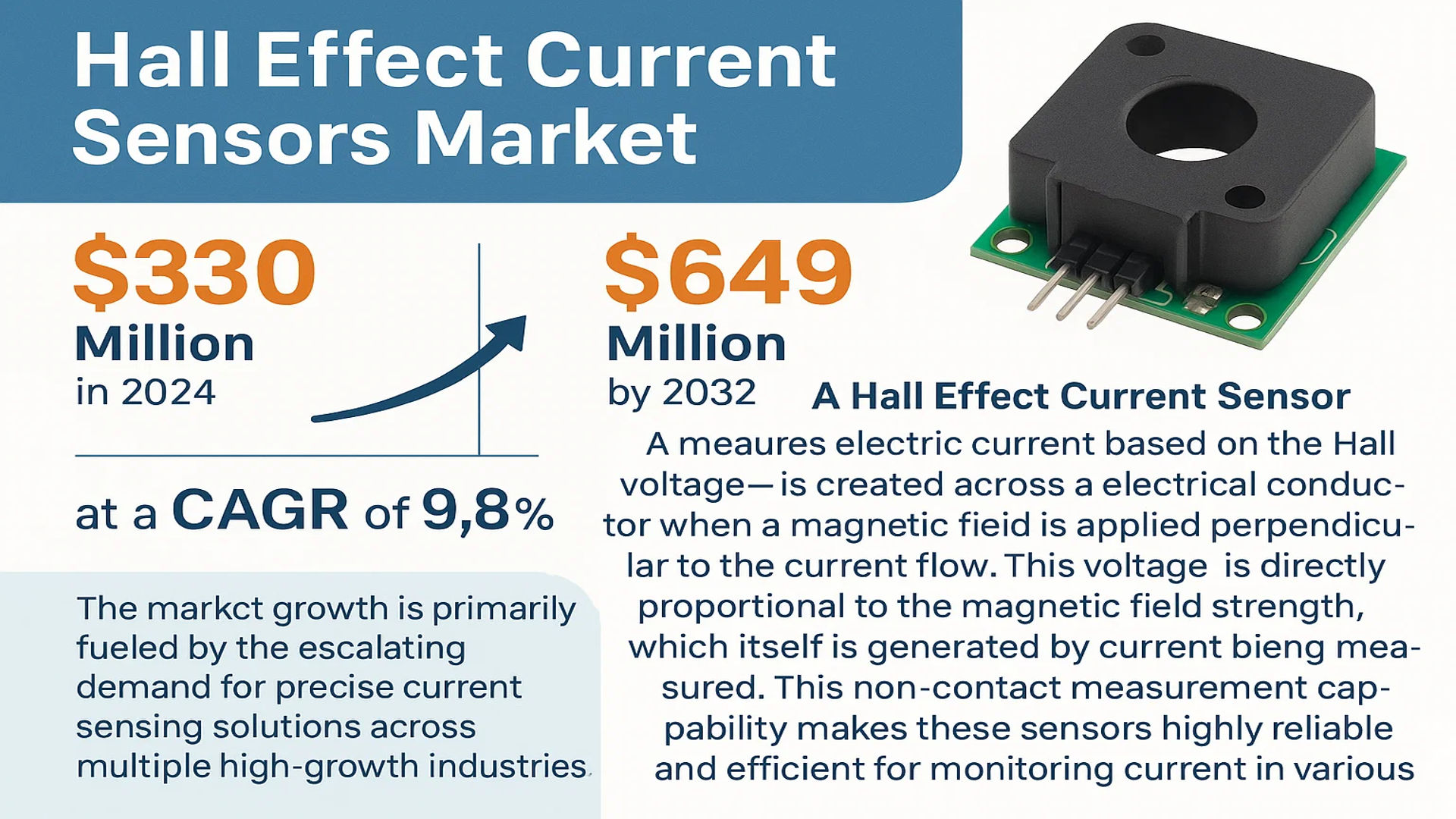
The global Hall Effect Current Sensors Market was valued at 330 million in 2024 and is projected to reach US$ 649 million by 2032, at a CAGR of 9.8% during the forecast period.
A Hall Effect Current Sensor is a device used to measure electric current based on the Hall effect. It operates on the principle that a voltage difference—the Hall voltage—is created across an electrical conductor when a magnetic field is applied perpendicular to the current flow. This voltage is directly proportional to the magnetic field strength, which itself is generated by the current being measured. This non-contact measurement capability makes these sensors highly reliable and efficient for monitoring current in various applications.
The market growth is primarily fueled by the escalating demand for precise current sensing solutions across multiple high-growth industries. The electric vehicle (EV) sector is a significant contributor, as these sensors are critical for battery management and motor control systems. Furthermore, the advancement of industrial automation and Industry 4.0 initiatives is driving adoption, as these sensors enable real-time monitoring to ensure operational stability and safety. The expansion of renewable energy infrastructure, including solar inverters and energy storage systems, also presents substantial opportunities, necessitating accurate current measurement for efficient energy management.
MARKET DYNAMICS
MARKET DRIVERS
Rapid Electrification of Automotive Sector to Drive Market Expansion
The global shift toward electric vehicles represents the most powerful growth driver for Hall Effect current sensors. With electric vehicle production projected to exceed 30 million units annually by 2030, the demand for precise current monitoring in battery management systems, motor controls, and charging infrastructure has surged exponentially. These sensors provide critical safety and performance monitoring in high-voltage applications ranging from 400V to 800V systems, enabling real-time current measurement without physical contact. The automotive industry’s transition to electric powertrains has created an unprecedented requirement for reliable current sensing solutions that can operate in harsh electromagnetic environments while maintaining accuracy within 1-2% across temperature variations from -40°C to 150°C. This sector’s expansion directly correlates with increased adoption of Hall Effect sensors, particularly in regions with strong EV adoption policies and manufacturing bases.
Industrial Automation and Industry 4.0 Implementation to Accelerate Demand
Industrial automation continues to be a significant growth catalyst for Hall Effect current sensors, driven by global investments in smart manufacturing infrastructure. The implementation of Industry 4.0 principles requires comprehensive current monitoring across motor drives, robotics, CNC machines, and power distribution systems. These sensors enable predictive maintenance by detecting abnormal current patterns before failures occur, reducing downtime by up to 45% in manufacturing environments. The industrial segment particularly favors closed-loop Hall Effect sensors for their high accuracy and fast response times, with typical bandwidth requirements exceeding 100 kHz for modern servo drives and automation equipment. The continuous modernization of manufacturing facilities worldwide, especially in regions with strong industrial bases, ensures sustained demand for these critical components.
Renewable Energy Integration and Grid Modernization to Fuel Market Growth
The global transition toward renewable energy sources has created substantial opportunities for Hall Effect current sensors in solar inverters, wind turbine converters, and energy storage systems. These applications require robust current monitoring solutions capable of handling high power levels while maintaining isolation between measurement and power circuits. The renewable energy sector particularly values the galvanic isolation provided by Hall Effect sensors, which prevents ground loops and enhances system safety. With global solar capacity expected to reach 5,800 GW by 2030 and wind capacity projected to exceed 2,100 GW, the infrastructure requirements for current monitoring present a substantial market opportunity. Additionally, smart grid implementations and distributed energy resources management systems increasingly incorporate these sensors for precise power quality monitoring and fault detection.
MARKET CHALLENGES
Temperature Sensitivity and Measurement Accuracy Constraints to Challenge Market Penetration
Hall Effect current sensors face significant technical challenges related to temperature dependence and measurement precision. These sensors exhibit temperature coefficients typically ranging from 0.02%/°C to 0.1%/°C, requiring sophisticated compensation circuits to maintain accuracy across operating temperatures. In automotive and industrial applications where temperature variations can exceed 100°C, maintaining measurement accuracy within specified tolerances becomes increasingly difficult and costly. The inherent limitations of Hall elements regarding offset voltage and magnetic hysteresis further complicate precision measurements, particularly in low-current applications where signal-to-noise ratios become critical. These technical constraints often necessitate additional signal conditioning circuitry, increasing both component count and system cost while potentially reducing reliability.
Other Challenges
Electromagnetic Interference Susceptibility
Hall Effect sensors demonstrate vulnerability to external magnetic fields and electromagnetic interference, particularly in high-power applications where strong magnetic fields are prevalent. This susceptibility can lead to measurement errors exceeding 5% in environments with significant electromagnetic noise, requiring additional shielding and filtering measures that increase system complexity and cost. The proliferation of power electronics and switching frequencies in modern applications exacerbates these challenges, creating design constraints for engineers implementing these sensors in noise-sensitive applications.
Packaging and Integration Limitations
The physical packaging requirements for Hall Effect sensors present challenges regarding space constraints and thermal management. Achieving adequate magnetic coupling while maintaining electrical isolation requires careful mechanical design, often resulting in larger form factors than competing technologies. The integration of additional features such as overcurrent detection and temperature monitoring further complicates packaging considerations, particularly in applications where board space is limited and thermal management is critical.
MARKET RESTRAINTS
High Cost Structure and Price Pressure to Limit Market Adoption
The relatively high cost of Hall Effect current sensors compared to alternative technologies represents a significant market restraint, particularly in price-sensitive applications and emerging markets. Advanced Hall Effect sensors incorporating digital interfaces and integrated signal conditioning typically command prices 2-3 times higher than shunt resistor solutions, creating adoption barriers in cost-conscious segments. The manufacturing process for these sensors involves specialized semiconductor fabrication techniques and precision assembly, contributing to higher production costs that cannot be easily reduced through volume manufacturing. Additionally, increasing price pressure from Asian manufacturers offering competitive alternatives has intensified margin compression for established players, potentially limiting investment in next-generation product development.
Competition from Alternative Sensing Technologies to Constrain Market Growth
Hall Effect current sensors face intensifying competition from emerging sensing technologies including magnetoresistive sensors, current transformers, and shunt-based measurement systems. Magnetoresistive sensors offer significantly higher sensitivity and lower power consumption, particularly advantageous in battery-powered applications where energy efficiency is paramount. Current transformers continue to dominate high-current AC applications due to their reliability and cost-effectiveness, while shunt resistors maintain strong positions in low-cost DC applications where isolation is not required. The continuous improvement of these competing technologies, coupled with their established manufacturing infrastructures and lower component costs, presents substantial challenges for Hall Effect sensor adoption across multiple market segments.
Supply Chain Vulnerabilities and Component Shortages to Impede Market Stability
The Hall Effect current sensor market faces ongoing challenges related to semiconductor supply chain constraints and material availability issues. The specialized semiconductor processes required for Hall element fabrication involve unique materials and equipment that remain susceptible to production disruptions and capacity limitations. Recent global semiconductor shortages have particularly affected sensor production, with lead times extending beyond 52 weeks for certain product categories. These supply chain vulnerabilities create uncertainty for OEMs incorporating these sensors into their designs, potentially leading to design changes or alternative technology selection. The concentration of manufacturing capacity among a limited number of suppliers further exacerbates these challenges, creating potential single-point-of-failure risks in the supply ecosystem.
MARKET OPPORTUNITIES
Integration with IoT and Smart Infrastructure to Create New Application Frontiers
The proliferation of Internet of Things technologies and smart infrastructure presents substantial growth opportunities for Hall Effect current sensors. These sensors enable distributed current monitoring in smart buildings, data centers, and municipal infrastructure, providing critical data for energy management and predictive maintenance systems. The ability to integrate digital interfaces directly into Hall Effect sensors facilitates seamless connectivity with IoT platforms, enabling real-time current monitoring across distributed networks. Smart city initiatives worldwide are incorporating these sensors into power distribution systems, street lighting controls, and public transportation infrastructure, creating new application segments beyond traditional industrial and automotive markets. The convergence of Hall Effect sensing with wireless communication technologies opens additional opportunities in remote monitoring applications where wired connections are impractical or cost-prohibitive.
Advancements in Wide Bandgap Semiconductor Applications to Drive Innovation
The adoption of wide bandgap semiconductors including silicon carbide and gallium nitride in power electronics creates significant opportunities for advanced Hall Effect current sensors. These new semiconductor materials operate at higher switching frequencies and temperatures than traditional silicon-based devices, requiring current sensors with enhanced bandwidth and temperature performance. Hall Effect sensors capable of operating at frequencies exceeding 1 MHz and temperatures above 200°C enable optimal utilization of wide bandgap technology advantages in applications including electric vehicle fast charging, industrial motor drives, and renewable energy conversion. The compatibility of Hall Effect sensors with these emerging semiconductor technologies positions them favorably for next-generation power electronic designs, particularly in applications requiring high efficiency and power density.
Miniaturization and Integration Trends to Enable New Design Possibilities
Ongoing miniaturization and integration trends in electronics manufacturing create opportunities for Hall Effect current sensors in space-constrained applications. The development of package-on-package solutions and system-in-package approaches enables integration of Hall elements with signal conditioning circuitry and protection features into compact form factors. These advancements facilitate adoption in consumer electronics, wearable devices, and medical equipment where board space is limited and functional integration is valued. The ability to combine current sensing with voltage monitoring, temperature sensing, and communication interfaces in single packages addresses design challenges in modern electronic systems while reducing component count and simplifying system architecture. These integration capabilities position Hall Effect sensors advantageously for applications requiring comprehensive power management in minimal physical footprints.
HALL EFFECT CURRENT SENSORS MARKET TRENDS
Electrification of Automotive and Industrial Systems Driving Market Expansion
The global Hall Effect Current Sensors market is experiencing robust growth, primarily fueled by the accelerating electrification of the automotive and industrial sectors. The transition to electric vehicles (EVs) and hybrid electric vehicles (HEVs) represents a monumental shift, creating an unprecedented demand for precise and reliable current sensing solutions. These sensors are indispensable in EV battery management systems (BMS) and motor control units, where they ensure operational safety, optimize energy efficiency, and monitor performance. In industrial automation, the march towards Industry 4.0 and smart manufacturing necessitates real-time, accurate current monitoring to enhance equipment reliability, predict maintenance needs, and minimize unplanned downtime. This trend is not merely about replacing mechanical systems but about building an intelligent, data-driven infrastructure where Hall effect sensors act as critical data acquisition points. While the automotive sector is a powerhouse of demand, industrial applications are equally significant, collectively forming the bedrock of the market’s projected ascent from a valuation of 330 million in 2024 to an anticipated 649 million by 2032.
Other Trends
Miniaturization and Integration for Next-Generation Electronics
A parallel and equally powerful trend is the relentless drive towards miniaturization and higher integration. The proliferation of consumer electronics, smart home devices, and wearable technology demands sensors that are not only accurate but also exceptionally small and power-efficient. Manufacturers are responding by developing highly integrated Hall effect sensor ICs that combine core sensing functionality with additional features like signal conditioning, temperature compensation, and built-in overcurrent protection circuits. This level of integration reduces the bill of materials (BOM), simplifies PCB design, and enhances overall system reliability. Furthermore, the adoption of advanced packaging technologies allows these miniaturized sensors to perform reliably in the harsh environments typical of automotive and industrial applications. This trend is crucial because it enables the seamless embedding of sophisticated current monitoring capabilities into increasingly compact and complex electronic products, thereby expanding the addressable market into new and innovative applications.
Digitalization and IoT Connectivity Reshaping Application Landscapes
The digital transformation is profoundly impacting the Hall Effect Current Sensors market, steering it away from traditional analog outputs towards digital interfaces. The integration of digital output protocols such as SPI (Serial Peripheral Interface) and I2C (Inter-Integrated Circuit) is becoming a standard expectation. This shift is critical for the era of the Internet of Things (IoT), as it allows sensors to communicate directly and efficiently with microcontrollers (MCUs) and system-on-chips (SoCs). This facilitates automated data logging, remote monitoring, and seamless integration into larger smart systems. In applications ranging from smart grids and renewable energy storage to connected home appliances and industrial IoT platforms, digitally-enabled Hall sensors provide the vital link between electrical current data and cloud-based analytics. This connectivity transforms the sensor from a simple measurement component into an intelligent node within a networked ecosystem, enabling predictive maintenance, energy optimization, and enhanced operational intelligence on a scale previously unattainable.
COMPETITIVE LANDSCAPE
Key Industry Players
Innovation and Strategic Expansion Drive Market Leadership
The global Hall Effect Current Sensors market exhibits a moderately fragmented competitive structure, characterized by the presence of multinational semiconductor giants, specialized sensor manufacturers, and emerging regional players. Allegro Microsystems maintains a dominant position, capturing approximately 22% of the global market share in 2024. This leadership stems from their comprehensive product portfolio spanning both open-loop and closed-loop sensors, particularly their strong penetration in the automotive sector where they supply major EV manufacturers like Tesla and Volkswagen.
Infineon Technologies and TDK Corporation collectively held nearly 30% market share in 2024, with Infineon’s strong foothold in European industrial applications and TDK’s extensive presence in Asian consumer electronics markets. These companies have demonstrated remarkable growth through continuous innovation in integrated circuit design and packaging technologies, enabling higher accuracy and smaller form factors that meet evolving industry requirements.
The competitive intensity is further heightened by strategic movements among key players. In early 2024, Texas Instruments announced a $300 million investment to expand their sensor production capacity, specifically targeting the industrial automation and renewable energy sectors. Meanwhile, Analog Devices completed the acquisition of a specialized sensor firm to strengthen their position in high-precision measurement applications, particularly for medical equipment and aerospace systems.
Chinese manufacturers including Suzhou Novosense Microlectronics and Shanghai Orient-Chip Technology are rapidly gaining market share through cost-competitive solutions and strong government support for domestic semiconductor production. Novosense reportedly increased their production capacity by 40% in 2023 to meet growing domestic demand from EV manufacturers like BYD and NIO.
Looking forward, the competitive landscape is expected to evolve through several key trends. Companies are increasingly focusing on developing sensors with enhanced cybersecurity features for IoT applications, while also investing in silicon carbide and gallium nitride-based sensors that offer higher temperature tolerance and better performance in high-voltage applications. The ongoing consolidation through mergers and acquisitions is likely to continue as larger players seek to acquire specialized technologies and access new regional markets.
List of Key Hall Effect Current Sensor Companies Profiled
- Allegro Microsystems (U.S.)
- Melexis (Belgium)
- Infineon Technologies (Germany)
- TDK Corporation (Japan)
- Asahi Kasei Microdevices (Japan)
- Texas Instruments (U.S.)
- Suzhou Novosense Microlectronics (China)
- Shanghai Orient-Chip Technology (China)
- Analog Devices, Inc. (U.S.)
- Semiment Technology (China)
- Cosemitech (Taiwan)
- Senksemi-electronics (China)
- CrossChip Microsystems (China)
Segment Analysis:
By Type
Closed-Loop Hall Effect Current Sensors Segment Dominates Due to Superior Accuracy and Stability in High-Performance Applications
The market is segmented based on type into:
- Open-Loop Hall Effect Current Sensors
- Closed-Loop Hall Effect Current Sensors
By Application
Automotive and Transportation Segment Leads Due to Surging Adoption in Electric Vehicles and Advanced Driver-Assistance Systems
The market is segmented based on application into:
- Industrial and Energy
- Automotive and Transportation
- Consumer Electronics
- Others
By Technology
Digital Output Sensors Segment is Gaining Traction Due to Enhanced Integration with IoT and Smart Systems
The market is segmented based on technology into:
- Analog Output Hall Effect Current Sensors
- Digital Output Hall Effect Current Sensors
By End-User
Automotive OEMs Represent a Key End-User Segment Driven by Electrification and Safety Regulations
The market is segmented based on end-user into:
- Automotive OEMs
- Industrial Equipment Manufacturers
- Consumer Electronics Brands
- Energy Sector Companies
- Others
Regional Analysis: Hall Effect Current Sensors Market
Asia-Pacific
Asia-Pacific dominates the global Hall Effect Current Sensors market, accounting for approximately 45% of total revenue share in 2024. This leadership is primarily driven by China’s massive manufacturing ecosystem for consumer electronics, industrial automation, and electric vehicles. The region benefits from strong government support for EV adoption, with China aiming for 40% of all new car sales to be electric by 2030. Additionally, countries like Japan and South Korea are home to leading semiconductor manufacturers such as Asahi Kasei Microdevices and TDK, which continuously innovate in sensor technology. India’s growing industrial sector and investments in smart infrastructure further contribute to market expansion. While cost-competitive open-loop sensors remain popular, there is increasing adoption of high-accuracy closed-loop sensors in premium applications.
North America
North America represents a significant and technologically advanced market for Hall Effect Current Sensors, characterized by high demand from the automotive, renewable energy, and industrial sectors. The United States, in particular, sees substantial adoption due to stringent automotive safety standards and the rapid growth of electric vehicles, supported by initiatives like the Inflation Reduction Act. The region’s focus on industrial automation and smart manufacturing under Industry 4.0 frameworks drives the need for precise current monitoring solutions. Key players like Allegro Microsystems and Texas Instruments are headquartered here, fostering innovation in integrated and digital-output sensors. High-performance applications often prefer closed-loop sensors for their accuracy and reliability.
Europe
Europe is a mature market with strong emphasis on automotive excellence and energy efficiency, driven by regulations such as the EU’s strict emissions standards and Green Deal initiatives. The region is a hub for premium automotive manufacturers, accelerating the adoption of Hall Effect Current Sensors in electric and hybrid vehicles for battery management and motor control. Industrial automation in countries like Germany and France further propels demand, with a focus on high-reliability and safety-compliant sensors. The presence of companies like Infineon and Melexis enhances the region’s innovation landscape, particularly in developing sensors with enhanced thermal stability and digital interfaces for smart systems.
South America
South America is an emerging market with gradual growth in the adoption of Hall Effect Current Sensors, primarily fueled by industrial expansion and increasing investment in renewable energy projects. Brazil and Argentina are leading this growth, with applications in energy management, industrial machinery, and consumer electronics. However, economic volatility and infrastructural challenges slow the pace of adoption compared to other regions. The market tends to favor cost-effective open-loop sensors, though there is budding interest in advanced sensors for solar energy and automotive applications. Long-term potential exists as industrialization and technological awareness increase.
Middle East & Africa
The Middle East & Africa region shows nascent but promising growth for Hall Effect Current Sensors, driven by infrastructure development, urbanization, and investments in energy and transportation projects. Countries like Saudi Arabia, UAE, and Israel are at the forefront, incorporating these sensors in renewable energy systems, industrial automation, and consumer electronics. The market is still developing, with growth hindered by limited local manufacturing and reliance on imports. However, increasing focus on smart city projects and energy efficiency is expected to boost demand over the coming years, particularly for sensors used in solar inverters and automotive applications.
Report Scope
This market research report provides a comprehensive analysis of the global and regional Hall Effect Current Sensors market, covering the forecast period 2025–2032. It offers detailed insights into market dynamics, technological advancements, competitive landscape, and key trends shaping the industry.
Key focus areas of the report include:
- Market Size & Forecast: Historical data and future projections for revenue, unit shipments, and market value across major regions and segments.
- Segmentation Analysis: Detailed breakdown by product type, technology, application, and end-user industry to identify high-growth segments and investment opportunities.
- Regional Outlook: Insights into market performance across North America, Europe, Asia-Pacific, Latin America, and the Middle East & Africa, including country-level analysis where relevant.
- Competitive Landscape: Profiles of leading market participants, including their product offerings, R&D focus, manufacturing capacity, pricing strategies, and recent developments such as mergers, acquisitions, and partnerships.
- Technology Trends & Innovation: Assessment of emerging technologies, integration of AI/IoT, semiconductor design trends, fabrication techniques, and evolving industry standards.
- Market Drivers & Restraints: Evaluation of factors driving market growth along with challenges, supply chain constraints, regulatory issues, and market-entry barriers.
- Stakeholder Analysis: Insights for component suppliers, OEMs, system integrators, investors, and policymakers regarding the evolving ecosystem and strategic opportunities.
Primary and secondary research methods are employed, including interviews with industry experts, data from verified sources, and real-time market intelligence to ensure the accuracy and reliability of the insights presented.
FREQUENTLY ASKED QUESTIONS:
What is the current market size of Global Hall Effect Current Sensors Market?
-> Hall Effect Current Sensors Market was valued at 330 million in 2024 and is projected to reach US$ 649 million by 2032, at a CAGR of 9.8% during the forecast period.
Which key companies operate in Global Hall Effect Current Sensors Market?
-> Key players include Allegro Microsystems, Melexis, Infineon, TDK, Asahi Kasei Microdevices, Texas Instruments, and Analog Devices, among others.
What are the key growth drivers?
-> Key growth drivers include the rapid expansion of the electric vehicle (EV) market, the advancement of industrial automation and Industry 4.0, the proliferation of consumer electronics, and the widespread adoption of renewable energy and energy storage systems.
Which region dominates the market?
-> Asia-Pacific is the largest and fastest-growing market, driven by its strong manufacturing base for electronics and automotive sectors, while North America and Europe remain significant markets due to their advanced industrial and automotive industries.
What are the emerging trends?
-> Emerging trends include the shift towards higher integration and multifunctional sensor chips, the adoption of digital output interfaces (SPI, I2C) for smarter connectivity, and the increasing use of these sensors in IoT applications for smart homes and cities.

Get Sample Report PDF for Exclusive Insights
Report Sample Includes
- Table of Contents
- List of Tables & Figures
- Charts, Research Methodology, and more...
 Download Sample Report PDF