MARKET INSIGHTS
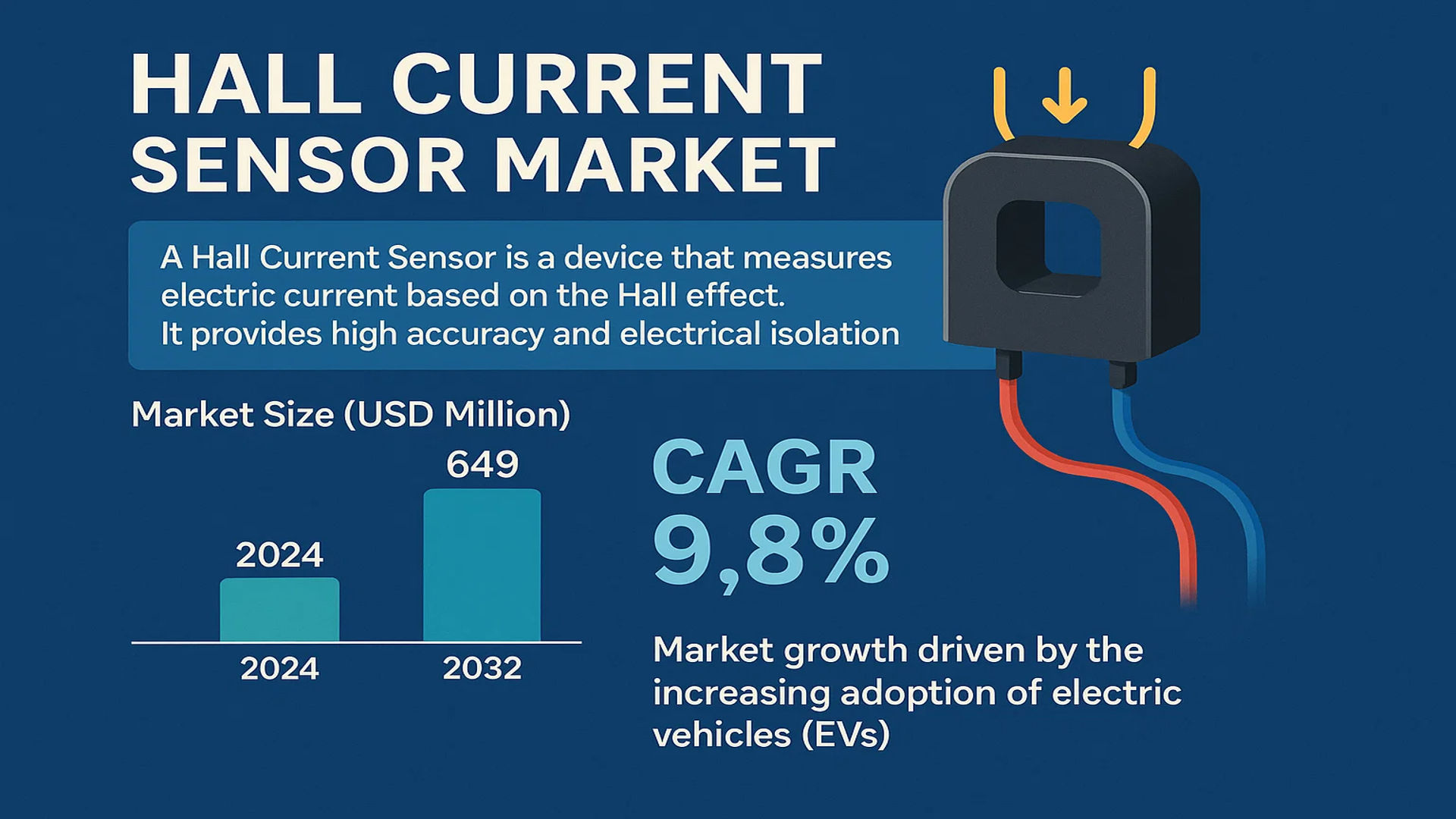
The global Hall Current Sensor Market was valued at 330 million in 2024 and is projected to reach US$ 649 million by 2032, at a CAGR of 9.8% during the forecast period.
A Hall Current Sensor is a device that measures electric current based on the Hall effect. It operates on the principle that a voltage difference—the Hall voltage—is created across an electrical conductor when a magnetic field is applied perpendicular to the current flow. This voltage is proportional to the magnetic field strength, which itself is generated by and directly proportional to the current being measured. This non-contact method of measurement provides high accuracy and electrical isolation, making these sensors critical components for monitoring and protection in various electronic systems.
The market is experiencing robust growth driven by the accelerating adoption of electric vehicles (EVs), which require precise battery management and motor control systems. Furthermore, the expansion of industrial automation under Industry 4.0 initiatives is fueling demand for real-time current monitoring to ensure operational safety and efficiency. The proliferation of renewable energy systems, such as solar inverters and energy storage, also relies heavily on these sensors for energy management. Key technological trends include the integration of digital interfaces like SPI and I2C for smarter connectivity and the development of highly integrated, multifunctional chips that include features such as temperature compensation.
MARKET DYNAMICS
MARKET DRIVERS
Electric Vehicle Revolution Accelerating Demand for Precision Current Sensing
The global transition toward electric mobility represents the most powerful growth driver for Hall current sensors. With electric vehicle production projected to exceed 30 million units annually by 2030, the demand for sophisticated battery management systems and motor control units has intensified dramatically. Hall current sensors provide critical non-contact current measurement capabilities essential for monitoring battery health, optimizing charging efficiency, and ensuring operational safety. The automotive industry’s shift toward 800V electrical architectures further amplifies this demand, as higher voltage systems require more precise current monitoring to maintain system integrity and performance. Major automotive manufacturers are increasingly integrating multiple Hall current sensors per vehicle, with premium electric models containing up to 15 individual sensors for comprehensive power management across various subsystems.
Industrial Automation and Industry 4.0 Driving Intelligent Current Monitoring
Industrial automation represents another significant growth vector, with global smart manufacturing investments exceeding $400 billion annually. Hall current sensors have become indispensable components in modern industrial equipment, providing real-time current monitoring for predictive maintenance, energy optimization, and operational safety. The implementation of Industry 4.0 principles has accelerated the adoption of intelligent sensors that can communicate operational data through digital interfaces. Modern manufacturing facilities utilize hundreds of Hall current sensors across production lines, robotic systems, and power distribution networks. The ability of these sensors to operate in harsh industrial environments while maintaining measurement accuracy has made them preferred solutions over traditional current transformers, particularly in space-constrained applications where compact form factors are essential.
Renewable Energy Expansion Creating New Application Frontiers
The rapid global expansion of renewable energy infrastructure has opened substantial new markets for Hall current sensors. Solar and wind energy systems require precise current monitoring for maximum power point tracking, grid synchronization, and system protection. With global renewable energy capacity additions reaching record levels annually, the demand for reliable current sensing solutions has correspondingly increased. Hall current sensors are particularly valued in these applications for their wide measurement range, excellent linearity, and isolation capabilities. The energy storage sector, which is experiencing exponential growth with projections indicating a twenty-fold capacity increase by 2030, similarly depends on accurate current measurement for battery management systems in both stationary storage and mobile applications.
MARKET CHALLENGES
Temperature Sensitivity and Measurement Accuracy Constraints
Hall current sensors face significant technical challenges related to temperature-dependent performance characteristics. The Hall effect is inherently temperature-sensitive, with voltage output varying by approximately 0.1% per degree Celsius in standard implementations. This temperature dependence necessitates sophisticated compensation circuits that add complexity and cost to sensor designs. In high-temperature industrial environments or automotive under-hood applications where temperatures can exceed 125°C, maintaining measurement accuracy becomes particularly challenging. The industry response has been the development of advanced temperature compensation algorithms and integrated temperature sensors, but these solutions increase both the technical complexity and production costs of Hall current sensors.
Other Challenges
Electromagnetic Interference Susceptibility
Hall current sensors are vulnerable to external magnetic fields and electromagnetic interference, which can significantly affect measurement accuracy. In applications with high power density or complex electromagnetic environments, such as electric vehicle powertrains or industrial motor drives, stray magnetic fields can induce measurement errors exceeding 5%. Shielding solutions add bulk and cost, while digital filtering techniques increase processing requirements and response time.
Power Consumption Constraints
While Hall current sensors generally consume less power than current transformers, their power requirements remain problematic for battery-operated and energy-sensitive applications. The need for constant excitation current creates a permanent power drain that becomes significant in systems with multiple sensors. This challenge is particularly acute in portable devices, IoT applications, and automotive systems where energy efficiency directly impacts operational duration and thermal management requirements.
MARKET RESTRAINTS
High Development Costs and Technical Complexity Limiting Market Penetration
The development and production of high-performance Hall current sensors involve substantial technical challenges and associated costs. Designing sensors that maintain accuracy across wide temperature ranges, varying magnetic fields, and different current levels requires sophisticated engineering expertise and extensive validation processes. The semiconductor fabrication processes for Hall elements demand specialized manufacturing facilities with precise control over material properties and doping concentrations. These technical requirements create significant barriers to entry for new market participants and constrain the ability of existing manufacturers to rapidly scale production for emerging applications.
Additionally, the integration of signal conditioning circuits, temperature compensation mechanisms, and digital interfaces further increases design complexity. The development cycle for new Hall current sensor products typically extends beyond 18 months, involving multiple iterations of design, prototyping, and testing. This extended development timeline makes it challenging for manufacturers to quickly respond to evolving market requirements and application-specific needs, particularly in fast-moving sectors such as consumer electronics and automotive technology.
MARKET OPPORTUNITIES
Integration with IoT and Smart Systems Creating New Value Propositions
The proliferation of Internet of Things technologies across industrial, commercial, and residential applications presents substantial growth opportunities for Hall current sensors. Smart energy management systems, predictive maintenance platforms, and automated control systems increasingly require intelligent current monitoring capabilities. The integration of digital interfaces such as I2C and SPI enables Hall current sensors to become active participants in networked systems, providing not only measurement data but also diagnostic information and status updates. This connectivity transformation allows Hall current sensors to move beyond simple measurement devices to become comprehensive energy management solutions.
Furthermore, the emergence of smart grid technologies and distributed energy resources creates additional application scenarios. Modern energy infrastructure requires precise current monitoring at multiple points for optimal power flow management, fault detection, and system protection. The ability of Hall current sensors to provide isolated, accurate measurements makes them ideal for these applications, particularly in medium-voltage systems where traditional measurement solutions face limitations. The ongoing digitalization of energy systems worldwide ensures sustained demand growth for advanced current sensing technologies with networking capabilities.
Miniaturization and Multi-function Integration Expanding Application Scope
Advancements in semiconductor packaging technologies and integration capabilities are creating new opportunities for Hall current sensors in space-constrained applications. The development of system-in-package solutions that combine Hall elements, signal conditioning circuits, and protection features within single-chip solutions enables deployment in previously inaccessible applications. Consumer electronics, wearable devices, and compact industrial equipment increasingly incorporate these integrated solutions for power monitoring and protection functions.
The trend toward functional integration also allows Hall current sensors to provide additional value beyond basic current measurement. Modern devices increasingly incorporate overcurrent detection, temperature monitoring, and diagnostic capabilities within the same package. This multi-function approach reduces system complexity and component count while improving reliability. The automotive industry particularly benefits from these integrated solutions, as they help address the ongoing challenges of space constraints and system complexity in modern vehicle architectures.
HALL CURRENT SENSOR MARKET TRENDS
Electrification of Automotive and Industrial Sectors to Drive Market Growth
The global transition towards electrification, particularly in the automotive and industrial sectors, is a primary catalyst for the Hall Current Sensor market. The explosive growth of the electric vehicle (EV) market, which is projected to exceed 26 million units sold annually by 2030, necessitates highly reliable and accurate current sensing for battery management systems (BMS), motor control, and onboard charging. Hall effect sensors, with their inherent isolation and non-contact measurement capabilities, are ideally suited for these high-voltage applications, ensuring safety and system integrity. Concurrently, the push for Industry 4.0 and smart manufacturing is driving the adoption of these sensors in industrial automation for real-time motor performance monitoring, predictive maintenance, and energy management within robotic systems and variable frequency drives. This dual demand from two of the world’s largest industries creates a robust foundation for sustained market expansion.
Other Trends
Miniaturization and Integration for Next-Generation Electronics
A significant trend shaping the market is the relentless drive towards miniaturization and higher integration. The proliferation of consumer electronics, wearable devices, and compact industrial equipment demands sensors that are not only smaller but also more feature-rich. Manufacturers are responding by developing highly integrated circuit (IC) solutions that combine the Hall element with signal conditioning, analog-to-digital converters, and digital interfaces like I2C or SPI on a single chip. This integration reduces the overall system footprint, simplifies design-in processes for engineers, and lowers total application cost. Furthermore, advancements in packaging technology are enabling these sensors to operate reliably in increasingly harsh and space-constrained environments, opening new application avenues in areas such as drone propulsion systems and miniature medical devices.
Advancements in Performance and Proliferation in Renewable Energy
Technological advancements are continuously enhancing the performance parameters of Hall Current Sensors, making them viable for more precision-critical applications. Key improvements include significantly reduced offset drift, enhanced signal-to-noise ratios, and wider operating temperature ranges, which are crucial for automotive and industrial use cases. These performance gains are being achieved through innovative design techniques and the adoption of new semiconductor materials. In parallel, the global renewable energy sector presents a massive growth opportunity. The installation of solar photovoltaic systems is accelerating, with global capacity expected to reach over 2.3 Terawatts by 2025. Hall sensors are indispensable components in solar inverters and energy storage systems (ESS), where they provide critical current monitoring for maximum power point tracking (MPPT), grid synchronization, and safety functions, ensuring efficient and stable power conversion and management.
COMPETITIVE LANDSCAPE
Key Industry Players
Companies Strive to Strengthen their Product Portfolio to Sustain Competition
The global Hall Current Sensor market exhibits a competitive landscape that is moderately consolidated, characterized by the presence of established multinational corporations, specialized semiconductor manufacturers, and emerging regional players. This dynamic environment is driven by continuous innovation, strategic partnerships, and expansion into high-growth application areas such as electric vehicles, industrial automation, and renewable energy systems.
Allegro Microsystems stands as a dominant force in this market, holding a significant revenue share. Their leadership is anchored in a robust portfolio of highly integrated and high-accuracy sensor ICs, particularly for automotive applications. The company’s strong relationships with major automotive OEMs and Tier-1 suppliers globally provide a substantial competitive edge. Similarly, Infineon Technologies and TDK Corporation command considerable market presence. Their growth is propelled by massive investments in research and development, resulting in advanced products that offer enhanced performance, such as lower drift and higher bandwidth, which are critical for next-generation power electronics.
These leading players are aggressively pursuing growth through geographic expansion and new product development. For instance, the push towards wider bandgap semiconductors like Silicon Carbide (SiC) and Gallium Nitride (GaN) in power systems has created a parallel demand for current sensors capable of operating at higher frequencies and temperatures, an area where these companies are focusing their innovation efforts.
Meanwhile, other key participants like Melexis and Texas Instruments are strengthening their positions through strategic market initiatives. Melexis, with its strong focus on the automotive sector, has recently launched new isolated sensor ICs designed for demanding xEV applications. Texas Instruments leverages its broad analog semiconductor expertise to offer highly programmable solutions, capturing value in the industrial and energy sectors. Their strategies often involve significant R&D expenditure and targeted acquisitions to fill technology gaps and enter new market segments, ensuring their continued relevance in an evolving competitive landscape.
List of Key Hall Current Sensor Companies Profiled
- Allegro Microsystems (U.S.)
- Melexis (Belgium)
- Infineon Technologies AG (Germany)
- TDK Corporation (Japan)
- Asahi Kasei Microdevices Corporation (Japan)
- Texas Instruments Incorporated (U.S.)
- Suzhou Novosense Microlectronics Co., Ltd. (China)
- Shanghai Orient-Chip Technology Co., Ltd. (China)
- Analog Devices, Inc. (U.S.)
Segment Analysis:
By Type
Closed Loop Hall Current Sensors Segment Dominates the Market Due to Superior Accuracy and Stability in High-Performance Applications
The market is segmented based on type into:
- Open Loop Hall Current Sensors
- Closed Loop Hall Current Sensors
By Application
Automotive and Transportation Segment Leads Due to Critical Role in Electric Vehicle Powertrains and Battery Management Systems
The market is segmented based on application into:
- Industrial and Energy
- Automotive and Transportation
- Consumer Electronics
- Others
Regional Analysis: Hall Current Sensor Market
Asia-Pacific
The Asia-Pacific region is the dominant force in the global Hall Current Sensor market, accounting for over 45% of global consumption by volume in 2024. This leadership is primarily driven by China, which functions as both the world’s largest manufacturing hub and the epicenter of electric vehicle production. The country’s ambitious “Made in China 2025” initiative heavily promotes advanced manufacturing and new energy vehicles, creating massive demand for precision current sensing in motor control and battery management systems. Japan and South Korea are also significant contributors, with their strong presence in the automotive and consumer electronics sectors. While cost sensitivity keeps demand high for standard open-loop sensors, there is a clear and accelerating trend towards the adoption of more sophisticated, high-accuracy closed-loop sensors, particularly in automotive and industrial automation applications. The region’s vast electronics manufacturing ecosystem, from component production to end-device assembly, ensures a robust and integrated supply chain, further solidifying its market position.
North America
North America represents a high-value, technologically advanced market for Hall Current Sensors, characterized by stringent performance and safety standards. The region’s growth is heavily fueled by the rapid expansion of the electric vehicle industry, with major investments from companies like Tesla, Ford, and GM necessitating reliable current sensing for powertrain and charging systems. Furthermore, the strong push for industrial automation and smart grid modernization under initiatives like the Infrastructure Investment and Jobs Act is creating sustained demand. The market here has a distinct preference for high-performance, digitally integrated sensors that offer enhanced accuracy, diagnostics, and communication capabilities (e.g., SPI, I2C interfaces). Leading semiconductor companies based in the U.S., such as Allegro Microsystems and Texas Instruments, drive innovation from within the region, focusing on developing sensors that meet the rigorous requirements of the automotive and aerospace industries.
Europe
The European market is shaped by a strong regulatory framework focused on energy efficiency and automotive safety, epitomized by the EU’s strict CO2 emission targets for vehicles. This has accelerated the transition to electric and hybrid vehicles, making the automotive sector a primary consumer of Hall Current Sensors for applications in battery monitoring and traction inverters. The region’s well-established industrial base, particularly in Germany, Italy, and the Nordic countries, is also a key driver, utilizing these sensors for precise motor control and energy management in manufacturing equipment. Innovation is a hallmark of the European market, with a strong emphasis on developing sensors that comply with automotive-grade AEC-Q100 standards and integrate advanced features for functional safety (ISO 26262). The presence of major players like Infineon and Melexis ensures a continuous pipeline of cutting-edge products tailored to these high-value applications.
South America
The Hall Current Sensor market in South America is emerging, with growth primarily concentrated in industrial and energy applications within countries like Brazil and Argentina. The region’s ongoing investments in renewable energy infrastructure, particularly wind and solar power, are generating demand for current sensors used in inverters and power conversion systems. The automotive sector shows potential for growth alongside the gradual adoption of hybrid vehicles, though it remains a nascent market compared to other regions. A significant challenge is economic volatility, which often delays large-scale infrastructure projects and limits capital expenditure on advanced sensor technologies. Consequently, the market currently has a higher reliance on cost-effective open-loop sensors, with the adoption of more advanced closed-loop variants progressing slowly. Nonetheless, the long-term outlook remains positive as industrialization continues.
Middle East & Africa
The market in the Middle East & Africa is in a developmental phase, with growth opportunities primarily linked to infrastructure modernization and diversification away from oil-based economies. Nations like Saudi Arabia, the UAE, and Israel are leading the charge, investing in smart city projects, renewable energy installations, and industrial automation, all of which require current sensing solutions. However, the market’s expansion is tempered by factors such as limited local manufacturing capabilities and a reliance on imports for advanced electronic components. Demand is currently strongest for durable sensors used in harsh environmental conditions, such as those found in oil & gas extraction and solar power generation in desert climates. While the overall market volume is smaller than in other regions, its potential for long-term growth is significant as economic diversification efforts gain further momentum.
Report Scope
This market research report provides a comprehensive analysis of the global and regional Hall Current Sensor markets, covering the forecast period 2025–2032. It offers detailed insights into market dynamics, technological advancements, competitive landscape, and key trends shaping the industry.
Key focus areas of the report include:
- Market Size & Forecast: Historical data and future projections for revenue, unit shipments, and market value across major regions and segments.
- Segmentation Analysis: Detailed breakdown by product type, technology, application, and end-user industry to identify high-growth segments and investment opportunities.
- Regional Outlook: Insights into market performance across North America, Europe, Asia-Pacific, Latin America, and the Middle East & Africa, including country-level analysis where relevant.
- Competitive Landscape: Profiles of leading market participants, including their product offerings, R&D focus, manufacturing capacity, pricing strategies, and recent developments such as mergers, acquisitions, and partnerships.
- Technology Trends & Innovation: Assessment of emerging technologies, integration of AI/IoT, semiconductor design trends, fabrication techniques, and evolving industry standards.
- Market Drivers & Restraints: Evaluation of factors driving market growth along with challenges, supply chain constraints, regulatory issues, and market-entry barriers.
- Stakeholder Analysis: Insights for component suppliers, OEMs, system integrators, investors, and policymakers regarding the evolving ecosystem and strategic opportunities.
Primary and secondary research methods are employed, including interviews with industry experts, data from verified sources, and real-time market intelligence to ensure the accuracy and reliability of the insights presented.
FREQUENTLY ASKED QUESTIONS:
What is the current market size of Global Hall Current Sensor Market?
-> Hall Current Sensor Market was valued at 330 million in 2024 and is projected to reach US$ 649 million by 2032, at a CAGR of 9.8% during the forecast period.
Which key companies operate in Global Hall Current Sensor Market?
-> Key players include Allegro Microsystems, Melexis, Infineon, TDK, Asahi Kasei Microdevices, Texas Instruments, Analog Devices, Suzhou Novosense Microlectronics, and Shanghai Orient-Chip Technology, among others.
What are the key growth drivers?
-> Key growth drivers include electric vehicle (EV) and hybrid electric vehicle (HEV) market expansion, industrial automation adoption, consumer electronics miniaturization, and energy management system deployment.
Which region dominates the market?
-> Asia-Pacific is the dominant market region, driven by manufacturing hubs in China, Japan, and South Korea, while North America and Europe show strong growth in automotive and industrial applications.
What are the emerging trends?
-> Emerging trends include higher integration and multifunctionality, digitization with SPI/I2C interfaces, IoT connectivity, and adoption of new materials for enhanced performance.

Get Sample Report PDF for Exclusive Insights
Report Sample Includes
- Table of Contents
- List of Tables & Figures
- Charts, Research Methodology, and more...
 Download Sample Report PDF