MARKET INSIGHTS
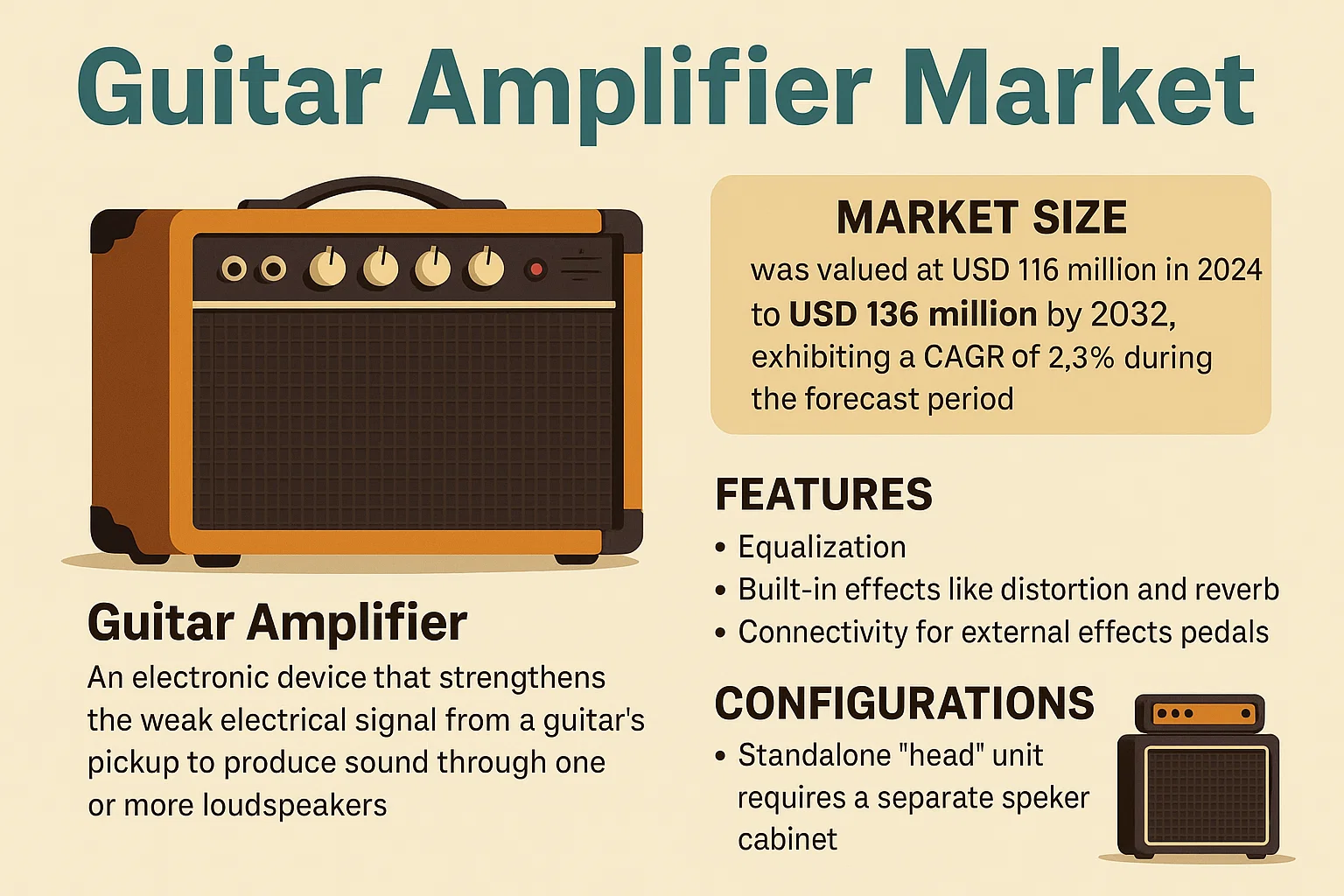
Global Guitar Amplifier Market size was valued at USD 116 million in 2024 to USD 136 million by 2032, exhibiting a CAGR of 2.3% during the forecast period.
A guitar amplifier is an electronic device that strengthens the weak electrical signal from a guitar’s pickup so that it can produce sound through one or more loudspeakers. These devices are fundamental for shaping a guitarist’s signature tone, offering capabilities such as equalization, built-in effects like distortion and reverb, and connectivity for external effects pedals. Amplifiers come in two primary configurations: standalone “head” units that require a separate speaker cabinet and “combo” amplifiers that integrate both the amplifier and speakers into a single cabinet.
The market is experiencing steady growth, primarily driven by a consistent global base of musicians and the enduring popularity of electric guitars. However, the market faces challenges from the increasing adoption of digital amp modeling software and hardware, which offer a wide range of tones in a compact form factor. Despite this, the demand for traditional amplifiers remains robust, particularly in the professional and enthusiast segments, where combo amplifiers dominate with over 75% market share. Key players such as Fender and Marshall Amplification continue to lead the market, collectively holding a significant portion of the global revenue.
MARKET DRIVERS
Rising Disposable Income and Music Education Expansion
The increasing disposable income globally, especially in emerging economies, allows more consumers to invest in musical instruments and equipment, including guitar amplifiers. Additionally, the expansion of music education programs in schools and universities is creating a new generation of musicians who need amplification equipment.
Growth of Live Music and Entertainment Industry
With the resurgence of live music events post-pandemic, there’s increased demand for amplification equipment both for performances and rehearsals. The entertainment industry’s growth directly correlates with sales of musical equipment, including amplifiers for both electric and acoustic guitars.
➤ Digital Integration and Multi-functional Devices
Modern guitar amplifiers increasingly incorporate digital technology, Bluetooth connectivity, and built-in effects that appeal to modern musicians. This convergence of traditional amplification with modern technology is driving adoption among both amateur and professional musicians.
Sustainability and Energy Efficiency
With growing environmental consciousness, manufacturers are developing more energy-efficient amplifiers using Class D amplification technology. These amplifiers generate less heat, last longer, and appeal to environmentally conscious consumers, driving market growth through sustainable innovation.
MARKET CHALLENGES
Intense Competition and Market Saturation
The guitar amplifier market faces significant competition from both established players and new entrants, particularly in the digital and modeling amplifier segments. This competition puts downward pressure on prices and profit margins, especially in mature markets like North America and Europe.
Other Challenges
Economic Uncertainty and Disposable Income Constraints
Economic uncertainties and inflation in key markets can reduce disposable income available for musical instrument purchases. This particularly affects the mid-to-high-end amplifier market where products are considered luxury items rather than necessities.
Used Market Competition
The robust used amplifier market offers quality products at lower prices, creating significant competition for new equipment manufacturers and retailers. This is particularly prominent in developed markets where vintage and used amplifiers maintain strong resale value.
MARKET RESTRAINTS
Digital Technology Disruption
The rise of digital amp simulators and modeling software presents a significant challenge to traditional amplifier sales. Many modern musicians, especially in home recording contexts, are opting for software solutions that emulate classic amplifier sounds at a fraction of the cost and space requirements.
Market Maturity in Developed Regions
In mature markets like North America and Europe, the amplifier market faces saturation as most serious musicians already own equipment. Growth in these regions is primarily limited to replacement purchases and upgrades rather than new customer acquisition.
MARKET OPPORTUNITIES
Emerging Markets Growth
Rapid economic development in Asia-Pacific countries, particularly China and India, is creating a new generation of musicians with disposable income to invest in quality amplification equipment. This represents the fastest growing market segment with the highest growth potential for the coming decade.
Hybrid and Multi-functional Products
The integration of traditional amplification with modern features like Bluetooth, USB connectivity, and built-in effects processors creates new product categories that appeal to both traditionalists and modern musicians. This convergence creates opportunities for innovation and market expansion.
Direct-to-Consumer Sales Channels
The growth of e-commerce and social media marketing allows manufacturers to reach customers directly, reducing distribution costs and improving margins. This is particularly effective for boutique and specialized amplifier manufacturers who can now reach global niche markets directly.
Guitar Amplifier Market Trends
Rising Demand for Compact and Portable Amplifiers
Manufacturers are increasingly focusing on compact and portable guitar amplifier designs to cater to musicians requiring mobility without compromising sound quality. The segment has grown significantly, with portable combos and head units gaining market share. This trend is driven by the increasing number of touring musicians, home studio enthusiasts, and musicians seeking versatile equipment that can adapt to various performance environments.
Other Trends
Integration of Digital Modeling and Multi-Effects Processors
The integration of digital modeling technology within guitar amplifiers continues to accelerate, allowing musicians to access multiple amplifier tones and effects within a single unit. This technology reduces the need for external pedals and processors while providing studio-quality sound in compact formats. Leading manufacturers are incorporating advanced DSP chips that emulate classic amplifier tones with high accuracy, attracting both professional musicians and hobbyists seeking versatile sound options.
Growing Demand for High-End Custom Tubes
The premium segment of the guitar amplifier market shows increasing demand for high-quality vacuum tubes in amplifier circuits, particularly among professional musicians and audiophiles. Premium tubes from manufacturers like JJ Electronic, Electro-Harmonix, and Tung-Sol are experiencing increased demand despite higher price points, as musicians seek superior sound quality and reliability. This trend extends to both combo amplifiers and separate head units, with many users willing to invest in premium components for better tone and longevity.
Market analysis indicates that the global guitar amplifier market reached $116 million in 2024 and is projected to grow at a 2.3% CAGR through 2032. North America remains the largest market, accounting for approximately 25% of global sales, followed by Europe and Asia-Pacific regions. The market demonstrates resilience despite economic fluctuations, as musicians continue to invest in quality amplification equipment across both commercial and residential applications.
COMPETITIVE LANDSCAPE
Key Industry Players
Leading Brands Drive Market Competition
The global guitar amplifier market is dominated by established audio equipment manufacturers with strong brand recognition. Fender Musical Instruments Corporation leads the market with its wide range of amplifier products across multiple price segments, followed closely by Marshall Amplification with its iconic rock-oriented amplifier designs. These two giants collectively hold significant market share, while smaller players like Orange and Vox maintain strong niche positions with their distinctive tonal characteristics and design philosophies.
Beyond the top-tier manufacturers, the competitive landscape includes several significant players specializing in different market segments. Peavey Electronics offers competitive pricing across both entry-level and professional amplifier lines, while Roland Corporation leverages its expertise in digital modeling technology through its BOSS brand. Yamaha combines musical instrument expertise with amplifier manufacturing, while companies like Laney and PRS Guitars focus on specific regional markets or premium product categories. The market also includes amplifier-only manufacturers like Mesa/Boogie and Hughes & Kettner, which focus exclusively on high-end and boutique amplifier production.
List of Key Guitar Amplifier Companies
- Fender Musical Instruments Corporation
- Marshall Amplification
- Orange Music Electronic Company Ltd.
- Vox Amplification (Korg)
- Peavey Electronics
- Roland Corporation (BOSS)
- Yamaha Corporation
- Laney Amplification
- PRS Guitars
- Fishman
- Mesa/Boogie
- Hughes & Kettner
- Blackstar Amplification
- Music Tribe (Behringer)
Segment Analysis:
| Segment Category | Sub-Segments | Key Insights |
| By Type |
|
Tube Amplifiers remain highly valued among professional musicians and audiophiles for their warm, organic tone and natural compression despite higher costs and maintenance requirements, while modeling amplifiers gain traction for their versatility and convenience. |
| By Application |
|
Live Performances drive demand for high-wattage, reliable amplifiers with robust feature sets, while home practice applications fuel demand for compact, low-wattage amplifiers with headphone compatibility and built-in effects. |
| By End User |
|
Professional Musicians typically invest in higher-end, road-worthy amplifier systems and often maintain collections for different tonal requirements, while hobbyists and enthusiasts show strong interest in affordable, versatile amplifiers with modern features. |
| By Distribution Channel |
|
Online Marketplaces have transformed amplifier sales through detailed product information, user reviews, and global reach, while specialty retailers maintain relevance through hands-on demos, trade-in programs, and expert advice particularly for high-end and vintage equipment. |
| By Technology |
|
Digital Modeling Technology continues to advance with improved amp modeling, effects processing, and integration capabilities, while traditional tube technology maintains strong appeal for its organic response and dynamic range, creating a diverse technological landscape. |
Regional Analysis: Guitar Amplifier Market
North America
North American consumers demonstrate the highest willingness to pay for premium amplifier features, with strong demand for built-in effects, wireless connectivity, and vintage reissue models. This drives global innovation as manufacturers target the North American market’s sophisticated demand.
North American players lead in adopting amplifier modeling technologies and digital integration, with strong demand for amps that interface with computers and mobile devices. This creates a ecosystem where amplifiers serve as central hubs for both digital audio workstations and live performance setups.
North America’s strong music education infrastructure and the influence of YouTube educators create a knowledgeable consumer base that researches extensively before purchasing. This has shifted marketing strategies toward transparency and technical education over traditional advertising.
Environmental considerations increasingly influence North American buyers, with many willing to pay premium for energy-efficient Class D amplifiers and companies offering carbon-neutral shipping options. This creates competitive advantage for eco-conscious brands.
Europe
European guitar amplifier market demonstrates strong regional variations, with Northern countries favoring high-end boutique amplifiers while Southern and Eastern markets show price sensitivity. The EU’s regulatory framework ensures high environmental and safety standards, creating a market for compliant, durable products. Cross-border trade remains strong with Germany acting as a central hub for both production and distribution of premium amplifier brands.
Asia-Pacific
Asia-Pacific represents the fastest growing guitar amplifier market, driven by rising disposable income and music education initiatives. While Japan and South Korea maintain sophisticated high-end markets, developing nations show strong growth in entry-level and mid-range amplifiers. The region’s manufacturing capabilities make it both a major production hub and consumption market, with local brands gaining significant market share through competitive pricing and digital marketing strategies.
South America
South America’s amplifier market remains heavily influenced by economic fluctuations, with Brazil and Argentina representing the largest markets. Currency instability often leads to preference for mid-range amplifiers with strong resale value. The region shows growing interest in hybrid amplifiers that combine analog warmth with digital flexibility, catering to both traditional and home studio musicians.
Middle East & Africa
Middle Eastern markets show growth in high-end amplifier imports, particularly in oil-rich nations where musicians invest heavily in equipment. African markets remain largely untapped with significant potential for growth, especially in urban centers. Both regions show increasing interest in compact and portable amplifier solutions suitable for smaller living spaces and mobile music instructors.
Report Scope
This report provides a comprehensive analysis of the global Guitar Amplifier market, covering the forecast period 2025-2032. It offers detailed insights into market dynamics, technological advancements, competitive landscape, and key trends shaping the industry.
Key focus areas include:
- Market Overview: The report begins with an overview outlining the current market scenario, key growth indicators, and industry transformation drivers. It discusses macroeconomic factors, demand-supply balance, regulatory landscape, and the strategic role of guitar amplifiers across various applications.
- Market Size & Forecast: Historical data and future projections for revenue, unit shipments, and market value across major regions and segments.
- Segmentation Analysis: Detailed breakdown by product type, technology, application, and end-user industry to identify high-growth segments and investment opportunities.
- Regional Insights: Insights into market performance across North America, Europe, Asia-Pacific, Latin America, and Middle East & Africa, including country-level analysis where relevant.
- Competitive Landscape: Profiles of leading market participants, including their product offerings, R&D focus, manufacturing capacity, pricing strategies, and recent developments such as mergers, acquisitions, and partnerships.
- Technology Trends & Innovation: Assessment of emerging technologies, integration of digital signal processing, amplifier design trends, and evolving industry standards.
- Market Drivers & Restraints: Evaluation of factors driving market growth along with challenges, supply chain constraints, regulatory issues, and market-entry barriers.
- Stakeholder Insights: Insights for component suppliers, OEMs, system integrators, investors, and policymakers regarding the evolving ecosystem and strategic opportunities.
Primary and secondary research methods are employed, including interviews with industry experts, data from verified sources, and real-time market intelligence to ensure the accuracy and reliability of the insights presented.
FREQUENTLY ASKED QUESTIONS:
What is the current market size of the Guitar Amplifier Market?
-> Guitar Amplifier Market size was valued at USD 116 million in 2024 to USD 136 million by 2032, exhibiting a CAGR of 2.3% during the forecast period.
Which are the key players in the Guitar Amplifier Market?
-> Key players include Fender, Marshall, Orange, Vox, Peavey, Roland, Yamaha, and other leading manufacturers.
Which region has the largest market share?
-> North America currently holds the largest market share, followed by Europe and Asia-Pacific.
What are the key product types in the Guitar Amplifier Market?
-> The market is segmented into Combo Amplifiers and Head Amplifiers, with Combo Amplifiers holding the majority market share.
What are the primary applications of Guitar Amplifiers?
-> Guitar Amplifiers are used across commercial applications (such as concerts, studios, and live performances) and household applications (home studios and personal use).

Get Sample Report PDF for Exclusive Insights
Report Sample Includes
- Table of Contents
- List of Tables & Figures
- Charts, Research Methodology, and more...