Green Semiconductor Materials Market Insights
Global green semiconductor materials market size was valued at USD 2.35 billion in 2025. The market is projected to grow from USD 2.45 billion in 2026 to USD 5.12 billion by 2034, exhibiting a CAGR of 8.6% during the forecast period.
Green semiconductor materials encompass eco‑friendly substrates and compounds such as silicon carbide (SiC), gallium nitride (GaN), indium phosphide (InP) and emerging perovskite alloys designed to reduce energy consumption and carbon footprint in power electronics and optoelectronic devices.
The market is experiencing rapid growth due to several factors, including increased investment in sustainable electronics, rising demand for high‑efficiency power converters, and supportive regulatory policies promoting low‑carbon technologies. Furthermore, advancements in manufacturing processes such as epitaxial growth and wafer‑scale integration are accelerating adoption across automotive, renewable energy and telecommunications sectors.
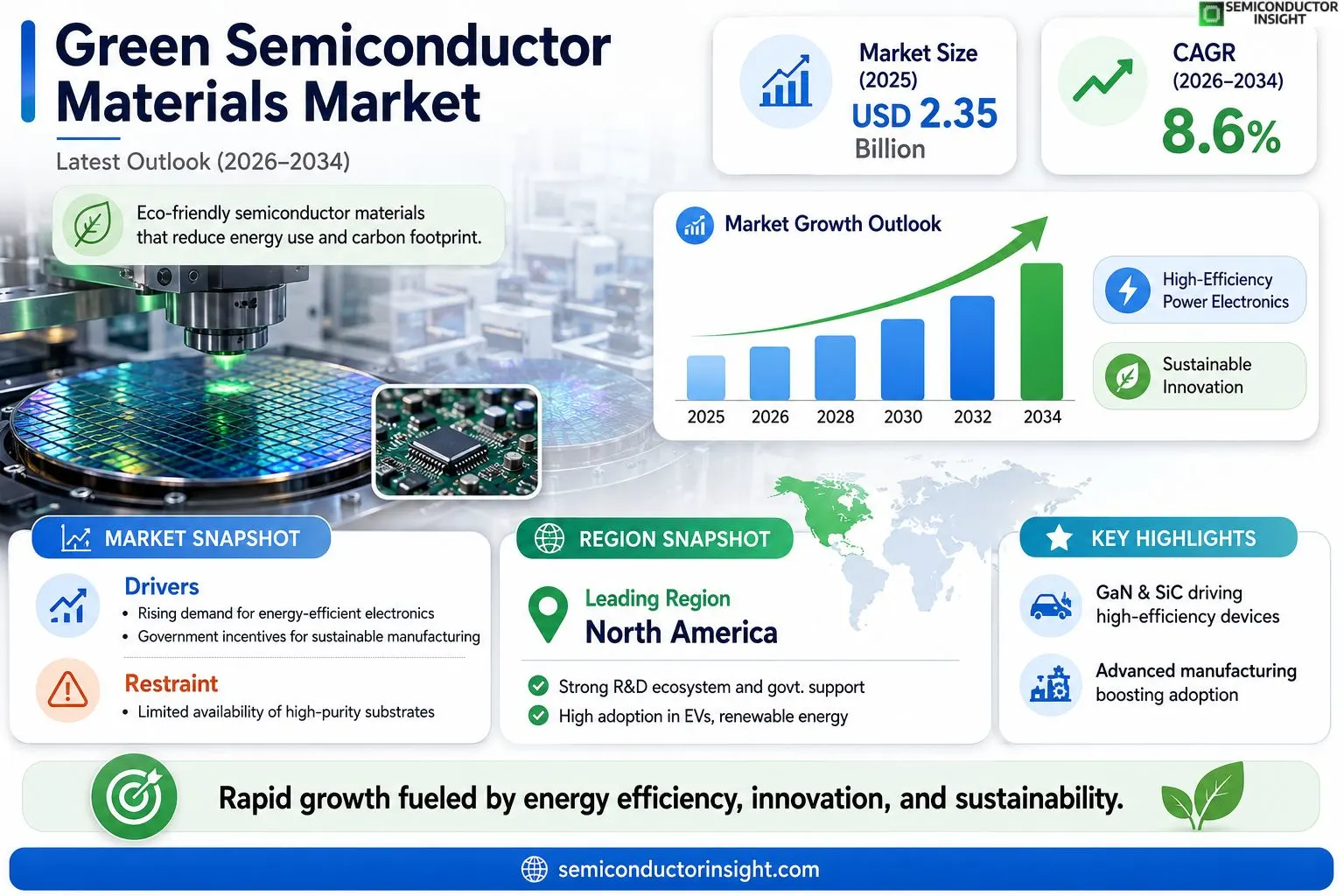
MARKET DRIVERS
Rising Demand for Energy‑Efficient Electronics
Green Semiconductor Materials Market is expanding rapidly as device manufacturers prioritize low‑power consumption to meet stricter energy‑efficiency standards. Consumers and enterprise buyers alike are seeking products that reduce operating costs, driving OEMs to adopt silicon‑based and emerging compound semiconductors with greener footprints.
Government Incentives for Sustainable Manufacturing
National policies in Europe, North America, and parts of Asia provide tax credits and subsidies for facilities that integrate eco‑friendly materials. These incentives lower capital barriers, encouraging new entrants to invest in clean‑room technologies that support Green Semiconductor Materials Market.
➤ “Adoption of low‑toxicity substrates is projected to increase 12% annually through 2030, outpacing traditional silicon growth.”
Furthermore, corporate sustainability pledges are compelling large tech firms to source greener components, creating a cascade of demand that reinforces market growth across the supply chain.
MARKET CHALLENGES
High Production Costs
Advanced fabrication techniques for green semiconductors, such as atomic‑layer deposition of low‑carbon materials, require significant capital investment. The elevated cost structure limits price competitiveness against conventional silicon, especially for cost‑sensitive consumer electronics.
Other Challenges
Material Supply Constraints
The scarcity of high‑purity gallium and indium, essential for many green compound semiconductors, creates bottlenecks. Fluctuating commodity prices add volatility, discouraging some manufacturers from scaling production.
MARKET RESTRAINTS
Limited Availability of High‑Purity Substrates
Supply chain disruptions have reduced the steady flow of ultrapure substrates, which are critical for achieving the performance targets of green devices. This limitation constrains volume growth and raises lead times for new product introductions.Additionally, the lack of standardized testing protocols for environmental performance creates uncertainty for buyers, slowing adoption across conservative industries.Regulatory variations between regions also pose compliance challenges, as differing definitions of “green” materials complicate cross‑border sourcing strategies.
MARKET OPPORTUNITIES
Emerging Applications in Automotive Power Electronics
Electric vehicles and autonomous driving systems demand high‑efficiency power modules. Green semiconductor materials, such as silicon‑carbide (SiC) and gallium‑nitride (GaN), offer superior thermal performance, presenting a sizable growth avenue for Green Semiconductor Materials Market.Renewable energy integration, particularly in smart‑grid inverters, also benefits from low‑loss, high‑frequency devices. Manufacturers that can deliver reliable, environmentally friendly components are positioned to capture a substantial share of this expanding niche.Finally, collaborations between semiconductor firms and research institutions are accelerating the development of recyclable semiconductor architectures, opening new revenue streams linked to circular‑economy initiatives.
Green Semiconductor Materials Market Trends
Sustainable Power Conversion Expansion
The shift toward low‑carbon power electronics is driving the most visible trend in the sector. Eco‑friendly substrates such as silicon carbide (SiC) and gallium nitride (GaN) are increasingly selected for high‑efficiency converters because they reduce ON‑resistance and enable higher switching frequencies. This performance edge aligns with corporate net‑zero pledges and government incentives that reward devices with lower energy loss. As a result, component designers are prioritizing green semiconductor solutions in data‑center power supplies, renewable‑energy inverters, and grid‑support hardware.
Other Trends
Automotive Electrification Impact
Electrified vehicle platforms rely heavily on power‑train modules that can operate at elevated temperatures while maintaining small form factors. The integration of SiC in on‑board chargers and inverters shortens charging times and improves range per kilowatt‑hour. Simultaneously, GaN devices are entering traction‑control systems, where fast switching reduces electromagnetic interference and improves safety. These applications reinforce the automotive sector as a catalyst for broader adoption of green semiconductor technologies.
Advanced Manufacturing and Integration
Process improvements are accelerating the transition from laboratory prototypes to volume production. Epitaxial growth techniques now achieve defect densities below 10⁴ cm⁻², which enhances yield for large‑diameter wafers. Wafer‑scale integration and heterogeneous bonding enable multi‑material chips that combine the high‑voltage capability of SiC with the low‑loss switching of GaN on a single platform. These manufacturing advances reduce cost per wafer and shorten time‑to‑market, encouraging suppliers to expand green semiconductor portfolios.Overall, Green Semiconductor Materials Market is reshaping power‑electronics design by offering materials that balance efficiency, reliability, and environmental compliance. The convergence of policy support, automotive demand, and manufacturing scalability creates a virtuous cycle that is expected to sustain growth throughout the next decade.
COMPETITIVE LANDSCAPEKey Industry Players
Strategic Positioning and Market Dynamics Shaping the Global Green Semiconductor Materials Industry
green semiconductor materials market is characterized by the presence of several well-established multinational corporations alongside a growing cohort of specialized material innovators. Infineon Technologies AG maintains a prominent position in the silicon carbide (SiC) and gallium nitride (GaN) segments, leveraging its vertically integrated manufacturing capabilities and extensive intellectual property portfolio to serve automotive and industrial power electronics customers. Wolfspeed, Inc. (formerly Cree) is recognized as one of the largest dedicated SiC wafer and device manufacturers globally, with significant capacity expansions underway to meet surging demand from electric vehicle and renewable energy applications. STMicroelectronics N.V. has similarly strengthened its foothold through strategic partnerships with automotive OEMs, while ON Semiconductor (onsemi) continues to scale its SiC module production for high-efficiency power conversion systems. ROHM Co., Ltd. and Mitsubishi Electric Corporation represent key Japanese contributors, each offering differentiated SiC and GaN product lines tailored for industrial inverters and telecommunications infrastructure. The competitive intensity in this market is further amplified by increasing R&D investments directed toward epitaxial growth techniques, wafer-scale integration, and next-generation perovskite-based compound materials that promise superior energy efficiency and reduced carbon footprint across optoelectronic and power device applications.Beyond the dominant Tier-1 players, the green semiconductor materials landscape accommodates a range of niche but strategically significant participants. II-VI Incorporated (now Coherent Corp.) has emerged as a notable supplier of compound semiconductor substrates including indium phosphide (InP) and silicon carbide, primarily targeting photonics and data communications markets. MACOM Technology Solutions Holdings, Inc. and Sumitomo Electric Industries, Ltd. contribute specialized GaN-on-silicon and InP wafer technologies respectively, catering to high-frequency telecommunications and 5G infrastructure deployments. Qorvo, Inc. and Skyworks Solutions, Inc. compete actively in the GaN RF semiconductor space, while companies such as Soitec S.A. are advancing engineered substrate technologies including silicon-on-insulator (SOI) platforms with sustainability-oriented design principles. Emerging players including Transphorm, Inc. and GaN Systems (acquired by Infineon) are pushing the boundaries of high-voltage GaN power device commercialization, reinforcing the market’s trajectory toward broader adoption across automotive, renewable energy, and industrial sectors. The combined effect of regulatory support for low-carbon technologies and accelerating electrification trends continues to intensify competition, incentivizing both incumbents and new entrants to invest heavily in sustainable semiconductor material innovation.
List of Key Green Semiconductor Materials Companies Profiled
- Infineon Technologies AG
- Wolfspeed, Inc.
- STMicroelectronics N.V.
- ON Semiconductor (onsemi)
- ROHM Co., Ltd.
- Mitsubishi Electric Corporation
- Coherent Corp. (formerly II-VI Incorporated)
- MACOM Technology Solutions Holdings, Inc.
- Sumitomo Electric Industries, Ltd.
- Qorvo, Inc.
- Skyworks Solutions, Inc.
- Soitec S.A.
- Transphorm, Inc.
- GaN Systems (acquired by Infineon Technologies)
- Renesas Electronics Corporation
Segment Analysis:
| Segment Category | Sub-Segments | Key Insights |
| By Type |
|
Gallium Nitride (GaN) is regarded as the leading material type because of several qualitative strengths:
|
| By Application |
|
Power Electronics dominates the application landscape, driven by the need to improve conversion efficiency and reduce thermal losses:
|
| By End User |
|
Automotive emerges as the leading end‑user segment, reflecting the sector’s aggressive push toward electrification and lightweight power solutions:
|
| By Material Innovation |
|
Wide‑Bandgap Materials command attention because they harmonize high voltage handling with reduced conduction losses:
|
| By Sustainability Drivers |
|
Energy‑Efficiency Objectives act as the primary sustainability driver, shaping product development and market adoption:
|
Regional Analysis: North America
United States
North America benefits from a well-established and diversified supply chain for green semiconductor materials, though recent geopolitical shifts are prompting diversification efforts. Focus is on securing critical raw materials and building resilient logistics networks to support the growing demand.
Innovation in Green Semiconductor Materials Market within the US is centered around developing materials that enhance energy efficiency, reduce waste, and enable new functionalities in electronic devices. Research is heavily invested in areas like flexible electronics and advanced packaging solutions.
Government regulations promoting sustainability and energy efficiency significantly influence Green Semiconductor Materials Market in North America. Compliance with environmental standards and incentives for eco-friendly technologies are key considerations for businesses operating in the region.
Significant private and public investments are flowing into Green Semiconductor Materials Market in the US, fueling research, development, and manufacturing capacity. Venture capital funding for startups in this sector is particularly strong.
Europe
Europe is making substantial strides in Green Semiconductor Materials Market, driven by stringent environmental policies and a strong commitment to circular economy principles. The region is focusing on developing and adopting materials that minimize environmental impact throughout the product lifecycle. Germany, France, and the Netherlands are key players, with significant investments in research and development. Business strategies in Europe emphasize sustainability, resource efficiency, and adherence to the European Green Deal. The market is characterized by a blend of established chemical companies and innovative startups.
Asia-Pacific
The Asia-Pacific region is rapidly emerging as a significant hub for Green Semiconductor Materials Market. Driven by the growth of the electronics manufacturing industry in countries like China, Japan, and South Korea, the demand for sustainable materials is soaring. Government support for green technologies and a focus on domestic innovation are further propelling market expansion. The region is witnessing increasing investment in manufacturing facilities and R&D centers. Business strategies emphasize cost competitiveness, technological innovation, and close collaboration with downstream industries.
South America
Green Semiconductor Materials Market in South America is still in its nascent stages but holds considerable potential. Growing awareness of environmental issues and increasing investments in the technology sector are driving demand for eco-friendly materials. Brazil and Argentina are the primary markets, with opportunities in renewable energy and electric vehicle sectors. Business strategies focus on leveraging regional resources and partnerships to address specific market needs.
Middle East & Africa
Green Semiconductor Materials Market in the Middle East and Africa is characterized by emerging opportunities linked to renewable energy projects and sustainable infrastructure development. Governments in the region are prioritizing green initiatives, leading to increased demand for eco-friendly materials. While the market size is currently smaller compared to other regions, it is expected to witness significant growth in the coming years. Business strategies emphasize strategic partnerships and adapting to local market conditions.
Report Scope
This market research report provides a comprehensive analysis of the Green Semiconductor Materials Market , covering the forecast period 2026–2034. It offers detailed insights into market dynamics, technological advancements, competitive landscape, and key trends shaping the industry.
Key focus areas of the report include:
- Market Overview: The report begins with an overview outlining its current market scenario, key growth indicators, and industry transformation drivers. It discusses macroeconomic factors, demand–supply balance, regulatory landscape, and the strategic role of semiconductors in powering advancements across industries such as automotive, telecommunications, consumer electronics, and industrial automation.
- Market Size & Forecast: Historical data and future projections for revenue, unit shipments, and market value across major regions and segments.
- Segmentation Analysis: Detailed breakdown by product type, technology, application, and end-user industry to identify high-growth segments and investment opportunities.
- Regional Insights: Insights into market performance across North America, Europe, Asia-Pacific, Latin America, and the Middle East & Africa, including country-level analysis where relevant.
- Competitive Landscape: Profiles of leading market participants, including their product offerings, R&D focus, manufacturing capacity, pricing strategies, and recent developments such as mergers, acquisitions, and partnerships.
- Technology Trends & Innovation: Assessment of emerging technologies, integration of AI/IoT, semiconductor design trends, fabrication techniques, and evolving industry standards.
- Market Drivers & Restraints: Evaluation of factors driving market growth along with challenges, supply chain constraints, regulatory issues, and market-entry barriers.
- Stakeholder Insights: Insights for component suppliers, OEMs, system integrators, investors, and policymakers regarding the evolving ecosystem and strategic opportunities.
Primary and secondary research methods are employed, including interviews with industry experts, data from verified sources, and real-time market intelligence to ensure the accuracy and reliability of the insights presented.
FREQUENTLY ASKED QUESTIONS:
What is the current market size of Green Semiconductor Materials Market?
-> Green Semiconductor Materials Market was valued at USD 2.35 billion in 2025 and is expected to reach USD 5.12 billion by 2034.
Which key companies operate in Green Semiconductor Materials Market?
-> Key players include major semiconductor manufacturers and material suppliers; specific company names are not detailed in the provided data.
What are the key growth drivers?
-> Key growth drivers include increased investment in sustainable electronics, rising demand for high‑efficiency power converters, and supportive regulatory policies promoting low‑carbon technologies.
Which region dominates the market?
-> Region dominance is not specified in the provided content.
What are the emerging trends?
-> Emerging trends include the development of eco‑friendly substrates such as silicon carbide (SiC), gallium nitride (GaN), indium phosphide (InP), and emerging perovskite alloys designed to reduce energy consumption and carbon footprint.

Get Sample Report PDF for Exclusive Insights
Report Sample Includes
- Table of Contents
- List of Tables & Figures
- Charts, Research Methodology, and more...
 Download Sample Report PDF