Key Statistics
Key Takeaways
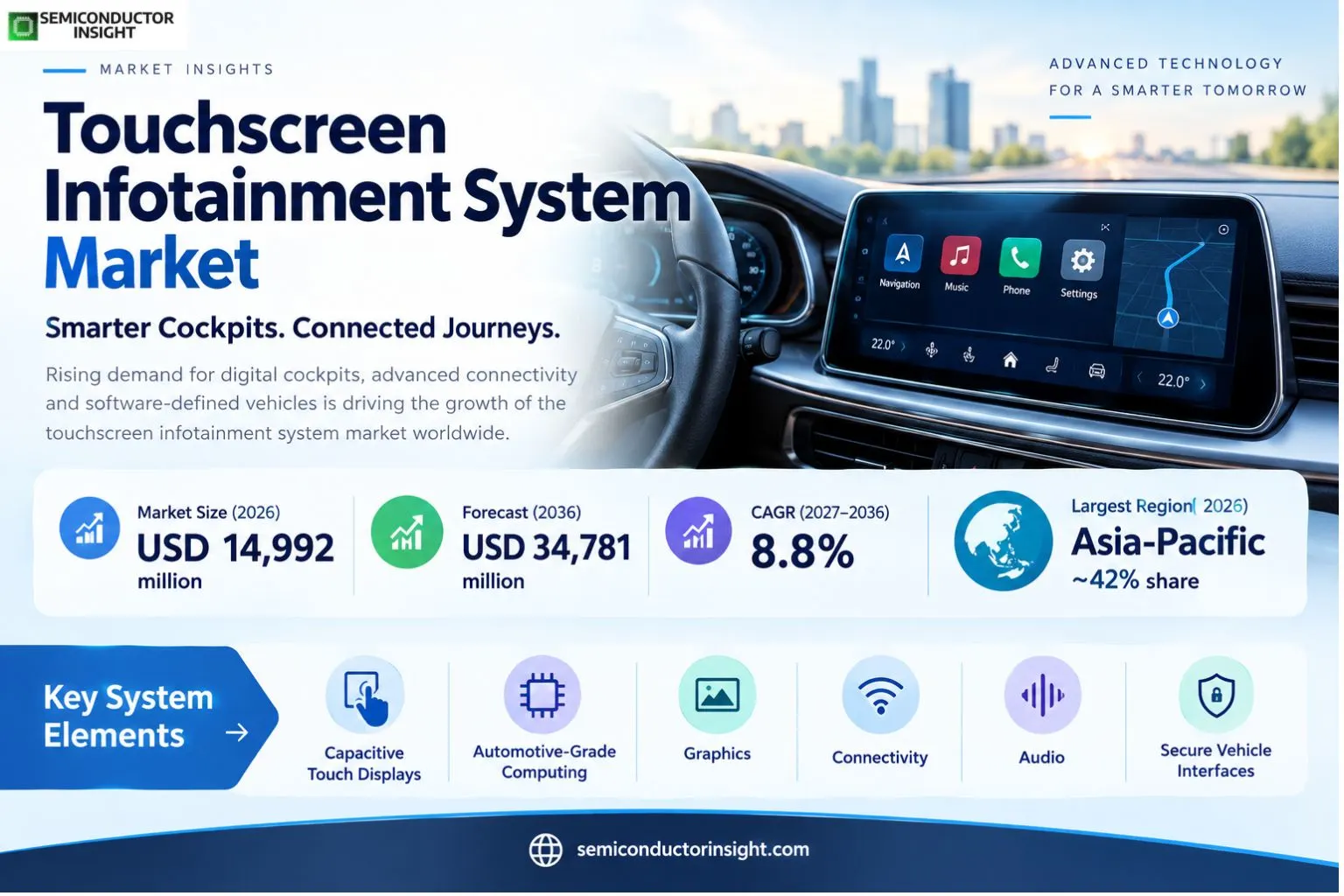
- Market scale: The touchscreen infotainment system market reached USD 14,992 million in 2026 and is projected to reach USD 34,781 million in 2036 at 8.8% CAGR over the 2027–2036 forecast period. Demand reflects software-defined vehicle platforms, electric-vehicle cockpits, smartphone integration and high-resolution screens.
- Large Size leadership: This type accounts for an estimated ~47% of 2026 revenue because its core role is above 10-inch and panoramic systems integrating navigation and cockpit controls; pricing, technical qualification and end-customer integration shape its commercial share.
- Automotive demand: The leading application represents an estimated ~78% of 2026 revenue, with procurement driven by passenger and commercial vehicle cockpit infotainment and distinct integration requirements relative to adjacent end uses.
- Asia-Pacific position: The largest region holds an estimated ~42% of 2026 revenue and an estimated ~9.9% regional CAGR, supported by vehicle assembly scale and domestic cockpit-electronics supply; regional shares represent market revenue rather than production units.
- Competitive priorities: Growth depends on capacitive touch displays, automotive-grade computing, graphics, connectivity, audio and secure vehicle interfaces, while driver-distraction rules, semiconductor qualification, cybersecurity and long vehicle development cycles constrain deployment economics and vendor selection.
Touchscreen Infotainment System Market Overview
Touchscreen infotainment system market was valued at USD 14,992 million in 2026 and is projected to reach USD 34,781 million by 2036, expanding at a CAGR of 8.8% during 2027–2036. Asia-Pacific held the largest 2026 regional revenue position at an estimated ~42%, reflecting vehicle assembly scale and domestic cockpit-electronics supply. Purchasers increasingly evaluate capacitive touch displays, automotive-grade computing, graphics, connectivity, audio and secure vehicle interfaces rather than relying only on unit price or headline performance.
The commercial boundary covers integrated touchscreen infotainment head units and cockpit displays for vehicles and selected transport applications; excludes the full vehicle price, unrelated instrument clusters and software subscriptions sold separately. This distinction separates integrated products and directly attributable packaging or equipment value from adjacent service, software and end-device revenue; in touchscreen infotainment system purchases linked to market-wide demand, that requirement shapes technical qualification and supplier selection. A customer normally purchases the system only after technical evaluation and acceptance testing, so revenue timing depends on qualification milestones, supplier capacity and the cadence of deployment programs; in touchscreen infotainment system purchases linked to market-wide demand, that requirement shapes technical qualification and supplier selection. The 2026 mix is therefore shaped by both product capability and the readiness of customers to operate it; in touchscreen infotainment system purchases linked to market-wide demand, that requirement shapes technical qualification and supplier selection. The baseline value of USD 14,992 million, the 2036 projection of USD 34,781 million, and the 8.8% annual growth trajectory provide the monetary context for product and application decisions.
Technically, the key system elements are capacitive touch displays, automotive-grade computing, graphics, connectivity, audio and secure vehicle interfaces. Engineering teams must balance performance against manufacturability, field reliability, cybersecurity or safety where relevant, and maintenance over several years; in touchscreen infotainment system purchases linked to market-wide demand, that requirement shapes technical qualification and supplier selection. Procurement specifications differ between high-volume standardized platforms and specialized configurations; in touchscreen infotainment system purchases linked to market-wide demand, that requirement shapes technical qualification and supplier selection. That distinction helps explain why a lower-volume segment may command a higher average selling price without dominating the overall revenue share; in touchscreen infotainment system purchases linked to market-wide demand, that requirement shapes technical qualification and supplier selection.
Demand is being shaped by software-defined vehicle platforms, electric-vehicle cockpits, smartphone integration and high-resolution screens. In Asia-Pacific, Qualcomm announced a Desay SV intelligent cabin collaboration in January 2025 and a Leapmotor cockpit program, illustrating Chinese OEM demand for integrated display and compute platforms. The available operating evidence demonstrates a practical use case and helps explain supplier investment, but the value of installed assets is different from annual revenue; in touchscreen infotainment system purchases linked to market-wide demand, that requirement shapes technical qualification and supplier selection. The most durable opportunities are tied to repeat orders, validated performance and a customer operating model that can scale beyond a pilot installation; in touchscreen infotainment system purchases linked to market-wide demand, that requirement shapes technical qualification and supplier selection. Euro NCAP’s 12 October 2026 results reported 90% for Audi Q7 driving controls, 20% for XPENG X9 and 100% for BMW iX3, illustrating the safety benefit of direct controls for essential tasks.
Competitive conditions depend on automotive electronics clusters in Japan, South Korea, China, Europe and North America with regional vehicle OEM qualification. Suppliers with access to production capacity, qualified components and local engineering support can shorten program lead times, while buyers remain sensitive to concentration of critical upstream processes; in touchscreen infotainment system purchases linked to market-wide demand, that requirement shapes technical qualification and supplier selection. A multi-year development program can generate relatively little revenue before qualification and then accelerate sharply when customer volume commitments begin, making capacity timing and order visibility important differentiators; in touchscreen infotainment system purchases linked to market-wide demand, that requirement shapes technical qualification and supplier selection. BMW’s January 2025 Panoramic iDrive demonstration supported as many as 6 configurable widgets and a separate 3D head-up display, showing the shift from one center screen to coordinated visual surfaces.
The main constraints are driver-distraction rules, semiconductor qualification, cybersecurity and long vehicle development cycles. These forces do not affect every end use equally: the most demanding installations face additional validation and integration work, while cost-sensitive projects may delay purchases or choose simpler architectures; in touchscreen infotainment system purchases linked to market-wide demand, that requirement shapes technical qualification and supplier selection. Across the forecast period, suppliers that reduce operating friction and provide clear lifecycle support should capture a larger share of incremental demand than suppliers relying on a single headline specification; in touchscreen infotainment system purchases linked to market-wide demand, that requirement shapes technical qualification and supplier selection. Apple launched CarPlay Ultra on 15 May 2025, initially supporting iPhone 12 or newer with iOS 18.5 and compatible Aston Martin vehicles, an example of cross-screen software integration.
Segment Analysis: By Type
By type, the touchscreen infotainment system market includes Small Size, Mid-size, Large Size. Large Size leads with an estimated ~47% of 2026 revenue, while the type mix reflects differences in capacitive touch displays, automotive-grade computing, graphics, connectivity, audio and secure vehicle interfaces. Buyers weigh production maturity, integration burden and product life against performance, so revenue share is not a direct proxy for shipments or installed base; in touchscreen infotainment system purchases linked to technology commercialization, that requirement shapes technical qualification and supplier selection.
| Type | Function | Market position |
|---|---|---|
| Small Size | Small Size covers below 7-inch displays used in entry-level and compact transport applications. Customers use this architecture where the required technical envelope, integration budget and field operating conditions justify its design; in touchscreen infotainment system purchases linked to Small Size products, that requirement shapes technical qualification and supplier selection. Procurement typically includes qualification of interfaces, reliability and supplier support, rather than merely a comparison of advertised throughput or dimensions; in touchscreen infotainment system purchases linked to Small Size products, that requirement shapes technical qualification and supplier selection. The resulting supplier mix is influenced by component availability and the maturity of the production process; in touchscreen infotainment system purchases linked to Small Size products, that requirement shapes technical qualification and supplier selection. | Estimated ~19% share in 2026 and ~6.6% CAGR. Small Size competes through below 7-inch displays used in entry-level and compact transport applications. Its revenue position depends on system price, delivery scale, certification and whether customers can reuse existing integration work; in touchscreen infotainment system purchases linked to Small Size products, that requirement shapes technical qualification and supplier selection. Across 2027–2036, changes in the technology mix could alter the value captured per installed system even where physical unit volumes grow at a different rate; in touchscreen infotainment system purchases linked to Small Size products, that requirement shapes technical qualification and supplier selection. |
| Mid-size | Mid-size covers 7 to 10-inch head units balancing usability, cost and dashboard space. Customers use this architecture where the required technical envelope, integration budget and field operating conditions justify its design; in touchscreen infotainment system purchases linked to Mid-size products, that requirement shapes technical qualification and supplier selection. Procurement typically includes qualification of interfaces, reliability and supplier support, rather than merely a comparison of advertised throughput or dimensions; in touchscreen infotainment system purchases linked to Mid-size products, that requirement shapes technical qualification and supplier selection. The resulting supplier mix is influenced by component availability and the maturity of the production process; in touchscreen infotainment system purchases linked to Mid-size products, that requirement shapes technical qualification and supplier selection. | Estimated ~34% share in 2026 and ~8.9% CAGR. Mid-size competes through 7 to 10-inch head units balancing usability, cost and dashboard space. Its revenue position depends on system price, delivery scale, certification and whether customers can reuse existing integration work; in touchscreen infotainment system purchases linked to Mid-size products, that requirement shapes technical qualification and supplier selection. Across 2027–2036, changes in the technology mix could alter the value captured per installed system even where physical unit volumes grow at a different rate; in touchscreen infotainment system purchases linked to Mid-size products, that requirement shapes technical qualification and supplier selection. |
| Large Size | Large Size covers above 10-inch and panoramic systems integrating navigation and cockpit controls. Customers use this architecture where the required technical envelope, integration budget and field operating conditions justify its design; in touchscreen infotainment system purchases linked to Large Size products, that requirement shapes technical qualification and supplier selection. Procurement typically includes qualification of interfaces, reliability and supplier support, rather than merely a comparison of advertised throughput or dimensions; in touchscreen infotainment system purchases linked to Large Size products, that requirement shapes technical qualification and supplier selection. The resulting supplier mix is influenced by component availability and the maturity of the production process; in touchscreen infotainment system purchases linked to Large Size products, that requirement shapes technical qualification and supplier selection. | Estimated ~47% share in 2026 and ~9.5% CAGR. Large Size competes through above 10-inch and panoramic systems integrating navigation and cockpit controls. Its revenue position depends on system price, delivery scale, certification and whether customers can reuse existing integration work; in touchscreen infotainment system purchases linked to Large Size products, that requirement shapes technical qualification and supplier selection. Across 2027–2036, changes in the technology mix could alter the value captured per installed system even where physical unit volumes grow at a different rate; in touchscreen infotainment system purchases linked to Large Size products, that requirement shapes technical qualification and supplier selection. |
Technology and specification boundaries
The distinction between Small Size and Large Size is commercially material because the former is associated with below 7-inch displays used in entry-level and compact transport applications, while the latter emphasizes above 10-inch and panoramic systems integrating navigation and cockpit controls. Buyers therefore evaluate different qualification pathways, support obligations and lifecycle economics; in touchscreen infotainment system purchases linked to technology commercialization, that requirement shapes technical qualification and supplier selection. The two configurations cannot be priced as interchangeable products, even when they share components or engineering suppliers; in touchscreen infotainment system purchases linked to technology commercialization, that requirement shapes technical qualification and supplier selection. Display classes are differentiated at 7-inch and 10-inch thresholds, while 2026 supplier offerings increasingly combine large screens with voice input and tactile controls for driving safety.
The 2026 type allocation assigns ~19% to Small Size and ~47% to Large Size. In practice, procurement teams evaluate expected performance over the complete installed life, including qualification cost and spare capacity; in touchscreen infotainment system purchases linked to technology commercialization, that requirement shapes technical qualification and supplier selection. These decisions favor suppliers that can demonstrate repeatable yields and meet end-user requirements in more than one product generation; in touchscreen infotainment system purchases linked to technology commercialization, that requirement shapes technical qualification and supplier selection.
Segment Analysis: By Application
By application, touchscreen infotainment system demand spans Automotive, Electronics, Aerospace, Marine, Others. Automotive is the largest end use at an estimated ~78% of 2026 revenue, with the application mix reflecting passenger and commercial vehicle cockpit infotainment. Customer requirements vary substantially, so a supplier qualified for one market cannot assume equivalent acceptance in another without further validation and commercial support; in touchscreen infotainment system purchases linked to technology commercialization, that requirement shapes technical qualification and supplier selection.
| Application | Demand characteristics |
|---|---|
| Automotive | Estimated ~78% of 2026 revenue, with ~9.0% CAGR. Automotive demand centers on passenger and commercial vehicle cockpit infotainment. Buyers usually require documented performance under the relevant operating conditions and dependable post-sale technical support; in touchscreen infotainment system purchases linked to Automotive applications, that requirement shapes technical qualification and supplier selection. Orders are influenced by the customer’s deployment cycle, product qualification and installed equipment replacement, which can produce different growth patterns from other application segments; in touchscreen infotainment system purchases linked to Automotive applications, that requirement shapes technical qualification and supplier selection. |
| Electronics | Estimated ~8% of 2026 revenue, with ~7.7% CAGR. Electronics demand centers on specialized interactive equipment and connected displays. Buyers usually require documented performance under the relevant operating conditions and dependable post-sale technical support; in touchscreen infotainment system purchases linked to Electronics applications, that requirement shapes technical qualification and supplier selection. Orders are influenced by the customer’s deployment cycle, product qualification and installed equipment replacement, which can produce different growth patterns from other application segments; in touchscreen infotainment system purchases linked to Electronics applications, that requirement shapes technical qualification and supplier selection. |
| Aerospace | Estimated ~5% of 2026 revenue, with ~9.6% CAGR. Aerospace demand centers on non-flight-critical passenger entertainment and cabin interfaces. Buyers usually require documented performance under the relevant operating conditions and dependable post-sale technical support; in touchscreen infotainment system purchases linked to Aerospace applications, that requirement shapes technical qualification and supplier selection. Orders are influenced by the customer’s deployment cycle, product qualification and installed equipment replacement, which can produce different growth patterns from other application segments; in touchscreen infotainment system purchases linked to Aerospace applications, that requirement shapes technical qualification and supplier selection. |
| Marine | Estimated ~4% of 2026 revenue, with ~6.7% CAGR. Marine demand centers on bridge navigation and onboard entertainment consoles. Buyers usually require documented performance under the relevant operating conditions and dependable post-sale technical support; in touchscreen infotainment system purchases linked to Marine applications, that requirement shapes technical qualification and supplier selection. Orders are influenced by the customer’s deployment cycle, product qualification and installed equipment replacement, which can produce different growth patterns from other application segments; in touchscreen infotainment system purchases linked to Marine applications, that requirement shapes technical qualification and supplier selection. |
| Others | Estimated ~5% of 2026 revenue, with ~8.5% CAGR. Others demand centers on industrial and mobility-related human-machine interfaces. Buyers usually require documented performance under the relevant operating conditions and dependable post-sale technical support; in touchscreen infotainment system purchases linked to Others applications, that requirement shapes technical qualification and supplier selection. Orders are influenced by the customer’s deployment cycle, product qualification and installed equipment replacement, which can produce different growth patterns from other application segments; in touchscreen infotainment system purchases linked to Others applications, that requirement shapes technical qualification and supplier selection. |
Application economics depend on the balance between passenger and commercial vehicle cockpit infotainment and industrial and mobility-related human-machine interfaces. Higher performance requirements can raise the content value of a system, but they also extend design and validation cycles; in touchscreen infotainment system purchases linked to technology commercialization, that requirement shapes technical qualification and supplier selection. Customers increasingly seek platforms that support upgrades while preserving safety, reliability and compatibility with established workflows, which gives integrated suppliers an advantage over component-only vendors; in touchscreen infotainment system purchases linked to technology commercialization, that requirement shapes technical qualification and supplier selection.
Regional Analysis
Asia-Pacific is the largest regional touchscreen infotainment system market with an estimated ~42% of 2026 revenue, followed by North America and Europe in a geographically diverse procurement landscape. The leading region benefits from vehicle assembly scale and domestic cockpit-electronics supply. Regional growth varies with local industrial capacity, regulations and customer budgets; estimated shares are regional revenue allocations and should not be confused with the location where individual components are manufactured; in touchscreen infotainment system purchases linked to technology commercialization, that requirement shapes technical qualification and supplier selection.
How do regional growth and procurement patterns differ for touchscreen infotainment system?
Regional competition follows distinct demand mechanisms. In Asia-Pacific, vehicle assembly scale and domestic cockpit-electronics supply; in North America, connected-car ecosystems and premium infotainment features; and in Europe, premium cockpit design and driver-distraction safety assessments. South America and the Middle East & Africa add opportunities tied to their own industrial and service needs; in touchscreen infotainment system purchases linked to technology commercialization, that requirement shapes technical qualification and supplier selection. Buyers also differ in how they assess supplier origin, service support and integration capability, so a global technology offering often requires a separate local commercialization strategy; in touchscreen infotainment system purchases linked to technology commercialization, that requirement shapes technical qualification and supplier selection.
| Region | Position | Growth outlook | Demand profile | What decides supplier selection |
|---|---|---|---|---|
| Asia-Pacific | ~42% share | ~9.9% CAGR | vehicle assembly scale and domestic cockpit-electronics supply | Technical qualification, local support and buyer-specific cost thresholds |
| North America | ~27% share | ~7.7% CAGR | connected-car ecosystems and premium infotainment features | Technical qualification, local support and buyer-specific cost thresholds |
| Europe | ~23% share | ~7.3% CAGR | premium cockpit design and driver-distraction safety assessments | Technical qualification, local support and buyer-specific cost thresholds |
| South America | ~5% share | ~10.2% CAGR | OEM vehicle assembly and cost-sensitive infotainment packages | Technical qualification, local support and buyer-specific cost thresholds |
| Middle East & Africa | ~3% share | ~9.0% CAGR | premium imported vehicles and regional assembly growth | Technical qualification, local support and buyer-specific cost thresholds |
Key Touchscreen Infotainment System Manufacturers and Competitive Landscape
The touchscreen infotainment system supplier landscape includes Pioneer Corporation, Alpine Electronics, JVCKENWOOD, Blaupunkt, Sony, MapmyIndia, with competition based on capacitive touch displays, automotive-grade computing, graphics, connectivity, audio and secure vehicle interfaces. End customers differentiate vendors by qualification, delivery reliability, product support and local compliance; in touchscreen infotainment system purchases linked to supplier competition, that requirement shapes technical qualification and supplier selection. The market also includes component providers whose revenues should not be counted as complete systems; that distinction is especially important when evaluating integrated technology platforms; in touchscreen infotainment system purchases linked to supplier competition, that requirement shapes technical qualification and supplier selection.
The competitive structure combines platform leaders, specialist integrators and suppliers of enabling components; in touchscreen infotainment system purchases linked to supplier competition, that requirement shapes technical qualification and supplier selection. Pioneer Corporation, Alpine Electronics, JVCKENWOOD, Blaupunkt are among the organizations associated with the market, but their product roles and revenue boundaries differ. Purchasers compare documented qualification history, available capacity and lifecycle support; in touchscreen infotainment system purchases linked to supplier competition, that requirement shapes technical qualification and supplier selection. A large parent company’s consolidated revenue is not a substitute for sales attributable to touchscreen infotainment system products.
Leading suppliers increasingly integrate capacitive touch displays, automotive-grade computing, graphics, connectivity, audio and secure vehicle interfaces to shorten customer validation. This changes the competitive advantage from component availability toward the ability to deliver a functioning and supportable system; in touchscreen infotainment system purchases linked to supplier competition, that requirement shapes technical qualification and supplier selection. Suppliers that control critical production stages can respond faster to specification changes, although integration also raises capital requirements and can make a product line less flexible when standards evolve; in touchscreen infotainment system purchases linked to supplier competition, that requirement shapes technical qualification and supplier selection.
The market also includes adjacent suppliers whose capabilities support but do not constitute complete touchscreen infotainment system products. For example, firms providing materials, chips or enabling software may be essential to the supply chain without booking the revenue of the finished product; in touchscreen infotainment system purchases linked to supplier competition, that requirement shapes technical qualification and supplier selection. Competitive assessments therefore distinguish direct manufacturers and service providers from upstream vendors and customers, particularly where complex products are assembled across multiple countries; in touchscreen infotainment system purchases linked to supplier competition, that requirement shapes technical qualification and supplier selection.
Regional sourcing is a further competitive lever because automotive electronics clusters in Japan, South Korea, China, Europe and North America with regional vehicle OEM qualification. Local testing, customer engineering teams and warranty support influence the practical cost of deployment, even when products share nominal specifications; in touchscreen infotainment system purchases linked to supplier competition, that requirement shapes technical qualification and supplier selection. Over 2027–2036, successful vendors are likely to maintain multiple qualified production routes and a stable roadmap for replacement components, rather than competing only on launch-day performance claims; in touchscreen infotainment system purchases linked to supplier competition, that requirement shapes technical qualification and supplier selection.
Tier structure
| Tier | Companies | Basis of competition |
|---|---|---|
| Global system suppliers | Pioneer Corporation, Alpine Electronics, JVCKENWOOD, Blaupunkt | This group participates in high-value touchscreen infotainment system procurement with established engineering, manufacturing and support resources. Customer selection depends on proven delivery programs, product reliability and the ability to adapt designs to multiple end markets; in touchscreen infotainment system purchases linked to supplier competition, that requirement shapes technical qualification and supplier selection. Scale is valuable, but only market-relevant products and services belong in the revenue boundary; in touchscreen infotainment system purchases linked to supplier competition, that requirement shapes technical qualification and supplier selection. For touchscreen infotainment system, the commercial consequence is most visible in global suppliers, where system qualification, customer operating requirements and lifecycle support determine which technically capable suppliers convert an opportunity into an actual equipment order. This distinction matters across the 2027–2036 forecast period because component availability alone does not establish deployment readiness or recurring revenue; in touchscreen infotainment system purchases linked to supplier competition, that requirement shapes technical qualification and supplier selection. |
| Specialist integrators | Sony, MapmyIndia, CASKA Automotive Electronics, Panasonic Automotive Systems | These suppliers compete through specialist capacitive touch displays, automotive-grade computing, graphics, connectivity, audio and secure vehicle interfaces capabilities, customer relationships and application-specific integration. Their advantages may include speed of engineering changes or detailed knowledge of regulated operating environments; in touchscreen infotainment system purchases linked to supplier competition, that requirement shapes technical qualification and supplier selection. Orders are often project-based, so revenue can fluctuate with qualification schedules and the timing of customer deployments; in touchscreen infotainment system purchases linked to supplier competition, that requirement shapes technical qualification and supplier selection. |
| Adjacent ecosystem | HARMAN, Bosch, Continental, Garmin | The broader ecosystem contributes enabling components, software or related systems that affect touchscreen infotainment system product development. Some companies also sell complete products, but their total reported revenue includes activities outside the defined scope; in touchscreen infotainment system purchases linked to supplier competition, that requirement shapes technical qualification and supplier selection. Supplier comparisons must account for differences in integration depth, product mix and the location where value is recognized; in touchscreen infotainment system purchases linked to supplier competition, that requirement shapes technical qualification and supplier selection. |
Key companies profiled
- Pioneer Corporation
- Alpine Electronics
- JVCKENWOOD
- Blaupunkt
- Sony
- MapmyIndia
- CASKA Automotive Electronics
- Panasonic Automotive Systems
- HARMAN
- Bosch
- Continental
- Garmin
Touchscreen Infotainment System Production Capacity Analysis
Production and delivery capacity for touchscreen infotainment system is distributed across automotive electronics clusters in Japan, South Korea, China, Europe and North America with regional vehicle OEM qualification. Capacity is not interchangeable across all products because customer validation, materials, technical standards and workforce skills differ; in touchscreen infotainment system purchases linked to production planning, that requirement shapes technical qualification and supplier selection. The ability to scale qualified output is particularly important when software-defined vehicle platforms, electric-vehicle cockpits, smartphone integration and high-resolution screens creates bursts of demand that exceed the pace of normal capacity expansion.
Upstream inputs include capacitive touch displays, automotive-grade computing, graphics, connectivity, audio and secure vehicle interfaces. Manufacturing capability depends on access to specialized equipment, trained staff and repeatable quality assurance; in touchscreen infotainment system purchases linked to production planning, that requirement shapes technical qualification and supplier selection. The cost of rejected material or failed field performance rises sharply in high-reliability applications, making process control a more durable advantage than nominal plant size; in touchscreen infotainment system purchases linked to production planning, that requirement shapes technical qualification and supplier selection. Suppliers also need documented traceability for customers that operate regulated or security-sensitive equipment; in touchscreen infotainment system purchases linked to production planning, that requirement shapes technical qualification and supplier selection.
Regional production is shaped by automotive electronics clusters in Japan, South Korea, China, Europe and North America with regional vehicle OEM qualification. Customer programs often require local engineering support and a reliable spare-parts channel even where the main manufacturing site is overseas; in touchscreen infotainment system purchases linked to production planning, that requirement shapes technical qualification and supplier selection. This encourages partnerships and distributed final integration, but critical subcomponents may remain concentrated in a smaller number of locations; in touchscreen infotainment system purchases linked to production planning, that requirement shapes technical qualification and supplier selection. Capacity announcements should therefore be distinguished from output that has passed customer qualification; in touchscreen infotainment system purchases linked to production planning, that requirement shapes technical qualification and supplier selection.
Over the forecast period, capacity planning must balance software-defined vehicle platforms, electric-vehicle cockpits, smartphone integration and high-resolution screens against driver-distraction rules, semiconductor qualification, cybersecurity and long vehicle development cycles. A supplier may have available assembly space but lack the certified process, specialist staff or customer approval needed to deliver finished products; in touchscreen infotainment system purchases linked to production planning, that requirement shapes technical qualification and supplier selection. The most effective expansion strategies align investment with committed programs and support a predictable transition from engineering samples to repeat orders; in touchscreen infotainment system purchases linked to production planning, that requirement shapes technical qualification and supplier selection.
Touchscreen Infotainment System Market Dynamics: Drivers, Restraints and Opportunities
The principal growth drivers are software-defined vehicle platforms, electric-vehicle cockpits, smartphone integration and high-resolution screens, supported by continued progress in capacitive touch displays, automotive-grade computing, graphics, connectivity, audio and secure vehicle interfaces. The main headwinds are driver-distraction rules, semiconductor qualification, cybersecurity and long vehicle development cycles. These effects vary by region and end use: high-specification customers emphasize lifecycle risk and documented performance, while high-volume buyers focus on manufacturing yield and installed cost; in touchscreen infotainment system purchases linked to market drivers and purchasing constraints, that requirement shapes technical qualification and supplier selection. Supplier strategies must address both adoption and the barriers that prevent pilots from becoming scaled procurement; in touchscreen infotainment system purchases linked to market drivers and purchasing constraints, that requirement shapes technical qualification and supplier selection.
MARKET DRIVERS
Drivers Impact Analysis*
| Driver | (~) % impact on CAGR forecast | Geographic relevance | Impact timeline |
|---|---|---|---|
| Application adoption | +2.1% | Asia-Pacific | Short term (1–2 years) |
| Technology qualification | +1.5% | North America | Medium term (2–4 years) |
| Regional industrial investment | +1.2% | Europe | Long term (4+ years) |
| Supply-chain integration | +0.9% | South America | Short term (1–2 years) |
Application adoption supports adoption
Software-defined vehicle platforms, electric-vehicle cockpits, smartphone integration and high-resolution screens supports application adoption in the touchscreen infotainment system market. In Asia-Pacific, Qualcomm announced a Desay SV intelligent cabin collaboration in January 2025 and a Leapmotor cockpit program, illustrating Chinese OEM demand for integrated display and compute platforms; in touchscreen infotainment system purchases linked to application adoption, that requirement shapes technical qualification and supplier selection. The commercial significance is a potential increase in qualified demand rather than an automatic increase in shipments; in touchscreen infotainment system purchases linked to application adoption, that requirement shapes technical qualification and supplier selection. Suppliers that connect technology improvements to measurable customer benefits can shorten adoption cycles and improve the economics of long-term deployment; in touchscreen infotainment system purchases linked to application adoption, that requirement shapes technical qualification and supplier selection.
Technology qualification supports adoption
Software-defined vehicle platforms, electric-vehicle cockpits, smartphone integration and high-resolution screens supports technology qualification in the touchscreen infotainment system market. In North America, Apple launched CarPlay Ultra with Aston Martin vehicles in North America in May 2025, showing how software ecosystems are expanding across driver displays. The commercial significance is a potential increase in qualified demand rather than an automatic increase in shipments; in touchscreen infotainment system purchases linked to technology qualification, that requirement shapes technical qualification and supplier selection. Suppliers that connect technology improvements to measurable customer benefits can shorten adoption cycles and improve the economics of long-term deployment; in touchscreen infotainment system purchases linked to technology qualification, that requirement shapes technical qualification and supplier selection.
Regional industrial investment supports adoption
Software-defined vehicle platforms, electric-vehicle cockpits, smartphone integration and high-resolution screens supports regional industrial investment in the touchscreen infotainment system market. In Europe, BMW introduced Panoramic iDrive in January 2025 while Euro NCAP in October 2026 emphasized physical controls for basic driving tasks, affecting interface design priorities. The commercial significance is a potential increase in qualified demand rather than an automatic increase in shipments; in touchscreen infotainment system purchases linked to regional industrial investment, that requirement shapes technical qualification and supplier selection. Suppliers that connect technology improvements to measurable customer benefits can shorten adoption cycles and improve the economics of long-term deployment; in touchscreen infotainment system purchases linked to regional industrial investment, that requirement shapes technical qualification and supplier selection.
Supply-chain integration supports adoption
Software-defined vehicle platforms, electric-vehicle cockpits, smartphone integration and high-resolution screens supports supply-chain integration in the touchscreen infotainment system market. In South America, The region generally receives cockpit architectures through global vehicle programs, making localization, serviceability and cost more important than first-to-market display experimentation. The commercial significance is a potential increase in qualified demand rather than an automatic increase in shipments; in touchscreen infotainment system purchases linked to supply-chain integration, that requirement shapes technical qualification and supplier selection. Suppliers that connect technology improvements to measurable customer benefits can shorten adoption cycles and improve the economics of long-term deployment; in touchscreen infotainment system purchases linked to supply-chain integration, that requirement shapes technical qualification and supplier selection.
MARKET RESTRAINTS
Restraints Impact Analysis*
| Restraint | (~) % impact on CAGR forecast | Geographic relevance | Impact timeline |
|---|---|---|---|
| Qualification delays | −1.2% | Asia-Pacific | Short term (1–2 years) |
| Capital and component costs | −0.9% | North America | Medium term (2–4 years) |
| Regulatory and reliability constraints | −0.6% | Europe | Long term (4+ years) |
Qualification delays
Qualification delays limits the speed of touchscreen infotainment system deployment because driver-distraction rules, semiconductor qualification, cybersecurity and long vehicle development cycles. Buyers may respond by extending evaluation periods, requesting alternative suppliers or postponing upgrades until operating benefits are demonstrated; in touchscreen infotainment system purchases linked to qualification delays, that requirement shapes technical qualification and supplier selection. These constraints can be particularly material for projects that require regulatory approval or long-term support, and they often affect smaller suppliers more severely than established vendors; in touchscreen infotainment system purchases linked to qualification delays, that requirement shapes technical qualification and supplier selection.
Capital and component costs
Capital and component costs limits the speed of touchscreen infotainment system deployment because driver-distraction rules, semiconductor qualification, cybersecurity and long vehicle development cycles. Buyers may respond by extending evaluation periods, requesting alternative suppliers or postponing upgrades until operating benefits are demonstrated; in touchscreen infotainment system purchases linked to capital and component costs, that requirement shapes technical qualification and supplier selection. These constraints can be particularly material for projects that require regulatory approval or long-term support, and they often affect smaller suppliers more severely than established vendors; in touchscreen infotainment system purchases linked to capital and component costs, that requirement shapes technical qualification and supplier selection.
Regulatory and reliability constraints
Regulatory and reliability constraints limits the speed of touchscreen infotainment system deployment because driver-distraction rules, semiconductor qualification, cybersecurity and long vehicle development cycles. Buyers may respond by extending evaluation periods, requesting alternative suppliers or postponing upgrades until operating benefits are demonstrated; in touchscreen infotainment system purchases linked to regulatory and reliability constraints, that requirement shapes technical qualification and supplier selection. These constraints can be particularly material for projects that require regulatory approval or long-term support, and they often affect smaller suppliers more severely than established vendors; in touchscreen infotainment system purchases linked to regulatory and reliability constraints, that requirement shapes technical qualification and supplier selection.
MARKET OPPORTUNITIES
Integrated platform upgrades
Integrated upgrades create opportunities where customers need capacitive touch displays, automotive-grade computing, graphics, connectivity, audio and secure vehicle interfaces within a dependable system. Suppliers can improve value capture by combining hardware with qualification support and maintenance options, especially in segments where replacement cycles are lengthy; in touchscreen infotainment system purchases linked to integrated platform upgrades, that requirement shapes technical qualification and supplier selection. The commercial opportunity is strongest when integration reduces customer engineering time and produces verifiable operating benefits; in touchscreen infotainment system purchases linked to integrated platform upgrades, that requirement shapes technical qualification and supplier selection.
Geographic diversification
Expansion beyond established production hubs may reduce sourcing risk for touchscreen infotainment system products, particularly because automotive electronics clusters in Japan, South Korea, China, Europe and North America with regional vehicle OEM qualification. Localized support can improve buyer confidence and shorten service response times, while upstream concentration remains a risk; in touchscreen infotainment system purchases linked to geographic diversification, that requirement shapes technical qualification and supplier selection. Manufacturers must balance these advantages against the cost of duplicate tooling, technical training and certification; in touchscreen infotainment system purchases linked to geographic diversification, that requirement shapes technical qualification and supplier selection.
Application-specific variants
Application-specific designs can address customers whose requirements are poorly served by standard touchscreen infotainment system platforms. Such variants should focus on demonstrable improvements in capacitive touch displays, automotive-grade computing, graphics, connectivity, audio and secure vehicle interfaces and avoid unnecessary complexity that raises support costs. Specialist vendors may gain share where customers value tailored integration more than the lowest initial purchase price; in touchscreen infotainment system purchases linked to application-specific variants, that requirement shapes technical qualification and supplier selection.
Touchscreen Infotainment System Supply Chain and Value Chain Analysis
The touchscreen infotainment system value chain begins with capacitive touch displays, automotive-grade computing, graphics, connectivity, audio and secure vehicle interfaces and ends with system integration, customer qualification and ongoing support. Value capture is distributed across component manufacturers, integrators, distributors and end users, with the largest risks at interfaces that require specialist expertise; in touchscreen infotainment system purchases linked to supply chain operations, that requirement shapes technical qualification and supplier selection. Long-term contracts and traceability can matter as much as nominal capacity when customer equipment must remain operational for years; in touchscreen infotainment system purchases linked to supply chain operations, that requirement shapes technical qualification and supplier selection.
Inputs. Critical inputs support capacitive touch displays, automotive-grade computing, graphics, connectivity, audio and secure vehicle interfaces. Buyers seek multiple qualified supply routes where feasible, but some specialist materials or components have limited manufacturing sources; in touchscreen infotainment system purchases linked to supply chain operations, that requirement shapes technical qualification and supplier selection. Traceability and documented specifications reduce integration risk, particularly where equipment must operate reliably for many years and unexpected substitutions can trigger renewed qualification; in touchscreen infotainment system purchases linked to supply chain operations, that requirement shapes technical qualification and supplier selection.
Manufacturing. Manufacturing capability is shaped by automotive electronics clusters in Japan, South Korea, China, Europe and North America with regional vehicle OEM qualification. Process yield, equipment utilization and trained labor determine how quickly production can expand; in touchscreen infotainment system purchases linked to supply chain operations, that requirement shapes technical qualification and supplier selection. A plant’s theoretical output is less useful to customers than the quantity that passes final test and can be delivered with stable quality across successive batches; in touchscreen infotainment system purchases linked to supply chain operations, that requirement shapes technical qualification and supplier selection.
Integration. System integration combines capacitive touch displays, automotive-grade computing, graphics, connectivity, audio and secure vehicle interfaces with customer-specific interfaces and validation procedures. Qualification work can involve hardware, software, safety and operating conditions, making integration a material source of value; in touchscreen infotainment system purchases linked to supply chain operations, that requirement shapes technical qualification and supplier selection. Suppliers with reusable test platforms and documented engineering changes are better placed to manage new generations without extending development cycles unnecessarily; in touchscreen infotainment system purchases linked to supply chain operations, that requirement shapes technical qualification and supplier selection.
Customers. Customers purchase touchscreen infotainment system products to meet practical requirements linked to software-defined vehicle platforms, electric-vehicle cockpits, smartphone integration and high-resolution screens. The total cost of ownership includes maintenance, training, replacement parts and the effect of downtime, not simply the equipment invoice; in touchscreen infotainment system purchases linked to supply chain operations, that requirement shapes technical qualification and supplier selection. Vendors that make support predictable and upgrades manageable can build durable relationships even when lower-priced alternatives are available; in touchscreen infotainment system purchases linked to supply chain operations, that requirement shapes technical qualification and supplier selection.
Recent Developments in the Touchscreen Infotainment System Market
- 12 Oct 2026 SAFETY
Euro NCAP published 2026 test observations supporting direct physical controls for essential vehicle functions and highlighted differences between vehicle models; in touchscreen infotainment system purchases linked to safety product developments, that requirement shapes technical qualification and supplier selection. The findings reinforce a design shift toward hybrid interfaces: touchscreen systems retain rich navigation and media functions while critical controls remain quickly accessible, influencing how suppliers qualify complete cockpit products; in touchscreen infotainment system purchases linked to safety product developments, that requirement shapes technical qualification and supplier selection. For touchscreen infotainment system, the commercial consequence is most visible in SAFETY, where system qualification, customer operating requirements and lifecycle support determine which technically capable suppliers convert an opportunity into an actual equipment order. This distinction matters across the 2027–2036 forecast period because component availability alone does not establish deployment readiness or recurring revenue; in touchscreen infotainment system purchases linked to safety product developments, that requirement shapes technical qualification and supplier selection. Source - 10 Sep 2025 COCKPIT AI
Qualcomm and HARMAN announced a collaboration to integrate Snapdragon Cockpit Elite platforms into HARMAN Ready products; in touchscreen infotainment system purchases linked to cockpit ai product developments, that requirement shapes technical qualification and supplier selection. The initiative links high-performance processing with automotive HMI and contextual assistance, increasing the integration burden on display-system suppliers and potentially raising the value of qualified cockpit modules; in touchscreen infotainment system purchases linked to cockpit ai product developments, that requirement shapes technical qualification and supplier selection. For touchscreen infotainment system, the commercial consequence is most visible in COCKPIT AI, where system qualification, customer operating requirements and lifecycle support determine which technically capable suppliers convert an opportunity into an actual equipment order. This distinction matters across the 2027–2036 forecast period because component availability alone does not establish deployment readiness or recurring revenue; in touchscreen infotainment system purchases linked to cockpit ai product developments, that requirement shapes technical qualification and supplier selection. Source - 15 May 2025 SOFTWARE
Apple began rolling out CarPlay Ultra with Aston Martin, extending smartphone-linked information to instrument and infotainment displays; in touchscreen infotainment system purchases linked to software product developments, that requirement shapes technical qualification and supplier selection. The launch demonstrates demand for consistent cross-screen user interfaces and secure integration with vehicle data, while leaving physical controls and safety-critical software architecture under the automaker’s authority; in touchscreen infotainment system purchases linked to software product developments, that requirement shapes technical qualification and supplier selection. For touchscreen infotainment system, the commercial consequence is most visible in SOFTWARE, where system qualification, customer operating requirements and lifecycle support determine which technically capable suppliers convert an opportunity into an actual equipment order. This distinction matters across the 2027–2036 forecast period because component availability alone does not establish deployment readiness or recurring revenue; in touchscreen infotainment system purchases linked to software product developments, that requirement shapes technical qualification and supplier selection. Source - 26 Mar 2025 DISPLAY
Continental presented an automotive display that uses surface actuators to generate sound, combining visual and audio functions in one unit; in touchscreen infotainment system purchases linked to display product developments, that requirement shapes technical qualification and supplier selection. Such integration illustrates how suppliers are differentiating beyond diagonal size and resolution, with packaging, weight, acoustic performance and qualification increasingly shaping component selection; in touchscreen infotainment system purchases linked to display product developments, that requirement shapes technical qualification and supplier selection. For touchscreen infotainment system, the commercial consequence is most visible in DISPLAY, where system qualification, customer operating requirements and lifecycle support determine which technically capable suppliers convert an opportunity into an actual equipment order. This distinction matters across the 2027–2036 forecast period because component availability alone does not establish deployment readiness or recurring revenue; in touchscreen infotainment system purchases linked to display product developments, that requirement shapes technical qualification and supplier selection. Source - 06 Jan 2025 PLATFORM
Panasonic Automotive Systems and Qualcomm expanded their collaboration on Snapdragon Cockpit Elite domain controllers and high-performance computing; in touchscreen infotainment system purchases linked to platform product developments, that requirement shapes technical qualification and supplier selection. The announcement illustrates the migration from separate head units toward centralized electronics that can drive multiple displays, making software integration and automotive validation major sources of supplier advantage; in touchscreen infotainment system purchases linked to platform product developments, that requirement shapes technical qualification and supplier selection. For touchscreen infotainment system, the commercial consequence is most visible in PLATFORM, where system qualification, customer operating requirements and lifecycle support determine which technically capable suppliers convert an opportunity into an actual equipment order. This distinction matters across the 2027–2036 forecast period because component availability alone does not establish deployment readiness or recurring revenue; in touchscreen infotainment system purchases linked to platform product developments, that requirement shapes technical qualification and supplier selection. Source
REPORT SCOPE & SEGMENTATION
| Attribute | Details |
|---|---|
| Report title | Touchscreen Infotainment System Market |
| Base year | 2026 |
| Estimated year | 2027 |
| Forecast year | 2036 |
| Forecast period | 2027–2036 |
| Historical period | 2021–2025 |
| Revenue boundary | integrated touchscreen infotainment head units and cockpit displays for vehicles and selected transport applications; excludes the full vehicle price, unrelated instrument clusters and software subscriptions sold separately |
| Value basis | Global market revenue, USD million |
| By Type | Small Size · Mid-size · Large Size |
| By Application | Automotive · Electronics · Aerospace · Marine · Others |
| By Secondary Technology | Capacitive touchscreen · Resistive touchscreen · Infrared touchscreen · Optical imaging touchscreen |
| By Region | Five regional markets with country-level analysis and estimated 2026 revenue shares. Asia-PacificChina, Japan, South Korea and India North AmericaUnited States, Canada and Mexico EuropeGermany, France, United Kingdom, Italy and Spain South AmericaBrazil, Argentina, Colombia and Chile Middle East & AfricaSaudi Arabia, United Arab Emirates, South Africa and Egypt |
| Key Companies Profiled | Pioneer Corporation · Alpine Electronics · JVCKENWOOD · Blaupunkt · Sony · MapmyIndia · CASKA Automotive Electronics · Panasonic Automotive Systems · HARMAN · Bosch · Continental · Garmin |
| Customization Scope | Country and segment demand analysis, supplier qualification, technology transition, and revenue allocation across touchscreen infotainment system applications. |
Frequently Asked Questions
What is the size of the global touchscreen infotainment system market in 2026?
The global touchscreen infotainment system market reached USD 14,992 million in 2026. This figure covers integrated touchscreen infotainment head units and cockpit displays for vehicles and selected transport applications; excludes the full vehicle price, unrelated instrument clusters and software subscriptions sold separately. Purchases are driven by software-defined vehicle platforms, electric-vehicle cockpits, smartphone integration and high-resolution screens, but customers require technical validation and a reliable operating case before deploying at scale. Revenue reflects the defined product and integration boundary, not all spending in adjacent industries; in touchscreen infotainment system purchases linked to market size, that requirement shapes technical qualification and supplier selection.
What is the projected touchscreen infotainment system market size in 2036?
The global touchscreen infotainment system market is projected to reach USD 34,781 million by 2036. Growth depends on software-defined vehicle platforms, electric-vehicle cockpits, smartphone integration and high-resolution screens and the ability of suppliers to deliver qualified products consistently. The forecast assumes that customers continue to invest in proven operating applications while balancing driver-distraction rules, semiconductor qualification, cybersecurity and long vehicle development cycles.
What CAGR is expected for touchscreen infotainment system during 2027–2036?
The projected CAGR is 8.8% for 2027–2036, reflecting the progression from the 2026 market base to the 2036 outlook. The rate describes market revenue growth rather than annual shipments, installed base or component prices; in touchscreen infotainment system purchases linked to growth rate, that requirement shapes technical qualification and supplier selection. Segment and regional growth can differ materially as product mix, qualification and customer demand evolve; in touchscreen infotainment system purchases linked to growth rate, that requirement shapes technical qualification and supplier selection. For touchscreen infotainment system, the commercial consequence is most visible in market questions, where system qualification, customer operating requirements and lifecycle support determine which technically capable suppliers convert an opportunity into an actual equipment order. This distinction matters across the 2027–2036 forecast period because component availability alone does not establish deployment readiness or recurring revenue; in touchscreen infotainment system purchases linked to growth rate, that requirement shapes technical qualification and supplier selection.
Which region leads the touchscreen infotainment system market?
Asia-Pacific leads with an estimated ~42% of global 2026 revenue and an estimated ~9.9% CAGR. The region benefits from vehicle assembly scale and domestic cockpit-electronics supply. Its position also reflects supplier capacity and customer purchasing patterns, while other regions may grow through distinct use cases and procurement frameworks; in touchscreen infotainment system purchases linked to regional leadership, that requirement shapes technical qualification and supplier selection. For touchscreen infotainment system, the commercial consequence is most visible in market questions, where system qualification, customer operating requirements and lifecycle support determine which technically capable suppliers convert an opportunity into an actual equipment order; in touchscreen infotainment system purchases linked to regional leadership, that requirement shapes technical qualification and supplier selection. This distinction matters across the 2027–2036 forecast period because component availability alone does not establish deployment readiness or recurring revenue; in touchscreen infotainment system purchases linked to regional leadership, that requirement shapes technical qualification and supplier selection.
Which product type is largest in touchscreen infotainment system?
Large Size is the largest type with an estimated ~47% of 2026 revenue. Its main role is above 10-inch and panoramic systems integrating navigation and cockpit controls. Market leadership reflects the combination of system value and purchasing scale, not simply the number of units shipped; in touchscreen infotainment system purchases linked to product type mix, that requirement shapes technical qualification and supplier selection. Alternative types can gain share when customer requirements shift toward higher performance or more specialized designs; in touchscreen infotainment system purchases linked to product type mix, that requirement shapes technical qualification and supplier selection.
Which application is most important for touchscreen infotainment system?
Automotive is the largest application, accounting for an estimated ~78% of 2026 revenue. Its demand is linked to passenger and commercial vehicle cockpit infotainment. Suppliers must meet specific operating and qualification requirements, which differ from those in smaller application categories; in touchscreen infotainment system purchases linked to application demand, that requirement shapes technical qualification and supplier selection. Product adaptation and after-sales support can influence the speed of market adoption; in touchscreen infotainment system purchases linked to application demand, that requirement shapes technical qualification and supplier selection.
What drives growth in the touchscreen infotainment system market?
Growth is supported by software-defined vehicle platforms, electric-vehicle cockpits, smartphone integration and high-resolution screens. These forces create demand for products that combine capacitive touch displays, automotive-grade computing, graphics, connectivity, audio and secure vehicle interfaces with dependable field performance. The conversion of technical interest into revenue depends on budget approval, certification, supply availability and customer operating economics, so adoption can progress unevenly across countries and applications; in touchscreen infotainment system purchases linked to growth drivers, that requirement shapes technical qualification and supplier selection.
What restraints affect touchscreen infotainment system suppliers?
The most important restraints include driver-distraction rules, semiconductor qualification, cybersecurity and long vehicle development cycles. Such constraints increase qualification costs, lengthen procurement and make suppliers invest in traceability, technical support and alternative production routes; in touchscreen infotainment system purchases linked to operating restraints, that requirement shapes technical qualification and supplier selection. Smaller suppliers may face a higher relative burden, while established companies can spread validation costs across multiple customer programs and product generations; in touchscreen infotainment system purchases linked to operating restraints, that requirement shapes technical qualification and supplier selection.
Who are leading suppliers in the touchscreen infotainment system industry?
Notable organizations include Pioneer Corporation, Alpine Electronics, JVCKENWOOD, Blaupunkt, Sony. They operate across different portions of the product and technology value chain, so direct market revenue cannot be inferred from consolidated company sales; in touchscreen infotainment system purchases linked to supplier landscape, that requirement shapes technical qualification and supplier selection. Customers compare product qualification, manufacturing capability, local support and the ability to sustain long operating lifecycles before selecting a supplier; in touchscreen infotainment system purchases linked to supplier landscape, that requirement shapes technical qualification and supplier selection.
How does technology change the outlook for touchscreen infotainment system?
New technology improves the outlook where it strengthens capacitive touch displays, automotive-grade computing, graphics, connectivity, audio and secure vehicle interfaces and solves practical customer constraints. Integration and validation remain critical because higher specifications can raise manufacturing complexity or service requirements; in touchscreen infotainment system purchases linked to technology changes, that requirement shapes technical qualification and supplier selection. Suppliers that deliver measurable operating benefits and maintain compatibility with existing systems are better positioned to win repeat orders throughout 2027–2036; in touchscreen infotainment system purchases linked to technology changes, that requirement shapes technical qualification and supplier selection.
Research Sources & Evidence Base

Get Sample Report PDF for Exclusive Insights
Report Sample Includes
- Table of Contents
- List of Tables & Figures
- Charts, Research Methodology, and more...
 Download Sample Report PDF