MARKET INSIGHTS
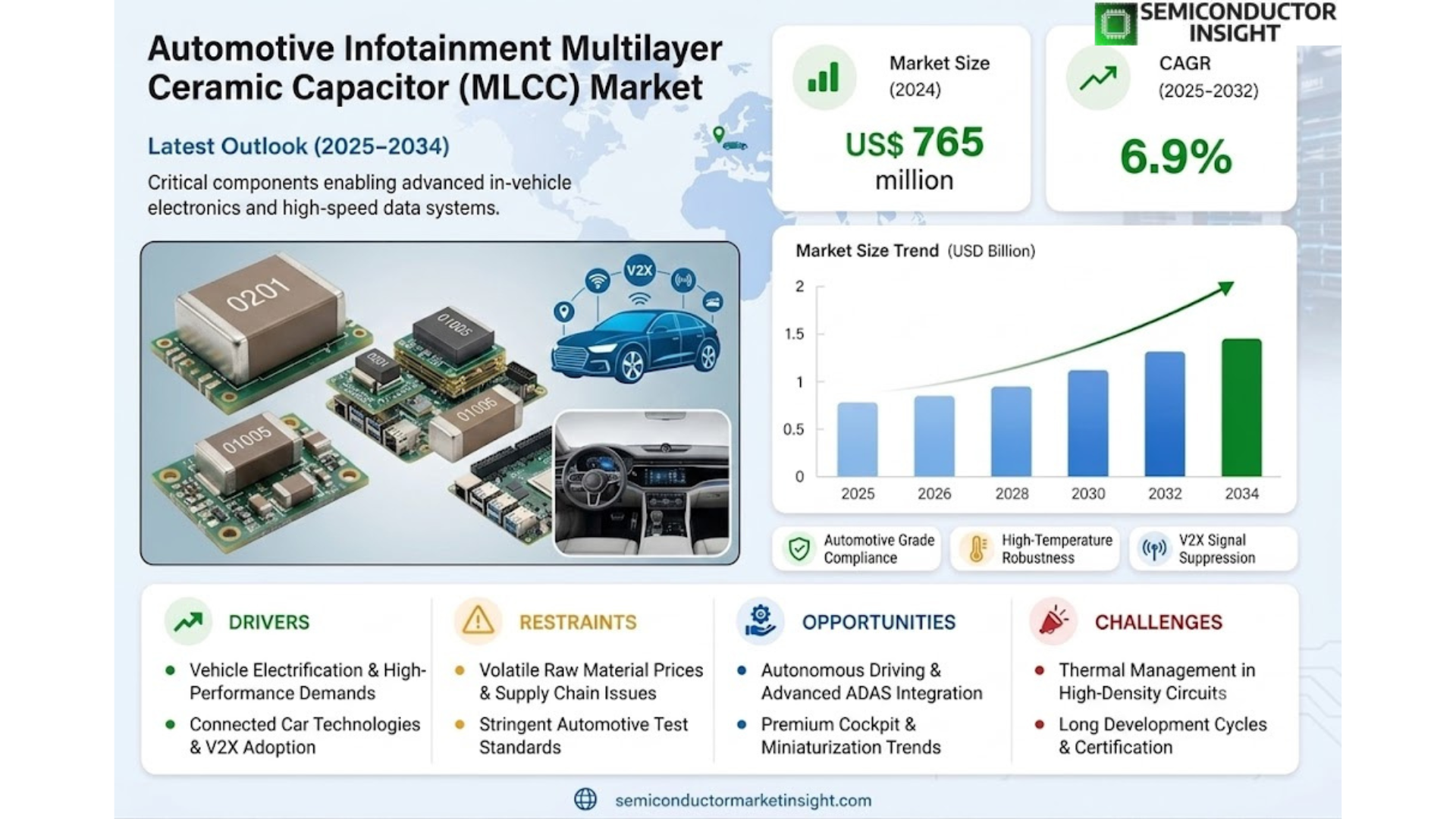
The global Automotive Infotainment Multilayer Ceramic Capacitor Market size was valued at US$ 765 million in 2024 and is projected to reach US$ 1.34 billion by 2032, at a CAGR of 6.9% during the forecast period 2025-2032.
Automotive infotainment multilayer ceramic capacitors (MLCCs) are passive electronic components that store energy and filter signals in vehicle entertainment and navigation systems. These compact, high-reliability components play a critical role in advanced driver assistance systems (ADAS), touchscreen displays, audio systems, and connectivity modules. The product segment includes medium/high voltage MLCCs (rated above 25V) and low voltage MLCCs (below 25V), with different dielectric materials optimized for automotive temperature ranges (-55°C to +125°C).
The market growth is primarily driven by increasing vehicle electrification and rising consumer demand for in-car connectivity features. While global automotive production reached 81.6 million units in 2022 (OICA data), the growing adoption of electric vehicles – projected to account for 30% of new car sales by 2030 – is creating additional demand for high-performance MLCCs. However, supply chain disruptions and raw material price volatility remain key challenges. Major players like Murata and TDK Corp are expanding production capacity, with Murata announcing a new USD 290 million MLCC plant in Japan specifically for automotive applications in Q3 2023.
MARKET DYNAMICS
MARKET DRIVERS
Electrification of Vehicles Accelerates Demand for High-Performance MLCCs
The rapid electrification of vehicles is fundamentally transforming automotive component requirements, with multilayer ceramic capacitors (MLCCs) emerging as critical elements in infotainment systems. Modern electric vehicles contain 3-5 times more MLCCs than conventional combustion engine vehicles, primarily due to their superior performance in high-frequency applications and compact form factor. As automakers intensify their EV production – with global EV sales projected to exceed 40 million units by 2030 – the demand for automotive-grade MLCCs continues its upward trajectory. Leading manufacturers are responding with product innovations such as Murata’s ultra-stable GCM series specifically designed for autonomous driving systems.
Connected Car Technologies Fuel MLCC Adoption
The proliferation of connected vehicle technologies is creating unprecedented demand for infotainment MLCCs. Advanced driver assistance systems (ADAS), vehicle-to-everything (V2X) communication, and in-vehicle networking all rely heavily on MLCCs for signal processing and noise suppression. Industry analysis indicates that the average premium vehicle now incorporates over 10,000 MLCCs, with infotainment systems accounting for approximately 30% of this total. This trend is exacerbated by consumer expectations for seamless connectivity, with over 75% of new car buyers considering in-vehicle technology a primary purchase factor. Recent product launches like TDK’s CGA series capacitors demonstrate the industry’s focus on meeting these evolving requirements.
Miniaturization Trend Drives Innovation in MLCC Technology
As automotive infotainment systems become more sophisticated yet space-constrained, component miniaturization has become paramount. MLCC manufacturers are responding with smaller footprint solutions that maintain or improve performance characteristics. The market has seen significant adoption of 0201 and 01005 case size MLCCs for infotainment applications, particularly in high-density circuit designs. This shift towards smaller components has been enabled by advances in multilayer ceramic technology and precision manufacturing processes. For instance, Samsung Electro-Mechanics recently introduced its ultra-miniature CL series capacitors specifically optimized for next-generation automotive displays and audio systems.
MARKET RESTRAINTS
Volatile Raw Material Prices Impact Production Costs
The MLCC manufacturing process depends heavily on specialty raw materials including barium titanate, nickel, and palladium, all of which have experienced significant price volatility in recent years. Market data shows that barium titanate prices fluctuated by nearly 40% in 2023, creating challenges for cost management across the supply chain. These material cost uncertainties are particularly problematic for automotive-grade MLCCs, which require stringent quality controls and more expensive base materials than consumer electronics components. The situation is further complicated by geopolitical factors affecting rare earth mineral supplies, prompting manufacturers to explore alternative materials and process optimizations.
Stringent Automotive Certification Requirements Limit Market Entry
Automotive MLCCs must meet rigorous qualification standards including AEC-Q200 certification, a process that can take 12-18 months and significant R&D investment per product variant. These requirements create substantial barriers for new market entrants and constrain the pace of product portfolio expansion even for established manufacturers. The certification burden is amplified by automakers’ growing preference for customized MLCC solutions tailored to specific infotainment system architectures. While these standards ensure reliability in harsh automotive environments, they significantly increase time-to-market and development costs for suppliers.
Thermal Management Challenges in Compact Designs
As infotainment systems incorporate more powerful processors and larger displays, thermal management has become a critical constraint for MLCC performance. The operating temperature range for automotive MLCCs has expanded to -55°C to 150°C in some applications, while simultaneously requiring stable capacitance characteristics. This thermal performance challenge is particularly acute for MLCCs located near heat-generating components like power amplifiers and system-on-chip processors. Manufacturers are addressing these constraints through advanced materials engineering, but the technical complexity adds both cost and development time to new product introductions.
MARKET OPPORTUNITIES
Autonomous Vehicle Development Opens New Application Areas
The advancement of autonomous driving technology represents a significant growth opportunity for infotainment MLCC suppliers. Level 4 and 5 autonomous vehicles will require substantially more advanced infotainment systems to support passenger entertainment and productivity during transit. Industry projections suggest that autonomous vehicles may incorporate 50-100% more MLCCs than current models, particularly for high-bandwidth interfaces and artificial intelligence processing. This emerging application space is driving demand for MLCCs with exceptional reliability and signal integrity characteristics at higher frequency ranges.
Aftermarket Upgrades Create Secondary Demand
The growing market for aftermarket infotainment system upgrades presents an often-overlooked opportunity for MLCC manufacturers. As consumers seek to retrofit older vehicles with modern connectivity and entertainment features, the demand for compatible high-reliability components continues to grow. This trend is particularly strong in developing markets where vehicle replacement cycles are longer. Component suppliers able to offer drop-in solutions for popular aftermarket infotainment systems stand to benefit from this sustained demand.
Emerging Markets Drive Volume Growth
While developed markets lead in advanced infotainment adoption, emerging economies are experiencing rapid growth in entry-level and mid-range systems. Countries like India, Brazil, and Indonesia are seeing double-digit annual growth in automotive electronics penetration, creating substantial demand for cost-optimized MLCC solutions. Manufacturers that can balance performance requirements with competitive pricing are well-positioned to capitalize on this growth, particularly as regional automakers expand production of vehicles with basic to moderate infotainment capabilities.
AUTOMOTIVE INFOTAINMENT MULTILAYER CERAMIC CAPACITOR MARKET TRENDS
Increasing Demand for Advanced In-Vehicle Connectivity to Drive Market Growth
The automotive infotainment multilayer ceramic capacitor (MLCC) market is experiencing robust growth due to the rising demand for advanced connectivity solutions in modern vehicles. With over 80% of new passenger cars now equipped with integrated infotainment systems, the need for reliable, high-performance MLCCs has surged. These components play a critical role in ensuring stable power supply and signal transmission across various infotainment features including navigation systems, touchscreen displays, and audio systems. The transition toward 5G-enabled vehicle-to-everything (V2X) communication is further accelerating MLCC adoption, as these capacitors enable high-frequency signal processing required for real-time data exchange.
Other Trends
Electrification and Autonomous Driving
The rapid growth of electric vehicles (EVs) and autonomous driving technologies is reshaping the MLCC market landscape. Modern EVs contain approximately 10,000-15,000 MLCCs per vehicle—nearly double the quantity found in conventional internal combustion engine cars—due to their extensive electronic systems. Advanced driver-assistance systems (ADAS) and autonomous driving functions require MLCCs with superior temperature stability and durability, pushing manufacturers to develop next-generation ceramic capacitors that can withstand extreme automotive environments while maintaining performance consistency.
Miniaturization and Performance Enhancement
Continual advancements in MLCC technology focus on miniaturization without compromising capacitance, a critical requirement as infotainment systems become more compact yet powerful. Leading manufacturers are introducing ultra-small form factors (down to 0201 inch packages) while achieving higher capacitance values through improved dielectric materials. This trend aligns with automotive OEMs’ demands for space-saving solutions that can handle increasing power requirements of high-resolution displays and advanced audio systems. Furthermore, the development of high-temperature MLCCs capable of operating at 150°C and above ensures reliable performance in under-the-hood applications adjacent to engine compartments.
COMPETITIVE LANDSCAPE
Key Industry Players
Innovation and Strategic Expansion Drive Competition in Automotive MLCC Market
The global automotive infotainment multilayer ceramic capacitor (MLCC) market features a highly competitive landscape dominated by established electronics component manufacturers. Murata Manufacturing leads the market with an estimated 30% revenue share in 2024, leveraging its technological expertise in miniaturization and high-capacity MLCCs. The company’s strong foothold in Asia, particularly Japan and China, positions it advantageously given these regions account for over 56% of global automobile production.
Close competitors Samsung Electro-Mechanics (SEMCO) and TDK Corporation collectively hold approximately 35% market share. Their growth stems from vertical integration strategies and partnerships with major automakers for customized infotainment solutions. Recent developments include SEMCO’s 2023 launch of ultra-stable MLCCs for automotive temperature extremes (-55°C to 150°C), addressing a critical industry need.
The market is witnessing intensified competition as mid-tier players like Taiyo Yuden and Yageo aggressively expand automotive-grade MLCC production capacity. Yageo’s 2022 acquisition of Kemet significantly strengthened its market position through combined R&D capabilities. Meanwhile, Kyocera differentiates itself through proprietary ceramic formulations that enhance signal integrity in advanced driver assistance systems (ADAS).
Emerging trends show manufacturers prioritizing three strategic areas: 1) Developing MLCCs compatible with 5G-connected infotainment, 2) Improving durability for electric vehicles, and 3) Reducing supply chain vulnerabilities through regional production hubs. This reflects the industry’s response to automakers’ demands for more reliable, high-performance components in next-generation vehicles.
List of Key Automotive Infotainment MLCC Manufacturers
- Murata Manufacturing Co., Ltd. (Japan)
- Samsung Electro-Mechanics (SEMCO) (South Korea)
- TDK Corporation (Japan)
- Kyocera Corporation (Japan)
- Taiyo Yuden Co., Ltd. (Japan)
- Yageo Corporation (Taiwan)
- Walsin Technology Corporation (Taiwan)
- Kemet Corporation (U.S.)
- Nippon Chemi-Con Corporation (Japan)
- Vishay Intertechnology, Inc. (U.S.)
Segment Analysis:
By Type
Medium & High Voltage MLCC Segment Leads Due to High Demand in Advanced Infotainment Systems
The market is segmented based on type into:
- Medium & High Voltage MLCC
- Low Voltage MLCC
By Application
Passenger Cars Segment Dominates Owing to Increasing Adoption of Connected Vehicle Technologies
The market is segmented based on application into:
- Passenger Cars
- Commercial Vehicles
By Region
Asia-Pacific Emerges as Key Market Due to Strong Automobile Manufacturing Base
The market is segmented based on region into:
- North America
- Europe
- Asia-Pacific
- Latin America
- Middle East & Africa
By Technology
Advanced Capacitor Technologies Gaining Traction for Enhanced Performance Requirements
The market is segmented based on technology into:
- Surface Mount Technology (SMT)
- Thin Film Technology
- Multilayer Technology
Regional Analysis: Automotive Infotainment Multilayer Ceramic Capacitor Market
North America
The North American market for Automotive Infotainment Multilayer Ceramic Capacitors (MLCCs) is driven by high demand for advanced in-vehicle technologies and stringent reliability standards. With the U.S. accounting for approximately 16% of global automotive production, leading automakers are accelerating the integration of smart infotainment systems requiring stable, high-performance MLCCs. The region sees strong adoption of low-voltage MLCCs for connected car applications, supported by technological leadership from chipmakers and Tier 1 suppliers. However, supply chain disruptions and semiconductor shortages have occasionally impacted production schedules, prompting automotive manufacturers to diversify MLCC sourcing strategies.
Europe
Europe’s automotive infotainment MLCC market benefits from the presence of premium automakers and strict electromagnetic compatibility (EMC) requirements. Germany, France, and Italy collectively account for over 60% of the region’s MLCC demand in automotive applications. The push toward electric vehicles (EVs) with sophisticated infotainment architectures is creating opportunities for high-voltage MLCCs capable of withstanding demanding operating conditions. Challenges include pricing pressures from Asian suppliers and the need for capacitors that meet both AEC-Q200 reliability standards and EU RoHS compliance. The region is also seeing increased R&D investments in MLCC miniaturization to support space-constrained infotainment module designs.
Asia-Pacific
Dominating global production with 56% market share, Asia-Pacific represents the largest consumption hub for automotive infotainment MLCCs. China’s booming electric vehicle sector and Japan’s leadership in MLCC manufacturing (with key players like Murata and TDK) create a robust ecosystem. While cost-sensitive markets still prioritize standard MLCCs, premium vehicles from Korean and Japanese OEMs are driving adoption of advanced high-capacitance MLCCs for 5G-enabled infotainment. The region faces challenges from counterfeit components and volatile raw material prices, though localized production by international suppliers is helping stabilize supply chains. India and Southeast Asia are emerging as growth hotspots due to expanding mid-range vehicle production.
South America
The South American market shows gradual growth, primarily serving regional automotive assembly plants in Brazil and Argentina. While infotainment system penetration remains lower compared to other regions (around 35-40% of new vehicles), increasing consumer demand for connectivity features is spurring MLCC adoption. The market predominantly uses standard low-voltage MLCCs due to cost considerations, though imported luxury vehicles create niche demand for high-performance variants. Economic instability and import dependency on Asian MLCC suppliers continue to constrain market expansion, leading some automakers to stockpile critical components during periods of currency volatility.
Middle East & Africa
This region presents a developing market where MLCC adoption closely tracks premium vehicle sales in GCC countries and South Africa. The focus remains on basic infotainment applications, with aftermarket upgrades accounting for significant MLCC demand. While lacking local MLCC production capabilities, the region benefits from distribution networks established by global players like Yageo and Walsin Technology. Growing investments in automotive manufacturing hubs (particularly in Morocco) could stimulate future demand, though market growth remains tempered by geopolitical uncertainties and fluctuating oil prices impacting vehicle purchase trends. The UAE serves as a key logistics hub for MLCC distribution across the region.
Report Scope
This market research report provides a comprehensive analysis of the global and regional Automotive Infotainment Multilayer Ceramic Capacitor (MLCC) markets, covering the forecast period 2025–2032. It offers detailed insights into market dynamics, technological advancements, competitive landscape, and key trends shaping the industry.
Key focus areas of the report include:
- Market Size & Forecast: Historical data and future projections for revenue, unit shipments, and market value across major regions and segments. The global market was valued at US$ 765 million in 2024 and is projected to reach US$ 1.34 billion by 2032, growing at a CAGR of 6.9%.
- Segmentation Analysis: Detailed breakdown by product type (Medium & High Voltage MLCC, Low Voltage MLCC), application (Passenger Cars, Commercial Vehicles), and end-user industry to identify high-growth segments and investment opportunities.
- Regional Outlook: Insights into market performance across North America, Europe, Asia-Pacific, Latin America, and the Middle East & Africa, including country-level analysis where relevant. Asia-Pacific dominates with 56% market share, driven by automotive production in China, Japan, and South Korea.
- Competitive Landscape: Profiles of leading market participants including Murata, Samsung Electro-Mechanics, TDK Corp, and Kyocera, covering their product offerings, R&D focus, manufacturing capacity, pricing strategies, and recent developments.
- Technology Trends & Innovation: Assessment of emerging technologies in MLCC manufacturing, miniaturization trends, and integration with advanced automotive infotainment systems.
- Market Drivers & Restraints: Evaluation of factors driving market growth including increasing vehicle production and demand for advanced infotainment systems, along with challenges like supply chain constraints and raw material price volatility.
- Stakeholder Analysis: Insights for component suppliers, automotive OEMs, system integrators, investors, and policymakers regarding the evolving ecosystem and strategic opportunities.
Primary and secondary research methods are employed, including interviews with industry experts, data from verified sources, and real-time market intelligence to ensure the accuracy and reliability of the insights presented.
FREQUENTLY ASKED QUESTIONS:
What is the current market size of Global Automotive Infotainment MLCC Market?
-> Automotive Infotainment Multilayer Ceramic Capacitor Market size was valued at US$ 765 million in 2024 and is projected to reach US$ 1.34 billion by 2032, at a CAGR of 6.9% during the forecast period 2025-2032.
Which key companies operate in Global Automotive Infotainment MLCC Market?
-> Key players include Murata, Samsung Electro-Mechanics (SEMCO), TDK Corp, Kyocera, Taiyo Yuden, and Yageo, among others.
What are the key growth drivers?
-> Key growth drivers include rising automotive production, increasing demand for advanced infotainment systems, and vehicle electrification trends.
Which region dominates the market?
-> Asia-Pacific is the dominant region, accounting for 56% of global market share, followed by Europe and North America.
What are the emerging trends?
-> Emerging trends include miniaturization of MLCC components, higher capacitance requirements, and integration with connected vehicle technologies.
Get Sample Report PDF for Exclusive Insights
Report Sample Includes
- Table of Contents
- List of Tables & Figures
- Charts, Research Methodology, and more...
 Download Sample Report PDF