The Global Tire Sensors Market size was valued at US$ 2.34 billion in 2024 and is projected to reach US$ 3.88 billion by 2030, at a CAGR of 8.8% during the forecast period 2024-2030.
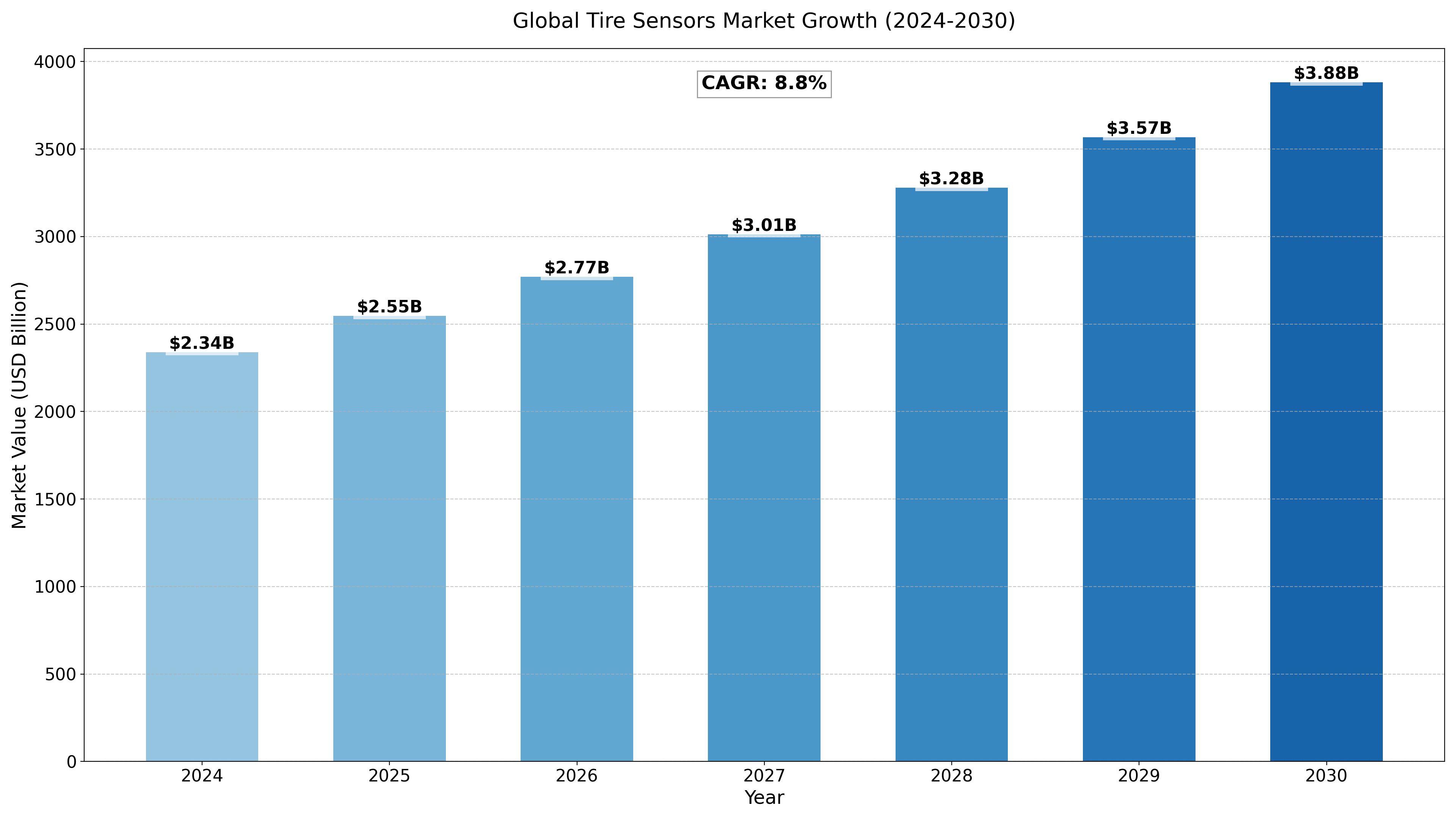
The United States Tire Sensors market size was valued at US$ 612.5 million in 2024 and is projected to reach US$ 985.4 million by 2030, at a CAGR of 8.3% during the forecast period 2024-2030.
Electronic sensors integrated into vehicle tires to monitor pressure, temperature, and other parameters in real-time. These devices enhance safety and performance through continuous tire condition monitoring.
Report Overview
Tire sensors are small programmable electronic devices, located in the pressurized pocket made by a wheel and tire. These are the transducers that convert one form of signal into another.
This report provides a deep insight into the global Tire Sensors market covering all its essential aspects. This ranges from a macro overview of the market to micro details of the market size, competitive landscape, development trend, niche market, key market drivers and challenges, SWOT analysis, value chain analysis, etc.
The analysis helps the reader to shape the competition within the industries and strategies for the competitive environment to enhance the potential profit. Furthermore, it provides a simple framework for evaluating and accessing the position of the business organization. The report structure also focuses on the competitive landscape of the Global Tire Sensors Market, this report introduces in detail the market share, market performance, product situation, operation situation, etc. of the main players, which helps the readers in the industry to identify the main competitors and deeply understand the competition pattern of the market.
In a word, this report is a must-read for industry players, investors, researchers, consultants, business strategists, and all those who have any kind of stake or are planning to foray into the Tire Sensors market in any manner.
Global Tire Sensors Market: Market Segmentation Analysis
The research report includes specific segments by region (country), manufacturers, Type, and Application. Market segmentation creates subsets of a market based on product type, end-user or application, Geographic, and other factors. By understanding the market segments, the decision-maker can leverage this targeting in the product, sales, and marketing strategies. Market segments can power your product development cycles by informing how you create product offerings for different segments.
Key Company
- Schrader Electronics
- TRW Automotive Holdings Corporation
- AVE technologies
- Bartec USA LLC
- General Electric
- ZF Friedrichshafen AG
- Continental AG
- Sensata Technologies, Inc.
- Denso Corporation
- Pacific Industrial Co., Ltd.
- NXP Semiconductors
- WABCO
- Tire Pressure Monitoring Systems (TPMS)
- Brake Booster System
- Air Bag System
- Vehicle Dynamic Control
- Others
- Passenger Vehicle
- Light Commercial Vehicle
- Heavy Commercial Vehicle
- North America (USA, Canada, Mexico)
- Europe (Germany, UK, France, Russia, Italy, Rest of Europe)
- Asia-Pacific (China, Japan, South Korea, India, Southeast Asia, Rest of Asia-Pacific)
- South America (Brazil, Argentina, Columbia, Rest of South America)
- The Middle East and Africa (Saudi Arabia, UAE, Egypt, Nigeria, South Africa, Rest of MEA)
- Industry drivers, restraints, and opportunities covered in the study
- Neutral perspective on the market performance
- Recent industry trends and developments
- Competitive landscape & strategies of key players
- Potential & niche segments and regions exhibiting promising growth covered
- Historical, current, and projected market size, in terms of value
- In-depth analysis of the Tire Sensors Market
- Overview of the regional outlook of the Tire Sensors Market:
- Access to date statistics compiled by our researchers. These provide you with historical and forecast data, which is analyzed to tell you why your market is set to change
- This enables you to anticipate market changes to remain ahead of your competitors
- You will be able to copy data from the Excel spreadsheet straight into your marketing plans, business presentations, or other strategic documents
- The concise analysis, clear graph, and table format will enable you to pinpoint the information you require quickly
- Provision of market value (USD Billion) data for each segment and sub-segment
- Indicates the region and segment that is expected to witness the fastest growth as well as to dominate the market
- Analysis by geography highlighting the consumption of the product/service in the region as well as indicating the factors that are affecting the market within each region
- Competitive landscape which incorporates the market ranking of the major players, along with new service/product launches, partnerships, business expansions, and acquisitions in the past five years of companies profiled
- Extensive company profiles comprising of company overview, company insights, product benchmarking, and SWOT analysis for the major market players
- The current as well as the future market outlook of the industry concerning recent developments which involve growth opportunities and drivers as well as challenges and restraints of both emerging as well as developed regions
- Includes in-depth analysis of the market from various perspectives through Porters five forces analysis
- Provides insight into the market through Value Chain
- Market dynamics scenario, along with growth opportunities of the market in the years to come
- 6-month post-sales analyst support
Customization of the Report
In case of any queries or customization requirements, please connect with our sales team, who will ensure that your requirements are met.
1. Drivers
- Growing Demand for Vehicle Safety and Compliance with Regulations: Safety standards are becoming stricter worldwide, with regulatory bodies mandating advanced safety systems, including tire pressure monitoring systems (TPMS), in vehicles. These regulations, notably in regions like North America, Europe, and parts of Asia, are driving increased adoption of tire sensors to comply with safety requirements and reduce accident risks caused by underinflated or overinflated tires.
- Rise in Vehicle Electrification and EV Adoption: The rapid growth of electric vehicles (EVs) has bolstered the demand for advanced tire sensors. EVs require specific monitoring due to their weight distribution and battery load, impacting tire pressure and wear. As the EV market expands, so does the demand for enhanced, efficient, and durable tire sensors, particularly in areas like range optimization and predictive maintenance.
- Growth in Autonomous and Connected Vehicles: The increasing integration of autonomous and connected vehicle technologies is a significant driver for tire sensors. Autonomous vehicles rely heavily on a constant flow of real-time data, and tire sensors provide crucial information for safety, stability, and ride quality. This push toward autonomous technology promotes the development of smart, high-accuracy tire sensors with real-time data transmission capabilities.
- Consumer Awareness and Demand for Better Fuel Efficiency: Consumers are increasingly aware of the benefits of proper tire maintenance in enhancing fuel efficiency and tire longevity. Proper tire pressure reduces rolling resistance, directly improving fuel efficiency. Tire sensors help consumers maintain optimal tire pressure, aligning with their demand for cost savings and environmental sustainability.
2. Restraints
- High Costs of Advanced Tire Sensors: Advanced tire sensors, especially smart TPMS with real-time data capabilities, can be relatively costly, which limits their adoption in budget and mid-range vehicle segments. Although regulatory requirements drive OEMs to install these systems, the cost-sensitive nature of the automotive market often restricts the inclusion of high-end sensors in economical vehicles.
- Battery Limitations and Maintenance Concerns: Many tire sensors, especially direct TPMS, rely on small, built-in batteries that have limited life spans and are challenging to replace. The need for periodic replacement of sensors due to battery drainage or wear adds to the maintenance costs for consumers, potentially discouraging adoption, especially in low-income regions.
- Challenges in Retrofitting Older Vehicles: The cost and technical difficulty of retrofitting older vehicles with modern tire sensor systems are major barriers. Older vehicle owners may be less inclined to invest in retrofitting these systems, especially when the costs are not subsidized, creating a hindrance to the growth of the tire sensor aftermarket.
3. Opportunities
- Technological Innovations in Sensor Capabilities and Materials: Advances in sensor technology, such as the use of MEMS (Micro-Electro-Mechanical Systems) and nanotechnology, are enabling the development of smaller, more accurate, and cost-effective tire sensors. Innovations in flexible, durable materials are also enhancing sensor performance, making sensors more adaptable to various driving conditions and improving longevity.
- Growing Demand in the Commercial Vehicle Sector: The commercial vehicle sector, particularly fleet operations, is experiencing increased demand for tire sensors due to their ability to monitor tire wear and pressure, reducing maintenance costs and downtime. Fleet operators are motivated by potential cost savings, fuel efficiency, and regulatory compliance, creating a substantial growth opportunity for tire sensors in this segment.
- Integration with IoT for Real-Time Monitoring and Predictive Analytics: Integrating tire sensors with IoT platforms allows for real-time monitoring, predictive maintenance, and analytics, a trend that is especially appealing in the commercial and logistics sectors. IoT-enabled tire sensors can predict and notify operators about potential tire issues before they occur, significantly enhancing safety and reducing unexpected breakdowns.
- Emerging Markets in Asia-Pacific and Latin America: Developing regions, particularly Asia-Pacific and Latin America, are witnessing rapid automotive market growth. As vehicle ownership rises and these regions implement new safety standards, they represent a significant untapped market for tire sensors, especially with government initiatives encouraging automotive safety technologies.
4. Challenges
- Environmental Impact and Disposal Issues: Tire sensors, especially those integrated into TPMS, are often discarded with tires, raising environmental concerns regarding electronic waste. The challenge lies in developing sustainable and recyclable sensor technologies that minimize their ecological footprint, meeting both regulatory standards and growing consumer demand for eco-friendly solutions.
- Compatibility and Standardization Issues: The lack of universal standards across different regions and automotive manufacturers creates compatibility issues for tire sensors. This diversity in requirements can lead to inconsistencies in performance and limit the scalability of tire sensor solutions, especially in global markets where cross-border standardization is minimal.
- Potential Security and Data Privacy Concerns: As tire sensors become connected and integrated with IoT systems, data security becomes a critical challenge. The risk of cyber threats, such as hacking and data breaches, can compromise the safety and privacy of vehicle systems. Ensuring robust cybersecurity measures for tire sensors is essential to prevent potential risks associated with unauthorized access.
- Accuracy and Calibration Challenges in Harsh Conditions: Tire sensors must function accurately in varying and often harsh environmental conditions, such as extreme temperatures, wet conditions, and off-road terrain. These factors can affect sensor calibration, accuracy, and longevity. Overcoming these technical challenges is crucial to ensure reliable performance across diverse driving environments.

Get Sample Report PDF for Exclusive Insights
Report Sample Includes
- Table of Contents
- List of Tables & Figures
- Charts, Research Methodology, and more...
 Download Sample Report PDF