
MARKET INSIGHTS
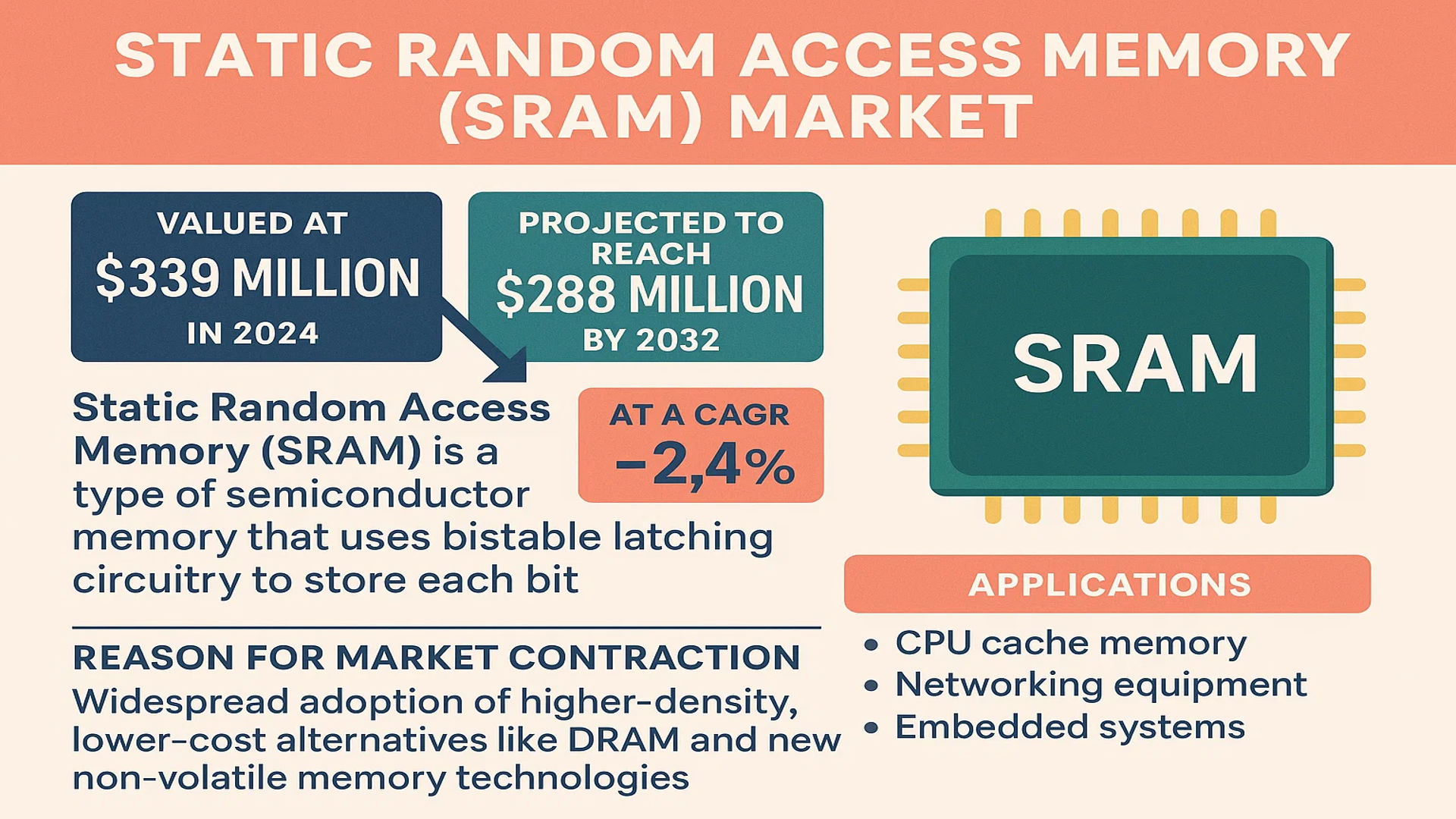
The global Static Random Access Memory (SRAM) Market was valued at 339 million in 2024 and is projected to reach US$ 288 million by 2032, at a CAGR of -2.4% during the forecast period.
Static Random Access Memory (SRAM) is a type of semiconductor memory that uses bistable latching circuitry to store each bit. Unlike Dynamic RAM (DRAM), which requires constant refreshing, SRAM retains data bits as long as power is supplied, offering significantly faster access times and greater reliability. This makes it ideal for applications requiring high-speed data access, such as CPU cache memory in computers, networking equipment, and various embedded systems. However, its higher cost per bit and larger physical size compared to DRAM have historically limited its use to niche, performance-critical applications.
The market is experiencing a gradual contraction primarily due to the widespread adoption of higher-density, lower-cost alternatives like DRAM and the emergence of new non-volatile memory technologies. Despite this overall trend, certain segments within the SRAM market, particularly low-power SRAM and nvSRAM (non-volatile SRAM), continue to find stable demand in specialized applications such as automotive electronics, medical devices, and industrial automation where speed, reliability, and data integrity are paramount. The market remains highly consolidated, with the top three players—Cypress, Renesas, and ISSI—collectively commanding approximately 80% of the global market share, underscoring the mature and competitive nature of this industry.
MARKET DYNAMICS
MARKET DRIVERS
Rising Demand for High-Performance Computing and AI Applications to Drive SRAM Adoption
The global surge in artificial intelligence, machine learning, and high-performance computing applications is creating substantial demand for SRAM technology. Unlike DRAM, SRAM offers significantly faster access times and lower latency, making it indispensable for cache memory in processors and specialized AI accelerators. The increasing complexity of computational tasks requires memory solutions that can keep pace with processor speeds, and SRAM’s ability to provide sub-nanosecond access times positions it as a critical component in advanced computing architectures. As AI workloads continue to expand across various sectors including healthcare diagnostics, autonomous vehicles, and financial modeling, the need for high-speed memory buffers and cache memory is expected to sustain SRAM demand despite overall market contraction.
Expansion of Automotive Electronics and Networking Infrastructure to Support Market Stability
The automotive electronics sector represents a significant growth area for SRAM applications, particularly in advanced driver assistance systems (ADAS), infotainment systems, and vehicle networking. Modern vehicles incorporate numerous electronic control units that require reliable, fast-access memory for real-time processing of sensor data and system commands. The transition toward autonomous driving capabilities further amplifies this demand, as these systems process enormous amounts of data from multiple sensors simultaneously. Similarly, networking equipment including routers, switches, and base stations utilize SRAM for buffer memory and lookup tables where speed and reliability are paramount. The continuous global expansion of 5G infrastructure and the Internet of Things ecosystem provides additional stability to the SRAM market despite broader industry challenges.
Critical Applications in Aerospace and Medical Devices to Maintain Specialty SRAM Demand
Specialized SRAM variants, particularly radiation-hardened and high-reliability types, continue to find essential applications in aerospace, defense, and medical equipment where data integrity and reliability cannot be compromised. Aerospace systems require memory that can withstand extreme environmental conditions and radiation exposure, making SRAM the preferred choice for flight control systems, satellite communications, and navigation equipment. In medical technology, SRAM is used in critical care monitoring systems, diagnostic imaging equipment, and surgical devices where instantaneous data processing and reliability are matters of patient safety. The stringent certification processes and long product lifecycles in these sectors create a stable, though specialized, demand base that helps offset broader market declines.
MARKET RESTRAINTS
High Manufacturing Costs and Price Competition from Alternative Memory Technologies to Constrain Growth
SRAM manufacturing involves complex processes and requires more silicon area per bit compared to DRAM and flash memory technologies, resulting in significantly higher production costs. A typical SRAM cell requires six transistors compared to DRAM’s one transistor and one capacitor, making SRAM approximately three to four times more expensive per megabyte. This cost structure becomes increasingly challenging as alternative memory technologies continue to improve their performance characteristics while maintaining lower price points. The development of faster DRAM variants and emerging non-volatile memory technologies that offer competitive access speeds at lower costs creates persistent pricing pressure on SRAM manufacturers. Additionally, the economies of scale favor higher-density memory technologies, making it difficult for SRAM producers to reduce per-unit costs through volume manufacturing.
Technical Limitations in Density Scaling and Power Consumption to Restrict Broader Adoption
While SRAM offers superior speed characteristics, it faces fundamental limitations in density scaling and power efficiency that restrict its application in many modern electronic devices. The six-transistor cell structure inherently occupies more silicon real estate than alternative memory technologies, making high-density SRAM implementations economically impractical for many applications. Furthermore, SRAM exhibits higher static power consumption due to current leakage in the transistor cells, which becomes increasingly problematic as device manufacturers prioritize energy efficiency in portable and battery-operated equipment. These technical constraints have led many system designers to implement hybrid memory architectures that use smaller amounts of SRAM for critical speed-sensitive functions while relying on other memory types for bulk storage, thereby limiting the overall SRAM content in many electronic products.
Market Concentration and Limited Innovation Investment to Hinder Long-Term Development
The SRAM market exhibits high concentration with the top three manufacturers controlling approximately 80% of global production, creating potential vulnerabilities in supply chain diversity and innovation pace. This market structure can lead to reduced competitive pressure for technological advancement and potentially slower response to emerging application requirements. Additionally, the projected market contraction has led many semiconductor companies to prioritize investment in more rapidly growing memory segments, resulting in relatively limited research and development allocation for SRAM technology improvements. The specialized nature of many SRAM applications also creates fragmentation in product requirements, making it challenging for manufacturers to achieve the volume efficiencies necessary to justify significant process innovation or architectural advancements.
MARKET CHALLENGES
Intense Competition from Emerging Memory Technologies to Challenge SRAM’s Traditional Advantages
The memory technology landscape is experiencing rapid innovation, with several emerging technologies threatening to encroach on traditional SRAM applications. Technologies such as magnetoresistive RAM (MRAM), ferroelectric RAM (FRAM), and phase-change memory (PCM) are achieving access times approaching SRAM performance while offering non-volatility and higher density characteristics. These alternatives are particularly attractive for applications where both speed and data persistence are required, potentially displacing SRAM in certain market segments. The development of embedded MRAM as cache memory in processors represents a particularly significant challenge, as it could reduce or eliminate the need for separate SRAM components in many integrated circuits. This technological disruption requires SRAM manufacturers to continuously innovate to maintain performance advantages while addressing the cost and density limitations that make their technology vulnerable to substitution.
Other Challenges
Geographic Market Concentration and Supply Chain Vulnerabilities
The SRAM market demonstrates significant geographic concentration, with the United States accounting for approximately 80% of global consumption and Japan representing another 15%. This concentration creates potential supply chain vulnerabilities and market access challenges for manufacturers outside these regions. Political and trade considerations can impact the stability of supply relationships, while currency fluctuations and import/export regulations add complexity to global distribution. The specialized nature of SRAM production also means that manufacturing capacity is limited to a relatively small number of facilities worldwide, creating potential bottlenecks during periods of high demand or production disruptions.
Technical Workforce Shortages and Knowledge Retention Issues
The semiconductor industry faces ongoing challenges in attracting and retaining skilled technical personnel, particularly in specialized areas like SRAM design and manufacturing. The complex nature of SRAM technology requires engineers with specific expertise in analog circuit design, semiconductor physics, and manufacturing processes. As experienced professionals retire and fewer new engineers enter this specialized field, knowledge retention becomes increasingly difficult. This skills gap can slow innovation and complicate manufacturing process improvements, potentially affecting product quality and time-to-market for new SRAM developments.
MARKET OPPORTUNITIES
Development of Ultra-Low-Power and Radiation-Hardened SRAM Variants to Open New Application Areas
While the overall SRAM market faces contraction, significant opportunities exist in developing specialized variants tailored to emerging application requirements. The growing Internet of Things ecosystem creates demand for ultra-low-power SRAM that can operate efficiently in energy-constrained environments while maintaining the speed advantages essential for sensor data processing and edge computing applications. Similarly, the expansion of space exploration and satellite communications drives need for radiation-hardened SRAM capable of operating reliably in high-radiation environments where conventional memory would fail. These specialized market segments often command premium pricing and demonstrate greater stability than the broader memory market, providing manufacturers with opportunities to leverage their SRAM expertise while avoiding the most intense price competition.
Integration with Emerging Computing Architectures and Heterogeneous Processing to Create New Demand Drivers
The evolution of computing architectures toward heterogeneous processing and specialized accelerators presents significant opportunities for SRAM technology. As processors incorporate more specialized cores for AI, graphics, and signal processing, the need for distributed cache memory increases correspondingly. Silicon interposer technologies and 3D packaging advancements enable tighter integration of SRAM with processing elements, creating performance advantages that alternative memory technologies cannot easily match. The development of compute-in-memory architectures, where processing occurs within or adjacent to memory arrays, particularly favors SRAM due to its compatibility with standard CMOS processes and design methodologies. These architectural trends may create new application areas that leverage SRAM’s speed advantages while mitigating its density and cost limitations through innovative integration approaches.
Strategic Partnerships and Technology Licensing to Expand Market Reach and Application Diversity
The specialized nature of SRAM technology creates opportunities for manufacturers to establish strategic partnerships with system integrators, semiconductor foundries, and research institutions. By licensing SRAM intellectual property for integration into system-on-chip designs, manufacturers can access markets that would be inaccessible through discrete component sales alone. Partnerships with automotive suppliers, medical device manufacturers, and aerospace contractors can lead to long-term supply agreements with stable pricing structures. Additionally, collaboration with academic and government research institutions on next-generation memory technologies can provide access to advanced research capabilities and potential funding sources, helping to offset the research and development costs associated with maintaining technological competitiveness in a challenging market environment.
STATIC RANDOM ACCESS MEMORY (SRAM) MARKET TRENDS
Increasing Demand for High-Performance Computing and AI Applications
The global Static Random Access Memory (SRAM) market is experiencing significant influence from the exponential growth in high-performance computing (HPC) and artificial intelligence (AI) applications. SRAM’s inherent advantages, such as ultra-fast access speeds and low latency, make it indispensable for cache memory in advanced microprocessors, AI accelerators, and data center servers. While the overall market is projected to see a slight contraction in revenue, the demand for high-density, high-speed SRAM variants used in these cutting-edge applications continues to grow. The integration of SRAM in AI chips, particularly for edge computing devices requiring immediate data processing, is a critical driver. This trend is further amplified by the ongoing development of more complex neural networks, which require vast amounts of fast, on-chip memory for efficient operation, solidifying SRAM’s role in the future of intelligent computing infrastructure.
Other Trends
Proliferation of Automotive Electronics and IoT Devices
The rapid expansion of the automotive electronics and Internet of Things (IoT) sectors is creating sustained demand for reliable, low-power memory solutions. In automotive applications, SRAM is crucial for advanced driver-assistance systems (ADAS), infotainment systems, and engine control units, where its data retention without refresh cycles ensures reliability and safety. The automotive segment’s growth, driven by the trend towards electric and autonomous vehicles, requires memory that can operate effectively in extreme temperature ranges, a strength of certain SRAM technologies. Similarly, the vast ecosystem of IoT devices, from smart sensors to wearable technology, often utilizes low-power SRAM (LP-SRAM) for its ability to maintain data with minimal energy consumption, which is paramount for battery-operated devices. This diversification of application areas helps counterbalance demand fluctuations in more traditional computing segments.
Consolidated Market Landscape and Regional Dominance
The global SRAM market is characterized by a highly consolidated vendor landscape, with the top three players collectively commanding approximately 80% of the market share. This concentration is a result of the significant technological expertise and capital investment required for advanced semiconductor manufacturing. The United States stands as the dominant regional market, accounting for nearly 80 percent of global demand, largely due to its strong presence of leading technology companies, extensive data center infrastructure, and advanced automotive and aerospace industries. Japan follows as a significant market, holding about 15 percent share, underpinned by its robust electronics manufacturing sector. This regional dominance influences global supply chains, R&D focus, and pricing strategies, making North America and Asia-Pacific the central hubs for SRAM production and consumption. The market’s evolution is thus heavily influenced by the strategic decisions and technological roadmaps of a small number of key players in these specific geographic regions.
COMPETITIVE LANDSCAPE
Key Industry Players
Leading Companies Focus on Niche Applications and Technological Innovation Amid Market Contraction
The global Static Random Access Memory (SRAM) market exhibits a highly consolidated structure, dominated by a few key players who collectively control the majority of market share. This consolidation is primarily driven by the specialized nature of SRAM technology and the high barriers to entry, including significant R&D investments and established intellectual property portfolios. The market is characterized by intense competition where companies are pivoting strategies to focus on high-value, niche applications as the overall market experiences a gradual decline.
Infineon Technologies AG (which acquired Cypress Semiconductor in 2020) is the undisputed market leader. This position is fortified by its comprehensive product portfolio spanning asynchronous, synchronous, and low-power SRAMs, and its deep-rooted relationships across the automotive, industrial, and networking sectors. Similarly, Renesas Electronics Corporation maintains a formidable presence, particularly strong in the Asian market, leveraging its expertise in microcontrollers and system-on-chips that integrate SRAM for high-performance computing applications.
These leading companies are actively strengthening their positions not through traditional market expansion, but by deepening penetration in stable or growing end-markets like automotive electronics, aerospace, and medical devices. This strategic shift is a direct response to the declining demand in broader consumer electronics. Furthermore, innovation is focused on developing more energy-efficient variants and embedded SRAM solutions for AI and IoT edge devices, areas that still show promise.
Meanwhile, other significant players like Integrated Silicon Solution Inc. (ISSI), now part of Sino Wealth Electronic Ltd., and ON Semiconductor are competing by offering highly reliable and cost-competitive products for the industrial and automotive segments. Their growth is increasingly dependent on securing long-term supply agreements and excelling in quality and reliability standards demanded by these industries.
List of Key Companies Profiled in the SRAM Market
- Infineon Technologies AG (Cypress) (Germany)
- Renesas Electronics Corporation (Japan)
- Integrated Silicon Solution Inc. (ISSI) (U.S.)
- GSI Technology, Inc. (U.S.)
- Samsung Electronics Co., Ltd. (South Korea)
- Renesas Electronics Corporation (U.S.)
- ON Semiconductor (U.S.)
- Amic Technology (Taiwan)
- Lyontek Inc. (Taiwan)
Segment Analysis:
By Type
Synchronous SRAM Segment Leads Due to High-Speed Performance Requirements in Modern Computing Systems
The market is segmented based on type into:
- nvSRAM
- Asynchronous SRAM
- Synchronous SRAM
- Low Power SRAM
By Application
Networking Segment Dominates Due to Critical Need for High-Speed Cache Memory in Data Centers and Communication Infrastructure
The market is segmented based on application into:
- Networking
- Aerospace
- Medical
- Automotive Electronics
- Consumer Electronics
- Others
By End User
Enterprise and Data Center Segment Holds Significant Share Due to Extensive Use in Server Cache Memory and High-Performance Computing Applications
The market is segmented based on end user into:
- Enterprise and Data Centers
- Telecommunications
- Automotive Manufacturers
- Medical Equipment Manufacturers
- Consumer Electronics Manufacturers
Regional Analysis: Static Random Access Memory (SRAM) Market
North America
The United States dominates the global SRAM market with approximately 80% market share, primarily driven by its advanced semiconductor industry and strong demand from defense, aerospace, and networking sectors. Leading companies like Cypress Semiconductor (now part of Infineon Technologies) and Integrated Silicon Solution Inc. (ISSI) have significant manufacturing and R&D operations in the region. The market benefits from substantial investments in high-performance computing, 5G infrastructure, and automotive electronics, where SRAM’s speed and reliability are critical. However, the overall market is experiencing a gradual decline due to the shift toward alternative memory technologies like DRAM and emerging non-volatile memories in some applications.
Asia-Pacific
Japan holds the second-largest share in the global SRAM market at around 15%, with key players like Renesas Electronics driving innovation and production. The region benefits from a robust electronics manufacturing ecosystem, particularly in consumer electronics, automotive systems, and industrial applications. Countries like South Korea and Taiwan also contribute significantly due to their strong semiconductor foundry presence. While cost sensitivity pushes some manufacturers toward DRAM alternatives, SRAM remains essential for high-speed cache applications in processors and specialized hardware. The market faces challenges from increasing competition and price pressures but maintains stability due to ongoing demand from legacy systems and niche high-performance applications.
Europe
Europe’s SRAM market is characterized by demand from automotive, industrial, and aerospace sectors, where reliability and performance under extreme conditions are paramount. Companies like Infineon Technologies (which acquired Cypress) have a strong presence, supporting innovation in automotive electronics and IoT devices. Strict regulatory standards and emphasis on quality drive the adoption of high-end SRAM products, though the market is constrained by the overall global decline. Research initiatives in quantum computing and autonomous vehicles offer potential growth avenues, but the region’s share remains modest compared to North America and Asia-Pacific.
South America
The SRAM market in South America is limited, with minimal local production and reliance on imports. Demand is primarily driven by industrial automation, medical equipment, and telecommunications infrastructure. Economic volatility and limited technological infrastructure hinder widespread adoption, and the market is largely served by global suppliers. While there is potential for growth in upgrading legacy systems, the region’s contribution to the global SRAM market remains negligible.
Middle East & Africa
This region represents an emerging but minor segment of the global SRAM market. Demand is primarily fueled by telecommunications, oil and gas automation, and defense applications. The lack of local semiconductor manufacturing means dependence on international suppliers. While infrastructure development and digitalization efforts could drive future demand, the market currently faces challenges related to economic constraints and limited technological adoption, resulting in a small market share globally.
Report Scope
This market research report provides a comprehensive analysis of the Global Static Random Access Memory (SRAM) market, covering the forecast period 2025–2032. It offers detailed insights into market dynamics, technological advancements, competitive landscape, and key trends shaping the industry.
Key focus areas of the report include:
- Market Size & Forecast: Historical data and future projections for revenue, unit shipments, and market value across major regions and segments.
- Segmentation Analysis: Detailed breakdown by product type (nvSRAM, Asynchronous SRAM, Synchronous SRAM, Low Power SRAM), application (Networking, Aerospace, Medical, Automotive Electronics, Consumer Electronics, Others), and end-user industry to identify high-growth segments.
- Regional Outlook: Insights into market performance across North America, Europe, Asia-Pacific, Latin America, and the Middle East & Africa, with country-level analysis where relevant.
- Competitive Landscape: Profiles of leading market participants including Cypress, Renesas, ISSI, GSI, Samsung, IDT, ON Semiconductor, Amic Technology, and Lyontek, covering their product offerings, R&D focus, and strategic developments.
- Technology Trends & Innovation: Assessment of emerging semiconductor technologies, integration with AI/IoT systems, and evolving fabrication techniques in SRAM production.
- Market Drivers & Restraints: Evaluation of factors influencing market growth including demand for high-speed memory in automotive and networking applications, along with challenges from alternative memory technologies.
- Stakeholder Analysis: Strategic insights for semiconductor manufacturers, OEMs, system integrators, and investors regarding market opportunities and competitive positioning.
The research methodology combines primary interviews with industry experts and analysis of verified market data to ensure the accuracy and reliability of findings.
FREQUENTLY ASKED QUESTIONS:
What is the current market size of Global Static Random Access Memory (SRAM) Market?
-> Static Random Access Memory (SRAM) Market was valued at 339 million in 2024 and is projected to reach US$ 288 million by 2032, at a CAGR of -2.4% during the forecast period.
Which key companies operate in Global SRAM Market?
-> Key players include Cypress, Renesas, ISSI, GSI, Samsung, IDT, ON Semiconductor, Amic Technology, and Lyontek, with the top three players holding approximately 80% market share.
What are the key growth drivers?
-> Key growth drivers include demand for high-speed memory in networking equipment, automotive electronics, and aerospace applications, despite overall market contraction.
Which region dominates the market?
-> North America (particularly the United States) dominates with about 80% market share, followed by Japan with 15%.
What are the emerging trends?
-> Emerging trends include development of low-power SRAM for IoT devices, integration with AI accelerators, and specialized SRAM for automotive ADAS systems.
Get Sample Report PDF for Exclusive Insights
Report Sample Includes
- Table of Contents
- List of Tables & Figures
- Charts, Research Methodology, and more...
 Download Sample Report PDF




