SEMICONDUCTOR INSIGHT
MARKET RESEARCH REPORT

Stainless Steel Resistors Market

2026 to 2034
MARKET INTELLIGENCE
ACROSS KEY REGIONS
2026 EDITION
ELECTRONIC COMPONENTS Semiconductor Market Research

Stainless Steel Resistors Market

◷
UPDATED 22 October 2026
▤
REPORT LENGTH Detailed Report
▣
REPORT CODE c047fc4c6ac7
▯
FORMATS PDF

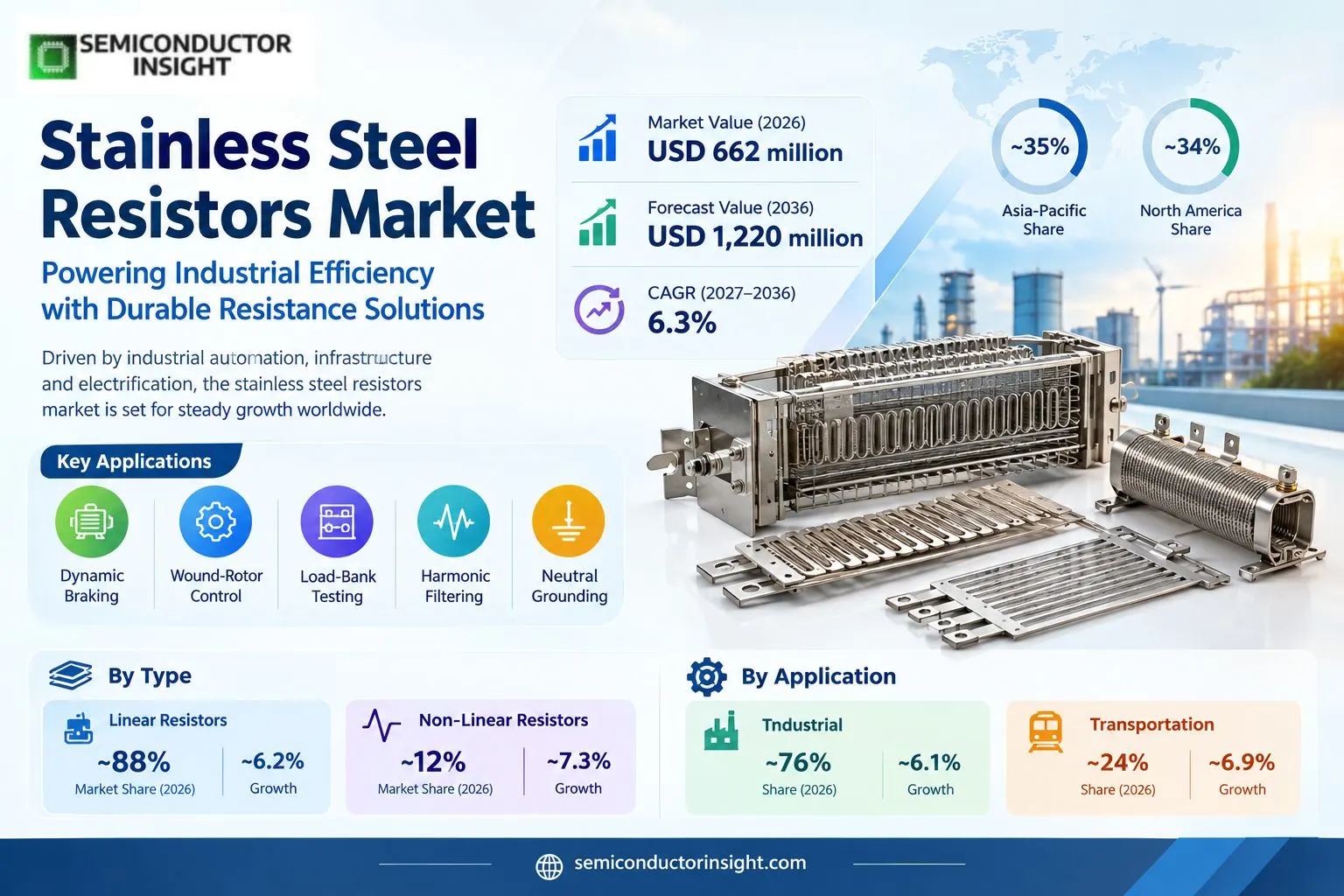
Stainless steel resistors market was valued at USD 662 million in 2026 and is projected to reach USD 1,220 million by 2036 at a 6.3% CAGR during 2027–2036. Asia-Pacific represents an estimated ~35% share, while North America accounts for ~34%. Revenue includes stainless-steel resistive elements and assemblies sold for current limitation, high-energy dissipation, dynamic braking and grounding; it does not include every resistor merely enclosed in stainless steel.

Get the sample PDF with study scope, segmentation and methodology details.

Key Statistics

2026 Market Size
USD 662 million
2036 Projected Size
USD 1,220 million
CAGR (2027–2036)
6.3%
Largest Market in 2026
Asia-Pacific (~35%)

Key Takeaways

  • Market outlook: USD 662 million in 2026 is projected to rise to USD 1,220 million in 2036 at 6.3% CAGR in 2027–2036, with demand linked to industrial motion control and engineered energy dissipation.
  • Linear-type leadership: Linear Resistors account for ~88% of modeled 2026 revenue and ~6.2% annual growth, consistent with suppliers describing conductive steel grid, ribbon and edgewound elements.
  • Application concentration: The published Tndustrial application class holds an estimated ~76% share; Transportation holds ~24% with ~6.9% modeled growth through the forecast horizon.
  • Regional positions: Asia-Pacific leads with ~35% modeled 2026 value, followed closely by North America at ~34% and Europe at ~21%; power-drive procurement is geographically diversified.
  • Engineering constraints: Continuous and pulse thermal ratings, mounting insulation, airflow, stainless alloy prices and competing resistor materials govern specification and replacement cycles in motor-drive systems.

Stainless Steel Resistors Market Overview

The stainless steel resistors market was valued at USD 662 million in 2026 and is projected to reach USD 1,220 million by 2036 at a 6.3% CAGR during 2027–2036. Asia-Pacific represents an estimated ~35% share, while North America accounts for ~34%. Revenue includes stainless-steel resistive elements and assemblies sold for current limitation, high-energy dissipation, dynamic braking and grounding; it does not include every resistor merely enclosed in stainless steel.

Global market | Base year 2026 | Estimated year 2027 | Forecast year 2036 | Unit USD million

Stainless steel resistance elements comprise formed plates, ribbons, wires or edgewound strips that convert electrical energy into heat at controlled resistance values. Suppliers assemble these conductors on insulating supports, often inside ventilated frames or protected cabinets. Their principal industrial functions include dynamic braking of motor-driven loads, wound-rotor control, load-bank testing, harmonic filtering and neutral grounding in electrically demanding locations.

The revenue boundary is the stainless-alloy conductor or purpose-built resistor assembly, including directly priced housings and terminals where supplied as part of the product. It excludes ordinary thick-film chip resistors made from other materials, resistive heaters sold solely as heaters, stainless steel cosmetic enclosures and complete drive systems. Keeping a common boundary avoids claiming that the entire market for precision electronic resistors is stainless steel.

Vishay describes welded stainless plate grids for medium- and high-power circuits, Post Glover lists stamped grids and long serpentine stainless ribbons, and Ohmite details AISI 304 grid plates and stainless-alloy edgewound elements. These manufacturer examples establish the core physical product more clearly than generic resistor segmentation. Component selection is dominated by current density, energy pulse duration, cooling and resistance stability over repeated operating cycles.

When a motor decelerates, excess energy may need to be dissipated in a resistor bank rather than passed back to the utility supply. In a grounding application, engineered resistance limits fault current and influences protective coordination. These use cases depend on distinct energy profiles, and material choice is not interchangeable with a miniature signal resistor. The supplier therefore competes on qualification, fabrication geometry and thermal durability.

Stainless alloys provide physical resilience in heavy industrial use, but the material alone does not guarantee a stable value or suitable environmental qualification. Grid design, welded electrical connections, temperature coefficient, corrosion performance and air circulation determine actual service suitability. Growth in transport electrification, infrastructure equipment and industrial automation supports opportunities only where the customer chooses resistive dissipation rather than regenerative braking or alternative circuit designs.

Segment Analysis: By Type

Published type labels separate Linear Resistors and Non-Linear Resistors. The first holds ~88% estimated 2026 market share with ~6.2% modeled growth, while the second represents ~12% and ~7.3% growth. Stainless grid, ribbon and edgewound power products behave principally as resistive conductors; any nonlinear category must therefore be treated as the published classification rather than evidence of a separately certified stainless-alloy device family.

Type Function Market position
Linear Resistors Steel plate grids, ribbons and edgewound alloy strips supply a chosen electrical resistance over their specified operating range. The product may be assembled into a ventilated resistor bank for braking, grounding or load simulation. Normal operating temperature changes alter the resistance to some degree, so engineers still review thermal coefficients instead of assuming mathematically perfect linearity. Largest modeled type with ~88% share of 2026 revenue and ~6.2% annual growth. Direct manufacturer examples include Ohmite GP plates, Vishay GRE grids and Post Glover ribbon elements. Purchasing is specification-led, and higher rated energy cycles and enclosure choices increase commercial differentiation. These modeled allocations are not supplier market-share disclosures. Within resistance equipment, engineers match peak-current and continuous ratings to a defined energy profile and examine the mounting geometry before procurement. Oversizing can impose needless enclosure and cost penalties while undersizing increases damage and downtime risk. Supplier application documentation provides design boundaries, whereas regional growth shares remain modeled estimates rather than measured manufacturer revenue distributions.
Non-Linear Resistors The second published type class reflects devices grouped by nonlinear resistance response. The accessible stainless-grid catalogues do not independently establish a large family of such components, so technical evaluation must verify the alloy composition and actual resistance-voltage or resistance-temperature characteristic of any product sold under the label. A nonlinear response should never be inferred from a stainless enclosure. Estimated ~12% of 2026 value and ~7.3% modeled annual growth under the published taxonomy. The figure is a provisional allocation that maintains overall reconciliation, not a demonstrated shipment share of stainless varistor products. Supply validation would require manufacturer datasheets with the relevant resistance characteristic and proof the element itself uses stainless alloy. For resistance equipment, an engineered purchase must specify resistance at operating temperature, permitted temperature rise, applied voltage, duty cycle, ventilation and insulation class. A manufacturer catalogue is a useful engineering reference, but it does not establish shipments in every geographic market or independently measured market share. Thermal validation and the buyer acceptance standard ultimately determine the component configuration.

Segment Analysis: By Application

The two published application classes are Tndustrial and Transportation, with modeled 2026 shares of ~76% and ~24%. The original spelling Tndustrial is retained as a taxonomy label; technically this covers industrial machinery, motor controls and power test systems. Transportation is projected to grow at ~6.9%, compared with ~6.1% for the first class, because traction and braking equipment place demanding cyclic loads on resistance assemblies.

Application Demand characteristics
Tndustrial An estimated ~76% of 2026 revenue with ~6.1% modeled growth is allocated to industrial functions, including cranes, pumps, industrial drives, neutral grounding and load banks. Post Glover documents stainless grid resistors for heavy-duty motors, while Vishay and Ohmite show high-power braking configurations. Engineers must distinguish a resistor alloy element from the complete drive cabinet and specify duty, insulation, current and available cooling.
Transportation An estimated ~24% share with ~6.9% modeled growth is linked to transportation traction and other motor-deceleration uses. Ohmite identifies resistor solutions for trains and elevators, and stainless resistance strips can withstand repeated energy pulses in appropriate designs. Actual product qualification depends on mechanical shock, enclosure protection, current cycling and mandated protection standards. Regenerative systems can reduce the need for energy dissipation in some configurations.

Industrial equipment makers commonly buy engineered resistance banks from specialist vendors, while transportation platforms may involve lengthy qualification and integration with a larger drive or brake manufacturer. Channels include direct engineering quotation, distributors and equipment integrators; low-cost standardized resistors are not suitable substitutes when thermal or electrical limits are exceeded. Replacement and retrofit contracts also create recurring demand where original dimensions and connection patterns can be matched.
Global Stainless Steel Resistors Market Industry Trends & Future Outlook

Regional Analysis

Asia-Pacific is assigned ~35% of 2026 stainless-steel resistor value, followed by North America at ~34%, Europe at ~21%, South America at ~6% and Middle East & Africa at ~4%. Estimated annual growth ranges from ~5.6% in Europe to ~6.8% in Middle East & Africa, with Asia-Pacific and North America each near ~6.5%. Manufacturers verify product capability; geographic shares are analytical estimates rather than independently published regional revenue totals.

Where do power-drive, braking and grounding applications support stainless resistance elements?

Geographic demand follows installed machinery, electric motor control upgrades, transport infrastructure, heavy-material handling and the presence of manufacturers able to supply qualified components. A resistor bank is bought for a duty-cycle and enclosure requirement, so market access varies with local machine builders and maintenance firms. Supplier catalogues describe technically relevant components, but country-level purchases and independent sales volumes are not supplied for every region.

Region Position Growth outlook Demand profile What decides supplier selection
Asia-Pacific Largest (~35%) ~6.5% CAGR Industrial manufacturing, urban rail systems and machinery exports; purchase shares are estimates. Equipment entry depends on locally qualified welding and heat-cycle tests, thermal testing and agreed mechanical interfaces.
North America Second largest (~34%) ~6.5% CAGR Resistor engineering firms, heavy industry and installed motor equipment; purchase shares are estimates. Equipment entry depends on defined temperature-rise, NEMA and equipment safety acceptance, thermal testing and agreed mechanical interfaces.
Europe Third largest (~21%) ~5.6% CAGR Industrial drive retrofits, rail power systems and wind infrastructure; purchase shares are estimates. Equipment entry depends on engineering documentation, enclosure ratings and procurement certification, thermal testing and agreed mechanical interfaces.
South America Developing (~6%) ~5.9% CAGR Mining machinery, industrial motors and equipment refurbishment; purchase shares are estimates. Equipment entry depends on availability of spares and tropical-environment corrosion controls, thermal testing and agreed mechanical interfaces.
Middle East & Africa Emerging (~4%) ~6.8% CAGR Energy utilities, rail investment and harsh-environment electrical equipment; purchase shares are estimates. Equipment entry depends on thermal derating and robust IP enclosure selection, thermal testing and agreed mechanical interfaces.

Asia-Pacific LARGEST · ~35% SHARE · ~6.5% CAGR

Which electrical applications shape the market for stainless grid and ribbon resistors in Asia-Pacific?

Asia-Pacific represents ~35% of estimated 2026 global stainless-steel resistor value with ~6.5% modeled annual growth. The region is associated with industrial manufacturing, urban rail systems and machinery exports. Buyers specify heat dissipation capacity and installation geometry before ordering, and market entry depends on locally qualified welding and heat-cycle tests. These positions reflect engineering demand scenarios rather than a manufacturer-reported regional sales audit.

Market positionLargest, ~35% modeled share
Growth outlook~6.5% CAGR, 2026–2036
Demand profileIndustrial manufacturing, urban rail systems and machinery exports
Market access gateLocally qualified welding and heat-cycle tests
Country Position in region What drives demand
China Asia-Pacific, ~35% region China participates in the Asia-Pacific engineering environment for industrial manufacturing, urban rail systems and machinery exports. For resistance banks, the key design inputs include full-load voltage, pulse current, cooling limits, enclosure space and the expected cycle interval. The modeled regional share is ~35% in 2026 with ~6.5% annual expansion; no independent national stainless-resistor revenue number is asserted here. Market access depends on locally qualified welding and heat-cycle tests.
Japan Asia-Pacific, ~35% region Japan participates in the Asia-Pacific engineering environment for industrial manufacturing, urban rail systems and machinery exports. For resistance banks, the key design inputs include full-load voltage, pulse current, cooling limits, enclosure space and the expected cycle interval. The modeled regional share is ~35% in 2026 with ~6.5% annual expansion; no independent national stainless-resistor revenue number is asserted here. Market access depends on locally qualified welding and heat-cycle tests.
South Korea Asia-Pacific, ~35% region South Korea participates in the Asia-Pacific engineering environment for industrial manufacturing, urban rail systems and machinery exports. For resistance banks, the key design inputs include full-load voltage, pulse current, cooling limits, enclosure space and the expected cycle interval. The modeled regional share is ~35% in 2026 with ~6.5% annual expansion; no independent national stainless-resistor revenue number is asserted here. Market access depends on locally qualified welding and heat-cycle tests.
India Asia-Pacific, ~35% region India participates in the Asia-Pacific engineering environment for industrial manufacturing, urban rail systems and machinery exports. For resistance banks, the key design inputs include full-load voltage, pulse current, cooling limits, enclosure space and the expected cycle interval. The modeled regional share is ~35% in 2026 with ~6.5% annual expansion; no independent national stainless-resistor revenue number is asserted here. Market access depends on locally qualified welding and heat-cycle tests.

Market instances

  • Manufacturer design data: Zenithsun in China describes BXG-1 stainless grids rated from 1 to 30 kW. This primary product evidence helps explain design requirements in Asia-Pacific, but it is not presented as proof of a completed local installation. Estimated regional share of ~35% and growth of ~6.5% are based on demand drivers and supplier access. The project engineer must verify resistance alloy, power rating, insulation and duty cycle.
  • Industrial equipment integration: Steel grid assemblies used for dynamic braking convert mechanical energy into heat during controlled motor deceleration. That function is relevant to Asia-Pacific where industrial manufacturing, urban rail systems and machinery exports create demand for robust resistive components. The specification is a duty-cycle and thermal test, not merely an interchangeable resistor value. No country shipment quantity is attributed to the general supplier catalogue.
  • Neutral grounding and load tests: Industrial grounding and equipment commissioning can require high-energy resistor banks, a use case documented in Vishay, Ohmite and Post Glover technical catalogues. Suppliers addressing Asia-Pacific must demonstrate thermal stability and insulation appropriate to system voltage. Regional growth of ~6.5% is modeled, and materials used in adjacent resistor systems are not automatically included without a stainless alloy verification.
In the full report: Technical purchase profiles, regional supply channels, Asia-Pacific qualified suppliers and application growth sensitivity.

North America SECOND LARGEST · ~34% SHARE · ~6.5% CAGR

Which electrical applications shape the market for stainless grid and ribbon resistors in North America?

North America represents ~34% of estimated 2026 global stainless-steel resistor value with ~6.5% modeled annual growth. The region is associated with resistor engineering firms, heavy industry and installed motor equipment. Buyers specify heat dissipation capacity and installation geometry before ordering, and market entry depends on defined temperature-rise, NEMA and equipment safety acceptance. These positions reflect engineering demand scenarios rather than a manufacturer-reported regional sales audit.

Market positionSecond largest, ~34% modeled share
Growth outlook~6.5% CAGR, 2026–2036
Demand profileResistor engineering firms, heavy industry and installed motor equipment
Market access gateDefined temperature-rise, nema and equipment safety acceptance
Country Position in region What drives demand
United States North America, ~34% region United States participates in the North America engineering environment for resistor engineering firms, heavy industry and installed motor equipment. For resistance banks, the key design inputs include full-load voltage, pulse current, cooling limits, enclosure space and the expected cycle interval. The modeled regional share is ~34% in 2026 with ~6.5% annual expansion; no independent national stainless-resistor revenue number is asserted here. Market access depends on defined temperature-rise, NEMA and equipment safety acceptance.
Canada North America, ~34% region Canada participates in the North America engineering environment for resistor engineering firms, heavy industry and installed motor equipment. For resistance banks, the key design inputs include full-load voltage, pulse current, cooling limits, enclosure space and the expected cycle interval. The modeled regional share is ~34% in 2026 with ~6.5% annual expansion; no independent national stainless-resistor revenue number is asserted here. Market access depends on defined temperature-rise, NEMA and equipment safety acceptance.
Mexico North America, ~34% region Mexico participates in the North America engineering environment for resistor engineering firms, heavy industry and installed motor equipment. For resistance banks, the key design inputs include full-load voltage, pulse current, cooling limits, enclosure space and the expected cycle interval. The modeled regional share is ~34% in 2026 with ~6.5% annual expansion; no independent national stainless-resistor revenue number is asserted here. Market access depends on defined temperature-rise, NEMA and equipment safety acceptance.

Market instances

  • Manufacturer design data: Post Glover in the United States describes stainless ribbons and severe-duty crane motor resistors. This primary product evidence helps explain design requirements in North America, but it is not presented as proof of a completed local installation. Estimated regional share of ~34% and growth of ~6.5% are based on demand drivers and supplier access. The project engineer must verify resistance alloy, power rating, insulation and duty cycle.
  • Industrial equipment integration: Steel grid assemblies used for dynamic braking convert mechanical energy into heat during controlled motor deceleration. That function is relevant to North America where resistor engineering firms, heavy industry and installed motor equipment create demand for robust resistive components. The specification is a duty-cycle and thermal test, not merely an interchangeable resistor value. No country shipment quantity is attributed to the general supplier catalogue.
  • Neutral grounding and load tests: Industrial grounding and equipment commissioning can require high-energy resistor banks, a use case documented in Vishay, Ohmite and Post Glover technical catalogues. Suppliers addressing North America must demonstrate thermal stability and insulation appropriate to system voltage. Regional growth of ~6.5% is modeled, and materials used in adjacent resistor systems are not automatically included without a stainless alloy verification.
In the full report: Technical purchase profiles, regional supply channels, North America qualified suppliers and application growth sensitivity.

Europe THIRD LARGEST · ~21% SHARE · ~5.6% CAGR

Which electrical applications shape the market for stainless grid and ribbon resistors in Europe?

Europe represents ~21% of estimated 2026 global stainless-steel resistor value with ~5.6% modeled annual growth. The region is associated with industrial drive retrofits, rail power systems and wind infrastructure. Buyers specify heat dissipation capacity and installation geometry before ordering, and market entry depends on engineering documentation, enclosure ratings and procurement certification. These positions reflect engineering demand scenarios rather than a manufacturer-reported regional sales audit.

Market positionThird largest, ~21% modeled share
Growth outlook~5.6% CAGR, 2026–2036
Demand profileIndustrial drive retrofits, rail power systems and wind infrastructure
Market access gateEngineering documentation, enclosure ratings and procurement certification
Country Position in region What drives demand
Germany Europe, ~21% region Germany participates in the Europe engineering environment for industrial drive retrofits, rail power systems and wind infrastructure. For resistance banks, the key design inputs include full-load voltage, pulse current, cooling limits, enclosure space and the expected cycle interval. The modeled regional share is ~21% in 2026 with ~5.6% annual expansion; no independent national stainless-resistor revenue number is asserted here. Market access depends on engineering documentation, enclosure ratings and procurement certification.
United Kingdom Europe, ~21% region United Kingdom participates in the Europe engineering environment for industrial drive retrofits, rail power systems and wind infrastructure. For resistance banks, the key design inputs include full-load voltage, pulse current, cooling limits, enclosure space and the expected cycle interval. The modeled regional share is ~21% in 2026 with ~5.6% annual expansion; no independent national stainless-resistor revenue number is asserted here. Market access depends on engineering documentation, enclosure ratings and procurement certification.
France Europe, ~21% region France participates in the Europe engineering environment for industrial drive retrofits, rail power systems and wind infrastructure. For resistance banks, the key design inputs include full-load voltage, pulse current, cooling limits, enclosure space and the expected cycle interval. The modeled regional share is ~21% in 2026 with ~5.6% annual expansion; no independent national stainless-resistor revenue number is asserted here. Market access depends on engineering documentation, enclosure ratings and procurement certification.
Italy Europe, ~21% region Italy participates in the Europe engineering environment for industrial drive retrofits, rail power systems and wind infrastructure. For resistance banks, the key design inputs include full-load voltage, pulse current, cooling limits, enclosure space and the expected cycle interval. The modeled regional share is ~21% in 2026 with ~5.6% annual expansion; no independent national stainless-resistor revenue number is asserted here. Market access depends on engineering documentation, enclosure ratings and procurement certification.

Market instances

  • Manufacturer design data: Vishay GRE product pages identify grid resistors for wind energy and industrial power equipment. This primary product evidence helps explain design requirements in Europe, but it is not presented as proof of a completed local installation. Estimated regional share of ~21% and growth of ~5.6% are based on demand drivers and supplier access. The project engineer must verify resistance alloy, power rating, insulation and duty cycle.
  • Industrial equipment integration: Steel grid assemblies used for dynamic braking convert mechanical energy into heat during controlled motor deceleration. That function is relevant to Europe where industrial drive retrofits, rail power systems and wind infrastructure create demand for robust resistive components. The specification is a duty-cycle and thermal test, not merely an interchangeable resistor value. No country shipment quantity is attributed to the general supplier catalogue.
  • Neutral grounding and load tests: Industrial grounding and equipment commissioning can require high-energy resistor banks, a use case documented in Vishay, Ohmite and Post Glover technical catalogues. Suppliers addressing Europe must demonstrate thermal stability and insulation appropriate to system voltage. Regional growth of ~5.6% is modeled, and materials used in adjacent resistor systems are not automatically included without a stainless alloy verification.
In the full report: Technical purchase profiles, regional supply channels, Europe qualified suppliers and application growth sensitivity.

South America DEVELOPING · ~6% SHARE · ~5.9% CAGR

Which electrical applications shape the market for stainless grid and ribbon resistors in South America?

South America represents ~6% of estimated 2026 global stainless-steel resistor value with ~5.9% modeled annual growth. The region is associated with mining machinery, industrial motors and equipment refurbishment. Buyers specify heat dissipation capacity and installation geometry before ordering, and market entry depends on availability of spares and tropical-environment corrosion controls. These positions reflect engineering demand scenarios rather than a manufacturer-reported regional sales audit.

Market positionDeveloping, ~6% modeled share
Growth outlook~5.9% CAGR, 2026–2036
Demand profileMining machinery, industrial motors and equipment refurbishment
Market access gateAvailability of spares and tropical-environment corrosion controls
Country Position in region What drives demand
Brazil South America, ~6% region Brazil participates in the South America engineering environment for mining machinery, industrial motors and equipment refurbishment. For resistance banks, the key design inputs include full-load voltage, pulse current, cooling limits, enclosure space and the expected cycle interval. The modeled regional share is ~6% in 2026 with ~5.9% annual expansion; no independent national stainless-resistor revenue number is asserted here. Market access depends on availability of spares and tropical-environment corrosion controls.
Argentina South America, ~6% region Argentina participates in the South America engineering environment for mining machinery, industrial motors and equipment refurbishment. For resistance banks, the key design inputs include full-load voltage, pulse current, cooling limits, enclosure space and the expected cycle interval. The modeled regional share is ~6% in 2026 with ~5.9% annual expansion; no independent national stainless-resistor revenue number is asserted here. Market access depends on availability of spares and tropical-environment corrosion controls.
Colombia South America, ~6% region Colombia participates in the South America engineering environment for mining machinery, industrial motors and equipment refurbishment. For resistance banks, the key design inputs include full-load voltage, pulse current, cooling limits, enclosure space and the expected cycle interval. The modeled regional share is ~6% in 2026 with ~5.9% annual expansion; no independent national stainless-resistor revenue number is asserted here. Market access depends on availability of spares and tropical-environment corrosion controls.

Market instances

  • Manufacturer design data: Post Glover catalogues welded elements for mining, material handling and heavy industrial starting. This primary product evidence helps explain design requirements in South America, but it is not presented as proof of a completed local installation. Estimated regional share of ~6% and growth of ~5.9% are based on demand drivers and supplier access. The project engineer must verify resistance alloy, power rating, insulation and duty cycle.
  • Industrial equipment integration: Steel grid assemblies used for dynamic braking convert mechanical energy into heat during controlled motor deceleration. That function is relevant to South America where mining machinery, industrial motors and equipment refurbishment create demand for robust resistive components. The specification is a duty-cycle and thermal test, not merely an interchangeable resistor value. No country shipment quantity is attributed to the general supplier catalogue.
  • Neutral grounding and load tests: Industrial grounding and equipment commissioning can require high-energy resistor banks, a use case documented in Vishay, Ohmite and Post Glover technical catalogues. Suppliers addressing South America must demonstrate thermal stability and insulation appropriate to system voltage. Regional growth of ~5.9% is modeled, and materials used in adjacent resistor systems are not automatically included without a stainless alloy verification.
In the full report: Technical purchase profiles, regional supply channels, South America qualified suppliers and application growth sensitivity.

Middle East & Africa EMERGING · ~4% SHARE · ~6.8% CAGR

Which electrical applications shape the market for stainless grid and ribbon resistors in Middle East & Africa?

Middle East & Africa represents ~4% of estimated 2026 global stainless-steel resistor value with ~6.8% modeled annual growth. The region is associated with energy utilities, rail investment and harsh-environment electrical equipment. Buyers specify heat dissipation capacity and installation geometry before ordering, and market entry depends on thermal derating and robust IP enclosure selection. These positions reflect engineering demand scenarios rather than a manufacturer-reported regional sales audit.

Market positionEmerging, ~4% modeled share
Growth outlook~6.8% CAGR, 2026–2036
Demand profileEnergy utilities, rail investment and harsh-environment electrical equipment
Market access gateThermal derating and robust ip enclosure selection
Country Position in region What drives demand
Saudi Arabia Middle East & Africa, ~4% region Saudi Arabia participates in the Middle East & Africa engineering environment for energy utilities, rail investment and harsh-environment electrical equipment. For resistance banks, the key design inputs include full-load voltage, pulse current, cooling limits, enclosure space and the expected cycle interval. The modeled regional share is ~4% in 2026 with ~6.8% annual expansion; no independent national stainless-resistor revenue number is asserted here. Market access depends on thermal derating and robust IP enclosure selection.
United Arab Emirates Middle East & Africa, ~4% region United Arab Emirates participates in the Middle East & Africa engineering environment for energy utilities, rail investment and harsh-environment electrical equipment. For resistance banks, the key design inputs include full-load voltage, pulse current, cooling limits, enclosure space and the expected cycle interval. The modeled regional share is ~4% in 2026 with ~6.8% annual expansion; no independent national stainless-resistor revenue number is asserted here. Market access depends on thermal derating and robust IP enclosure selection.
South Africa Middle East & Africa, ~4% region South Africa participates in the Middle East & Africa engineering environment for energy utilities, rail investment and harsh-environment electrical equipment. For resistance banks, the key design inputs include full-load voltage, pulse current, cooling limits, enclosure space and the expected cycle interval. The modeled regional share is ~4% in 2026 with ~6.8% annual expansion; no independent national stainless-resistor revenue number is asserted here. Market access depends on thermal derating and robust IP enclosure selection.
Egypt Middle East & Africa, ~4% region Egypt participates in the Middle East & Africa engineering environment for energy utilities, rail investment and harsh-environment electrical equipment. For resistance banks, the key design inputs include full-load voltage, pulse current, cooling limits, enclosure space and the expected cycle interval. The modeled regional share is ~4% in 2026 with ~6.8% annual expansion; no independent national stainless-resistor revenue number is asserted here. Market access depends on thermal derating and robust IP enclosure selection.

Market instances

  • Manufacturer design data: Vishay and Ohmite supplier catalogs include neutral grounding and outdoor-compatible resistor enclosures. This primary product evidence helps explain design requirements in Middle East & Africa, but it is not presented as proof of a completed local installation. Estimated regional share of ~4% and growth of ~6.8% are based on demand drivers and supplier access. The project engineer must verify resistance alloy, power rating, insulation and duty cycle.
  • Industrial equipment integration: Steel grid assemblies used for dynamic braking convert mechanical energy into heat during controlled motor deceleration. That function is relevant to Middle East & Africa where energy utilities, rail investment and harsh-environment electrical equipment create demand for robust resistive components. The specification is a duty-cycle and thermal test, not merely an interchangeable resistor value. No country shipment quantity is attributed to the general supplier catalogue.
  • Neutral grounding and load tests: Industrial grounding and equipment commissioning can require high-energy resistor banks, a use case documented in Vishay, Ohmite and Post Glover technical catalogues. Suppliers addressing Middle East & Africa must demonstrate thermal stability and insulation appropriate to system voltage. Regional growth of ~6.8% is modeled, and materials used in adjacent resistor systems are not automatically included without a stainless alloy verification.
In the full report: Technical purchase profiles, regional supply channels, Middle East & Africa qualified suppliers and application growth sensitivity.

Competitive Landscape

Stainless-steel resistance products compete on verified alloy construction and duty-cycle capability, not the size of a company’s overall chip-resistor portfolio. Vishay, Ohmite, Post Glover and Zenithsun publish direct grid, ribbon or edgewound product information. The larger profile universe also contains general electronic resistor manufacturers for which current stainless grid production has not been substantiated by the reviewed product documents.

Vishay Milwaukee specifies welded stainless grid plates with high-energy absorption requirements, including GRE1 and GRE2 arrangements. Ohmite GP uses AISI 304 stainless plate construction; HCLB uses a stainless alloy edgewound element. Post Glover documents both stamped grids and serpentine ribbons. These are direct material-qualified examples, though their catalogs do not reveal a verified global supplier ranking.

Zenithsun’s BXG-1 stainless steel grid page states 1 kW to 30 kW ratings and 0.01 to 50 ohm configurations, supporting the presence of an Asian supplier in high-energy industrial applications. Steel grade, resistor bank isolation and enclosure protection vary by design. Comparison requires the same power and duty conditions; relative catalog breadth does not establish revenue market share.

The larger profiled list includes chip and film resistor suppliers. Their presence in adjacent electronics sectors cannot be treated as evidence they sell stainless resistance elements matching these products. A qualification-based tier structure therefore places companies with explicit steel grid or alloy element disclosures in the direct classes and keeps unverified participants in an adjacent category.

The engineering buyer selects on voltage, pulse energy, continuous amperage, thermal derating, mechanical robustness and documentation of materials. Fabrication quality at welded joints matters because repeated high-energy cycles can create hot spots and resistance drift. Distributors compete on lead time and spares, while original manufacturers compete on custom frame design and certified operating envelopes.

Tier structure

Tier Companies Basis of competition
Tier 1 — Direct steel grid suppliers Vishay Milwaukee; Ohmite Vishay and Ohmite show named grid series manufactured with stainless steel plate elements, including GRE and GP models. Both vendors provide technical parameters required for industrial procurement, but neither source provides a complete audited market share. They are listed as verified direct suppliers, not as proven first- and second-largest companies by turnover. Within resistance equipment, engineers match peak-current and continuous ratings to a defined energy profile and examine the mounting geometry before procurement. Oversizing can impose needless enclosure and cost penalties while undersizing increases damage and downtime risk. Supplier application documentation provides design boundaries, whereas regional growth shares remain modeled estimates rather than measured manufacturer revenue distributions.
Tier 2 — Specialist element suppliers Post Glover Resistors; Zenithsun Post Glover provides stamped grids, ribbons and alloy edgewound elements for severe industrial conditions. Zenithsun offers stainless steel grid banks with published power and resistance ranges. Their supplier status is grounded in product pages; the tier refers to their specialist construction focus and does not claim lower sales than the preceding vendors. For resistance equipment, an engineered purchase must specify resistance at operating temperature, permitted temperature rise, applied voltage, duty cycle, ventilation and insulation class. A manufacturer catalogue is a useful engineering reference, but it does not establish shipments in every geographic market or independently measured market share. Thermal validation and the buyer acceptance standard ultimately determine the component configuration.
Tier 3 — Adjacent electronics suppliers Koa, Yageo, Panasonic Electronic Devices, Walsin Technology, Rohm, Hokuriku Electric, Ta-I Technology, Akahane Electronics Industrial, Aeco Electronics, Aem, Akahane Electronics, Alpha, Amotech, Avx, Barry Industries, Beihai Yinhe, Betatherm, Bourns These companies appear in the published broader resistor-profile universe, yet the inspected evidence does not substantiate each as an active steel grid, ribbon or stainless-alloy element supplier. Several principally address different electronic component constructions. They are retained for category visibility and must not be presented as verified direct-market leaders without a relevant material-qualified product reference.

Key companies profiled

  • Vishay Intertechnology
  • Koa
  • Yageo
  • Panasonic Electronic Devices
  • Walsin Technology
  • Rohm
  • Hokuriku Electric
  • Ta-I Technology
  • Akahane Electronics Industrial
  • Aeco Electronics
  • Aem
  • Akahane Electronics
  • Alpha
  • Amotech
  • Avx
  • Barry Industries
  • Beihai Yinhe
  • Betatherm
  • Bourns

Production Capacity Analysis

Stainless steel resistor supply involves alloy sourcing, plate stamping or ribbon forming, controlled resistance geometry, welded connections, ceramic or mica insulation and bank assembly. Manufacturer documentation describes multiple construction methods, but global unit capacity for this particular material-qualified category is not disclosed consistently. Available production therefore depends on application-specific fabrication cells and the ability to complete electrical and heat-cycle verification.

Stamping stainless grid plates enables repeatable current paths and mechanically rugged resistor banks. A fabricator can alter plate count, geometry or series connections to reach a target nominal ohmic value and permitted energy profile. Production constraints include alloy thickness control, weld quality and insulator availability. A named power rating must also be interpreted against the supplier’s temperature and airflow conditions.

Ribbon and edgewound fabrication supports different current, space and cooling conditions. Post Glover describes a continuous stainless strip in a formed ribbon, while Ohmite specifies edgewound stainless-alloy elements in high-current banks. International customers often require customized mounting and terminal positions; assembly capacity is therefore less meaningful than the output of fully tested equipment conforming to the project drawing.

Industrial power product manufacturing can be constrained by steel alloy cost, thermal treatment, insulating supports, specialized welding and the time needed for cyclic testing. Electrical failures in braking or grounding are high-consequence, making traceability and defect screening important commercial capabilities. Regional growth estimates should not be interpreted as proportional increases in available production capacity without plant and supplier evidence.

Market Dynamics

Demand for steel grid and alloy ribbon resistors reflects industrial motor control, power equipment maintenance, transport braking and electrical protection. Competing technologies can reduce reliance on resistive energy dissipation, while stronger industrial automation and retrofit budgets create demand for rugged replacement banks. Directional drivers and restraints have distinct economic effects; they are not additive pieces of the forecast CAGR.

MARKET DRIVERS

Drivers Impact Analysis*

Driver (~) % impact on CAGR forecast Geographic relevance Impact timeline
Industrial motor renewal +0.7% Factory equipment worldwide 2026–2034
Dynamic braking retrofits +0.5% Crane and materials handling 2027–2036
High-current load testing +0.4% Power and utility systems 2026–2035
Rail and traction equipment +0.6% Asia-Pacific and Europe 2028–2036
Grounding system upgrades +0.3% Industrial utilities 2026–2036

Heavy-duty braking duty cycles

A stainless grid resistor bank absorbs high-energy pulses when a motor slows a heavy load and the drive requires resistive braking. This is relevant for cranes, hoists and industrial movement systems that repeatedly accelerate and decelerate. Selection depends on thermal storage, cooling intervals and electrical protection rather than general electronic component miniaturisation. For resistance equipment, an engineered purchase must specify resistance at operating temperature, permitted temperature rise, applied voltage, duty cycle, ventilation and insulation class. A manufacturer catalogue is a useful engineering reference, but it does not establish shipments in every geographic market or independently measured market share. Thermal validation and the buyer acceptance standard ultimately determine the component configuration.

Industrial equipment refurbishment

Installed machinery creates replacement needs when a resistor element becomes corroded, electrically damaged or unsuited to a changed operating profile. Post Glover’s industrial descriptions and Vishay’s product literature emphasize robust constructions for severe-duty use. A replacement must match terminal positions, resistance and thermal specifications, which benefits capable custom fabricators. For resistance equipment, a customer typically considers stainless alloy grade, mechanical supports, corrosion exposure and the frequency of high-energy pulses. Selection criteria are materially different from a surface-mounted signal resistor because the system converts electrical energy to heat. Project specifications, cooling conditions, frame protection and maintainability shape the purchase more than the headline nominal ohms value.

Utility and power-system protection

Neutral grounding and harmonic-filter assemblies rely on appropriately sized resistive elements to manage fault energy or dissipate unwanted currents. Stainless alloy grid products are offered by several suppliers for these applications. The customer’s relevant acceptance tests include resistance stability, insulation, current waveform and enclosed heat rise at the specific duty. Within resistance equipment, engineers match peak-current and continuous ratings to a defined energy profile and examine the mounting geometry before procurement. Oversizing can impose needless enclosure and cost penalties while undersizing increases damage and downtime risk. Supplier application documentation provides design boundaries, whereas regional growth shares remain modeled estimates rather than measured manufacturer revenue distributions.

Industrial transportation electrification

Transport equipment and elevators expose braking components to mechanical vibration and repeated electrical pulses. Ohmite lists high-current braking solutions for rail and elevators, while Zenithsun describes traction-related grid applications. Opportunity depends on the selected brake architecture because energy recovery technologies can replace some resistive dissipation duties. For resistance equipment, an engineered purchase must specify resistance at operating temperature, permitted temperature rise, applied voltage, duty cycle, ventilation and insulation class. A manufacturer catalogue is a useful engineering reference, but it does not establish shipments in every geographic market or independently measured market share. Thermal validation and the buyer acceptance standard ultimately determine the component configuration.

MARKET RESTRAINTS

Restraints Impact Analysis*

Restraint (~) % impact on CAGR forecast Geographic relevance Impact timeline
Stainless alloy cost -0.4% Global metal fabricators 2026–2031
Regenerative drive alternatives -0.6% Industrial and traction drives 2027–2036
Thermal and enclosure penalties -0.5% Space-constrained projects 2026–2036
Custom validation lead times -0.3% Safety critical equipment 2026–2034

Alternative dissipative materials

Nickel-chromium alloys, ceramic systems and other resistor technologies may be preferable for particular temperature coefficients or package sizes. Material selection is guided by electrical and thermal qualification rather than broad claims about corrosion resistance. A stainless steel element that meets one braking requirement should not be assumed superior in every precision measurement or signal circuit.

Competing energy recovery designs

Modern variable speed drives can route braking energy into a regenerative front end or shared electrical bus. Where those systems are economical, a resistor bank becomes a safety backup or smaller auxiliary load rather than the main heat dissipation path. A growing electric motor market therefore does not translate into identical growth for braking resistors.

Thermal and airflow constraints

The resistor converts electrical energy into heat, and insufficient cooling can damage elements or nearby equipment. Vishay discusses braking failures from improper sizing or cooling, making thermal design a central selection hurdle. Enclosures with greater ingress protection can also complicate ventilation, requiring project-specific derating and physical clearance. For resistance equipment, an engineered purchase must specify resistance at operating temperature, permitted temperature rise, applied voltage, duty cycle, ventilation and insulation class. A manufacturer catalogue is a useful engineering reference, but it does not establish shipments in every geographic market or independently measured market share. Thermal validation and the buyer acceptance standard ultimately determine the component configuration.

Price and qualification costs

A fabricated stainless grid assembly may require customized plates, welded joints, isolators, wiring and an enclosure. Such bills of material create a higher engineering burden than commodity chip resistors. Long qualification cycles, transport vibration tests and repeatable insulation performance can delay orders, particularly where buyers face uncertain machinery investment plans. For resistance equipment, a customer typically considers stainless alloy grade, mechanical supports, corrosion exposure and the frequency of high-energy pulses. Selection criteria are materially different from a surface-mounted signal resistor because the system converts electrical energy to heat. Project specifications, cooling conditions, frame protection and maintainability shape the purchase more than the headline nominal ohms value.

MARKET OPPORTUNITIES

Modular grid bank designs

Manufacturers can offer configurable resistor banks assembled from validated plate or ribbon elements. Standard frame and terminal options simplify engineering, while tailored series and parallel connections meet the target ohms and energy rating. Buyers benefit when suppliers provide transparent duty-cycle curves, testing documentation and quick access to replaceable modules. Within resistance equipment, engineers match peak-current and continuous ratings to a defined energy profile and examine the mounting geometry before procurement. Oversizing can impose needless enclosure and cost penalties while undersizing increases damage and downtime risk. Supplier application documentation provides design boundaries, whereas regional growth shares remain modeled estimates rather than measured manufacturer revenue distributions.

Industrial after-market replacements

Older cranes, pumps and transport systems often require components matched to established mechanical dimensions. Suppliers offering retrofit engineering can compete on short delivery schedules and mechanical compatibility. Care is necessary because an apparently similar resistance value may behave differently under pulse energy, vibration and sustained current. For resistance equipment, an engineered purchase must specify resistance at operating temperature, permitted temperature rise, applied voltage, duty cycle, ventilation and insulation class. A manufacturer catalogue is a useful engineering reference, but it does not establish shipments in every geographic market or independently measured market share. Thermal validation and the buyer acceptance standard ultimately determine the component configuration.

Wind and energy-infrastructure duty

Wind turbines, industrial inverters and grounding systems can require energy absorption or resistive testing during operation and commissioning. Vishay identifies these end uses in its grid product descriptions. Suppliers that can deliver corrosion-resilient frames and calibrated protection ratings may secure technically differentiated contracts in harsh-service energy assets. For resistance equipment, a customer typically considers stainless alloy grade, mechanical supports, corrosion exposure and the frequency of high-energy pulses. Selection criteria are materially different from a surface-mounted signal resistor because the system converts electrical energy to heat. Project specifications, cooling conditions, frame protection and maintainability shape the purchase more than the headline nominal ohms value.

High-current test and load-bank equipment

Grid and edgewound elements can be built into load banks that simulate demanding electrical conditions for equipment tests. Custom power, voltage and cooling arrangements can generate value beyond the conductor alone, although whole systems must not be double-counted in an element-focused revenue total. Engineering channels and maintenance support remain important differentiators. Within resistance equipment, engineers match peak-current and continuous ratings to a defined energy profile and examine the mounting geometry before procurement. Oversizing can impose needless enclosure and cost penalties while undersizing increases damage and downtime risk. Supplier application documentation provides design boundaries, whereas regional growth shares remain modeled estimates rather than measured manufacturer revenue distributions.

Supply Chain Analysis

A stainless resistance element passes through alloy procurement, forming and welding, insulation, electrical finishing, bank assembly, mechanical qualification and customer installation. Direct suppliers provide metal-specific product evidence; broader electronic resistor companies cannot be assumed to use the same manufacturing route. The customer buys a complete electrical and thermal performance envelope, with distributor service and spare components often shaping long-term value.

UpstreamResistance-grade stainless alloy strip or plate, insulators, terminals, frames and fasteners.
ManufacturingGrid stamping, ribbon shaping, welding, bank assembly, resistance and insulation testing.
ChannelSpecialist OEMs, power equipment integrators, engineered component dealers and distributors.
DownstreamElectric drives, cranes, rail systems, power stations, industrial grounding and load banks.

Upstream. Material quality influences the resistive behavior and life of a fabricated element. Alloy batches require suitable chemical composition and thickness, while porcelain, mica and other supports must withstand voltage and temperature requirements. Changes in sourcing need to be reflected in technical acceptance because a power-bank design cannot be validated solely by visual geometry.

Manufacturing. Fabricators form conductor paths that distribute current and avoid local overheating. Welding must maintain low-contact resistance while accommodating thermal expansion, and insulated supports must endure vibration and electrical stress. Final verification includes ohmic checks, insulation integrity and thermal qualification appropriate to the finished frame rather than the nominal raw material alone. Within resistance equipment, engineers match peak-current and continuous ratings to a defined energy profile and examine the mounting geometry before procurement. Oversizing can impose needless enclosure and cost penalties while undersizing increases damage and downtime risk. Supplier application documentation provides design boundaries, whereas regional growth shares remain modeled estimates rather than measured manufacturer revenue distributions.

Channel. Many industrial buyers order through an electrical equipment integrator or a company servicing installed motors. A component maker may provide an approved bank design while a local contractor handles enclosure wiring and commissioning. Commercial terms often depend on documentation, lead time, field support and the ability to replicate special terminals from a legacy installation.

Downstream. End uses include crane brakes, large pumps, rail traction control, wind-related equipment and grounding networks. Each imposes different duration, frequency, fault and ambient temperature profiles, so the same resistance value can require very different metal volumes and cooling. Supplier differentiation follows the application duty rather than simply the count of resistor elements assembled.

Recent Developments

  • October 2026 Reported
    Vishay Milwaukee’s current grid-resistor documentation describes welded stainless plates for dynamic braking, wind-related equipment, harmonic filtering and neutral grounding. This confirms product availability for several heavy electrical uses, but does not assign a new product launch date or country shipment total. Buyers still need to validate resistance, enclosure ingress protection and peak-energy duty for each purchase. Source
  • October 2026 Reported
    Vishay’s GRE3 technical information states power handling as high as 36 kW at a specified ambient temperature and identifies braking and load simulation applications. The catalog rating is a product specification, not an observed utilization rate. The commercial significance is the ability to engineer larger energy absorption requirements with verified stainless-grid technology. For high-power resistor engineering, a customer typically considers stainless alloy grade, mechanical supports, corrosion exposure and the frequency of high-energy pulses. Selection criteria are materially different from a surface-mounted signal resistor because the system converts electrical energy to heat. Project specifications, cooling conditions, frame protection and maintainability shape the purchase more than the headline nominal ohms value. Source
  • October 2026 Reported
    Ohmite’s GP product documentation describes welded grid plates using primarily AISI 304 stainless steel and alternative enclosure arrangements for industrial braking and grounding. An available product range with multiple protection options gives engineers configuration flexibility. These product specifications are not treated as evidence of a newly announced factory, customer contract or installation count. Source
  • October 2026 Reported
    Post Glover’s resistor-element information describes stamped metal grids and serpentine stainless steel ribbons rated for severe-duty industrial use. The direct metal-construction statement is important for separating these banks from ordinary chip resistor suppliers. Rated voltage, allowable continuous current and installation conditions remain critical when comparing competing engineered offers. For high-power resistor engineering, an engineered purchase must specify resistance at operating temperature, permitted temperature rise, applied voltage, duty cycle, ventilation and insulation class. A manufacturer catalogue is a useful engineering reference, but it does not establish shipments in every geographic market or independently measured market share. Thermal validation and the buyer acceptance standard ultimately determine the component configuration. Source
  • October 2026 Reported
    Ohmite’s HCLB high-current load-bank documentation specifies a stainless steel resistance-alloy element in an oval edgewound construction used in severe transportation braking applications. Its data supports a distinct manufacturing route from welded grid plates. The availability of different forms gives equipment designers options for fitting the required current and heat-duty profile into an existing package. Source
  • October 2026 Reported
    Zenithsun’s BXG-1 product listing describes stainless grid resistance banks spanning specified power and ohmic ranges for traction, motor braking and neutral grounding. The published figures establish an Asian catalog offering in the defined material group without indicating sales volume. Engineering buyers need to check thermal protection, duty cycle and installed voltage before design acceptance. Source

REPORT SCOPE & SEGMENTATION

Attribute Details
Study Period 2021–2036
Historical Period 2021–2025
Base Year 2026
Estimated Year 2027
Forecast Period 2027–2036
2026 Market Size USD 662 million
2027 Estimated Size USD 704 million
2036 Market Size USD 1,220 million
CAGR (2027–2036) 6.3%
Unit USD million, stainless-steel resistance elements and qualified resistor banks
By Type Linear Resistors · Non-Linear Resistors
By Application Tndustrial · Transportation
By Region Five international regions and country coverage; all region shares are estimated, not audited manufacturer revenues.
Asia-PacificChina, Japan, South Korea, India
North AmericaUnited States, Canada, Mexico
EuropeGermany, United Kingdom, France, Italy
South AmericaBrazil, Argentina, Colombia
Middle East & AfricaSaudi Arabia, United Arab Emirates, South Africa, Egypt
Key Companies Profiled Vishay Intertechnology, Koa, Yageo, Panasonic Electronic Devices, Walsin Technology, Rohm, Hokuriku Electric, Ta-I Technology, Akahane Electronics Industrial, Aeco Electronics, Aem, Akahane Electronics, Alpha, Amotech, Avx, Barry Industries, Beihai Yinhe, Betatherm, Bourns
Customization Scope Stainless alloy grade, ribbon/grid geometry, energy cycle, power/ohmic parameters, industrial and transport application, enclosure class and manufacturer verification.

Frequently Asked Questions

What is the global market size and outlook for stainless steel resistors?

The market is valued at USD 662 million in 2026 and projected to reach USD 1,220 million in 2036, equivalent to a 6.3% CAGR over 2027–2036. This product boundary concerns stainless alloy resistance elements used in industrial power control and related applications. General-purpose film chip resistors and stainless enclosures without stainless resistive material are excluded from the defined product revenue.

Which resistor type has the largest estimated share?

Linear Resistors represent ~88% of the modeled 2026 market and expand at ~6.2% annually. Product catalogs from Vishay, Ohmite and Post Glover show steel plate, ribbon and edgewound construction used to create defined resistance paths. The published Non-Linear Resistors label remains in the segmentation, but direct stainless-alloy product proof is more limited for that class.

What applications are most important?

The published Tndustrial segment, including industrial motor control and power equipment, contributes ~76% of modeled 2026 revenue. Transportation is estimated at ~24%, with ~6.9% annual growth through 2036. Industrial demand is associated with cranes, motor drives, grounding and load banks, whereas transportation specifications place emphasis on repeated braking pulses, shock exposure and safe heat dissipation.

Which geographic market is the largest?

Asia-Pacific is assigned ~35% of 2026 revenue, followed by North America at ~34% and Europe at ~21%. South America represents ~6%, and Middle East & Africa ~4%. These values are geographically distributed estimates based on application demand and supplier presence; they are not independently published stainless steel resistor revenues for all five regions.

How fast are regional markets expected to grow?

Modeled annual regional growth is ~6.5% in Asia-Pacific and ~6.5% in North America, ~5.6% in Europe, ~5.9% in South America and ~6.8% in Middle East & Africa. The rates reconcile with the total forecast but rely on engineering-demand scenarios. Rail programs, industrial investments, manufacturing costs and local supplier qualification could shift realized rates.

Why use stainless steel in a high-power resistor?

Stainless resistance alloys can be fabricated into grids, ribbons and edgewound strips for robust electrically resistive paths under demanding conditions. Manufacturers emphasize high pulse absorption, mechanical strength and industrial durability. Material choice still depends on calculated temperature rise, resistance drift, corrosion and the duty cycle; stainless steel is not a universal substitute for every precision electronic component.

How are these products used for dynamic braking?

During electrical motor deceleration, some circuits route the generated energy into a resistive load that converts it to heat. Steel grids and ribbon banks can be sized for the resulting voltage, current, energy and cooling requirements. Engineers must consider repeated cycles and mounting ventilation; regenerative braking can displace the resistor function in certain system designs.

Which manufacturers document relevant products?

Vishay Milwaukee provides GRE steel grid products; Ohmite documents GP stainless plates and HCLB steel-alloy edgewound banks; Post Glover describes stainless stamped grids and ribbon elements; Zenithsun lists BXG-1 steel grids. These manufacturers offer directly relevant product descriptions. Their public catalogs do not establish independent global market-share rankings or sales in every country.

What causes the largest purchasing risks?

Underestimated braking energy, insufficient airflow, unsuitable alloy grades, poor weld quality, weak insulation and mismatched enclosures can undermine life expectancy. Buyers need thermal and electrical acceptance tests with project-specific conditions. Procurement risk also arises when the supplier is qualified for a different resistor construction rather than the stainless alloy specified in the equipment drawing.

What does the report cover?

The research examines 2026 to 2036 global revenue, published Linear and Non-Linear type classes, Tndustrial and Transportation applications, regional models across five international markets, engineered supplier groups, fabrication and supply-chain constraints, end-use drivers, and component qualification considerations. The category does not include non-stainless general resistor revenues or the price of entire motor-drive systems.

Research Sources & Evidence Base

View research sources used for this overview
  1. Vishay Milwaukee. Grid Resistors, stainless steel welded grid construction and major end uses
  2. Vishay. GRE1 and GRE2 Products, published high-power ratings and enclosure configuration
  3. Vishay. GRE3 Grid Resistor, 36 kW class high-energy grid design
  4. Ohmite. GP Series, AISI 304 stainless plate construction and protected frame options
  5. Ohmite. HCLB Series, stainless resistance-alloy edgewound element
  6. Ohmite. WLRH Series, adjacent high-current power resistance use
  7. Ohmite. High Current and Braking Resistors, industrial braking and transportation applications
  8. Post Glover. Resistor Elements, stainless stamped grids and serpentine ribbons
  9. Post Glover. Motor Control Resistors, stainless grids for cranes and motors
  10. Post Glover. Standard Round Edgewound Resistors, stainless alloy strip mounted on porcelain supports
  11. Zenithsun. BXG-1 Stainless Steel Grid Resistor, power rating, resistance range and grounding/braking uses
Stainless Steel Resistors Market

Get Sample Report PDF for Exclusive Insights

Report Sample Includes

  • Table of Contents
  • List of Tables & Figures
  • Charts, Research Methodology, and more...

PDF Icon Download Sample Report PDF

Download Sample Report

Table of Content

Table of Contents
1 Research Methodology and Statistical Scope
1.1 Market Definition and Statistical Scope of Stainless Steel Resistors
1.2 Key Market Segments
1.2.1 Stainless Steel Resistors Segment by Type
1.2.2 Stainless Steel Resistors Segment by Application
1.3 Methodology & Sources of Information
1.3.1 Research Methodology
1.3.2 Research Process
1.3.3 Market Breakdown and Data Triangulation
1.3.4 Base Year
1.3.5 Report Assumptions & Caveats
2 Stainless Steel Resistors Market Overview
2.1 Global Market Overview
2.1.1 Global Stainless Steel Resistors Market Size (M USD) Estimates and Forecasts (2026-2034)
2.1.2 Global Stainless Steel Resistors Sales Estimates and Forecasts (2026-2034)
2.2 Market Segment Executive Summary
2.3 Global Market Size by Region
3 Stainless Steel Resistors Market Competitive Landscape
3.1 Global Stainless Steel Resistors Sales by Manufacturers (2019-2024)
3.2 Global Stainless Steel Resistors Revenue Market Share by Manufacturers (2019-2024)
3.3 Stainless Steel Resistors Market Share by Company Type (Tier 1, Tier 2, and Tier 3)
3.4 Global Stainless Steel Resistors Average Price by Manufacturers (2019-2024)
3.5 Manufacturers Stainless Steel Resistors Sales Sites, Area Served, Product Type
3.6 Stainless Steel Resistors Market Competitive Situation and Trends
3.6.1 Stainless Steel Resistors Market Concentration Rate
3.6.2 Global 5 and 10 Largest Stainless Steel Resistors Players Market Share by Revenue
3.6.3 Mergers & Acquisitions, Expansion
4 Stainless Steel Resistors Industry Chain Analysis
4.1 Stainless Steel Resistors Industry Chain Analysis
4.2 Market Overview of Key Raw Materials
4.3 Midstream Market Analysis
4.4 Downstream Customer Analysis
5 The Development and Dynamics of Stainless Steel Resistors Market
5.1 Key Development Trends
5.2 Driving Factors
5.3 Market Challenges
5.4 Market Restraints
5.5 Industry News
5.5.1 New Product Developments
5.5.2 Mergers & Acquisitions
5.5.3 Expansions
5.5.4 Collaboration/Supply Contracts
5.6 Industry Policies
6 Stainless Steel Resistors Market Segmentation by Type
6.1 Evaluation Matrix of Segment Market Development Potential (Type)
6.2 Global Stainless Steel Resistors Sales Market Share by Type (2019-2024)
6.3 Global Stainless Steel Resistors Market Size Market Share by Type (2019-2024)
6.4 Global Stainless Steel Resistors Price by Type (2019-2024)
7 Stainless Steel Resistors Market Segmentation by Application
7.1 Evaluation Matrix of Segment Market Development Potential (Application)
7.2 Global Stainless Steel Resistors Market Sales by Application (2019-2024)
7.3 Global Stainless Steel Resistors Market Size (M USD) by Application (2019-2024)
7.4 Global Stainless Steel Resistors Sales Growth Rate by Application (2019-2024)
8 Stainless Steel Resistors Market Segmentation by Region
8.1 Global Stainless Steel Resistors Sales by Region
8.1.1 Global Stainless Steel Resistors Sales by Region
8.1.2 Global Stainless Steel Resistors Sales Market Share by Region
8.2 North America
8.2.1 North America Stainless Steel Resistors Sales by Country
8.2.2 U.S.
8.2.3 Canada
8.2.4 Mexico
8.3 Europe
8.3.1 Europe Stainless Steel Resistors Sales by Country
8.3.2 Germany
8.3.3 France
8.3.4 U.K.
8.3.5 Italy
8.3.6 Russia
8.4 Asia Pacific
8.4.1 Asia Pacific Stainless Steel Resistors Sales by Region
8.4.2 China
8.4.3 Japan
8.4.4 South Korea
8.4.5 India
8.4.6 Southeast Asia
8.5 South America
8.5.1 South America Stainless Steel Resistors Sales by Country
8.5.2 Brazil
8.5.3 Argentina
8.5.4 Columbia
8.6 Middle East and Africa
8.6.1 Middle East and Africa Stainless Steel Resistors Sales by Region
8.6.2 Saudi Arabia
8.6.3 UAE
8.6.4 Egypt
8.6.5 Nigeria
8.6.6 South Africa
9 Key Companies Profile
9.1 Vishay Intertechnology
9.1.1 Vishay Intertechnology Stainless Steel Resistors Basic Information
9.1.2 Vishay Intertechnology Stainless Steel Resistors Product Overview
9.1.3 Vishay Intertechnology Stainless Steel Resistors Product Market Performance
9.1.4 Vishay Intertechnology Business Overview
9.1.5 Vishay Intertechnology Stainless Steel Resistors SWOT Analysis
9.1.6 Vishay Intertechnology Recent Developments
9.2 Koa
9.2.1 Koa Stainless Steel Resistors Basic Information
9.2.2 Koa Stainless Steel Resistors Product Overview
9.2.3 Koa Stainless Steel Resistors Product Market Performance
9.2.4 Koa Business Overview
9.2.5 Koa Stainless Steel Resistors SWOT Analysis
9.2.6 Koa Recent Developments
9.3 Yageo
9.3.1 Yageo Stainless Steel Resistors Basic Information
9.3.2 Yageo Stainless Steel Resistors Product Overview
9.3.3 Yageo Stainless Steel Resistors Product Market Performance
9.3.4 Yageo Stainless Steel Resistors SWOT Analysis
9.3.5 Yageo Business Overview
9.3.6 Yageo Recent Developments
9.4 Panasonic Electronic Devices
9.4.1 Panasonic Electronic Devices Stainless Steel Resistors Basic Information
9.4.2 Panasonic Electronic Devices Stainless Steel Resistors Product Overview
9.4.3 Panasonic Electronic Devices Stainless Steel Resistors Product Market Performance
9.4.4 Panasonic Electronic Devices Business Overview
9.4.5 Panasonic Electronic Devices Recent Developments
9.5 Walsin Technology
9.5.1 Walsin Technology Stainless Steel Resistors Basic Information
9.5.2 Walsin Technology Stainless Steel Resistors Product Overview
9.5.3 Walsin Technology Stainless Steel Resistors Product Market Performance
9.5.4 Walsin Technology Business Overview
9.5.5 Walsin Technology Recent Developments
9.6 Rohm
9.6.1 Rohm Stainless Steel Resistors Basic Information
9.6.2 Rohm Stainless Steel Resistors Product Overview
9.6.3 Rohm Stainless Steel Resistors Product Market Performance
9.6.4 Rohm Business Overview
9.6.5 Rohm Recent Developments
9.7 Hokuriku Electric
9.7.1 Hokuriku Electric Stainless Steel Resistors Basic Information
9.7.2 Hokuriku Electric Stainless Steel Resistors Product Overview
9.7.3 Hokuriku Electric Stainless Steel Resistors Product Market Performance
9.7.4 Hokuriku Electric Business Overview
9.7.5 Hokuriku Electric Recent Developments
9.8 Ta-I Technology
9.8.1 Ta-I Technology Stainless Steel Resistors Basic Information
9.8.2 Ta-I Technology Stainless Steel Resistors Product Overview
9.8.3 Ta-I Technology Stainless Steel Resistors Product Market Performance
9.8.4 Ta-I Technology Business Overview
9.8.5 Ta-I Technology Recent Developments
9.9 Akahane Electronics Industrial
9.9.1 Akahane Electronics Industrial Stainless Steel Resistors Basic Information
9.9.2 Akahane Electronics Industrial Stainless Steel Resistors Product Overview
9.9.3 Akahane Electronics Industrial Stainless Steel Resistors Product Market Performance
9.9.4 Akahane Electronics Industrial Business Overview
9.9.5 Akahane Electronics Industrial Recent Developments
9.10 Aeco Electronics
9.10.1 Aeco Electronics Stainless Steel Resistors Basic Information
9.10.2 Aeco Electronics Stainless Steel Resistors Product Overview
9.10.3 Aeco Electronics Stainless Steel Resistors Product Market Performance
9.10.4 Aeco Electronics Business Overview
9.10.5 Aeco Electronics Recent Developments
9.11 Aem
9.11.1 Aem Stainless Steel Resistors Basic Information
9.11.2 Aem Stainless Steel Resistors Product Overview
9.11.3 Aem Stainless Steel Resistors Product Market Performance
9.11.4 Aem Business Overview
9.11.5 Aem Recent Developments
9.12 Akahane Electronics
9.12.1 Akahane Electronics Stainless Steel Resistors Basic Information
9.12.2 Akahane Electronics Stainless Steel Resistors Product Overview
9.12.3 Akahane Electronics Stainless Steel Resistors Product Market Performance
9.12.4 Akahane Electronics Business Overview
9.12.5 Akahane Electronics Recent Developments
9.13 Alpha
9.13.1 Alpha Stainless Steel Resistors Basic Information
9.13.2 Alpha Stainless Steel Resistors Product Overview
9.13.3 Alpha Stainless Steel Resistors Product Market Performance
9.13.4 Alpha Business Overview
9.13.5 Alpha Recent Developments
9.14 Amotech
9.14.1 Amotech Stainless Steel Resistors Basic Information
9.14.2 Amotech Stainless Steel Resistors Product Overview
9.14.3 Amotech Stainless Steel Resistors Product Market Performance
9.14.4 Amotech Business Overview
9.14.5 Amotech Recent Developments
9.15 Avx
9.15.1 Avx Stainless Steel Resistors Basic Information
9.15.2 Avx Stainless Steel Resistors Product Overview
9.15.3 Avx Stainless Steel Resistors Product Market Performance
9.15.4 Avx Business Overview
9.15.5 Avx Recent Developments
9.16 Barry Industries
9.16.1 Barry Industries Stainless Steel Resistors Basic Information
9.16.2 Barry Industries Stainless Steel Resistors Product Overview
9.16.3 Barry Industries Stainless Steel Resistors Product Market Performance
9.16.4 Barry Industries Business Overview
9.16.5 Barry Industries Recent Developments
9.17 Beihai Yinhe
9.17.1 Beihai Yinhe Stainless Steel Resistors Basic Information
9.17.2 Beihai Yinhe Stainless Steel Resistors Product Overview
9.17.3 Beihai Yinhe Stainless Steel Resistors Product Market Performance
9.17.4 Beihai Yinhe Business Overview
9.17.5 Beihai Yinhe Recent Developments
9.18 Betatherm
9.18.1 Betatherm Stainless Steel Resistors Basic Information
9.18.2 Betatherm Stainless Steel Resistors Product Overview
9.18.3 Betatherm Stainless Steel Resistors Product Market Performance
9.18.4 Betatherm Business Overview
9.18.5 Betatherm Recent Developments
9.19 Bourns
9.19.1 Bourns Stainless Steel Resistors Basic Information
9.19.2 Bourns Stainless Steel Resistors Product Overview
9.19.3 Bourns Stainless Steel Resistors Product Market Performance
9.19.4 Bourns Business Overview
9.19.5 Bourns Recent Developments
10 Stainless Steel Resistors Market Forecast by Region
10.1 Global Stainless Steel Resistors Market Size Forecast
10.2 Global Stainless Steel Resistors Market Forecast by Region
10.2.1 North America Market Size Forecast by Country
10.2.2 Europe Stainless Steel Resistors Market Size Forecast by Country
10.2.3 Asia Pacific Stainless Steel Resistors Market Size Forecast by Region
10.2.4 South America Stainless Steel Resistors Market Size Forecast by Country
10.2.5 Middle East and Africa Forecasted Consumption of Stainless Steel Resistors by Country
11 Forecast Market by Type and by Application (2025-2030)
11.1 Global Stainless Steel Resistors Market Forecast by Type (2025-2030)
11.1.1 Global Forecasted Sales of Stainless Steel Resistors by Type (2025-2030)
11.1.2 Global Stainless Steel Resistors Market Size Forecast by Type (2025-2030)
11.1.3 Global Forecasted Price of Stainless Steel Resistors by Type (2025-2030)
11.2 Global Stainless Steel Resistors Market Forecast by Application (2025-2030)
11.2.1 Global Stainless Steel Resistors Sales (K Units) Forecast by Application
11.2.2 Global Stainless Steel Resistors Market Size (M USD) Forecast by Application (2025-2030)
12 Conclusion and Key FindingsList of Tables
Table 1. Introduction of the Type
Table 2. Introduction of the Application
Table 3. Market Size (M USD) Segment Executive Summary
Table 4. Stainless Steel Resistors Market Size Comparison by Region (M USD)
Table 5. Global Stainless Steel Resistors Sales (K Units) by Manufacturers (2019-2024)
Table 6. Global Stainless Steel Resistors Sales Market Share by Manufacturers (2019-2024)
Table 7. Global Stainless Steel Resistors Revenue (M USD) by Manufacturers (2019-2024)
Table 8. Global Stainless Steel Resistors Revenue Share by Manufacturers (2019-2024)
Table 9. Company Type (Tier 1, Tier 2, and Tier 3) & (based on the Revenue in Stainless Steel Resistors as of 2022)
Table 10. Global Market Stainless Steel Resistors Average Price (USD/Unit) of Key Manufacturers (2019-2024)
Table 11. Manufacturers Stainless Steel Resistors Sales Sites and Area Served
Table 12. Manufacturers Stainless Steel Resistors Product Type
Table 13. Global Stainless Steel Resistors Manufacturers Market Concentration Ratio (CR5 and HHI)
Table 14. Mergers & Acquisitions, Expansion Plans
Table 15. Industry Chain Map of Stainless Steel Resistors
Table 16. Market Overview of Key Raw Materials
Table 17. Midstream Market Analysis
Table 18. Downstream Customer Analysis
Table 19. Key Development Trends
Table 20. Driving Factors
Table 21. Stainless Steel Resistors Market Challenges
Table 22. Global Stainless Steel Resistors Sales by Type (K Units)
Table 23. Global Stainless Steel Resistors Market Size by Type (M USD)
Table 24. Global Stainless Steel Resistors Sales (K Units) by Type (2019-2024)
Table 25. Global Stainless Steel Resistors Sales Market Share by Type (2019-2024)
Table 26. Global Stainless Steel Resistors Market Size (M USD) by Type (2019-2024)
Table 27. Global Stainless Steel Resistors Market Size Share by Type (2019-2024)
Table 28. Global Stainless Steel Resistors Price (USD/Unit) by Type (2019-2024)
Table 29. Global Stainless Steel Resistors Sales (K Units) by Application
Table 30. Global Stainless Steel Resistors Market Size by Application
Table 31. Global Stainless Steel Resistors Sales by Application (2019-2024) & (K Units)
Table 32. Global Stainless Steel Resistors Sales Market Share by Application (2019-2024)
Table 33. Global Stainless Steel Resistors Sales by Application (2019-2024) & (M USD)
Table 34. Global Stainless Steel Resistors Market Share by Application (2019-2024)
Table 35. Global Stainless Steel Resistors Sales Growth Rate by Application (2019-2024)
Table 36. Global Stainless Steel Resistors Sales by Region (2019-2024) & (K Units)
Table 37. Global Stainless Steel Resistors Sales Market Share by Region (2019-2024)
Table 38. North America Stainless Steel Resistors Sales by Country (2019-2024) & (K Units)
Table 39. Europe Stainless Steel Resistors Sales by Country (2019-2024) & (K Units)
Table 40. Asia Pacific Stainless Steel Resistors Sales by Region (2019-2024) & (K Units)
Table 41. South America Stainless Steel Resistors Sales by Country (2019-2024) & (K Units)
Table 42. Middle East and Africa Stainless Steel Resistors Sales by Region (2019-2024) & (K Units)
Table 43. Vishay Intertechnology Stainless Steel Resistors Basic Information
Table 44. Vishay Intertechnology Stainless Steel Resistors Product Overview
Table 45. Vishay Intertechnology Stainless Steel Resistors Sales (K Units), Revenue (M USD), Price (USD/Unit) and Gross Margin (2019-2024)
Table 46. Vishay Intertechnology Business Overview
Table 47. Vishay Intertechnology Stainless Steel Resistors SWOT Analysis
Table 48. Vishay Intertechnology Recent Developments
Table 49. Koa Stainless Steel Resistors Basic Information
Table 50. Koa Stainless Steel Resistors Product Overview
Table 51. Koa Stainless Steel Resistors Sales (K Units), Revenue (M USD), Price (USD/Unit) and Gross Margin (2019-2024)
Table 52. Koa Business Overview
Table 53. Koa Stainless Steel Resistors SWOT Analysis
Table 54. Koa Recent Developments
Table 55. Yageo Stainless Steel Resistors Basic Information
Table 56. Yageo Stainless Steel Resistors Product Overview
Table 57. Yageo Stainless Steel Resistors Sales (K Units), Revenue (M USD), Price (USD/Unit) and Gross Margin (2019-2024)
Table 58. Yageo Stainless Steel Resistors SWOT Analysis
Table 59. Yageo Business Overview
Table 60. Yageo Recent Developments
Table 61. Panasonic Electronic Devices Stainless Steel Resistors Basic Information
Table 62. Panasonic Electronic Devices Stainless Steel Resistors Product Overview
Table 63. Panasonic Electronic Devices Stainless Steel Resistors Sales (K Units), Revenue (M USD), Price (USD/Unit) and Gross Margin (2019-2024)
Table 64. Panasonic Electronic Devices Business Overview
Table 65. Panasonic Electronic Devices Recent Developments
Table 66. Walsin Technology Stainless Steel Resistors Basic Information
Table 67. Walsin Technology Stainless Steel Resistors Product Overview
Table 68. Walsin Technology Stainless Steel Resistors Sales (K Units), Revenue (M USD), Price (USD/Unit) and Gross Margin (2019-2024)
Table 69. Walsin Technology Business Overview
Table 70. Walsin Technology Recent Developments
Table 71. Rohm Stainless Steel Resistors Basic Information
Table 72. Rohm Stainless Steel Resistors Product Overview
Table 73. Rohm Stainless Steel Resistors Sales (K Units), Revenue (M USD), Price (USD/Unit) and Gross Margin (2019-2024)
Table 74. Rohm Business Overview
Table 75. Rohm Recent Developments
Table 76. Hokuriku Electric Stainless Steel Resistors Basic Information
Table 77. Hokuriku Electric Stainless Steel Resistors Product Overview
Table 78. Hokuriku Electric Stainless Steel Resistors Sales (K Units), Revenue (M USD), Price (USD/Unit) and Gross Margin (2019-2024)
Table 79. Hokuriku Electric Business Overview
Table 80. Hokuriku Electric Recent Developments
Table 81. Ta-I Technology Stainless Steel Resistors Basic Information
Table 82. Ta-I Technology Stainless Steel Resistors Product Overview
Table 83. Ta-I Technology Stainless Steel Resistors Sales (K Units), Revenue (M USD), Price (USD/Unit) and Gross Margin (2019-2024)
Table 84. Ta-I Technology Business Overview
Table 85. Ta-I Technology Recent Developments
Table 86. Akahane Electronics Industrial Stainless Steel Resistors Basic Information
Table 87. Akahane Electronics Industrial Stainless Steel Resistors Product Overview
Table 88. Akahane Electronics Industrial Stainless Steel Resistors Sales (K Units), Revenue (M USD), Price (USD/Unit) and Gross Margin (2019-2024)
Table 89. Akahane Electronics Industrial Business Overview
Table 90. Akahane Electronics Industrial Recent Developments
Table 91. Aeco Electronics Stainless Steel Resistors Basic Information
Table 92. Aeco Electronics Stainless Steel Resistors Product Overview
Table 93. Aeco Electronics Stainless Steel Resistors Sales (K Units), Revenue (M USD), Price (USD/Unit) and Gross Margin (2019-2024)
Table 94. Aeco Electronics Business Overview
Table 95. Aeco Electronics Recent Developments
Table 96. Aem Stainless Steel Resistors Basic Information
Table 97. Aem Stainless Steel Resistors Product Overview
Table 98. Aem Stainless Steel Resistors Sales (K Units), Revenue (M USD), Price (USD/Unit) and Gross Margin (2019-2024)
Table 99. Aem Business Overview
Table 100. Aem Recent Developments
Table 101. Akahane Electronics Stainless Steel Resistors Basic Information
Table 102. Akahane Electronics Stainless Steel Resistors Product Overview
Table 103. Akahane Electronics Stainless Steel Resistors Sales (K Units), Revenue (M USD), Price (USD/Unit) and Gross Margin (2019-2024)
Table 104. Akahane Electronics Business Overview
Table 105. Akahane Electronics Recent Developments
Table 106. Alpha Stainless Steel Resistors Basic Information
Table 107. Alpha Stainless Steel Resistors Product Overview
Table 108. Alpha Stainless Steel Resistors Sales (K Units), Revenue (M USD), Price (USD/Unit) and Gross Margin (2019-2024)
Table 109. Alpha Business Overview
Table 110. Alpha Recent Developments
Table 111. Amotech Stainless Steel Resistors Basic Information
Table 112. Amotech Stainless Steel Resistors Product Overview
Table 113. Amotech Stainless Steel Resistors Sales (K Units), Revenue (M USD), Price (USD/Unit) and Gross Margin (2019-2024)
Table 114. Amotech Business Overview
Table 115. Amotech Recent Developments
Table 116. Avx Stainless Steel Resistors Basic Information
Table 117. Avx Stainless Steel Resistors Product Overview
Table 118. Avx Stainless Steel Resistors Sales (K Units), Revenue (M USD), Price (USD/Unit) and Gross Margin (2019-2024)
Table 119. Avx Business Overview
Table 120. Avx Recent Developments
Table 121. Barry Industries Stainless Steel Resistors Basic Information
Table 122. Barry Industries Stainless Steel Resistors Product Overview
Table 123. Barry Industries Stainless Steel Resistors Sales (K Units), Revenue (M USD), Price (USD/Unit) and Gross Margin (2019-2024)
Table 124. Barry Industries Business Overview
Table 125. Barry Industries Recent Developments
Table 126. Beihai Yinhe Stainless Steel Resistors Basic Information
Table 127. Beihai Yinhe Stainless Steel Resistors Product Overview
Table 128. Beihai Yinhe Stainless Steel Resistors Sales (K Units), Revenue (M USD), Price (USD/Unit) and Gross Margin (2019-2024)
Table 129. Beihai Yinhe Business Overview
Table 130. Beihai Yinhe Recent Developments
Table 131. Betatherm Stainless Steel Resistors Basic Information
Table 132. Betatherm Stainless Steel Resistors Product Overview
Table 133. Betatherm Stainless Steel Resistors Sales (K Units), Revenue (M USD), Price (USD/Unit) and Gross Margin (2019-2024)
Table 134. Betatherm Business Overview
Table 135. Betatherm Recent Developments
Table 136. Bourns Stainless Steel Resistors Basic Information
Table 137. Bourns Stainless Steel Resistors Product Overview
Table 138. Bourns Stainless Steel Resistors Sales (K Units), Revenue (M USD), Price (USD/Unit) and Gross Margin (2019-2024)
Table 139. Bourns Business Overview
Table 140. Bourns Recent Developments
Table 141. Global Stainless Steel Resistors Sales Forecast by Region (2025-2030) & (K Units)
Table 142. Global Stainless Steel Resistors Market Size Forecast by Region (2025-2030) & (M USD)
Table 143. North America Stainless Steel Resistors Sales Forecast by Country (2025-2030) & (K Units)
Table 144. North America Stainless Steel Resistors Market Size Forecast by Country (2025-2030) & (M USD)
Table 145. Europe Stainless Steel Resistors Sales Forecast by Country (2025-2030) & (K Units)
Table 146. Europe Stainless Steel Resistors Market Size Forecast by Country (2025-2030) & (M USD)
Table 147. Asia Pacific Stainless Steel Resistors Sales Forecast by Region (2025-2030) & (K Units)
Table 148. Asia Pacific Stainless Steel Resistors Market Size Forecast by Region (2025-2030) & (M USD)
Table 149. South America Stainless Steel Resistors Sales Forecast by Country (2025-2030) & (K Units)
Table 150. South America Stainless Steel Resistors Market Size Forecast by Country (2025-2030) & (M USD)
Table 151. Middle East and Africa Stainless Steel Resistors Consumption Forecast by Country (2025-2030) & (Units)
Table 152. Middle East and Africa Stainless Steel Resistors Market Size Forecast by Country (2025-2030) & (M USD)
Table 153. Global Stainless Steel Resistors Sales Forecast by Type (2025-2030) & (K Units)
Table 154. Global Stainless Steel Resistors Market Size Forecast by Type (2025-2030) & (M USD)
Table 155. Global Stainless Steel Resistors Price Forecast by Type (2025-2030) & (USD/Unit)
Table 156. Global Stainless Steel Resistors Sales (K Units) Forecast by Application (2025-2030)
Table 157. Global Stainless Steel Resistors Market Size Forecast by Application (2025-2030) & (M USD)
List of Figures
Figure 1. Product Picture of Stainless Steel Resistors
Figure 2. Data Triangulation
Figure 3. Key Caveats
Figure 4. Global Stainless Steel Resistors Market Size (M USD), 2026-2034
Figure 5. Global Stainless Steel Resistors Market Size (M USD) (2026-2034)
Figure 6. Global Stainless Steel Resistors Sales (K Units) & (2026-2034)
Figure 7. Evaluation Matrix of Segment Market Development Potential (Type)
Figure 8. Evaluation Matrix of Segment Market Development Potential (Application)
Figure 9. Evaluation Matrix of Regional Market Development Potential
Figure 10. Stainless Steel Resistors Market Size by Country (M USD)
Figure 11. Stainless Steel Resistors Sales Share by Manufacturers in 2023
Figure 12. Global Stainless Steel Resistors Revenue Share by Manufacturers in 2023
Figure 13. Stainless Steel Resistors Market Share by Company Type (Tier 1, Tier 2 and Tier 3): 2023
Figure 14. Global Market Stainless Steel Resistors Average Price (USD/Unit) of Key Manufacturers in 2023
Figure 15. The Global 5 and 10 Largest Players: Market Share by Stainless Steel Resistors Revenue in 2023
Figure 16. Evaluation Matrix of Segment Market Development Potential (Type)
Figure 17. Global Stainless Steel Resistors Market Share by Type
Figure 18. Sales Market Share of Stainless Steel Resistors by Type (2019-2024)
Figure 19. Sales Market Share of Stainless Steel Resistors by Type in 2023
Figure 20. Market Size Share of Stainless Steel Resistors by Type (2019-2024)
Figure 21. Market Size Market Share of Stainless Steel Resistors by Type in 2023
Figure 22. Evaluation Matrix of Segment Market Development Potential (Application)
Figure 23. Global Stainless Steel Resistors Market Share by Application
Figure 24. Global Stainless Steel Resistors Sales Market Share by Application (2019-2024)
Figure 25. Global Stainless Steel Resistors Sales Market Share by Application in 2023
Figure 26. Global Stainless Steel Resistors Market Share by Application (2019-2024)
Figure 27. Global Stainless Steel Resistors Market Share by Application in 2023
Figure 28. Global Stainless Steel Resistors Sales Growth Rate by Application (2019-2024)
Figure 29. Global Stainless Steel Resistors Sales Market Share by Region (2019-2024)
Figure 30. North America Stainless Steel Resistors Sales and Growth Rate (2019-2024) & (K Units)
Figure 31. North America Stainless Steel Resistors Sales Market Share by Country in 2023
Figure 32. U.S. Stainless Steel Resistors Sales and Growth Rate (2019-2024) & (K Units)
Figure 33. Canada Stainless Steel Resistors Sales (K Units) and Growth Rate (2019-2024)
Figure 34. Mexico Stainless Steel Resistors Sales (Units) and Growth Rate (2019-2024)
Figure 35. Europe Stainless Steel Resistors Sales and Growth Rate (2019-2024) & (K Units)
Figure 36. Europe Stainless Steel Resistors Sales Market Share by Country in 2023
Figure 37. Germany Stainless Steel Resistors Sales and Growth Rate (2019-2024) & (K Units)
Figure 38. France Stainless Steel Resistors Sales and Growth Rate (2019-2024) & (K Units)
Figure 39. U.K. Stainless Steel Resistors Sales and Growth Rate (2019-2024) & (K Units)
Figure 40. Italy Stainless Steel Resistors Sales and Growth Rate (2019-2024) & (K Units)
Figure 41. Russia Stainless Steel Resistors Sales and Growth Rate (2019-2024) & (K Units)
Figure 42. Asia Pacific Stainless Steel Resistors Sales and Growth Rate (K Units)
Figure 43. Asia Pacific Stainless Steel Resistors Sales Market Share by Region in 2023
Figure 44. China Stainless Steel Resistors Sales and Growth Rate (2019-2024) & (K Units)
Figure 45. Japan Stainless Steel Resistors Sales and Growth Rate (2019-2024) & (K Units)
Figure 46. South Korea Stainless Steel Resistors Sales and Growth Rate (2019-2024) & (K Units)
Figure 47. India Stainless Steel Resistors Sales and Growth Rate (2019-2024) & (K Units)
Figure 48. Southeast Asia Stainless Steel Resistors Sales and Growth Rate (2019-2024) & (K Units)
Figure 49. South America Stainless Steel Resistors Sales and Growth Rate (K Units)
Figure 50. South America Stainless Steel Resistors Sales Market Share by Country in 2023
Figure 51. Brazil Stainless Steel Resistors Sales and Growth Rate (2019-2024) & (K Units)
Figure 52. Argentina Stainless Steel Resistors Sales and Growth Rate (2019-2024) & (K Units)
Figure 53. Columbia Stainless Steel Resistors Sales and Growth Rate (2019-2024) & (K Units)
Figure 54. Middle East and Africa Stainless Steel Resistors Sales and Growth Rate (K Units)
Figure 55. Middle East and Africa Stainless Steel Resistors Sales Market Share by Region in 2023
Figure 56. Saudi Arabia Stainless Steel Resistors Sales and Growth Rate (2019-2024) & (K Units)
Figure 57. UAE Stainless Steel Resistors Sales and Growth Rate (2019-2024) & (K Units)
Figure 58. Egypt Stainless Steel Resistors Sales and Growth Rate (2019-2024) & (K Units)
Figure 59. Nigeria Stainless Steel Resistors Sales and Growth Rate (2019-2024) & (K Units)
Figure 60. South Africa Stainless Steel Resistors Sales and Growth Rate (2019-2024) & (K Units)
Figure 61. Global Stainless Steel Resistors Sales Forecast by Volume (2026-2034) & (K Units)
Figure 62. Global Stainless Steel Resistors Market Size Forecast by Value (2026-2034) & (M USD)
Figure 63. Global Stainless Steel Resistors Sales Market Share Forecast by Type (2025-2030)
Figure 64. Global Stainless Steel Resistors Market Share Forecast by Type (2025-2030)
Figure 65. Global Stainless Steel Resistors Sales Forecast by Application (2025-2030)
Figure 66. Global Stainless Steel Resistors Market Share Forecast by Application (2025-2030)