MARKET INSIGHTS
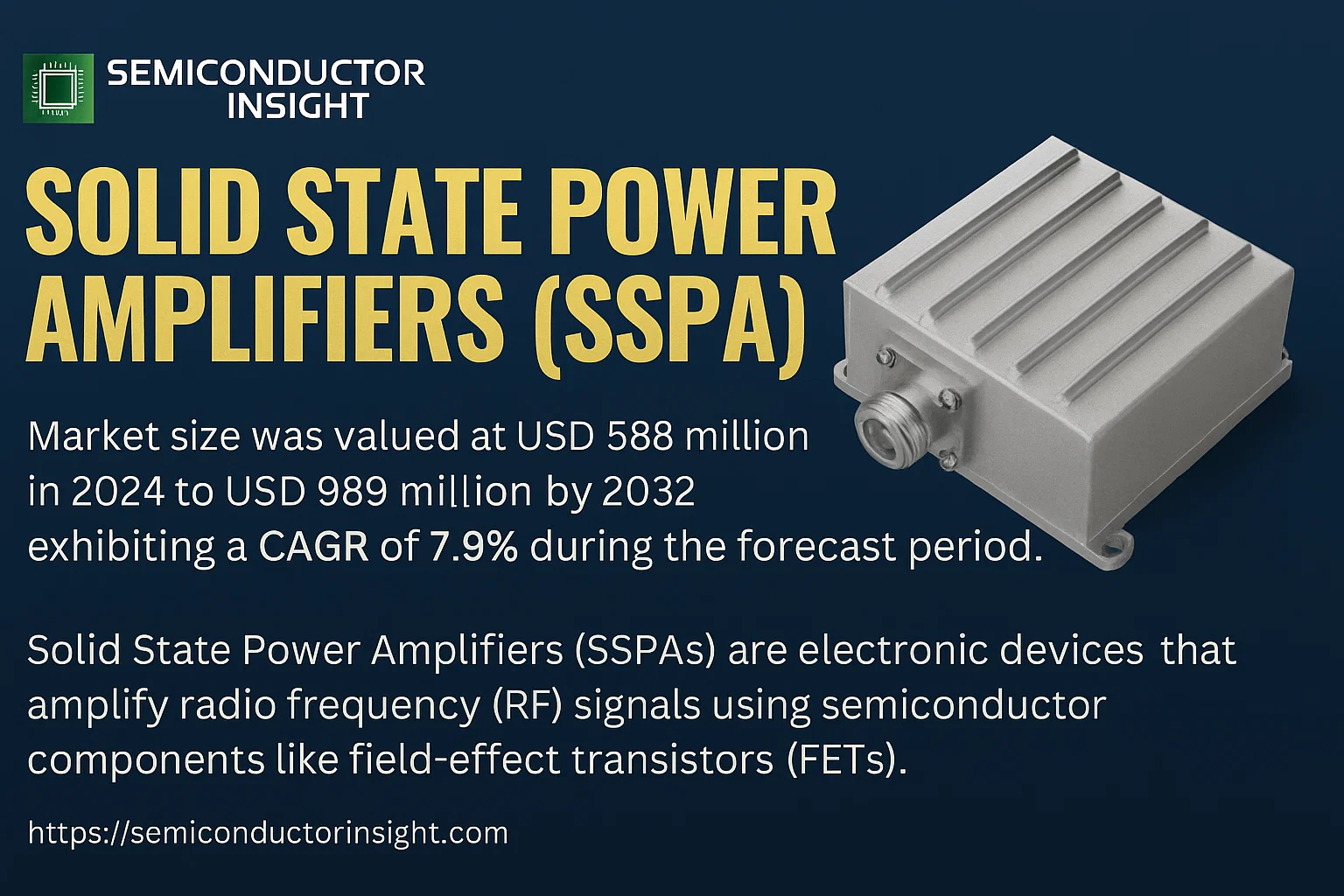
Global Solid State Power Amplifiers (SSPA) Market size was valued at USD 588 million in 2024 to USD 989 million by 2032, exhibiting a CAGR of 7.9% during the forecast period.
Solid State Power Amplifiers (SSPAs) are electronic devices that amplify radio frequency (RF) signals using semiconductor components like field-effect transistors (FETs). Designed for demanding applications, they are crucial in satellite broadcasting systems, airborne and missile systems, radars, and commercial communications. SSPAs utilize advanced semiconductor materials such as Gallium Nitride (GaN) and Gallium Arsenide (GaAs), which offer superior performance at high frequencies compared to traditional silicon due to their high band gaps and electron mobility.
The market is experiencing steady growth driven by increasing demand for satellite communication, modernization of defense and radar systems, and the expansion of 5G infrastructure. However, the high cost of advanced semiconductor materials presents a challenge. Key players are actively engaged in technological advancements to improve efficiency and power output. For instance, the development of wider bandgap semiconductors like GaN is a significant trend, enabling more compact and powerful amplifiers. Leading companies operating in this market with diverse product portfolios include Qorvo, Thales Alenia Space, Beverly Microwave Division (CPI BMD), and General Dynamics.
MARKET DRIVERS
Increasing Demand from Defense and Aerospace Sector
The global solid state power amplifier (SSPA) market is significantly driven by robust and sustained demand from the defense and aerospace industry. SSPAs are critical components in radar systems, electronic warfare (EW) suites, satellite communications (SATCOM), and unmanned aerial vehicles (UAVs). The ongoing modernization of military platforms worldwide, coupled with rising geopolitical tensions, is compelling governments to invest heavily in advanced electronic systems where high-frequency, high-reliability SSPAs are essential. The shift towards phased array radar systems, which utilize hundreds or thousands of SSPA modules, further propels market growth. The inherent advantages of SSPAs, including longer lifespan, smaller size, and better thermal management compared to traveling wave tube amplifiers (TWTAs), make them the preferred choice for next-generation defense applications.
Proliferation of 5G Infrastructure and Wireless Communication
The global rollout of 5G networks represents a monumental driver for the SSPA market. 5G technology requires a dense network of small cells and massive MIMO (Multiple-Input Multiple-Output) systems, all of which rely on highly efficient, compact power amplifiers to transmit and receive signals at millimeter-wave (mmWave) frequencies. SSPAs are uniquely suited for these applications due to their ability to provide high linearity and efficiency in compact form factors. The continuous expansion of mobile broadband, the Internet of Things (IoT), and fixed wireless access (FWA) services ensures sustained investment in 5G infrastructure, directly fueling demand for GaN (Gallium Nitride) and GaAs (Gallium Arsenide) based SSPAs. Market analysis indicates that the telecommunications segment is expected to be one of the fastest-growing end-user markets.
➤ The transition from vacuum tube technology to solid-state solutions is a foundational trend, driven by demands for reliability, efficiency, and miniaturization across all application sectors.
Furthermore, the expansion of satellite communication for both commercial and government use is a key driver. The deployment of Low Earth Orbit (LEO) satellite constellations for global broadband coverage requires ground station terminals and satellite payloads equipped with high-power, radiation-hardened SSPAs. The commercial space race and the growing demand for in-flight connectivity and remote area internet access are creating substantial opportunities for SSPA manufacturers, pushing technological advancements in power output and frequency bands.
MARKET CHALLENGES
High Initial Costs and Design Complexity
A significant challenge facing the solid state power amplifier market is the high cost associated with advanced semiconductor materials and intricate design processes. Developing SSPAs, particularly those operating at higher frequencies (Ka-band, Q-band, V-band) and power levels, requires specialized expertise in RF circuit design and thermal management. The use of expensive compound semiconductors like Gallium Nitride (GaN) and Gallium Arsenide (GaAs), while offering superior performance, increases the bill of materials. This high cost can be a barrier to adoption, especially for price-sensitive applications or in developing regions, and necessitates continuous R&D to achieve cost reductions through improved manufacturing yields and economies of scale.
Other Challenges
Thermal Management and Reliability Concerns
As power densities increase, effectively dissipating heat becomes a critical challenge. Excessive heat can degrade performance and shorten the lifespan of the amplifier. Designing efficient and compact thermal management systems adds complexity and cost to the overall product. Ensuring long-term reliability, especially in harsh environments like space or defense applications, requires rigorous testing and high-quality components, further challenging manufacturers.
Intense Competition and Rapid Technological Obsolescence
The market is characterized by intense competition among established players and new entrants, leading to pricing pressures. Additionally, the rapid pace of technological innovation means that products can become obsolete quickly. Manufacturers must continuously invest in research and development to stay ahead, creating a challenging environment where maintaining a competitive edge requires significant and sustained investment.
MARKET RESTRAINTS
Supply Chain Vulnerabilities for Critical Materials
The solid state power amplifier market faces restraints from vulnerabilities in the global supply chain for critical raw materials and semiconductors. The production of high-performance SSPAs is heavily reliant on semiconductor wafers, particularly GaN and GaAs, which have complex and geographically concentrated supply chains. Geopolitical tensions, trade restrictions, and disruptions like those experienced during recent global events can lead to shortages and price volatility for these essential components. This dependency poses a significant risk to manufacturing consistency and the ability to meet growing demand, potentially slowing market growth.
Stringent Regulatory and Certification Requirements
Another major restraint is the stringent regulatory environment and lengthy certification processes, especially for applications in defense, aerospace, and telecommunications. SSPAs used in these sectors must comply with strict standards for performance, safety, and electromagnetic compatibility (EMC). For instance, amplifiers for aviation or satellite use require qualifications from bodies like the FAA or ESA, which involve rigorous and time-consuming testing. These processes increase time-to-market and development costs, acting as a barrier for smaller companies and potentially delaying the adoption of new technologies.
MARKET OPPORTUNITIES
Emerging Applications in Automotive Radar and Medical Equipment
The expansion of SSPAs into new application areas presents substantial growth opportunities. In the automotive sector, the advancement of Advanced Driver-Assistance Systems (ADAS) and autonomous vehicles is driving demand for high-frequency radar systems. SSPAs are crucial components in automotive radar modules operating at 77 GHz and 79 GHz, providing the necessary power for object detection and collision avoidance. Similarly, in the medical field, SSPAs are finding increased use in therapeutic and diagnostic equipment, such as magnetic resonance imaging (MRI) systems and radiation therapy devices, where precise and reliable RF power is essential.
Advancements in Wide Bandgap Semiconductor Technologies
Continuous innovation in wide bandgap semiconductors, particularly Gallium Nitride (GaN), is creating significant opportunities for market expansion. GaN-based SSPAs offer superior power density, efficiency, and higher operating temperatures compared to traditional GaAs or silicon-based devices. These advantages are enabling the development of next-generation SSPAs for more demanding applications, including higher-frequency 5G/6G networks, advanced electronic warfare systems, and compact satellite payloads. Investment in GaN-on-SiC (Silicon Carbide) technology is poised to further improve performance and reduce costs, opening up new market segments and applications that were previously not feasible with older technologies.
Growth in Commercial Satellite and Space Exploration
The burgeoning commercial space industry, characterized by private companies launching constellations of communication and Earth observation satellites, represents a major growth frontier. These projects require reliable, high-performance SSPAs for both ground infrastructure and the satellites themselves. The increasing accessibility of space and the push for inter-satellite links and deep-space communication for exploration missions create a long-term, high-value opportunity for SSPA manufacturers capable of producing radiation-tolerant and highly efficient amplifiers.
Solid State Power Amplifiers Market Trends
Robust Market Expansion Driven by Critical Applications
The global Solid State Power Amplifiers market is on a significant growth trajectory, with its value projected to increase from $588 million in 2024 to $989 million by 2032, representing a compound annual growth rate (CAGR) of 7.9%. This steady expansion is fueled by the critical role SSPAs play in demanding sectors. These amplifiers, which utilize semiconductor materials like Gallium Nitride (GaN) and Gallium Arsenide (GaAs) for superior high-frequency performance, are essential components in satellite broadcasting, radar systems, missile guidance, and commercial communication networks. The inherent advantages of GaN and GaAs over traditional silicon, including higher band gaps and greater electron mobility, are key technological trends driving adoption in advanced applications.
Other Trends
Material Science and Frequency Band Development
A prominent trend is the segmentation of the market by type, categorized according to operational frequency bands. The market includes L-band & S-band, C-band, X-band, and Ku-band & Ka-band SSPAs, among others. Each band caters to specific applications, with ongoing R&D focused on enhancing the efficiency and power output of amplifiers in higher frequency ranges like Ka-band to support next-generation satellite communication and 5G backhaul infrastructure. The evolution of semiconductor materials continues to be a primary driver of performance improvements across all segments.
Regional Market Dynamics
Geographically, the market exhibits clear leadership from North America, which holds approximately 30% of the global market share. This dominance is largely attributable to significant defense spending and advanced aerospace and satellite communication industries. Europe follows closely as a major market, accounting for about 28% share, supported by strong technological capabilities and government investments in space and defense programs. Meanwhile, the Asia-Pacific region is anticipated to exhibit substantial growth potential due to increasing investments in communication infrastructure and military modernization.
Application-Driven Demand and Competitive Landscape
The application landscape is segmented into Military, Commercial & Communication, and Critical Infrastructure & Government sectors. Defense applications remain a cornerstone of demand, requiring highly reliable amplifiers for radar and electronic warfare systems. The commercial sector is experiencing rapid growth, driven by the expansion of satellite internet and cellular networks. The market is competitive and fragmented, with the top three companies holding around 23% of the market share. Key players such as Beverly Microwave Division (CPI BMD), Thales Alenia Space, and Qorvo compete on technological innovation, product reliability, and strategic contracts to secure their positions in this evolving market.
COMPETITIVE LANDSCAPE
Key Industry Players
A Market Characterized by Technological Specialization and Global Presence
The global Solid State Power Amplifiers (SSPA) market is moderately concentrated, with the top three companies collectively holding approximately 23% of the market share. Technology leadership, particularly in Gallium Nitride (GaN) and Gallium Arsenide (GaAs) semiconductors, is a key competitive differentiator. The market is led by established players like Beverly Microwave Division (CPI BMD), Thales Alenia Space, and Qorvo, who possess strong R&D capabilities and hold significant contracts in defense and aerospace sectors. These leaders dominate due to their ability to produce high-reliability, high-power amplifiers for critical applications in satellite communications, radar systems, and electronic warfare. Competition is intense, with companies vying for contracts that demand superior performance in terms of efficiency, bandwidth, and ruggedness for airborne, missile, and space applications.
Beyond the market leaders, a significant number of specialized and niche players contribute to the competitive dynamics. Companies such as Ametek, Teledyne Defense Electronics, and General Dynamics serve specific high-value segments within the military and critical infrastructure domains. Furthermore, regional players like NEC Space Technologies in Japan, BONN Elektronik in Germany, and Shenzhen Hwadar Microwave Science & Technology in China cater to local demand and specific application needs, often focusing on commercial communications or specialized frequency bands. This landscape also includes innovative firms like Advantech Wireless and Rflight Communication Electronic, which compete by offering advanced solutions for evolving communication standards, including satellite broadcasting and 5G infrastructure.
List of Key Solid State Power Amplifiers Companies Profiled
- Beverly Microwave Division (CPI BMD)
- Thales Alenia Space
- Qorvo
- Ametek
- Teledyne Defense Electronics
- General Dynamics
- Kratos
- NEC Space Technologies, Ltd.
- Rflight Communication Electronic
- Advantech Wireless
- Jersey Microwave
- Shenzhen Hwadar Microwave Science & Technology
- BONN Elektronik GmbH
- Diamond Microwave Devices Limited
Segment Analysis:
| Segment Category | Sub-Segments | Key Insights |
| By Type |
|
Ku-band & Ka-band SSPAs demonstrate leadership due to their critical role in modern high-throughput satellite communication systems, including broadband internet and direct-to-home broadcasting. Their ability to operate at higher frequencies meets the escalating demand for greater data transmission capacity. The L-band & S-band segment remains foundational for basic navigation and communication, while C-band and X-band amplifiers are essential for radar and specific communication links. The market for other specialized frequencies continues to be driven by niche, high-performance applications in research and development. |
| By Application |
|
Military applications represent the most significant and demanding segment for solid state power amplifiers. This dominance is driven by the extensive use of SSPAs in advanced electronic warfare systems, radar for surveillance and targeting, and secure military satellite communications. The requirements for reliability, ruggedness, and high performance in harsh environments create a sustained and technologically advanced market. The Commercial & Communication segment is witnessing robust growth fueled by the global expansion of satellite communication networks and terrestrial wireless infrastructure. Critical Infrastructure & Government applications utilize SSPAs for vital functions such as air traffic control and public safety networks. |
| By End User |
|
Defense & Aerospace Contractors are the primary end users, driven by large-scale procurement for military platforms and space systems. Their demand is characterized by stringent specifications, long product lifecycles, and a focus on technological superiority. Satellite Broadcasting Systems represent another key end-user group, relying heavily on high-power SSPAs for uplink stations. Telecommunication Service Providers are increasingly significant as they deploy new ground segment equipment for expanding satellite constellations. Research & Development Institutions form a smaller but crucial segment that pushes the boundaries of amplifier technology for next-generation applications. |
| By Semiconductor Material |
|
Gallium Nitride (GaN) is the leading semiconductor material technology, offering superior performance advantages for high-frequency and high-power applications. Its high band gap and electron mobility translate to greater efficiency, higher power density, and better thermal performance compared to older technologies. This makes GaN-based SSPAs particularly attractive for modern radar, electronic warfare, and satellite communication systems where performance and size are critical. Gallium Arsenide (GaAs) remains a well-established technology for many standard applications, while Silicon-based amplifiers are typically used in lower-frequency, cost-sensitive scenarios. |
| By Power Output |
|
Medium Power amplifiers are the dominant segment, finding the broadest application across military communications, radar systems, and commercial satellite ground stations. They offer an optimal balance between performance, size, and cost. The High Power segment is critical for demanding applications such as long-range radar, satellite uplinks, and electronic countermeasures, where maximum output is essential. This segment demands advanced thermal management and represents the high-end of the technology spectrum. The Low Power segment caters to applications like test equipment, receivers, and portable communication devices, emphasizing efficiency and compact design. |
Regional Analysis: Solid State Power Amplifiers Market
North America
The region’s leadership is heavily anchored in its defense sector. Advanced radar systems, electronic warfare suites, and secure military communications require highly reliable, high-power SSPAs. Continuous modernization programs and substantial government funding for defense technologies create a sustained and high-value demand pipeline, fostering a specialized and technically advanced domestic supplier base.
Aggressive deployment of 5G infrastructure across urban and rural areas is a primary growth driver. SSPAs are critical components in base stations and small cells, requiring high linearity and efficiency. The presence of major telecom operators and equipment vendors accelerates the adoption of the latest amplifier technologies, driving innovation in power efficiency and bandwidth capabilities.
North America hosts premier research institutions and corporate R&D centers focused on semiconductor physics and RF engineering. This environment fosters breakthroughs in wide-bandgap semiconductors like GaN and SiC, which are crucial for enhancing the power density and thermal performance of SSPAs, giving local manufacturers a significant competitive edge.
A strong market exists for industrial heating, scientific research, and medical equipment that utilize SSPAs. Furthermore, the region is a hub for manufacturers of advanced test and measurement equipment, which themselves incorporate high-performance amplifiers, creating a synergistic demand loop and ensuring a deep, diversified market beyond core communications and defense.
Europe
Europe represents a mature and technologically advanced market for solid state power amplifiers, characterized by strong aerospace, satellite communication, and research applications. The region benefits from collaborative multinational projects, such as those led by the European Space Agency, which drive demand for highly reliable and specialized SSPAs for satellite payloads and ground stations. Countries like Germany, France, and the UK have robust industrial bases that integrate amplifiers into automation, industrial heating, and medical equipment. The ongoing transition to 5G and fiber-optic networks also provides steady demand, although at a pace sometimes more measured than in North America. European regulations emphasizing energy efficiency and electromagnetic compatibility influence amplifier design, pushing manufacturers towards more efficient architectures. The market is supported by a strong network of specialized component suppliers and a focus on high-quality, precision engineering.
Asia-Pacific
The Asia-Pacific region is the fastest-growing market for solid state power amplifiers, propelled by massive investments in telecommunications infrastructure, particularly 5G rollout in China, South Korea, and Japan. The region is a global manufacturing powerhouse for consumer electronics and telecommunications equipment, creating immense demand for SSPAs used in base stations and network hardware. Expanding satellite communication services and growing defense budgets in countries like India and Australia further contribute to market expansion. The presence of major semiconductor fabricators facilitates the adoption of newer GaN and LDMOS technologies, driving down costs and improving performance. While the market is highly competitive and price-sensitive, it offers significant growth potential due to the sheer scale of infrastructure development and the rising adoption of advanced electronic systems across various industries.
South America
The South American market for solid state power amplifiers is developing, with growth primarily driven by gradual modernization of telecommunications infrastructure and expanding satellite communication services. Brazil is the largest market in the region, with investments in public safety communication systems and broadcasting equipment. The oil and gas industry also presents niche opportunities for SSPAs used in exploration and communication systems. However, market growth is often constrained by economic volatility and lower levels of R&D investment compared to more developed regions. The market is characterized by a reliance on imports for high-end amplifier solutions, though local assembly and integration services are emerging. Demand is steadily increasing but remains focused on cost-effective and robust solutions suitable for the region’s diverse climatic and operational conditions.
Middle East & Africa
The Middle East and Africa region shows varied dynamics for the SSPA market. The Middle East, particularly the Gulf Cooperation Council countries, demonstrates strong demand driven by defense modernization programs, expansive telecommunications projects, and investments in satellite and broadcast infrastructure. High-value projects often specify top-tier amplifier technology. In contrast, the African market is nascent but growing, fueled by the rapid expansion of mobile network coverage and the development of critical communication infrastructure for utilities and public safety. The region overall presents opportunities tied to infrastructure development, though challenges include navigating diverse regulatory landscapes and economic disparities. The market is increasingly recognizing the reliability benefits of SSPAs over older tube-based amplifiers for critical communications in harsh environments.
Report Scope
This market research report provides a comprehensive analysis of the Solid State Power Amplifiers Market, covering the forecast period 2025–2032. It offers detailed insights into market dynamics, technological advancements, competitive landscape, and key trends shaping the industry.
Key focus areas of the report include:
- Market Overview: The report begins with an overview outlining the current market scenario, key growth indicators, and industry transformation drivers. It discusses macroeconomic factors, demand–supply balance, regulatory landscape, and the strategic role of advanced semiconductor materials in powering critical applications such as satellite broadcasting, radar systems, airborne and missile systems, and commercial & communication networks.
- Market Size & Forecast: Historical data and future projections for revenue, unit shipments, and market value across major regions and segments.
- Segmentation Analysis: Detailed breakdown by product type (L-band & S-band, C-band, X-band, Ku-band & Ka-band), application (Military, Commercial & Communication, Critical Infrastructure & Government), and end-user industry to identify high-growth segments and investment opportunities.
- Regional Insights: Insights into market performance across North America, Europe, Asia, South America, and the Middle East & Africa, including country-level analysis where relevant.
- Competitive Landscape: Profiles of leading market participants, including their product offerings, R&D focus, manufacturing capacity, pricing strategies, and recent developments such as mergers, acquisitions, and partnerships.
- Technology Trends & Innovation: Assessment of emerging technologies, semiconductor material advancements (GaN, GaAs), fabrication techniques, and evolving industry standards.
- Market Drivers & Restraints: Evaluation of factors driving market growth along with challenges, supply chain constraints, regulatory issues, and market-entry barriers.
- Stakeholder Insights: Insights for component suppliers, OEMs, system integrators, investors, and policymakers regarding the evolving ecosystem and strategic opportunities.
Primary and secondary research methods are employed, including interviews with industry experts, data from verified sources, and real-time market intelligence to ensure the accuracy and reliability of the insights presented.
FREQUENTLY ASKED QUESTIONS:
What is the current market size of Solid State Power Amplifiers Market?
-> Global Solid State Power Amplifiers Market was valued at USD 588 million in 2024 and is projected to reach USD 989 million by 2032, exhibiting a CAGR of 7.9% during the forecast period.
Which key companies operate in Solid State Power Amplifiers Market?
-> Key players include Beverly Microwave Division (CPI BMD), Thales Alenia Space, Qorvo, Ametek, Teledyne Defense Electronics, General Dynamics, Kratos, NEC Space Technologies, Ltd., Rflight Communication Electronic, Advantech Wireless, Jersey Microwave, Shenzhen Hwadar Microwave Science & Technology, BONN Elektronik GmbH, and Diamond Microwave Devices Limited, among others. The top 3 companies occupy about 23% market share.
What are the key growth drivers?
-> Key growth drivers include demand from demanding applications like satellite broadcasting, airborne and missile systems, radars, and commercial & communication networks, alongside advancements in semiconductor materials like Gallium Nitride (GaN) and Gallium Arsenide (GaAs).
Which region dominates the market?
-> North America is the largest market with about 30% share, while Europe is a significant follower, accounting for about 28% market share.
What are the emerging trends?
-> Emerging trends include the adoption of high-frequency semiconductor materials like GaN and GaAs for superior performance, and the increasing integration of SSPAs in critical defense and communication infrastructure.
Get Sample Report PDF for Exclusive Insights
Report Sample Includes
- Table of Contents
- List of Tables & Figures
- Charts, Research Methodology, and more...
 Download Sample Report PDF