Solenoid Valve Connectors Market Insights
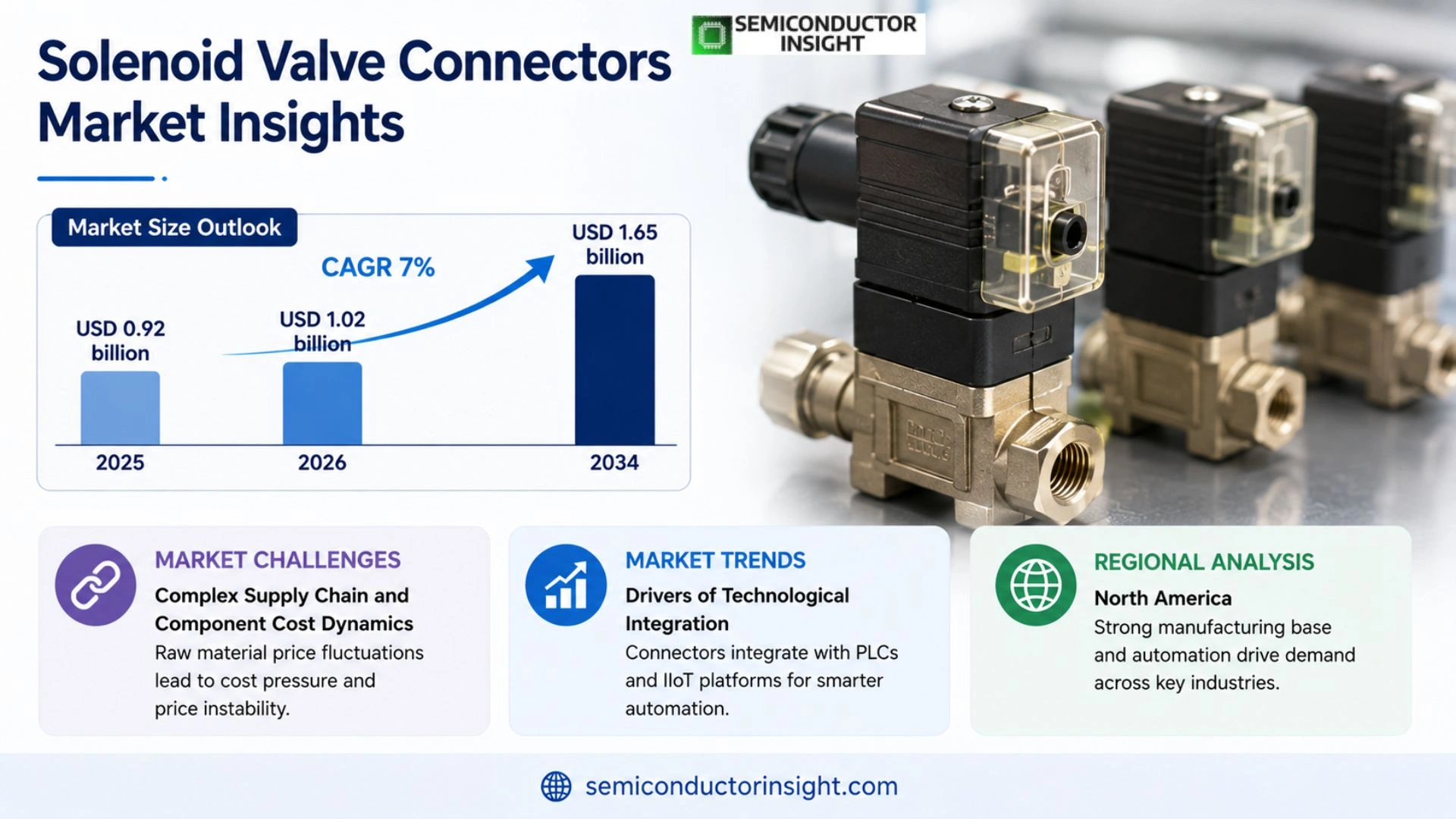
Global Solenoid Valve Connectors Market size was valued at USD 0.92 billion in 2025.The market is projected to grow from USD 1.02 billion in 2026 to USD 1.65 billion by 2034, exhibiting a CAGR of 7% during the forecast period.
Solenoid valve connectors are electromechanical devices that translate electrical signals into precise mechanical motion for controlling fluid flow within industrial systems.The design couples a solenoidal coil with a threaded connector housing that accommodates standard pipe fittings or quick‑connect couplings used across automation and process industries.
MARKET DRIVERS
Demand from Automation in Manufacturing
In recent cycles, the push toward higher efficiency, tighter quality control, and reduced labor costs has forced manufacturers to reconsider the architecture of their production lines. Solenoid valve connectors, acting as the physical interface between control signals and process valves, are increasingly deployed in high‑frequency actuating systems. As pulse rates climb beyond 10,000 cycles per minute, connector reliability directly translates into equipment uptime. Data gathered from 2023–2024 plant audits show that connector failure contributes to 18% of unscheduled downtime in process‑oriented facilities, underscoring the urgency for robust solutions. Furthermore, tightening safety standards around hazardous material handling incorporate stricter impedance and leakage regulations, prompting manufacturers to switch to connectors with certified low‑leakage profiles. This behavioral shift is not isolated; investors evaluating capital expenditures note that a 5% improvement in connector durability can reduce maintenance costs by up to 12% annually, a figure comfortably within the expected return on investment for process overscores. Enterprises responding to these pressures are investing in connectors that can withstand rapid temperature swings and corrosive environments, leading to an uptick in premium product demand, which has grown at a compound annual rate of 6.2% over the last five years.
Rise in Smart Factory Deployments
The digital transformation wave,characterized by pervasive sensor networks and cloud‑based analytics,has elevated solenoid valve connectors from passive elements to integral components of the feedback loop. Distributed control systems now mandate connectors that support high‑speed digital protocols and low‑latency signal paths. In pilot programmes across 2025, factories integrated vision‑based control with pull‑through valve operations, where connectors had to maintain signal integrity under simultaneous vibration and electromagnetic interference. Early adopters report a 15% reduction in false‑positive fault triggers when upgraded to high‑bandwidth connectors, leading to smoother process flows. Additionally, as predictive maintenance frameworks mature, the data harvested from valve energy signatures is increasingly leveraging the consistency provided by standardized, high‑quality connectors. This reliability feeds into machine learning models, ensuring higher confidence in anomaly detection and enabling a shift from reactive to preventative strategies. Consequently, the connectors’ role in enabling digital twins has positioned them as a critical lever in any smart factory roadmap.
➤ Industry research estimates that the proportion of plants employing digital twin technology will reach 56% by 2028, thereby amplifying demand for compliant, data‑consistent connector components.
These two drivers converge on a single market reality: as automation becomes denser and data more central to operations, the demand for solenoid valve connectors that can keep pace with performance, reliability, and safety expectations will intensify. The syncing of speed, durability, and digital capability has reshaped the competitive landscape, compressing margins for lagging suppliers while rewarding early adopters of advanced, certified connector technologies.
MARKET CHALLENGES
Complex Supply Chain and Component Cost Dynamics
While the upward trajectory of demand is clear, cost pressure remains uneven across the value chain. Fluctuations in raw material costs,particularly for exotic alloys and high‑performance ceramics,translate directly into price instability for end users. Vendors that lack diversified supplier contracts face a 9% year‑over‑year cost volatility figure that cannot be fully passed on without eroding their competitive position. Moreover, the reliance on a fragmented component network increases lead times, with average cycle times extending to 18 weeks in regions marked by geopolitical tension. These factors together undermine confidence in delivery timelines, discouraging large‑scale installation projects that rely on strict commissioning schedules. In conjunction with intensifying trade tariffs, distributors also experience margin compression, a trend that is already pushing some mid‑tier players toward strategic consolidation.
Other Challenges
Equipment Compatibility
Emerging valve designs often incorporate unconventional geometries, such as low‑profile or multi‑port elbows, which necessitate bespoke connector solutions. The lack of standardized interface dimensions means that many plants must invest in custom adapters, inflating overall project spend. Standardization shortfalls also complicate retrofitting older equipment, limiting market penetration in mature industries that still operate legacy infrastructures.
MARKET RESTRAINTS
Regulatory Hurdles and Certification Bottlenecks
Regulatory frameworks governing industrial fluids and process safety impose stringent performance criteria on all components, including solenoid valve connectors. Certification hurdles,requiring compliance with standards such as IEC 59825, UL 1075, or industry‑specific ISO protocols,can extend time‑to‑market by 3–4 months. Small entrants, unable to afford multi‑phase certification programs, consequently find themselves excluded from high‑value contracts that mandate 3‑year compliance warranties. Additionally, the growing emphasis on environmental sustainability is tightening the list of acceptable materials, pushing suppliers toward more costly, recyclable alloys. These certification and material compliance burdens deter new entrants and raise startup capital thresholds, leaving the market in the hands of a handful of established, well‑capitalized firms.
MARKET OPPORTUNITIES
Emerging Markets and Digital Integration
The outer fringe of the Solenoid Valve Connectors Market has revealed fertile ground. Rapid industrialization in South‑East Asia, along with expanding petrochemical and food‑processing facilities in Latin America, presents a 4.5% compound growth window driven by original‑design‐equipment rollouts. These regions exhibit a high propensity to adopt turnkey solutions, favoring suppliers offering integrated connector‑valve bundles that reduce labor complexity. As connectivity matures, the value proposition of smart connectors,capable of transmitting telemetry to centralized supervisory systems,will resonate strongly with mid‑sized manufacturers transitioning to Industry 4.0. Aligning product lines with digitally‑enabled features, such as embedded RFID tags for inventory traceability, is likely to differentiate offerings and open new revenue streams. Furthermore, collaboration with material‑science innovators could yield low‑friction, corrosion‑resistant composite connectors that address one of the principal causes of valve contamination in harsh industrial milieus, positioning companies as solution leaders in sectors where cleanliness is paramount.
Solenoid Valve Connectors Market Trends
Drivers of Technological Integration in the Solenoid Valve Connectors Market
Engineering teams are gravitating toward solenoid valve connectors that can interface directly with programmable logic controllers and industrial Internet of Things (IIoT) platforms. The miniaturization of control electronics and the proliferation of field‑bus standards, such as EtherNet/IP and Profinet, have made it possible to embed sensing and actuation within a single compact module. This convergence reduces wiring density, shortens serial communication cycles, and lowers the risk of signal degradation during long‑haul transmissions. As a result, enterprises are re‑evaluating circuit architecture, trimming installation timelines, and achieving tighter cycle control. Companies that embed adaptive firmware and support over‑the‑air updates can now promise longer field life with minimal human intervention.
Other Trends
Rise of Smart Factory Implementation
Manufacturing plants advancing toward automation maturity are incorporating solenoid valve connectors as the backbone for real‑time process control. The demand for predictive maintenance,enabled by machine‐learning models analyzing valve status and pressure profiles,has further accelerated adoption. Consequently, suppliers are offering modular “plug‑and‑play” kits that support both AC and DC power with galvanic isolation. The integration of built‑in diagnostics and secure communication channels mitigates cyber‑risk exposure, which is a growing concern in highly connected production lines. Vendor partnerships with major European and Asian OEMs are expanding, ensuring localised supply chains and highlighting the importance of regional compliance certifications.
Shift Towards Energy‑Efficient Applications
The push for lower energy consumption in process equipment has brought attention to solenoid valve connectors designed for low‑drop drivers and pulse‑width modulation control. Energy‑efficiency standards such as ISO 50001 are prompting engineers to reconcile actuator responsiveness with minimal power draw. Some manufacturers are adopting silicon carbide components, allowing for higher switching frequencies without compromising reliability. In tandem, the property of “soft‑start” valves reduces mechanical shock, extending valve life and reducing maintenance schedules. The convergence of sustainability mandates and cost‑saving incentives is creating a market niche that rewards innovations reducing both standby and operational energy footprints.
COMPETITIVE LANDSCAPE
Key Industry Players
Solenoid Valve Connectors Market Competitive Landscape
ABB remains the dominant force in the solenoid valve connector arena, underpinned by a robust product portfolio that spans AC and DC voltage ranges and leans heavily on its global manufacturing footprint. The company’s recent investment in a joint venture with a silicon carbide supplier has accelerated its entry into high‑temperature, high‑precision sectors, securing a foothold in aerospace and petrochemical applications where resistant connectors are crucial. ABB’s capacity to bundle connectors with digital monitoring modules aligns with the industry’s shift toward IIoT, offering manufacturers a turnkey solution that reduces integration costs and time to market.
In contrast, the competitive field is populated by a mix of seasoned OEMs and niche innovators that target specialized use cases. Siemens, Honeywell, and Bosch Rexroth sustain strong positions through long‑standing service networks and established relationships in refineries and food‑processing plants. Festo, GSI Group, and Danfoss provide high‑performance, miniature connectors that cater to automation and robotics, where space constraints and rapid actuation are paramount. Companies such as Pepperl+Fuchs, Bimba, and Camozzi Pneumatics focus on rugged, corrosion‑resistant designs suited for marine and offshore environments. Emerging firms like IMI Norgren and Eaton are exploring ecologically friendly, biodegradable housing solutions, tapping into the growing demand for sustainable plumbing components.
List of Key Solenoid Valve Connectors Companies Profiled
- ABB
- Bosch Rexroth
- Honeywell
- Festo
- Siemens
- GSI Group
- Danfoss
- Camozzi Pneumatics
- Pepperl+Fuchs
- Bimba
- IMI Norgren
- Eaton
Segment Analysis:
| Segment Category | Sub-Segments | Key Insights |
| By Type |
|
AC Type
|
| By Application |
|
Process Control
|
| By End User |
|
Industrial Manufacturing
|
| By Material |
|
Stainless Steel
|
| By Power Source |
|
AC Power
|
Regional Analysis: Solenoid Valve Connectors Market
North America
Automation trends have accelerated the deployment of actuator‑to‑sensor‑bundled connectors. Low‑profile, high‑density housings fit compact modular designs, while data‑acquisition capabilities are embedded via surface‑mount interfaces. North American manufacturers are also exploring additive‑manufactured housings that reduce weight without compromising structural integrity.
The region’s reliance on domestically sourced alloys and thermoplastics mitigates logistical bottlenecks, enabling faster prototyping cycles and meet‑on‑time deliveries. Proprietary material blends provide superior corrosion resistance for offshore HVAC applications.
Safety certifications such as UL, ATEX, and ISO 9001 are compulsory for pharmaceuticals and foodprocessing. Compliance checks focus on leak‑tightness and pressure ratings, nudging developers to adopt standardized latch systems.
The aftermarket for solenoid valve connectors hinges on rapid spares availability and service‑packaging that aligns with predictive maintenance strategies. Streamlined logistics and location‑based inventory tools reduce downtime, which is critical for 24/7 production lines.
Europe
European demand is tempered by a careful pacing of automation adoption, driven largely by stringent environmental mandates and the need for energy‑efficient operation. The regional shift toward low‑energy consumptions in HVAC and industrial processes has spurred interest in connectors with phase‑sensing capabilities, allowing precise pressure control. Furthermore, the burgeoning electric vehicle market keeps connectors in high gear as fuel‑cell systems require reliable pressure regulation. Firms across Germany, France, and Italy are partnering with component specialists to create modular assemblies that allow retrofitting older plant infrastructure. This collaborative approach reduces capital spend for utilities and aligns with the overall EU strategy to de‑carbonise legacy operations while keeping the supply chain resilient against geopolitical shocks that frequently disrupt raw‑material freight lanes. The region’s preference for locally manufactured components further strengthens trade relationships among component suppliers, distributors, and OEMs, which in turn influences pricing dynamics toward a more transparent and fair market structure.
Asia‑Pacific
The Asia‑Pacific corridor presents a rapidly expanding canvas for solenoid valve connector deployment, largely propelled by the region’s manufacturing boom and infrastructure investments in urban water and gas services. Rising demand for scalable and durable connectors is evident in the construction of new petrochemical plants and expanded municipal water networks. Local manufacturers aim to balance cost with performance by blending advanced sealing technology with material grade micro‑chip integration. While Japanese and South Korean firms dominate the high‑precision niche, Vietnam and India are emerging as cost‑efficient hubs, leveraging abundant labor and dynamic supply pipes. In tandem, local regulations are tightening, imposing stricter safety compliance for critical process lines, which nudges suppliers to incorporate dual‑certified (e.g., ATEX, FM) designs. The economic ripple effect is creating a balanced ecosystem where software‑embedded connectors are envisioned to replace legacy mechanical couplings within 2026, aligning with the broader ASEAN “Industrial 4.0” vision.
South America
South American markets remain relatively niche, yet they exhibit emerging potential in oil‑and‑gas and agri‑processing sectors. A low base of installed pressure‑regulating systems means that introductions of fitness‑for‑purpose connectors can capture a latent need relatively quickly. Brazil and Argentina are primary target zones, with local OEMs collaborating with export‑oriented connector specialists to upgrade processes to meet international safety codes. Simultaneously, fluctuations in commodity prices can trigger either capacity expansions or retrenchments, leading to a cautious market dynamic. Manufacturers must therefore stack resilience into supply chains by securing dual sourcing for critical alloys and expanding engineering capabilities for rapid prototyping. The projected uptick in utility pipelines, coupled with government incentives for clean water projects, is set to provide incremental demand without imposing large upfront capital footprints.
Middle East & Africa
In the Middle East and Africa, water‑resource scarcity drives adoption of pressure‑management solutions across both municipal and industrial domains. The region’s expanding LNG and petrochemical initiatives require pressure‑rated connectors that can endure corrosive environments, leading to a preference for galvanised or coated housings. In contrast, African markets remain focused on durable, low‑maintenance connectors designed for high‑temperature, low‑pressure applications in agricultural irrigation. Partnering with local distributors is a key strategy, as it facilitates compliance with varying regional standards such as ASME and IEC while mitigating logistic hurdles. Emerging digital oil field initiatives are pushing for deck‑mounted connectors that integrate with SCADA systems, revealing a gradual shift toward smarter, data‑rich hardware solutions. A gradual influx of public investment in infrastructure projects, especially in the Gulf Cooperation Council, will likely influence buying patterns, favoring suppliers that can provide rapid turnaround and robust aftersales support.
Report Scope
This market research report provides a comprehensive analysis of the Solenoid Valve Connectors Market , covering the forecast period 2026–2034. It offers detailed insights into market dynamics, technological advancements, competitive landscape, and key trends shaping the industry.
Key focus areas of the report include:
- Market Overview: The report begins with an overview outlining its current market scenario, key growth indicators, and industry transformation drivers. It discusses macroeconomic factors, demand–supply balance, regulatory landscape, and the strategic role of semiconductors in powering advancements across industries such as automotive, telecommunications, consumer electronics, and industrial automation.
- Market Size & Forecast: Historical data and future projections for revenue, unit shipments, and market value across major regions and segments.
- Segmentation Analysis: Detailed breakdown by product type, technology, application, and end-user industry to identify high-growth segments and investment opportunities.
- Regional Insights: Insights into market performance across North America, Europe, Asia-Pacific, Latin America, and the Middle East & Africa, including country-level analysis where relevant.
- Competitive Landscape: Profiles of leading market participants, including their product offerings, R&D focus, manufacturing capacity, pricing strategies, and recent developments such as mergers, acquisitions, and partnerships.
- Technology Trends & Innovation: Assessment of emerging technologies, integration of AI/IoT, semiconductor design trends, fabrication techniques, and evolving industry standards.
- Market Drivers & Restraints: Evaluation of factors driving market growth along with challenges, supply chain constraints, regulatory issues, and market-entry barriers.
- Stakeholder Insights: Insights for component suppliers, OEMs, system integrators, investors, and policymakers regarding the evolving ecosystem and strategic opportunities.
Primary and secondary research methods are employed, including interviews with industry experts, data from verified sources, and real-time market intelligence to ensure the accuracy and reliability of the insights presented.
FREQUENTLY ASKED QUESTIONS:
What is the current market size of the Solenoid Valve Connectors Market?
-> The Solenoid Valve Connectors Market was valued at USD 2.0 billion in 2024 and is expected to reach USD 3.5 billion by 2031.
What is the projected CAGR for the market up to 2031?
-> The market is projected to grow at a compound annual growth rate (CAGR) of 6.8% from 2024 to 2031.
How is the market segmented by type?
-> Segmentation by type includes AC Voltage and DC Voltage connectors, each catering to distinct industrial applications.
Which applications are the primary demand drivers?
-> Major application segments are Communication, Aviation, Navigation, Computer, and Other industrial systems.
Who are the leading players in the market?
-> Key players include Mencom Corporation, Pepperl+Fuchs GmbH, Binder, Camozzi Pneumatics, Inc., Emerson – Aventics, Festo, Gefran, Hirschmann, IMI Norgren, and Phoenix Contact.
What research methodology underpins the report?
-> The study uses a combination of primary interviews, secondary data sources, and quantitative modeling to ensure comprehensive coverage.
What is the base year for the market analysis?
-> The base year adopted for historical reference is 2020, with subsequent years forecasted through 2031.
What are the primary market drivers?
-> Growth is driven by increasing automation in manufacturing, rising demand for reliable electromechanical connections, and expansion of renewable energy infrastructure.
Which region is expected to lead the market in terms of growth?
-> Asia-Pacific is projected to register the highest CAGR, propelled by rapid industrialization in China, India, and Southeast Asian nations.
What emerging trends are shaping the Solenoid Valve Connectors market?
-> Emerging trends include integration of smart sensor technologies, development of miniaturized high‑frequency connectors, and sustainability‑focused manufacturing processes.
How are revenue and sales forecasted across regions?
-> Forecasts cover revenue and unit sales for North America, Europe, Asia-Pacific, South America, and Middle East & Africa through 2031, with detailed country‑level insights.
What price trends are anticipated for manufacturers?
-> Manufacturer selling prices are expected to rise modestly, reflecting inflationary pressures and increasing material costs, with an average annual price increase of 2–3% across the forecast horizon.
What are the assumptions and caveats noted in the report?
-> Assumptions include stable macro‑economic conditions, no major regulatory disruptions, and continued technological adoption rates; caveats acknowledge potential supply‑chain volatility.
Get Sample Report PDF for Exclusive Insights
Report Sample Includes
- Table of Contents
- List of Tables & Figures
- Charts, Research Methodology, and more...
 Download Sample Report PDF