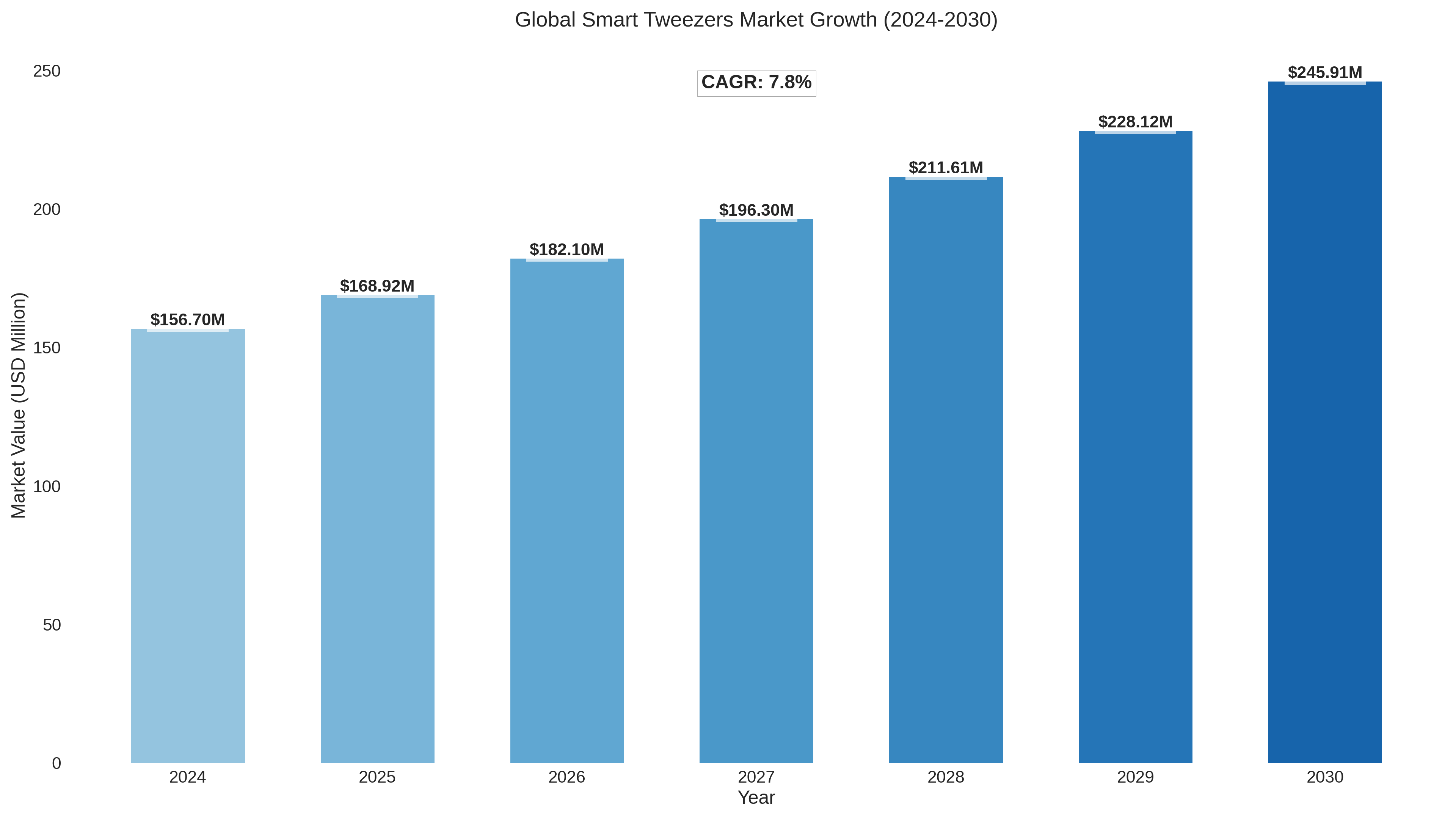
The Global Smart Tweezers Market size was valued at US$ 156.7 million in 2024 and is projected to reach US$ 245.91 million by 2030, at a CAGR of 7.8% during the forecast period 2024-2030.
The United States Smart Tweezers market size was valued at US$ 41.2 million in 2024 and is projected to reach US$ 62.8 million by 2030, at a CAGR of 7.3% during the forecast period 2024-2030.
Electronic testing tools combining precision tweezers with built-in measurement capabilities for component testing and SMD troubleshooting. These instruments provide automated component identification and measurement functions.
Report Overview
Smart Tweezer is a handheld electronic tool of a new concept.
Its unique design combines a pair of gold-plated SMD tweezers with ergonomic shielded handles and a precise full featured LCR impedance meter in a compact, lightweight instrument.
This report provides a deep insight into the global Smart Tweezers market covering all its essential aspects. This ranges from a macro overview of the market to micro details of the market size, competitive landscape, development trend, niche market, key market drivers and challenges, SWOT analysis, value chain analysis, etc.
The analysis helps the reader to shape the competition within the industries and strategies for the competitive environment to enhance the potential profit. Furthermore, it provides a simple framework for evaluating and accessing the position of the business organization. The report structure also focuses on the competitive landscape of the Global Smart Tweezers Market, this report introduces in detail the market share, market performance, product situation, operation situation, etc. of the main players, which helps the readers in the industry to identify the main competitors and deeply understand the competition pattern of the market.
In a word, this report is a must-read for industry players, investors, researchers, consultants, business strategists, and all those who have any kind of stake or are planning to foray into the Smart Tweezers market in any manner.
Global Smart Tweezers Market: Market Segmentation Analysis
The research report includes specific segments by region (country), manufacturers, Type, and Application. Market segmentation creates subsets of a market based on product type, end-user or application, Geographic, and other factors. By understanding the market segments, the decision-maker can leverage this targeting in the product, sales, and marketing strategies. Market segments can power your product development cycles by informing how you create product offerings for different segments.
Key Company
- Siborg Systems
- Smart Tweezers LCR Meter
- RS Pro
- Ideal-tek
- Excelta
- MetroQ
- Guangzhou e-Design Intelligent Technology
- Straight Tips
- Bent Tips
- Electronics
- Laboratories
- Others
- North America (USA, Canada, Mexico)
- Europe (Germany, UK, France, Russia, Italy, Rest of Europe)
- Asia-Pacific (China, Japan, South Korea, India, Southeast Asia, Rest of Asia-Pacific)
- South America (Brazil, Argentina, Columbia, Rest of South America)
- The Middle East and Africa (Saudi Arabia, UAE, Egypt, Nigeria, South Africa, Rest of MEA)
- Industry drivers, restraints, and opportunities covered in the study
- Neutral perspective on the market performance
- Recent industry trends and developments
- Competitive landscape & strategies of key players
- Potential & niche segments and regions exhibiting promising growth covered
- Historical, current, and projected market size, in terms of value
- In-depth analysis of the Smart Tweezers Market
- Overview of the regional outlook of the Smart Tweezers Market:
- Access to date statistics compiled by our researchers. These provide you with historical and forecast data, which is analyzed to tell you why your market is set to change
- This enables you to anticipate market changes to remain ahead of your competitors
- You will be able to copy data from the Excel spreadsheet straight into your marketing plans, business presentations, or other strategic documents
- The concise analysis, clear graph, and table format will enable you to pinpoint the information you require quickly
- Provision of market value (USD Billion) data for each segment and sub-segment
- Indicates the region and segment that is expected to witness the fastest growth as well as to dominate the market
- Analysis by geography highlighting the consumption of the product/service in the region as well as indicating the factors that are affecting the market within each region
- Competitive landscape which incorporates the market ranking of the major players, along with new service/product launches, partnerships, business expansions, and acquisitions in the past five years of companies profiled
- Extensive company profiles comprising of company overview, company insights, product benchmarking, and SWOT analysis for the major market players
- The current as well as the future market outlook of the industry concerning recent developments which involve growth opportunities and drivers as well as challenges and restraints of both emerging as well as developed regions
- Includes in-depth analysis of the market from various perspectives through Porters five forces analysis
- Provides insight into the market through Value Chain
- Market dynamics scenario, along with growth opportunities of the market in the years to come
- 6-month post-sales analyst support
Customization of the Report
In case of any queries or customization requirements, please connect with our sales team, who will ensure that your requirements are met.
1. Drivers
- Increasing Demand in Electronics Repair and Prototyping: As electronic devices become more complex, there is a growing need for accurate testing and troubleshooting tools. Smart tweezers, which combine precision and functionality, are increasingly being adopted by electronics professionals for circuit repairs, testing, and prototyping. Their ability to measure various electrical parameters like resistance, capacitance, and inductance in compact, delicate components makes them indispensable in the repair and maintenance of consumer electronics, industrial equipment, and medical devices. This trend is driving the demand for smart tweezers in the market.
- Growth of Consumer Electronics: The rise in consumer electronics, such as smartphones, wearables, and home appliances, has led to an increase in the need for efficient testing and quality control. Smart tweezers are used by manufacturers and technicians to ensure the quality and functionality of small and delicate components during production and repair processes. As the consumer electronics industry expands globally, so does the market for smart tweezers, as these tools play a crucial role in maintaining the performance and reliability of electronic products.
- Advancement in Miniaturization of Electronic Components: The ongoing trend of miniaturization in electronics, where components are becoming smaller and more intricate, has created a need for more precise and compact testing equipment. Smart tweezers are ideal for measuring tiny components in small circuit boards, offering high precision without the need for complex setups. This development supports the increased adoption of smart tweezers in fields that require high levels of accuracy, such as research and development (R&D), repair, and manufacturing.
- Demand in Research and Development (R&D): In industries that require high-precision testing, such as semiconductors and advanced electronics, smart tweezers are playing an increasingly important role. Their ability to handle small components efficiently allows R&D teams to experiment and iterate faster. This is particularly important in fields like robotics, nanotechnology, and telecommunications, where small, sensitive components are often tested and refined. As these industries grow, so too does the demand for smart tweezers.
- Automation and Efficiency in Manufacturing: In electronics manufacturing, there is a growing emphasis on automation and efficiency. Smart tweezers support this transition by providing automated measurement capabilities, reducing the need for manual handling of delicate components. This enhances the productivity of assembly lines, particularly in high-volume manufacturing environments where precision is crucial, such as in the production of circuit boards and other electronics.
2. Restraints
- High Cost of Smart Tweezers: One of the key challenges in the widespread adoption of smart tweezers is their relatively high price compared to traditional manual tweezers and other testing tools. For many small businesses, startups, or hobbyists, the cost of smart tweezers can be prohibitive, limiting their accessibility. While smart tweezers provide advanced functionality, the initial investment may deter some potential users from adopting them, especially when cheaper alternatives are available.
- Limited Awareness and Adoption in Emerging Markets: While smart tweezers are widely used in developed markets, their adoption is still relatively limited in emerging markets. This is primarily due to a lack of awareness, limited availability of these tools, and the relatively high cost compared to other testing tools. Additionally, in regions with less developed electronics industries, there may be less demand for advanced testing tools like smart tweezers, limiting their market potential.
- Complexity of Use for Novices: While smart tweezers are designed to make testing more efficient, they require users to have a certain level of expertise to fully leverage their capabilities. For novice users or those new to electronics, there may be a learning curve involved in using these tools effectively. This complexity could limit adoption among individuals or small enterprises that lack specialized knowledge, especially in industries where basic tools are sufficient for most tasks.
- Competition from Alternative Tools: Traditional multimeters, oscilloscopes, and other handheld measurement tools are still commonly used in electronics testing, particularly for larger components or in environments where precision is not as critical. These alternatives often come at a lower cost, and in some cases, they may be easier to use. The presence of these competing products could slow the growth of the smart tweezers market, as some users may prefer more familiar or less expensive tools.
3. Opportunities
- Rising Demand for Wearable Electronics: The wearable electronics market, including smartwatches, fitness trackers, and medical monitoring devices, is growing rapidly. These devices often rely on miniaturized components that require precise testing and calibration. As wearable technology becomes more advanced, the need for accurate testing tools, like smart tweezers, will increase. This presents a significant opportunity for growth in the smart tweezers market, as these tools are ideal for handling the small, delicate components used in wearables.
- Growth in Automotive Electronics: With the rise of electric vehicles (EVs), autonomous vehicles, and connected car technologies, the automotive industry is becoming more reliant on advanced electronics. Smart tweezers are valuable tools in the automotive sector for testing components like sensors, microcontrollers, and power management units. As the demand for automotive electronics grows, so does the opportunity for smart tweezers to become integral in automotive manufacturing, diagnostics, and repair.
- Increased Adoption in Medical Electronics: The medical device industry presents a growing opportunity for the smart tweezers market, as the need for precision and reliability in medical electronics is critical. Devices like pacemakers, hearing aids, and diagnostic equipment often rely on small components that require careful handling and testing. Smart tweezers are ideal for ensuring the quality and functionality of these components during production and maintenance, contributing to their growing adoption in the medical sector.
- Integration with IoT and Smart Devices: The proliferation of the Internet of Things (IoT) and smart devices in various sectors, including home automation, healthcare, and industrial control systems, offers a substantial opportunity for smart tweezers. As IoT devices become more interconnected and embedded in daily life, the need for high-precision testing and assembly increases. Smart tweezers, with their ability to handle small, intricate components, will continue to play a key role in ensuring the performance and reliability of these devices.
- Technological Advancements in Smart Tweezers: The ongoing development of smarter tools with enhanced capabilities, such as integrated digital displays, wireless connectivity, and automated testing features, creates new opportunities for the smart tweezers market. As manufacturers continue to innovate and add new features to smart tweezers, the market potential will expand further, attracting new users and applications in various sectors.
4. Challenges
- Technological Obsolescence: The rapid pace of technological advancement in electronics means that tools like smart tweezers must continuously evolve to stay relevant. Manufacturers face the challenge of keeping up with emerging technologies and ensuring that their products remain compatible with new devices and components. This pressure to innovate and upgrade can be both costly and resource-intensive for companies in the smart tweezers market.
- Lack of Standardization: The smart tweezers market lacks a high degree of standardization, which can create confusion for buyers and slow down the adoption of these tools across industries. Different brands may offer slightly different features, measurement ranges, or compatibility with various electronic components, making it difficult for users to select the best product for their needs. Greater standardization in product features and capabilities could help streamline the market and encourage wider adoption.
- Dependency on Specialized Applications: While smart tweezers are useful in many fields, their applications are still relatively niche, with heavy reliance on sectors like electronics repair, R&D, and prototyping. Expanding their use in a broader range of industries, particularly in smaller-scale or less technology-driven sectors, remains a challenge.

Get Sample Report PDF for Exclusive Insights
Report Sample Includes
- Table of Contents
- List of Tables & Figures
- Charts, Research Methodology, and more...
 Download Sample Report PDF