Market Insights
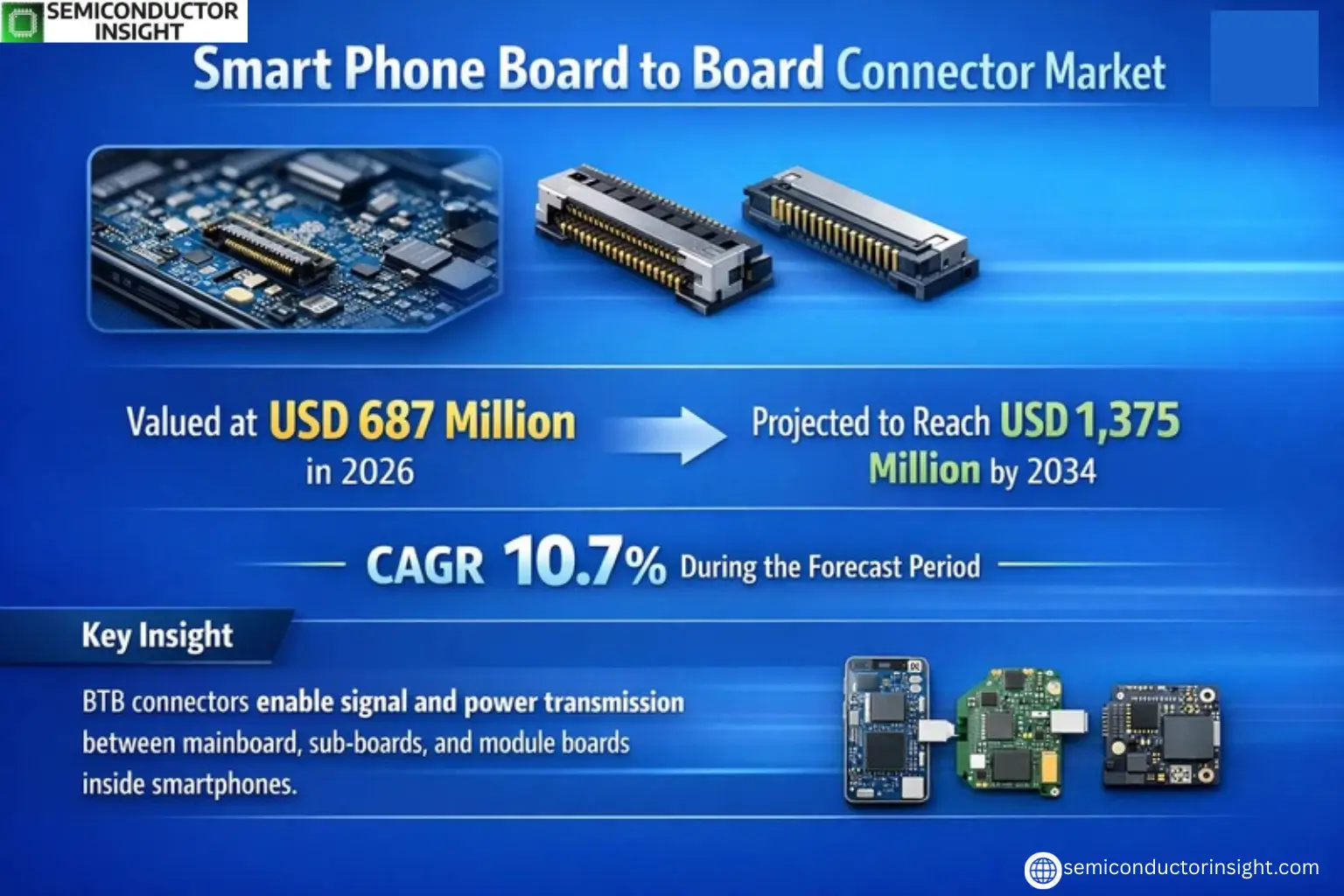
Global Smart Phone Board to Board Connector Market was valued at USD 687 million in 2026 and is projected to reach USD 1,375 million by 2034, exhibiting a CAGR of 10.7% during the forecast period.
Smart phone board-to-board (BTB) connectors are core interconnect components that enable signal and power transmission between the mainboard, sub-boards, and functional module boards inside smartphones. These connectors primarily consist of insulating bases, conductive terminals, and shielding shells, designed with miniaturized, high-pin-count stacked or docking structures. Their key features include compact size, high transmission rates, and robust plug-in reliability critical for meeting the ultra-thin and highly integrated design demands of modern smartphones.
The market growth is driven by increasing smartphone miniaturization trends and the rising adoption of advanced functionalities like 5G connectivity, high-refresh-rate displays, and multi-camera systems. However, manufacturers face challenges such as stringent technical requirements for high-density designs and pricing pressures from dominant smartphone brands. Leading players like TE Connectivity, Amphenol, and Molex are investing in R&D to develop next-generation connectors supporting higher data speeds and mechanical durability for foldable devices.
MARKET DRIVERS
Smartphone Miniaturization Demands Advanced Board-to-Board Connectors
The growing trend of smartphone miniaturization is driving demand for compact and high-density board-to-board connectors. Manufacturers are adopting connectors with 0.35mm pitch or smaller to accommodate thinner device designs while maintaining reliable signal transmission. Global smartphone market’s push for slimmer form factors has increased adoption of these precision components by 18% year-over-year.
5G Technology Accelerates Connector Innovation
5G smartphone proliferation is requiring board-to-board connectors that support high-speed data transfer up to 20Gbps. Leading manufacturers are developing connectors with improved EMI shielding and insertion loss characteristics, with the 5G-compatible segment growing at 22% CAGR. This technological shift represents a USD 450 million opportunity for specialized connector solutions.
The increasing complexity of smartphone camera systems, including multi-lens arrays and periscope zoom mechanisms, has created additional demand for high-reliability connectors in flex-to-board applications.
MARKET CHALLENGES
Precision Manufacturing Requirements Increase Production Costs
The extreme tolerances required for modern smartphone board-to-board connectors (typically ±0.02mm) have increased tooling and production costs by 30-35% compared to previous generations. This creates pricing pressure in a market where OEMs demand annual cost reductions of 3-5%.
Other Challenges
Material Compatibility Issues
The trend toward lead-free and halogen-free connector materials has created challenges in maintaining mechanical durability while meeting environmental regulations, particularly in the European and North American markets.
Supply Chain Vulnerabilities
Recent disruptions in rare earth metal supplies have impacted the production of specialized alloys used in high-performance connector contacts, with delivery times extending from 8 to 14 weeks.
MARKET RESTRAINTS
Maturing Smartphone Market Growth
The slowing global smartphone replacement cycle (now averaging 33 months) is limiting volume growth in the board-to-board connector market. Market saturation in developed economies has led to a 4% decline in annual connector shipments for mid-range devices.
MARKET OPPORTUNITIES
Foldable Smartphone Expansion Creates Niche Demand
The emerging foldable smartphone segment, projected to grow at 49% CAGR through 2027, requires specialized board-to-board connectors capable of withstanding 200,000+ flex cycles. This represents a USD 120 million addressable market for high-reliability solutions, with current yields below 85% creating opportunities for process improvements.
Automotive Smartphone Integration
The convergence of smartphone and automotive interfaces is driving demand for robust board-to-board connectors that can operate in extreme temperature ranges (-40°C to 105°C). This emerging application is expected to account for 15% of the premium connector market by 2026.
Smart Phone Board to Board Connector Market Trends
Rapid Market Growth Driven by Smartphone Innovation
Global Smart Phone Board to Board Connector Market is experiencing strong growth, projected to expand from USD 687 million in 2026 to USD 1375 million by 2034 at a 10.7% CAGR. This expansion is primarily driven by increasing smartphone complexity, with connectors requiring higher pin counts (80-200 pins) to support 5G transmission and advanced display technologies. Unit pricing ranges from USD 0.1 for basic connectors to USD 5 for specialized foldable phone variants, reflecting wide performance differentiators across market segments.
Other Trends
Miniaturization and High-Density Designs
Smartphone thickness reduction necessitates connectors with stacking heights below 0.7mm, now representing 42% of market volume. Manufacturers are adopting advanced LCP plastics and beryllium copper alloys to maintain signal integrity in these constrained spaces. High-density connectors supporting 10Gbps+ transmission speeds are seeing 28% annual demand growth.
Regional Production Shifts and Supply Chain Evolution
Asia accounts for 78% of global Smart Phone Board to Board Connector production, with China’s Sunway Communication and YXT capturing 19% combined market share. Recent trade policies are driving dual sourcing strategies, with manufacturers establishing secondary production in Southeast Asia. The industry faces raw material lead times of 8-12 weeks for specialized copper alloys and engineering plastics, creating inventory challenges.
Application-Specific Connector Development
Foldable smartphones require connectors with 50,000+ bending cycles, commanding 35% price premiums. Camera modules now utilize floating connectors with ±0.3mm tolerance to compensate for assembly variations. High-speed variants for 5G RF modules represent the fastest-growing segment at 31% annual growth.
COMPETITIVE LANDSCAPE
Key Industry Players
Global Smartphone BTB Connector Market Dominated by Established Electronics Component Giants
Smart Phone Board to Board Connector Market is characterized by strong competition among established global electronic component manufacturers with vertically integrated production capabilities. TE Connectivity, Amphenol, and Molex collectively hold over 45% of the market share, leveraging their technological expertise in high-density interconnect solutions and longstanding relationships with major smartphone OEMs. These leaders continue to invest heavily in R&D for miniaturized connectors supporting 5G and foldable phone applications.
Several Japanese and Chinese manufacturers are gaining traction through cost-competitive offerings, with Panasonic and JAE Electronics excelling in high-reliability connectors for premium smartphones. Emerging players like Sunway Communication and YXT are rapidly expanding their footprint by specializing in customized connector solutions for Chinese smartphone brands, offering 15-20% lower pricing than multinational competitors while maintaining acceptable quality standards.
List of Key Smart Phone Board to Board Connector Companies Profiled
- TE Connectivity
- Amphenol
- Molex
- Panasonic
- Kyocera
- Hirose Electric (HRS)
- LCN Connectors
- JAE Electronics
- ECT Electronics
- OCN
- Sunway Communication
- YXT Technology
- Acon
- CSCONN
- Luxshare Precision
Segment Analysis:
| Segment Category | Sub-Segments | Key Insights |
| By Type |
|
Stacked BTB Connectors dominate the market due to:
|
| By Application |
|
Camera Module Connections show strongest demand growth because:
|
| By End User |
|
Flagship Smartphone OEMs drive innovation with:
|
| By Technology |
|
High-Speed Transmission connectors are becoming critical due to:
|
| By Stacking Height |
|
Below 0.7mm height variants show fastest adoption because:
|
Regional Analysis: Smart Phone Board to Board Connector Market
Asia-Pacific hosts the world’s most concentrated smartphone manufacturing ecosystem, creating strong demand for board to board connectors. Component suppliers are strategically located near assembly plants, enabling just-in-time delivery and collaborative innovation with device manufacturers.
Regional players lead in developing advanced board to board connector technologies for high-speed data transfer and power delivery in compact spaces. Innovations focus on improved signal integrity for 5G smartphones and wear-resistant designs for connector durability.
APAC manufacturers achieve significant economies of scale in board to board connector production. Advanced automation and material science expertise allow regional suppliers to offer competitive pricing while maintaining quality, crucial for high-volume smartphone production.
The region features deeply integrated supply chains where connector specialists collaborate closely with semiconductor firms and PCB manufacturers. This ecosystem enables rapid iterations of board to board connector designs to match evolving smartphone architectures.
North America
The North American smart phone board to board connector market focuses on high-performance solutions for premium devices. With strong R&D capabilities in the US and Canada, the region specializes in connectors for cutting-edge smartphone features. Local manufacturers emphasize ruggedized designs and advanced materials to meet stringent reliability requirements. The presence of major smartphone brands drives demand for customized connector solutions. North American suppliers maintain leadership in high-speed data transmission connectors essential for flagship smartphones, though they face cost pressures from Asian competitors.
Europe
Europe’s smart phone board to board connector market is characterized by precision engineering and regulatory compliance. German and Swiss manufacturers excel in producing high-precision connectors with exceptional durability. The region’s focus on sustainability influences connector material choices and production processes. European suppliers collaborate closely with automotive and industrial clients, transferring rugged connector technologies to smartphone applications. While production volumes are smaller than Asia, Europe maintains strong positions in premium and specialist smartphone connector segments.
South America
South America’s smart phone board to board connector market is growing with increasing smartphone adoption across the region. Local assembly plants drive demand for standard connector solutions, with most components imported from Asia. Brazil represents the largest market, with growing investments in local electronics manufacturing infrastructure. Price sensitivity influences product preferences, favoring cost-effective connector solutions. Regional manufacturers are developing more localized supply chains to reduce import dependencies in the smartphone component ecosystem.
Middle East & Africa
The Middle East & Africa smart phone board to board connector market shows uneven development patterns. Gulf countries import premium connector solutions for high-end devices, while African markets focus on affordable components for entry-level smartphones. The region benefits from growing smartphone penetration but lacks local manufacturing capabilities. Some Middle Eastern nations are investing in electronics production facilities that could stimulate future demand for regional connector sourcing. Market growth is closely tied to telecommunications infrastructure development across Africa.
Report Scope
This market research report provides a comprehensive analysis of the Smart Phone Board to Board Connector Market, covering the forecast period 2026–2034. It offers detailed insights into market dynamics, technological advancements, competitive landscape, and key trends shaping the industry.
Key focus areas of the report include:
- Market Overview: The report begins with an overview outlining its current market scenario, key growth indicators, and industry transformation drivers. It discusses macroeconomic factors, demand–supply balance, regulatory landscape, and the strategic role of semiconductors in powering advancements across industries such as automotive, telecommunications, consumer electronics, and industrial automation.
- Market Size & Forecast: Historical data and future projections for revenue, unit shipments, and market value across major regions and segments.
- Segmentation Analysis: Detailed breakdown by product type, technology, application, and end-user industry to identify high-growth segments and investment opportunities.
- Regional Insights: Insights into market performance across North America, Europe, Asia-Pacific, Latin America, and the Middle East & Africa, including country-level analysis where relevant.
- Competitive Landscape: Profiles of leading market participants, including their product offerings, R&D focus, manufacturing capacity, pricing strategies, and recent developments such as mergers, acquisitions, and partnerships.
- Technology Trends & Innovation: Assessment of emerging technologies, integration of AI/IoT, semiconductor design trends, fabrication techniques, and evolving industry standards.
- Market Drivers & Restraints: Evaluation of factors driving market growth along with challenges, supply chain constraints, regulatory issues, and market-entry barriers.
- Stakeholder Insights: Insights for component suppliers, OEMs, system integrators, investors, and policymakers regarding the evolving ecosystem and strategic opportunities.
Primary and secondary research methods are employed, including interviews with industry experts, data from verified sources, and real-time market intelligence to ensure the accuracy and reliability of the insights presented.
FREQUENTLY ASKED QUESTIONS:
What is the current market size of Smart Phone Board to Board Connector Market?
-> Smart Phone Board to Board Connector Market was valued at USD 687 million in 2026 and is projected to reach USD 1,375 million by 2034, exhibiting a CAGR of 10.7% during the forecast period.
Which key companies operate in Smart Phone Board to Board Connector Market?
-> Key players include TE Connectivity, Amphenol, Molex, Panasonic, Kyosera, HRS, LCN, JAE, ECT, OCN, Sunway Communication, YXT, Acon, and CSCONN among others.
What are the key growth drivers?
-> Key growth drivers include upgrading smartphone slimness and integration, 5G technology adoption, high-refresh-rate displays, and emerging applications like foldable smartphones and under-display cameras.
Which region dominates the market?
-> Asia is the dominant market, led by China, Japan, and South Korea, due to concentrated smartphone manufacturing ecosystems.
What are the emerging trends?
-> Emerging trends include miniaturization, high-density pin configurations, bend-resistant designs for foldable phones, and dual-mode transmission capabilities.
Get Sample Report PDF for Exclusive Insights
Report Sample Includes
- Table of Contents
- List of Tables & Figures
- Charts, Research Methodology, and more...
 Download Sample Report PDF