Silicon Photomultiplier Detectors Market Overview
Silicon Photomultiplier (SiPM) detectors are radiation detectors that use arrays of silicon photodiodes to detect photon signals. These detectors are used in various applications like medical imaging, nuclear physics, high-energy physics, and biological research due to their high sensitivity, low noise, and high resolution.
This report provides a deep insight into the global Silicon Photomultiplier Detectors market covering all its essential aspects. This ranges from a macro overview of the market to micro details of the market size, competitive landscape, development trend, niche market, key market drivers and challenges, SWOT analysis, value chain analysis, etc.
The analysis helps the reader to shape the competition within the industries and strategies for the competitive environment to enhance the potential profit. Furthermore, it provides a simple framework for evaluating and accessing the position of the business organization. The report structure also focuses on the competitive landscape of the Global Silicon Photomultiplier Detectors Market, this report introduces in detail the market share, market performance, product situation, operation situation, etc. of the main players, which helps the readers in the industry to identify the main competitors and deeply understand the competition pattern of the market.
In a word, this report is a must-read for industry players, investors, researchers, consultants, business strategists, and all those who have any kind of stake or are planning to foray into the Silicon Photomultiplier Detectors market in any manner.
Silicon Photomultiplier Detectors Market Analysis:
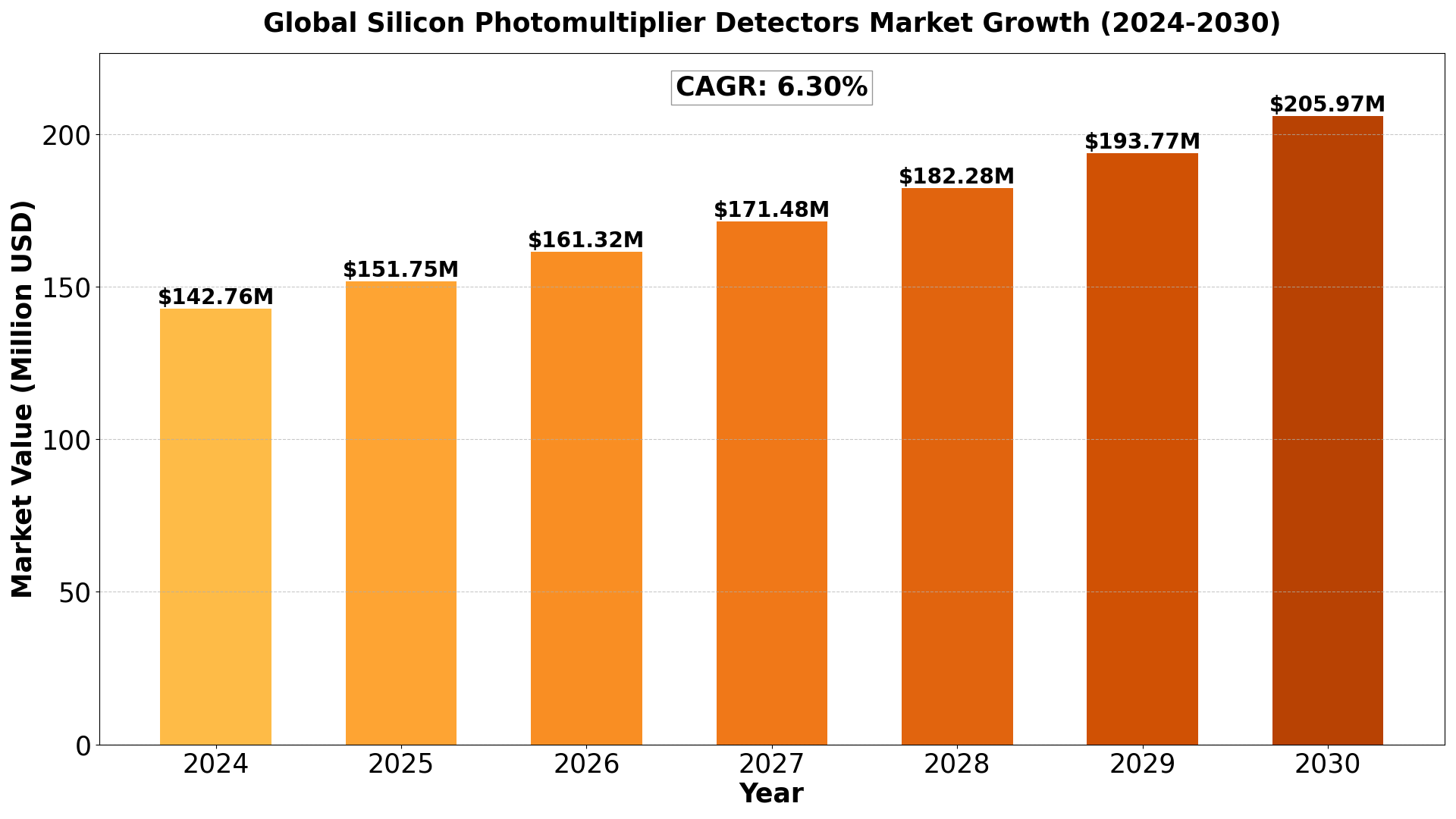
The Global Silicon Photomultiplier Detectors Market size was estimated at USD 134.30 million in 2023 and is projected to reach USD 205.97 million by 2030, exhibiting a CAGR of 6.30% during the forecast period.
North America Silicon Photomultiplier Detectors market size was USD 34.99 million in 2023, at a CAGR of 5.40% during the forecast period of 2024 through 2030.
Access Your Free Sample Report Now
Silicon Photomultiplier Detectors Key Market Trends :
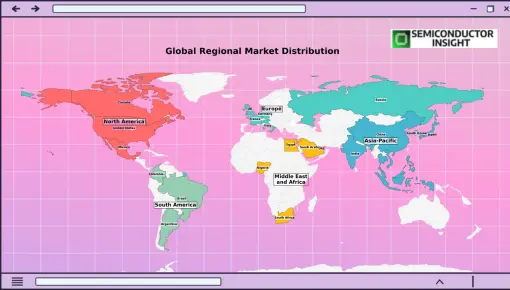
1. North America (USA, Canada, Mexico)
- USA: The largest market in the region due to advanced infrastructure, high disposable income, and technological advancements. Key industries include technology, healthcare, and manufacturing.
- Canada: Strong market potential driven by resource exports, a stable economy, and government initiatives supporting innovation.
- Mexico: A growing economy with strengths in automotive manufacturing, agriculture, and tourism, benefitting from trade agreements like the USMCA.
2. Europe (Germany, UK, France, Russia, Italy, Rest of Europe)
- Germany: The region’s industrial powerhouse with a focus on engineering, automotive, and machinery.
- UK: A hub for financial services, fintech, and pharmaceuticals, though Brexit has altered trade patterns.
- France: Strong in luxury goods, agriculture, and aerospace with significant innovation in renewable energy.
- Russia: Resource-driven economy with strengths in oil, gas, and minerals but geopolitical tensions affect growth.
- Italy: Known for fashion, design, and manufacturing, especially in luxury segments.
- Rest of Europe: Includes smaller yet significant economies like Spain, Netherlands, and Switzerland with strengths in finance, agriculture, and manufacturing.
3. Asia-Pacific (China, Japan, South Korea, India, Southeast Asia, Rest of Asia-Pacific)
- China: The largest market in the region with a focus on technology, manufacturing, and e-commerce. Rapid urbanization and middle-class growth fuel consumption.
- Japan: Technological innovation, particularly in robotics and electronics, drives the economy.
- South Korea: Known for technology, especially in semiconductors and consumer electronics.
- India: Rapidly growing economy with strengths in IT services, agriculture, and pharmaceuticals.
- Southeast Asia: Key markets like Indonesia, Thailand, and Vietnam show growth in manufacturing and tourism.
- Rest of Asia-Pacific: Emerging markets with growing investment in infrastructure and services.
4. South America (Brazil, Argentina, Colombia, Rest of South America)
- Brazil: Largest economy in the region, driven by agriculture, mining, and energy.
- Argentina: Known for agriculture exports and natural resources but faces economic instability.
- Colombia: Growing economy with strengths in oil, coffee, and flowers.
- Rest of South America: Includes Chile and Peru, which have strong mining sectors.
5. The Middle East and Africa (Saudi Arabia, UAE, Egypt, Nigeria, South Africa, Rest of MEA)
- Saudi Arabia: Oil-driven economy undergoing diversification with Vision 2030 initiatives.
- UAE: Financial hub with strengths in tourism, real estate, and trade.
- Egypt: Growing infrastructure development and tourism.
- Nigeria: Largest economy in Africa with strengths in oil and agriculture.
- South Africa: Industrialized economy with strengths in mining and finance.
- Rest of MEA: Includes smaller yet resource-rich markets like Qatar and Kenya with growing infrastructure investments.
Silicon Photomultiplier Detectors Market Segmentation :
The research report includes specific segments by region (country), manufacturers, Type, and Application. Market segmentation creates subsets of a market based on product type, end-user or application, Geographic, and other factors. By understanding the market segments, the decision-maker can leverage this targeting in the product, sales, and marketing strategies. Market segments can power your product development cycles by informing how you create product offerings for different segments.
Market Segmentation (by Type)
- Analog Silicon Photomultiplier
- Digital Silicon Photomultiplier
Market Segmentation (by Application)
- Medical Imaging
- Lidar & 3D-Ranging
- Sorting & Recycling
- Hazard & Threat Detection
- Biophotonics & Sciences
- High Energy Physics
- Others
Silicon Photomultiplier Detectors Market Competitive landscape :
- Hamamatsu
- ON Semiconductor (SensL)
- KETEK
- Excelitas Technologies
- Philips
- Broadcom
- First Sensor
- AdvanSiD
- Cremat
- Radiation Monitoring Devices
- TE Connectivity
Download Your Complimentary Sample Report
Drivers
- High Sensitivity and Efficiency: Silicon photomultipliers (SiPMs) are known for their high photon detection efficiency, making them highly effective in applications like medical imaging, LIDAR systems, and particle physics. This ability to detect low light levels and provide high resolution is driving the demand for SiPM detectors.
- Compact and Robust Design: Unlike traditional photomultiplier tubes (PMTs), SiPMs are solid-state devices that are compact, lightweight, and more robust. Their resilience to mechanical shocks and environmental factors (such as magnetic fields and high radiation) makes them suitable for a range of harsh environments, including aerospace, medical, and industrial applications.
- Low Operating Voltage: SiPMs operate at lower voltages compared to traditional PMTs, which makes them safer, more energy-efficient, and easier to integrate into modern electronic systems. This cost-effective feature drives adoption across various industries that require reliable and power-efficient devices.
- Growing Demand in Medical Imaging: SiPM detectors are finding extensive use in positron emission tomography (PET) scanners and other medical imaging equipment. As the demand for non-invasive diagnostic tools grows, the need for SiPMs, which offer high spatial resolution and fast timing, continues to rise.
- Advancements in Technology: Ongoing research and technological advancements in SiPMs, such as improvements in their dark-count rate, time resolution, and overall performance, are contributing to the growth of the market. These advancements are making SiPMs a more attractive alternative to traditional photon detectors.
Restraints:
- High Cost: SiPM detectors, especially those with high-performance characteristics, can be relatively expensive compared to other photodetectors like PMTs or avalanche photodiodes (APDs). This high cost may limit their adoption, especially in applications with tight budgets or cost sensitivity.
- Temperature Sensitivity: While SiPMs are more resilient than PMTs in many ways, they can still be sensitive to temperature variations, which may affect their performance. To maintain optimal performance, these devices may require temperature stabilization or cooling, adding complexity and cost to their integration.
- Limited Scalability: Despite being highly effective in certain applications, SiPM detectors are still limited when it comes to scaling up for large-area detection applications. Their performance can degrade when used in larger systems or when handling very high radiation doses.
Opportunities:
- Growing Adoption in Autonomous Vehicles: The increasing use of autonomous vehicles is a significant opportunity for SiPMs, especially in Light Detection and Ranging (LIDAR) systems. SiPMs can provide the high precision and reliability needed for LIDAR-based navigation systems, creating a new market for these detectors.
- Expanding Applications in Nuclear and High Energy Physics: SiPMs are ideal for use in high-energy physics experiments, such as in the detection of low-energy photons or in radiation detection systems. The growing number of experiments in these fields, including particle accelerators and dark matter research, offers considerable opportunities for SiPM manufacturers.
- Advancements in Quantum Technologies: As quantum technologies develop, SiPMs are expected to play a crucial role in quantum sensing, quantum communication, and quantum computing. Their ability to detect single photons makes them highly valuable for quantum applications, thus creating new opportunities for growth in the sector.
- Integration into Wearable Health Devices: With the rise of wearable health technology, such as pulse oximeters and blood glucose sensors, SiPMs could be integrated into these devices to provide better sensor performance and faster readings. This trend is expected to drive growth in the consumer electronics market.
Challenges:
- Competition from Alternative Photodetectors: SiPMs face stiff competition from other photodetectors, such as avalanche photodiodes (APDs) and photomultiplier tubes (PMTs), which are widely used in similar applications. These alternatives often offer more established technology and may present challenges for SiPMs to differentiate themselves in certain sectors.
- Technological Barriers to Mass Production: While SiPM technology is advancing, there are still some barriers to mass production and cost reduction. The complex nature of SiPM devices and their manufacturing processes can pose challenges in scaling up production while keeping costs competitive.
- Calibration and Maintenance Complexity: SiPMs require precise calibration to maintain high performance over time. While they are more stable than PMTs, any drift in their characteristics due to environmental factors or aging components can reduce their effectiveness. This requirement for ongoing calibration and maintenance can be a burden for users, especially in systems where uptime is critical.
- Limited Standardization: The SiPM market lacks universal standards in terms of specifications, interfaces, and performance criteria. This lack of standardization can make it difficult for companies to compare products or integrate them into larger systems, slowing down adoption in certain industries.
Key Benefits of This Market Research:
- Industry drivers, restraints, and opportunities covered in the study
- Neutral perspective on the market performance
- Recent industry trends and developments
- Competitive landscape & strategies of key players
- Potential & niche segments and regions exhibiting promising growth covered
- Historical, current, and projected market size, in terms of value
- In-depth analysis of the CVD SiC Focus Ring Market
- Overview of the regional outlook of the CVD SiC Focus Ring Market:
Key Reasons to Buy this Report:
- Access to date statistics compiled by our researchers. These provide you with historical and forecast data, which is analyzed to tell you why your market is set to change
- This enables you to anticipate market changes to remain ahead of your competitors
- You will be able to copy data from the Excel spreadsheet straight into your marketing plans, business presentations, or other strategic documents
- The concise analysis, clear graph, and table format will enable you to pinpoint the information you require quickly
- Provision of market value (USD Billion) data for each segment and sub-segment
- Indicates the region and segment that is expected to witness the fastest growth as well as to dominate the market
- Analysis by geography highlighting the consumption of the product/service in the region as well as indicating the factors that are affecting the market within each region
- Competitive landscape which incorporates the market ranking of the major players, along with new service/product launches, partnerships, business expansions, and acquisitions in the past five years of companies profiled
- Extensive company profiles comprising of company overview, company insights, product benchmarking, and SWOT analysis for the major market players
- The current as well as the future market outlook of the industry concerning recent developments which involve growth opportunities and drivers as well as challenges and restraints of both emerging as well as developed regions
- Includes in-depth analysis of the market from various perspectives through Porters five forces analysis
- Provides insight into the market through Value Chain
- Market dynamics scenario, along with growth opportunities of the market in the years to come
- 6-month post-sales analyst support
Customization of the Report
In case of any queries or customization requirements, please connect with our sales team, who will ensure that your requirements are met.
FAQs

Get Sample Report PDF for Exclusive Insights
Report Sample Includes
- Table of Contents
- List of Tables & Figures
- Charts, Research Methodology, and more...
 Download Sample Report PDF