Sensory Switch Market Overview
Sensory Switch (or adaptive switch) is an access device that allows people with movement-limiting disabilities to use technology and operate electronic devices. Instead of the person performing complex actions such as turning a knob, adaptive switches will offer easier movement solutions, such as pressing a button. Its possible to have a switch adapter for toys, home appliances, voice-output communication tools, computers and more.
This report provides a deep insight into the global Sensory Switch market covering all its essential aspects. This ranges from a macro overview of the market to micro details of the market size, competitive landscape, development trend, niche market, key market drivers and challenges, SWOT analysis, value chain analysis, etc.
The analysis helps the reader to shape the competition within the industries and strategies for the competitive environment to enhance the potential profit. Furthermore, it provides a simple framework for evaluating and accessing the position of the business organization. The report structure also focuses on the competitive landscape of the Global Sensory Switch Market, this report introduces in detail the market share, market performance, product situation, operation situation, etc. of the main players, which helps the readers in the industry to identify the main competitors and deeply understand the competition pattern of the market.
In a word, this report is a must-read for industry players, investors, researchers, consultants, business strategists, and all those who have any kind of stake or are planning to foray into the Sensory Switch market in any manner.
Sensory Switch Market Analysis:
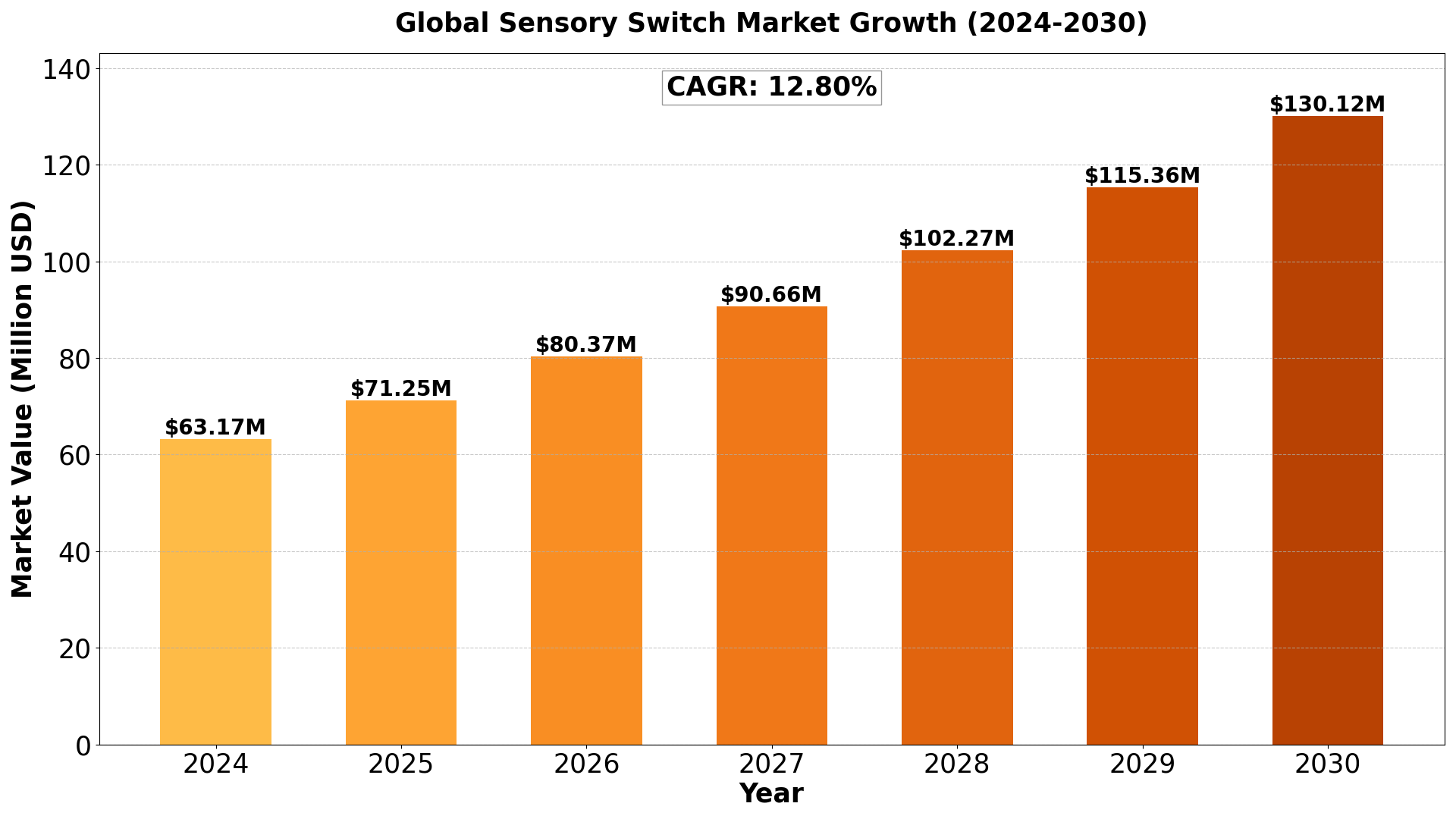
The Global Sensory Switch Market size was estimated at USD 56 million in 2023 and is projected to reach USD 130.12 million by 2030, exhibiting a CAGR of 12.80% during the forecast period.
North America Sensory Switch market size was USD 14.59 million in 2023, at a CAGR of 10.97% during the forecast period of 2024 through 2030.
Sensory Switch Key Market Trends :
1. Growth in Consumer Electronics
With the rise in smartphones, wearables, and smart home devices, the demand for intuitive user interfaces that allow for easy control of devices is growing. Sensory switches, which can be activated by a simple touch or gesture, are ideal for this application. In devices like smartphones, smart speakers, and television remotes, sensory switches provide more seamless and engaging user experiences, leading to their increased adoption.
2. Rise in Automotive Applications
Sensory switches are becoming popular in the automotive industry as vehicles are equipped with more smart technologies. With the focus on driver safety, sensory switches allow drivers to control in-car features like navigation, entertainment, and climate settings without taking their hands off the wheel or eyes off the road. This contactless switching improves convenience and safety, driving the demand for sensory switches in automotive interiors.
3. Increased Demand for Touchless Technology
The global push for contactless technologies has been accelerated by the COVID-19 pandemic, as businesses and consumers look for ways to interact with devices without physical contact. Sensory switches, especially those based on capacitive touch or infrared sensors, allow for a hygienic and efficient way to control various products. Industries such as healthcare, retail, and public spaces are increasingly adopting these switches for elevators, access control systems, and other shared devices to reduce the spread of germs.
4. Advancements in Gesture and Pressure Sensing Technology
The development of gesture sensing and pressure-sensitive switches has expanded the functionality of sensory switches. These advanced sensors can detect subtle gestures or varying levels of pressure, making them ideal for smart appliances, interactive displays, and gaming consoles. The integration of machine learning and AI technologies with sensory switches allows for more sophisticated, personalized user experiences.
5. Growing Adoption in Industrial Automation
In industrial environments, sensory switches are being used for automation control systems, especially in high-risk environments where physical buttons may not be practical or safe. Sensory switches provide hands-free control for operators, improving safety, productivity, and reducing the likelihood of contamination or error in manufacturing and warehouse management.
Sensory Switch Market Regional Analysis :
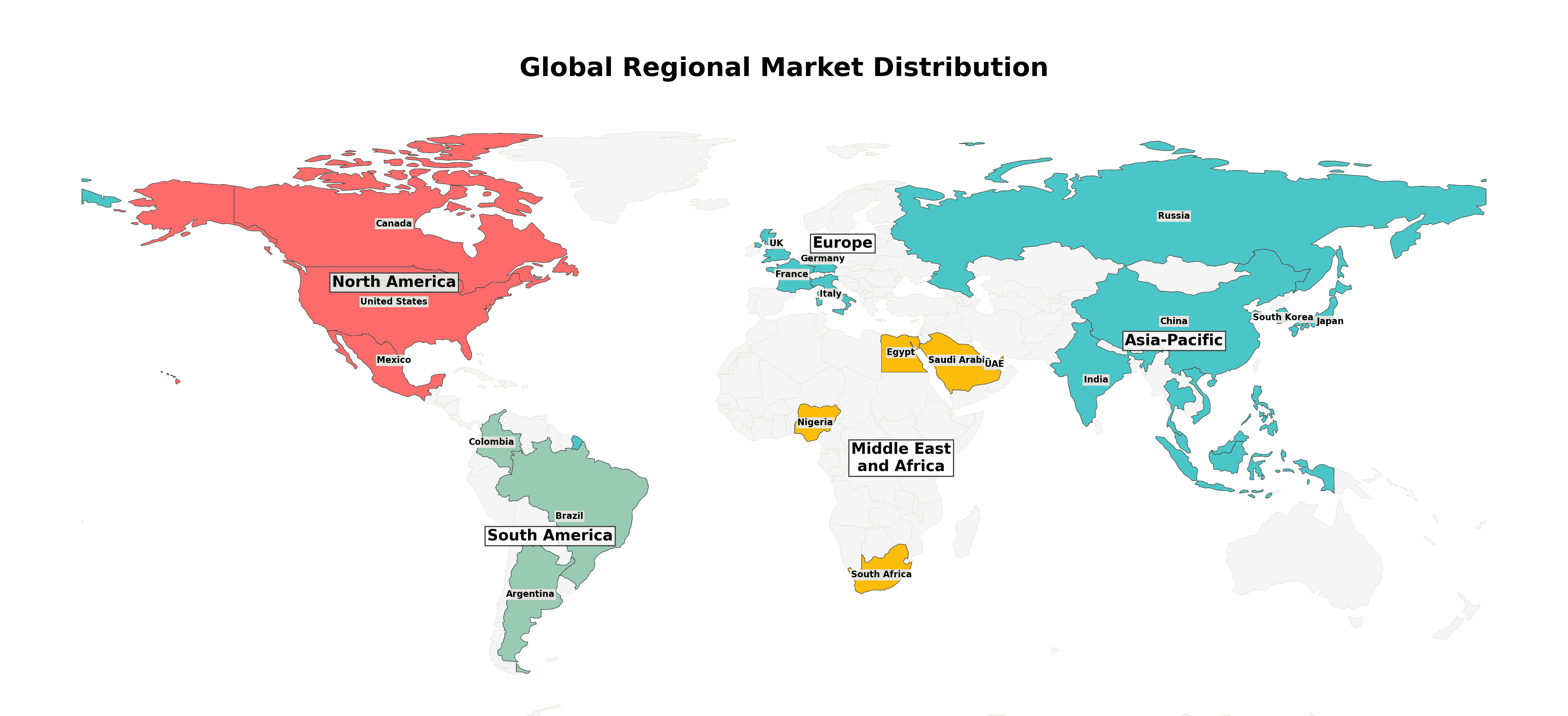
1. North America (USA, Canada, Mexico)
- USA: The largest market in the region due to advanced infrastructure, high disposable income, and technological advancements. Key industries include technology, healthcare, and manufacturing.
- Canada: Strong market potential driven by resource exports, a stable economy, and government initiatives supporting innovation.
- Mexico: A growing economy with strengths in automotive manufacturing, agriculture, and tourism, benefitting from trade agreements like the USMCA.
2. Europe (Germany, UK, France, Russia, Italy, Rest of Europe)
- Germany: The region’s industrial powerhouse with a focus on engineering, automotive, and machinery.
- UK: A hub for financial services, fintech, and pharmaceuticals, though Brexit has altered trade patterns.
- France: Strong in luxury goods, agriculture, and aerospace with significant innovation in renewable energy.
- Russia: Resource-driven economy with strengths in oil, gas, and minerals but geopolitical tensions affect growth.
- Italy: Known for fashion, design, and manufacturing, especially in luxury segments.
- Rest of Europe: Includes smaller yet significant economies like Spain, Netherlands, and Switzerland with strengths in finance, agriculture, and manufacturing.
3. Asia-Pacific (China, Japan, South Korea, India, Southeast Asia, Rest of Asia-Pacific)
- China: The largest market in the region with a focus on technology, manufacturing, and e-commerce. Rapid urbanization and middle-class growth fuel consumption.
- Japan: Technological innovation, particularly in robotics and electronics, drives the economy.
- South Korea: Known for technology, especially in semiconductors and consumer electronics.
- India: Rapidly growing economy with strengths in IT services, agriculture, and pharmaceuticals.
- Southeast Asia: Key markets like Indonesia, Thailand, and Vietnam show growth in manufacturing and tourism.
- Rest of Asia-Pacific: Emerging markets with growing investment in infrastructure and services.
4. South America (Brazil, Argentina, Colombia, Rest of South America)
- Brazil: Largest economy in the region, driven by agriculture, mining, and energy.
- Argentina: Known for agriculture exports and natural resources but faces economic instability.
- Colombia: Growing economy with strengths in oil, coffee, and flowers.
- Rest of South America: Includes Chile and Peru, which have strong mining sectors.
5. The Middle East and Africa (Saudi Arabia, UAE, Egypt, Nigeria, South Africa, Rest of MEA)
- Saudi Arabia: Oil-driven economy undergoing diversification with Vision 2030 initiatives.
- UAE: Financial hub with strengths in tourism, real estate, and trade.
- Egypt: Growing infrastructure development and tourism.
- Nigeria: Largest economy in Africa with strengths in oil and agriculture.
- South Africa: Industrialized economy with strengths in mining and finance.
- Rest of MEA: Includes smaller yet resource-rich markets like Qatar and Kenya with growing infrastructure investments.
Sensory Switch Market Segmentation :
The research report includes specific segments by region (country), manufacturers, Type, and Application. Market segmentation creates subsets of a market based on product type, end-user or application, Geographic, and other factors. By understanding the market segments, the decision-maker can leverage this targeting in the product, sales, and marketing strategies. Market segments can power your product development cycles by informing how you create product offerings for different segments.
Key Company
- Enabling Devices
- Experia
- SpaceKraft
- Smartbox Assistive Technology
- Ablenet
- Med Labs
- Inc
- RJ Cooper & Associates Inc
- Bellman & Symfon AB
- Fabrication Enterprises
Market Segmentation (by Type)
- Wired Models
- Wireless Models
Market Segmentation (by Application)
- Medical Care
- Toys and Game Equipment
- Others
Drivers:
- Growing Demand for Smart Homes and IoT Devices: The increasing adoption of smart home technologies and Internet of Things (IoT) devices is one of the major drivers of the sensory switch market. Smart homes require more intuitive, touchless, and automated controls for devices like lights, thermostats, security systems, and appliances. Sensory switches, such as those activated by proximity or motion, are integral to creating seamless user experiences in these environments.
- Rising Consumer Preference for Touchless Controls: With growing concerns around hygiene and convenience, particularly after the COVID-19 pandemic, many consumers are seeking touchless solutions that reduce physical contact with switches. Capacitive touch switches and motion-sensing switches are being preferred as they allow users to operate devices without the need for direct physical touch, making them ideal for applications in healthcare, public spaces, and home appliances.
- Technological Advancements in Sensory Switch Design: The development of advanced technologies, such as capacitive sensing, infrared (IR), ultrasonic, and pressure-sensitive sensors, has made sensory switches more reliable, accurate, and affordable. These innovations allow manufacturers to design more versatile switches with features like multi-touch capabilities, gesture recognition, and proximity sensing, which enhance the functionality and appeal of these devices.
- Integration of Sensory Switches in Automotive and Industrial Applications: Sensory switches are increasingly being integrated into automotive and industrial control systems. In the automotive sector, features such as touchless doors, gesture-based control systems, and hands-free operation are becoming more popular. In industrial environments, capacitive and infrared switches are being used to enhance safety, productivity, and efficiency by enabling touchless or remote controls for heavy machinery and equipment.
- Increased Focus on Energy-Efficient Solutions: Sensory switches can contribute to energy efficiency in both residential and commercial buildings. For example, motion-sensitive light switches ensure that lights are only on when needed, thus reducing energy consumption. As energy efficiency becomes a key priority globally, the demand for sensory switches that help in reducing power wastage is expected to grow.
Restraints:
- High Cost of Sensory Switches: One of the primary challenges in the sensory switch market is the relatively higher cost of these switches compared to traditional mechanical switches. The advanced sensing technology, materials, and precision required for production often make sensory switches more expensive, which could limit their adoption in cost-sensitive applications and markets.
- Limited Awareness and Adoption in Emerging Markets: While sensory switches are gaining popularity in developed regions, their adoption in emerging markets is still limited due to factors such as lack of awareness, higher product costs, and lower penetration of smart home and IoT technologies. This market may face slow growth in countries where traditional switches remain the dominant solution.
- Complexity in Integration and Installation: The installation and integration of sensory switches, particularly in existing systems, can be complex and require skilled labor. For example, integrating gesture-based sensors or proximity sensors into older buildings or industrial systems might involve significant retrofitting. This can deter some potential users, especially those with budget constraints or less technical expertise.
- Sensitivity to Environmental Factors: Sensory switches, particularly those that rely on infrared or capacitive technology, can be sensitive to environmental conditions such as temperature, humidity, or electrical interference. For instance, infrared-based sensors may not work effectively in high ambient light conditions, and capacitive sensors could be affected by moisture or electrical noise. This limitation may hinder the widespread adoption of sensory switches in certain applications.
Opportunities:
- Expansion of Smart Home and Building Automation: The growing trend of smart homes and building automation presents a significant opportunity for the sensory switch market. As consumers increasingly adopt voice assistants like Amazon Alexa, Google Assistant, and Apple Siri, there is an increased need for advanced, touchless control systems, and sensory switches can provide that hands-free operation. This opens up opportunities in applications such as lighting, HVAC, security, and appliances.
- Growing Demand for Gesture Recognition in Automotive: Gesture-based control systems are becoming a key feature in automotive infotainment systems. Many car manufacturers are integrating gesture recognition technologies into their vehicles, allowing drivers to control music, navigation, and other functions without touching physical buttons. Sensory switches, particularly those based on infrared or ultrasonic sensing, can be a significant component of these systems, offering opportunities in the automotive industry.
- Advancements in Healthcare: Sensory switches have significant potential in healthcare settings. For example, motion-sensing switches can be used to control medical equipment or hospital lighting without the need for physical contact, reducing the spread of germs and bacteria. In elderly care, pressure-sensitive or capacitive switches can enable simpler interaction with medical devices for patients with limited mobility or physical capabilities, providing a more comfortable experience.
- Use of Sensory Switches in Consumer Electronics: As consumer electronics manufacturers continue to develop innovative products, sensory switches are becoming a key feature in devices such as smartphones, tablets, wearable tech, and home appliances. The ability to replace physical buttons with capacitive or touch-sensitive sensors offers a sleek, modern look while also enhancing user convenience.
- Integration with Artificial Intelligence (AI): The integration of AI with sensory switch technology could enhance the functionality of these devices. For instance, AI-powered gesture recognition or voice recognition systems could improve the accuracy of sensory switches and expand their application in areas like gaming, virtual reality (VR), and smart home automation. The ability to learn user preferences and behaviors will open up new opportunities for sensory switches in personalized and adaptive technologies.
Challenges:
- Reliability in Harsh Environments: Sensory switches, particularly those based on infrared, ultrasonic, or capacitive technologies, may face challenges in harsh environments. Industrial settings or outdoor applications often involve dust, dirt, moisture, and extreme temperatures, which can affect the reliability and functionality of the sensors. Manufacturers need to design sensory switches that can operate effectively in such environments to address this challenge.
- Integration with Legacy Systems: One of the key challenges facing the sensory switch market is the integration of advanced sensory technologies with older or legacy systems that may rely on traditional switches. Retrofitting existing systems with sensory switches could be costly and time-consuming, requiring specialized expertise and adjustments to infrastructure.
- Data Privacy and Security: As sensory switches become more integrated with IoT systems and smart home networks, ensuring data privacy and security becomes crucial. Sensory switches often require connectivity to cloud services or local devices, and if these systems are not properly secured, they could be vulnerable to hacking or unauthorized access, which could limit their adoption in sensitive environments.
Key Benefits of This Market Research:
- Industry drivers, restraints, and opportunities covered in the study
- Neutral perspective on the market performance
- Recent industry trends and developments
- Competitive landscape & strategies of key players
- Potential & niche segments and regions exhibiting promising growth covered
- Historical, current, and projected market size, in terms of value
- In-depth analysis of the Sensory Switch Market
- Overview of the regional outlook of the Sensory Switch Market:
Key Reasons to Buy this Report:
- Access to date statistics compiled by our researchers. These provide you with historical and forecast data, which is analyzed to tell you why your market is set to change
- This enables you to anticipate market changes to remain ahead of your competitors
- You will be able to copy data from the Excel spreadsheet straight into your marketing plans, business presentations, or other strategic documents
- The concise analysis, clear graph, and table format will enable you to pinpoint the information you require quickly
- Provision of market value (USD Billion) data for each segment and sub-segment
- Indicates the region and segment that is expected to witness the fastest growth as well as to dominate the market
- Analysis by geography highlighting the consumption of the product/service in the region as well as indicating the factors that are affecting the market within each region
- Competitive landscape which incorporates the market ranking of the major players, along with new service/product launches, partnerships, business expansions, and acquisitions in the past five years of companies profiled
- Extensive company profiles comprising of company overview, company insights, product benchmarking, and SWOT analysis for the major market players
- The current as well as the future market outlook of the industry concerning recent developments which involve growth opportunities and drivers as well as challenges and restraints of both emerging as well as developed regions
- Includes in-depth analysis of the market from various perspectives through Porters five forces analysis
- Provides insight into the market through Value Chain
- Market dynamics scenario, along with growth opportunities of the market in the years to come
- 6-month post-sales analyst support
Customization of the Report
In case of any queries or customization requirements, please connect with our sales team, who will ensure that your requirements are met.
FAQs
Q1. What is the Sensory Switch market?
A1. The Sensory Switch market involves the production and sale of switches that are activated through sensory inputs, such as touch, pressure, or proximity. These switches are used in various applications, including consumer electronics, automotive, medical devices, and industrial automation.
Q2. What are the key applications of Sensory Switches?
A2. Key applications include use in touch-sensitive devices, wearable electronics, smart home systems, automotive controls, medical equipment, and industrial machinery, where tactile interaction or proximity detection is required.
Q3. What are the growth drivers in the Sensory Switch market?
A3. Growth drivers include the increasing adoption of smart devices, the rise in demand for touch-sensitive and gesture-based interfaces, and advancements in wearable technology and IoT devices that require sensory switch technology.
Q4. What are the challenges faced in the Sensory Switch market?
A4. Challenges include the high cost of advanced sensory switch technology, the need for miniaturization in certain applications, and ensuring reliability and durability in harsh environments, particularly for industrial and automotive uses.
Q5. Which regions dominate the Sensory Switch market?
A5. North America, Europe, and Asia-Pacific are leading regions in the Sensory Switch market, with significant contributions from the U.S., China, Japan, and South Korea, driven by advancements in electronics, automotive, and healthcare sectors.
Get Sample Report PDF for Exclusive Insights
Report Sample Includes
- Table of Contents
- List of Tables & Figures
- Charts, Research Methodology, and more...
 Download Sample Report PDF