Market Insights
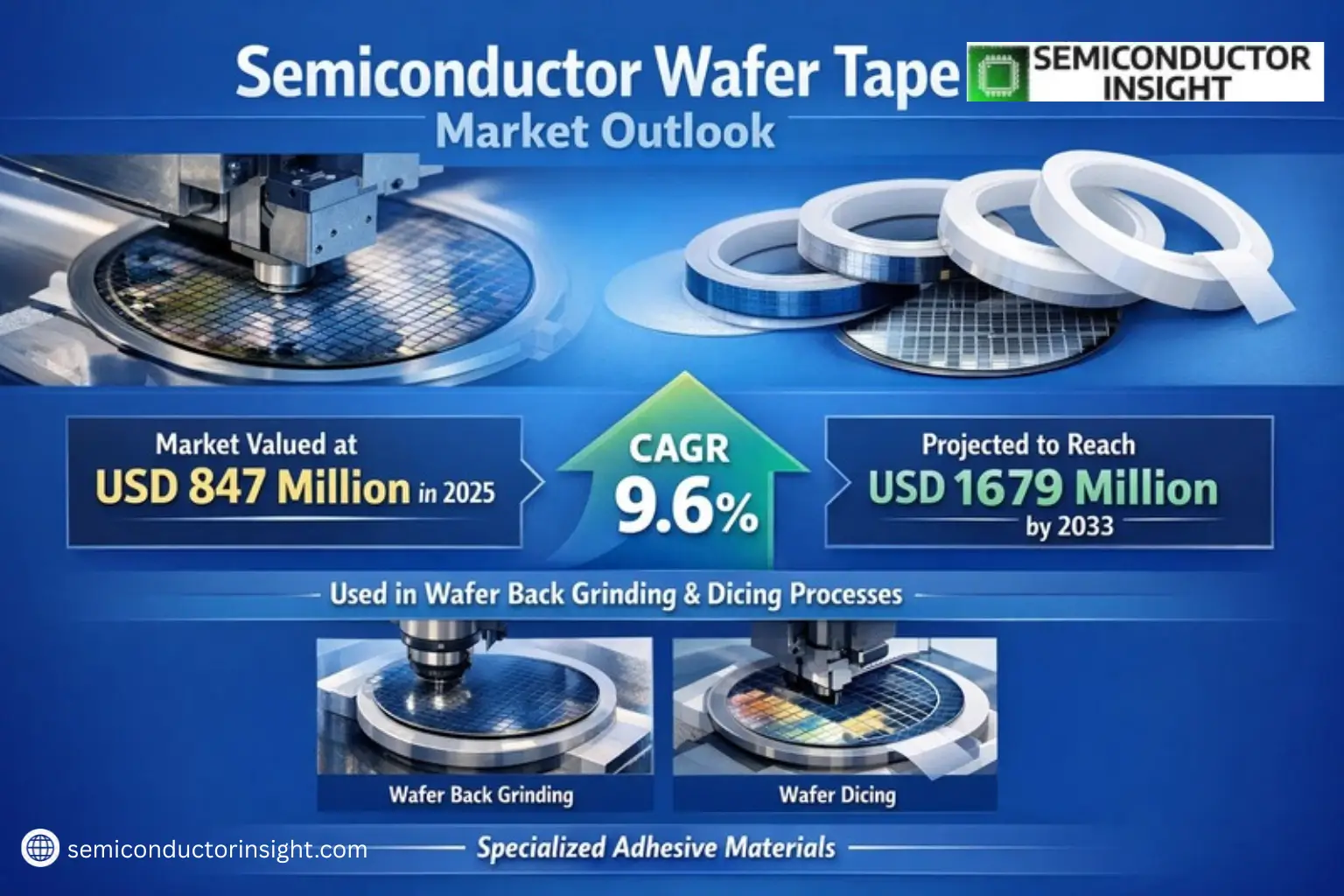
Global Semiconductor Wafer Tape Market was valued at USD 847 million in 2025 and is projected to reach USD 1679 million by 2033, exhibiting a CAGR of 9.6% during the forecast period.
Semiconductor Wafer Tapes are specialized adhesive materials used in wafer back grinding and dicing processes. These tapes include UV and non-UV variants, each designed for specific manufacturing requirements. UV tape offers strong adhesive strength during processing but reduces drastically after UV irradiation, enabling easy de-taping. Non-UV tape peels off without requiring UV exposure, providing flexibility in production workflows.
The market growth is driven by increasing semiconductor demand across consumer electronics, automotive, and industrial applications. Taiwan leads global consumption with 34.0% market share in 2023, followed by mainland China (27.4%) and North America (9.27%). Japan dominates production with 83% market share, though China’s domestic manufacturers are gaining traction through local verification programs. Key players like Mitsui Chemicals and Nitto Denko Corporation collectively hold 82.5% market share, while emerging Chinese competitors focus on capturing regional demand through technological advancements.
MARKET DRIVERS
Growing Demand for Semiconductor Devices
Semiconductor Wafer Tape Market is experiencing strong growth driven by increasing demand for advanced semiconductor devices in consumer electronics, automotive, and AI applications. The rise of 5G technology and IoT devices has accelerated wafer-level packaging adoption, boosting the need for high-performance wafer tapes.
Technological Advancements in Packaging
Continuous innovation in wafer thinning and dicing processes requires specialized tapes that can withstand extreme processing conditions. The shift toward thinner wafers below 50μm has increased demand for ultra-thin semiconductor wafer tapes with superior adhesion properties.
Material science breakthroughs in acrylic and silicone-based adhesives are enabling semiconductor wafer tapes to meet stringent thermal and chemical resistance requirements in advanced packaging.
MARKET CHALLENGES
High Material and Processing Costs
The specialized formulations required for semiconductor wafer tapes result in higher production costs compared to conventional adhesive tapes. Stringent purity requirements add complexity to manufacturing processes.
Other Challenges
Technical Limitations in Extreme Environments
Developing tapes that maintain performance at temperatures exceeding 300°C while preventing silicon contamination remains a key technical hurdle for semiconductor wafer tape manufacturers.
MARKET RESTRAINTS
Supply Chain Disruptions
Semiconductor Wafer Tape Market faces constraints from raw material shortages and geopolitical trade restrictions. Specialized polymer resins and release liners have experienced volatile pricing and availability in recent years.
MARKET OPPORTUNITIES
Expansion in Advanced Packaging
The transition to fan-out wafer-level packaging (FOWLP) and 3D IC stacking creates new opportunities for specialized semiconductor wafer tapes. Emerging applications in heterogeneous integration require tapes with precise thickness control and stress management properties.
Regional Capacity Expansion
New semiconductor fabrication plants under construction in North America and Southeast Asia represent significant growth avenues for semiconductor wafer tape suppliers, with an estimated 42 new facilities planned through 2026.
Semiconductor Wafer Tape Market Trends
Robust Market Growth Projected Through 2033
Global Semiconductor Wafer Tape Market, valued at USD 847 million in 2025, is projected to reach USD 1,679 million by 2033, growing at a CAGR of 9.6%. This growth is driven by increasing semiconductor production and advancements in wafer processing technologies. The market expansion reflects rising demand for both UV and non-UV wafer tapes across fabrication facilities globally.
Other Trends
Regional Consumption Patterns Shift
China Taiwan remains the dominant consumer with 34% market share in 2023, followed by mainland China (27.4%) and North America (9.27%). Southeast Asia is emerging as the fastest-growing region with an expected CAGR of 10.6% through 2030, indicating a geographic shift in semiconductor manufacturing capacity.
Production Landscape and Competitive Dynamics
Japan controls 83% of global production with key manufacturers like Mitsui Chemicals and Nitto Denko leading the market. The Chinese domestic market is expanding rapidly, projected to reach 9.41% production share by 2030. The top five manufacturers collectively hold 82.5% market share, demonstrating high industry concentration.
Technology and Application Trends
UV Tape Dominance Continues
UV wafer tapes accounted for 62.5% of the market in 2023, with projections showing growth to 64% by 2030. This preference stems from their superior adhesive properties during back grinding and dicing processes, followed by easy de-bonding post-UV exposure.
Application Shift Toward Wafer Grinding
While dicing applications held 54.95% share in 2023, the wafer grinding segment is forecast to grow faster, increasing from 45.05% to 46.01% market share by 2030. This reflects changing semiconductor packaging requirements and process optimizations.
COMPETITIVE LANDSCAPE
Key Industry Players
Japan Dominates Semiconductor Wafer Tape Production with 83% Market Share
Semiconductor Wafer Tape Market is highly concentrated, with Japanese manufacturers holding a dominant position. Mitsui Chemicals, LINTEC Corporation, and Nitto Denko Corporation collectively control over 50% of the global market. These established players benefit from advanced adhesive technologies and strong relationships with semiconductor manufacturers. The top five companies accounted for 82.5% of revenues in 2023, reflecting significant barriers to entry in this specialized materials sector.
Emerging Chinese manufacturers are accelerating R&D efforts to capture domestic market share, with Shanghai Guke Adhesive Tape Technology and Plusco Tech making notable progress. The UV tape segment (62.5% market share) remains the primary growth driver, particularly for wafer dicing applications. Regional expansion is focusing on Southeast Asia, projected to grow at 10.6% CAGR through 2030.
List of Key Semiconductor Wafer Tape Companies Profiled
- Mitsui Chemicals
- LINTEC Corporation
- Denka
- Nitto Denko Corporation
- Furukawa Electric
- Sekisui Chemical
- Maxell Sliontec
- Resonac Corporation
- Sumitomo Bakelite Company
- D&X Co., Ltd
- KGK Chemical Corporation
- AI Technology, Inc. (AIT)
- Shanghai Guke Adhesive Tape Technology
- Plusco Tech
- Yantai Darbond Technology
Segment Analysis:
| Segment Category | Sub-Segments | Key Insights |
| By Type |
|
UV Tape dominates the market with superior performance characteristics:
|
| By Application |
|
Dicing Tape leads applications with critical performance advantages:
|
| By End User |
|
Foundries represent the most significant demand segment:
|
| By Tape Thickness |
|
Ultra-Thin Tapes gaining prominence in advanced applications:
|
| By Supply Chain Position |
|
Direct to OEM represents the dominant supply model:
|
Regional Analysis: Global Semiconductor Wafer Tape Market
Asia-Pacific
Taiwan’s semiconductor foundries account for the highest wafer tape consumption globally, with TSMC and UMC driving demand for ultra-thin dicing tapes compatible with 5nm and below process nodes.
South Korean manufacturers require specialized wafer tapes for high-volume memory production, with Samsung and SK Hynix prioritizing tapes offering superior die protection during backgrinding processes.
China’s semiconductor self-sufficiency initiatives are creating demand for wafer tapes compatible with legacy nodes, with SMIC and Yangtze Memory driving adoption of cost-effective localized tape solutions.
Japanese chemical companies lead in developing advanced wafer tape materials, with Nitto Denko and Mitsui Chemicals pioneering UV-curable tapes for heterogeneous integration packaging applications.
North America
North America maintains strong Semiconductor Wafer Tape Market demand through research-driven applications and advanced packaging development. The U.S. hosts multiple IDMs and fabless companies requiring specialized tapes for low-volume, high-mix production. Regional growth stems from packaging R&D centers developing chiplets and 3D IC solutions requiring temporary bonding/debonding tapes. Major tape suppliers collaborate closely with U.S. semiconductor equipment manufacturers to develop integrated tape-handling solutions compatible with advanced pick-and-place systems.
Europe
Europe’s Semiconductor Wafer Tape Market focuses on automotive and industrial applications, with specialized requirements for high-temperature resistant tapes. Germany leads in MEMS production requiring precision dicing tapes while the Netherlands’ photolithography expertise drives demand for contamination-free handling solutions. Regional tape manufacturers emphasize environmentally sustainable formulations to align with EU regulations, developing bio-based adhesive systems without compromising performance characteristics.
Middle East & Africa
The region shows emerging Semiconductor Wafer Tape Market potential through strategic investments in semiconductor assembly facilities. Middle Eastern nations are developing back-end packaging capabilities, creating demand for basic wafer dicing and backgrinding tapes. Africa’s market remains nascent but shows promise through localized assembly operations in North Africa serving European electronics manufacturers.
South America
South America’s Semiconductor Wafer Tape Market is concentrated in Brazil’s electronics manufacturing sector, primarily serving automotive and consumer electronics applications. The region imports most advanced wafer tape solutions while developing local capabilities for basic dicing tape production. Growth opportunities exist in supporting regional back-end packaging operations serving the Argentine and Chilean electronics industries.
Report Scope
This market research report provides a comprehensive analysis of the Semiconductor Wafer Tape Market , covering the forecast period 2025–2033. It offers detailed insights into market dynamics, technological advancements, competitive landscape, and key trends shaping the industry.
Key focus areas of the report include:
- Market Overview: The report begins with an overview outlining its current market scenario, key growth indicators, and industry transformation drivers. It discusses macroeconomic factors, demand–supply balance, regulatory landscape, and the strategic role of semiconductors in powering advancements across industries such as automotive, telecommunications, consumer electronics, and industrial automation.
- Market Size & Forecast: Historical data and future projections for revenue, unit shipments, and market value across major regions and segments.
- Segmentation Analysis: Detailed breakdown by product type, technology, application, and end-user industry to identify high-growth segments and investment opportunities.
- Regional Insights: Insights into market performance across North America, Europe, Asia-Pacific, Latin America, and the Middle East & Africa, including country-level analysis where relevant.
- Competitive Landscape: Profiles of leading market participants, including their product offerings, R&D focus, manufacturing capacity, pricing strategies, and recent developments such as mergers, acquisitions, and partnerships.
- Technology Trends & Innovation: Assessment of emerging technologies, integration of AI/IoT, semiconductor design trends, fabrication techniques, and evolving industry standards.
- Market Drivers & Restraints: Evaluation of factors driving market growth along with challenges, supply chain constraints, regulatory issues, and market-entry barriers.
- Stakeholder Insights: Insights for component suppliers, OEMs, system integrators, investors, and policymakers regarding the evolving ecosystem and strategic opportunities.
Primary and secondary research methods are employed, including interviews with industry experts, data from verified sources, and real-time market intelligence to ensure the accuracy and reliability of the insights presented.
FREQUENTLY ASKED QUESTIONS:
What is the current market size of Semiconductor Wafer Tape Market?
-> Semiconductor Wafer Tape Market was valued at USD 847 million in 2025 and is projected to reach USD 1679 million by 2033, exhibiting a CAGR of 9.6% during the forecast period.
Which key companies operate in Semiconductor Wafer Tape Market?
-> Key players include Mitsui Chemicals, LINTEC Corporation, Furukawa Electric, Denka, Nitto Denko Corporation, Maxell Sliontec, Sekisui Chemical, among others. The top five manufacturers accounted for 82.5% of the market share in 2023.
What are the key growth drivers?
-> Key growth drivers include increasing semiconductor manufacturing activities, expansion of wafer fabrication facilities, and rising demand for advanced packaging technologies.
Which region dominates the market?
-> Asia-Pacific dominates the market, with China Taiwan being the largest consumer (34% share in 2023), followed by mainland China (27.4%) and North America (9.27%). Southeast Asia is projected to grow fastest at 10.6% CAGR.
What are the emerging trends?
-> Emerging trends include growth of UV tape adoption (64% share by 2030), expansion of Chinese manufacturers, and technological advancements in wafer dicing and back grinding processes.

Get Sample Report PDF for Exclusive Insights
Report Sample Includes
- Table of Contents
- List of Tables & Figures
- Charts, Research Methodology, and more...
 Download Sample Report PDF