Semiconductor Chiller Market Insights
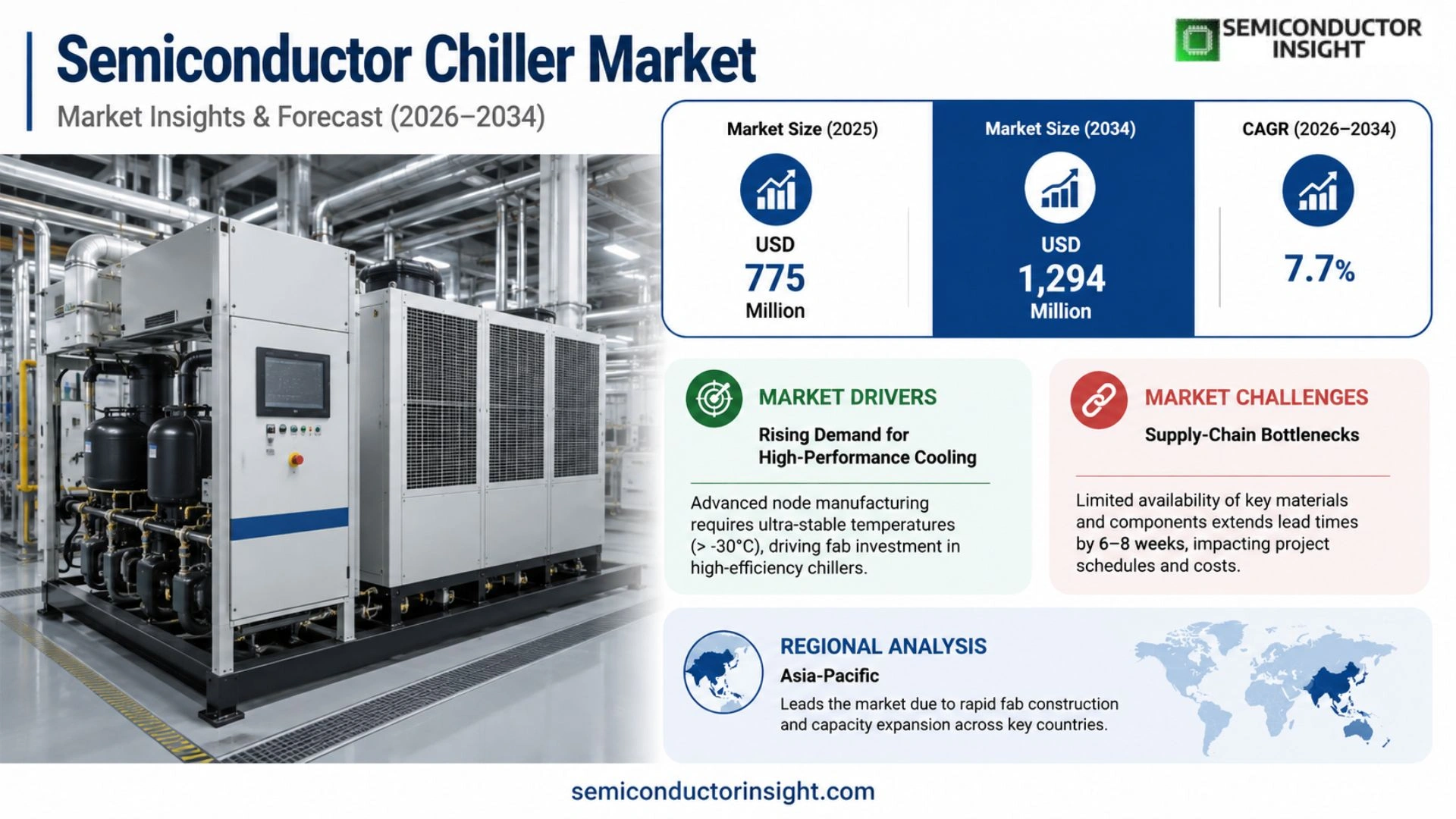
Semiconductor Chiller market was valued at USD 775 million in 2025 and is expected to attain USD 1,294 million by 2034, reflecting a CAGR of 7.7% over the forecast period.
Semiconductor Chiller is a self‑balancing circulation device used to precisely control the temperature of reaction chambers during semiconductor manufacturing. It integrates a heat exchanger, circulation pump, compressor and control system, employing refrigeration‑cycle principles together with process cooling water to regulate fluid temperature, flow and pressure with high accuracy. By directing temperature‑controlled liquid through electrodes or chamber walls, heat is transferred from the process equipment to the refrigerant and ultimately rejected to cooling water, ensuring stable thermal conditions essential for yield‑critical steps such as etching or lithography.
MARKET DRIVERS
Rising Demand for High‑Performance Cooling
Semiconductor Chiller market is being propelled by the acceleration of advanced node manufacturing, where wafer processing temperatures must be held within a narrow band to preserve yield. As fabs transition to sub‑5 nm technologies, the thermal envelope tightens, prompting equipment makers to source chillers that can sustain >‑30 °C coolant stability. This shift translates into a measurable increase in equipment orders, with vendors reporting a 14 % annual rise in chiller‑related sales since 2021.
Regulatory Push for Energy Efficiency
Governments across the Asia‑Pacific region have introduced stricter energy‑consumption standards for semiconductor manufacturing, compelling fabs to adopt chillers that deliver higher Coefficient of Performance (COP). Manufacturers that retrofit legacy chillers with variable‑speed drives are realizing up to 18 % electricity savings, which directly improves operational margins and justifies the capital outlay. The policy environment therefore creates a clear incentive for next‑generation chillers that blend cooling capacity with low‑power operation.
➤ Operators that integrate IoT‑enabled chillers report a 22 % reduction in unplanned downtime, underscoring the strategic value of predictive maintenance.
Beyond equipment efficiency, the broader ecosystem,material suppliers, metrology tools, and test rigs,is aligning its roadmaps around thermal stability. This convergence amplifies the market’s growth trajectory, as the ancillary demand for precision cooling compounds the volume of chiller units required to support end‑to‑end production lines.
MARKET CHALLENGES
Supply‑Chain Bottlenecks
Despite robust demand, the availability of critical components such as high‑purity refrigerants and specialty alloys remains constrained. Recent geopolitical tensions have disrupted the flow of raw materials, extending lead times for turnkey chiller projects by an average of 6‑8 weeks. This lag forces fab managers to balance inventory costs against the risk of production hold‑ups, a trade‑off that can erode the perceived advantage of newer cooling solutions.
Other Challenges
Cost Sensitivity
Capital expenditure thresholds in emerging fabs are tightening, especially in regions where government subsidies are limited. While high‑efficiency chillers deliver long‑term savings, the upfront price premium,often 30‑40 % higher than conventional units,creates hesitation among cost‑conscious operators, slowing the rate of technology diffusion.
MARKET RESTRAINTS
Capital Intensity Limits Adoption
The substantial initial outlay required for modular, high‑capacity chillers acts as a ceiling on market expansion, particularly for midsize foundries that operate on thin profit margins. Financing structures in many manufacturing hubs still favor incremental upgrades over full system replacements, meaning that many plants defer adoption until the next major fab refresh cycle. Consequently, the market experiences periodic spikes rather than a smooth, continuous climb.
MARKET OPPORTUNITIES
Emerging Applications in Power Electronics
Beyond traditional wafer fabrication, the rise of silicon‑carbide (SiC) and gallium‑nitride (GaN) power devices is generating a parallel demand for precision cooling in power‑module testing facilities. These applications require chillers capable of handling rapid thermal transients while maintaining tight temperature uniformity, a niche that current suppliers are only beginning to address. Targeted product development for this segment can unlock a new revenue stream that complements the core semiconductor manufacturing base.
Semiconductor Chiller Market Trends
Escalating Thermal Precision Requirements
The semiconductor fab ecosystem is tightening its tolerance bands to ±0.1 K for most etch loops and even tighter for lithography, a shift that forces chillers to deliver steadier temperature control across a broader operating envelope. Manufacturers are therefore prioritizing dual‑channel architectures that can isolate critical zones while maintaining rapid transient response. This move is not merely a technical upgrade; it translates into higher throughput because fewer process excursions mean less scrap and faster tool change‑overs. Consequently, equipment vendors are bundling advanced hydraulic manifolds and high‑resolution sensors with their chillers, creating a new revenue tier that commands premium pricing and drives aftermarket service contracts.
Other Trends
Regional Production Shifts
China retains the largest share of Semiconductor Chiller market, accounting for roughly 31 % of production in 2025, yet its growth rate outpaces all other regions, projected to rise to 31.3 % by 2034. The surge is linked to aggressive fab expansions in Shanghai and Shenzhen, where new 300 mm lines demand higher‑capacity chillers. North America, while supplying 29 % of the 2025 output, experiences a steadier increase, reflecting incremental upgrades rather than greenfield builds. South Korea and Japan together contribute over 44 % of the 2025 output, a testament to their mature supply chains and strong OEM presence.
Technology Diversification and Energy Efficiency
Water‑cooled chillers dominate the technology mix, holding more than 80 % of the 2025 market share, but the industry is witnessing a modest but decisive migration toward thermoelectric (TEC) units. TEC chillers, although presently a niche, are gaining traction because they eliminate refrigerants, aligning with the EU’s 2024 F‑gas regulation and reducing lifecycle carbon footprints. Simultaneously, manufacturers are integrating IoT‑enabled telemetry that supports remote diagnostics and predictive maintenance, a capability that lowers total cost of ownership by pre‑empting downtime. The convergence of regulatory pressure, sustainability targets, and the need for tighter thermal loops is reshaping product roadmaps, prompting legacy suppliers to launch hybrid platforms that blend liquid‑to‑liquid heat exchange with smart control layers.
COMPETITIVE LANDSCAPE
Key Industry Players
Semiconductor Chiller Market Competitive Overview
The market is heavily concentrated among a handful of global manufacturers that together command roughly three‑quarters of revenue in 2025. Advanced Thermal Sciences (ATS) leads with a broad portfolio that blends high‑precision control electronics and robust heat‑exchanger designs, enabling fabs to meet sub‑kilokelvin stability requirements. Shinwa Controls and Unisem follow closely, leveraging strong OEM relationships in North America and South Korea to secure recurring service contracts. Thermo Fisher Scientific adds depth through its integration of chiller units into larger equipment suites, while SMC Corporation exploits its extensive distribution network across Japan and Europe. This tier of players benefits from economies of scale in component sourcing and from long‑term maintenance agreements that lock in aftermarket revenue.
Beyond the front‑run tier, a diverse set of niche firms drive innovation in specialized segments. Beijing Jingyi Automation focuses on water‑cooled configurations tailored for Chinese fabs, capitalizing on rapid capacity expansion in the region. Fine Semitech Corp (FST) and Techist concentrate on thermoelectric (TEC) solutions that address ultra‑low temperature loops for lithography. Ferrotec and GST (Global Standard Technology) specialize in custom refrigerant cycles that meet emerging EU F‑gas regulations. Smaller entrants such as Mirapro, Solid State Cooling Systems, and LAUDA‑Noah provide modular, multi‑zone designs that appeal to fab owners seeking flexibility and reduced energy consumption.
List of Key Semiconductor Chiller Companies Profiled
- Advanced Thermal Sciences (ATS)
- Shinwa Controls
- Unisem
- Thermo Fisher Scientific
- SMC Corporation
- Beijing Jingyi Automation Equipment Technology
- Fine Semitech Corp (FST)
- Techist
- Ferrotec
- GST (Global Standard Technology)
- Mirapro Co., Ltd
- Solid State Cooling Systems
- LAUDA‑Noah
- Maruyama Chillers
- Ebara
Segment Analysis:
| Segment Category | Sub-Segments | Key Insights |
| By Type |
|
Dual Channel Chiller
|
| By Application |
|
Etching Process
|
| By End User |
|
Foundries
|
| By Technology |
|
Thermoelectric (TEC) Chiller
|
| By Cooling Method |
|
Water‑Cooled
|
Regional Analysis: Semiconductor Chiller Market
Asia-Pacific
China’s aggressive semiconductor roadmap fuels demand for high‑efficiency chillers capable of handling multi‑megawatt fabs. Domestic OEMs are leveraging government subsidies to accelerate R&D on low‑GWP refrigerants, aiming to capture market share from imported systems while complying with tightening environmental standards.
Japan remains a technology hub where legacy chiller manufacturers are reinventing product portfolios to serve next‑generation lithography. Emphasis on reliability and precision has spurred collaborations with process equipment firms to co‑develop integrated cooling modules.
In South Korea, the convergence of memory‑chip production and advanced logic fab upgrades is prompting fabs to upgrade existing cooling infrastructure. Vendors are responding with scalable, footprint‑optimized chillers that can be retrofitted without significant plant downtime.
Taiwan’s fab ecosystem, dominated by foundry leaders, is focusing on energy‑aware cooling strategies. Chiller manufacturers are integrating IoT telemetry to deliver predictive maintenance, aligning with customers’ cost‑containment objectives.
North America
North America retains a sophisticated client base, where major fabs prioritize operational resilience over capital cost. The market here is shaped by a preference for chillers that incorporate redundancy and advanced diagnostics, reflecting the region’s stringent uptime requirements. Major OEMs are investing in service‑network expansion across the United States and Canada, a tactic that reinforces customer loyalty and provides a platform for upselling advanced control software. Environmental compliance continues to steer design choices, encouraging the adoption of low‑impact refrigerants and heat‑recovery solutions that can offset utility expenses while meeting regulatory benchmarks.
Europe
European semiconductor facilities are characterized by a strong emphasis on sustainability and energy efficiency, prompting vendors to offer chillers with modular heat‑exchange capabilities that can be paired with district‑level cooling networks. The region’s fragmented market, spanning Germany, the Netherlands, and Israel, fuels niche specialization; several firms focus on ultra‑low‑temperature units to support quantum‑computing research. Regulatory pressure on refrigerant leakage and carbon footprints stimulates continuous innovation, leading to a steady pipeline of next‑generation chiller prototypes that promise lower total cost of ownership.
South America
South America’s semiconductor footprint is emerging, with Brazil and Chile leading modest fab investments. Customers in this region value equipment that can be serviced locally, driving demand for chillers with straightforward mechanical designs and robust spare‑part availability. While overall spend remains modest, manufacturers view the market as a strategic foothold for future growth, aligning product roadmaps with anticipated government incentives aimed at expanding regional chip production capabilities.
Middle East & Africa
In the Middle East & Africa, nascent semiconductor projects are often tied to government‑backed technology parks seeking diversification beyond oil‑centric economies. The harsh climatic conditions dictate a need for chillers with enhanced corrosion resistance and high ambient temperature performance. Companies entering this market are prioritizing turnkey solutions that bundle installation, commissioning, and long‑term maintenance, thereby reducing the technical barrier for local operators and fostering early adoption of advanced cooling technologies.
Report Scope
This market research report provides a comprehensive analysis of the Semiconductor Chiller Market , covering the forecast period 2026–2034. It offers detailed insights into market dynamics, technological advancements, competitive landscape, and key trends shaping the industry.
Key focus areas of the report include:
- Market Overview: The report begins with an overview outlining its current market scenario, key growth indicators, and industry transformation drivers. It discusses macroeconomic factors, demand–supply balance, regulatory landscape, and the strategic role of semiconductors in powering advancements across industries such as automotive, telecommunications, consumer electronics, and industrial automation.
- Market Size & Forecast: Historical data and future projections for revenue, unit shipments, and market value across major regions and segments.
- Segmentation Analysis: Detailed breakdown by product type, technology, application, and end-user industry to identify high-growth segments and investment opportunities.
- Regional Insights: Insights into market performance across North America, Europe, Asia-Pacific, Latin America, and the Middle East & Africa, including country-level analysis where relevant.
- Competitive Landscape: Profiles of leading market participants, including their product offerings, R&D focus, manufacturing capacity, pricing strategies, and recent developments such as mergers, acquisitions, and partnerships.
- Technology Trends & Innovation: Assessment of emerging technologies, integration of AI/IoT, semiconductor design trends, fabrication techniques, and evolving industry standards.
- Market Drivers & Restraints: Evaluation of factors driving market growth along with challenges, supply chain constraints, regulatory issues, and market-entry barriers.
- Stakeholder Insights: Insights for component suppliers, OEMs, system integrators, investors, and policymakers regarding the evolving ecosystem and strategic opportunities.
Primary and secondary research methods are employed, including interviews with industry experts, data from verified sources, and real-time market intelligence to ensure the accuracy and reliability of the insights presented.
FREQUENTLY ASKED QUESTIONS:
What is the current market size of Semiconductor Chiller Market?
-> Semiconductor Chiller market is expected to attain USD 1,294 million by 2034, reflecting a CAGR of 7.7% over the forecast period
Which key companies operate in Semiconductor Chiller Market?
-> Key players include Advanced Thermal Sciences (ATS), Shinwa Controls, Beijing Jingyi Automation, Unisem, Thermo Fisher Scientific, FST (Fine Semitech Corp), SMC Corporation, Techist, Ferrotec, GST (Global Standard Technology), among others.
What are the key growth drivers?
-> Key growth drivers include expansion of semiconductor fabs, increasing demand for high‑precision temperature control in etching and lithography, adoption of water‑cooled and thermoelectric chillers, and stricter environmental regulations driving efficiency improvements.
Which region dominates the market?
-> Asia, led by China which accounted for 30.63% of global share in 2025, is the dominant region, followed by North America (22.79%).
What are the emerging trends?
-> Emerging trends include the rise of thermoelectric (TEC) chillers with the fastest growth rate, increased connectivity for telemetry and predictive maintenance, and a shift toward lower‑GWP refrigerants to comply with new EU regulations.
Get Sample Report PDF for Exclusive Insights
Report Sample Includes
- Table of Contents
- List of Tables & Figures
- Charts, Research Methodology, and more...
 Download Sample Report PDF