
MARKET INSIGHTS
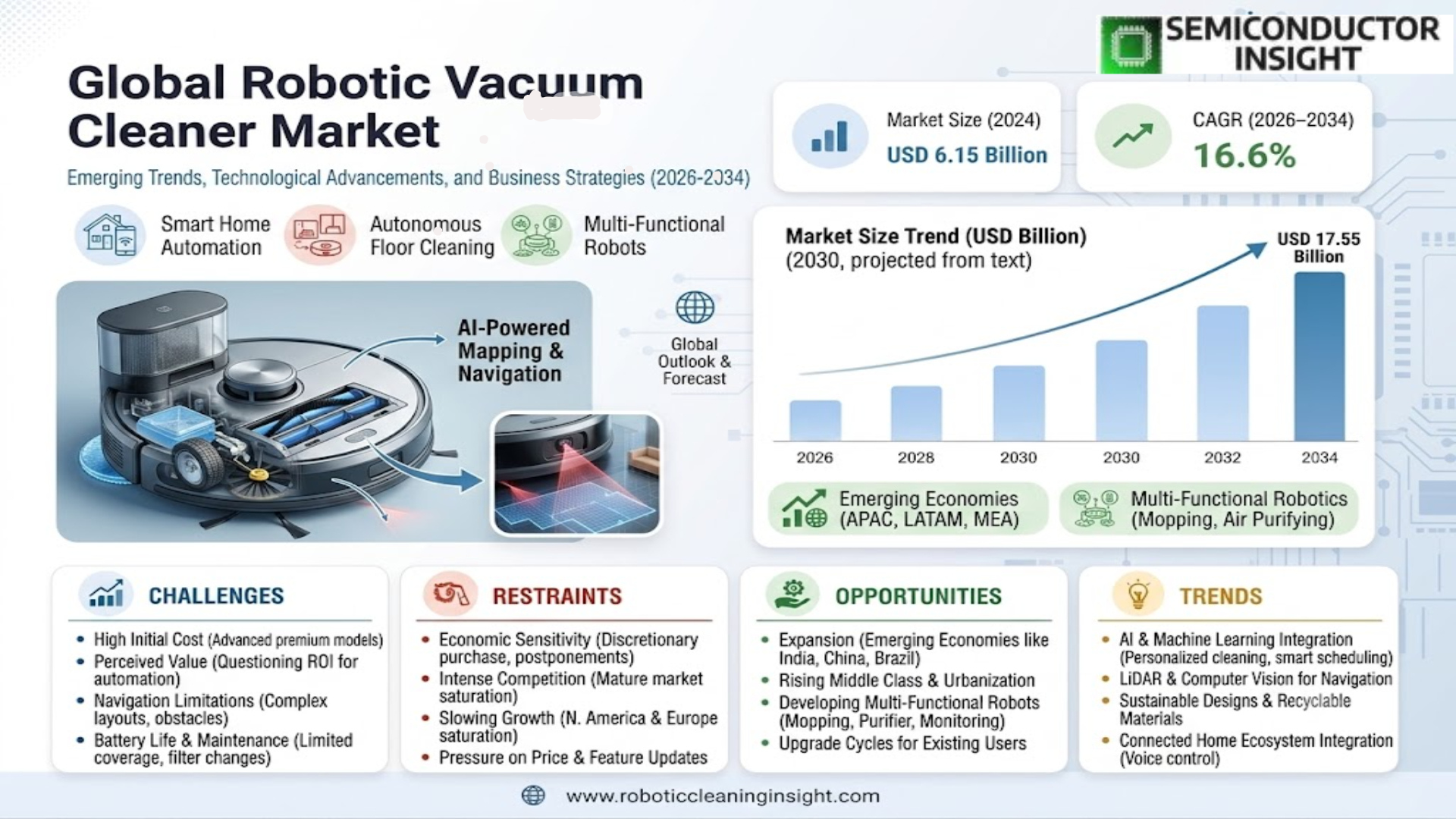
Global Robotic Vacuum Cleaner Market size was valued at USD 6.15 billion in 2024 to USD 17.55 billion by 2032, exhibiting a CAGR of 16.6% during the forecast period.
A robotic vacuum cleaner is an autonomous cleaning device that uses intelligent programming and a vacuum system for floor maintenance. These devices typically employ sensors for navigation and obstacle avoidance, with many models incorporating spinning brushes to clean edges and corners effectively. Advanced units combine multiple cleaning features such as mopping, UV sterilization, and self-emptying capabilities alongside their primary vacuuming function.
The market is experiencing rapid growth due to several factors, including rising consumer demand for smart home appliances, increasing disposable incomes in developing regions, and continuous technological advancements in AI and sensor technology. Furthermore, the growing emphasis on hygiene and convenience in both household and commercial settings is contributing to market expansion. Initiatives by key players are also expected to fuel market growth; for instance, ongoing development of models with improved battery life, smarter mapping technology, and enhanced suction power are common focus areas. iRobot, Ecovacs, Proscenic, Matsutek, and Neato Robotics are some of the key players that operate in the market with a wide range of portfolios.
MARKET DRIVERS
Growing Adoption of Smart Home Technologies
The proliferation of smart home ecosystems, including voice assistants like Amazon Alexa and Google Assistant, has significantly boosted the Robotic Vacuum Cleaner Market. Consumers are increasingly seeking convenience and are integrating these devices into their connected homes for automated cleaning schedules.
Increasing Consumer Disposable Income and Busy Lifestyles
Rising disposable incomes, particularly in emerging economies, coupled with time-poor urban populations, have fueled the demand for labor-saving appliances. Robotic vacuums offer a hands-free solution for maintaining cleanliness, appealing to working professionals and families.
➤ Continuous technological innovation, such as LiDAR navigation and AI-powered object recognition, is a primary force propelling market growth by enhancing cleaning efficiency and user experience.
Additionally, heightened awareness of indoor air quality and hygiene, especially post-pandemic, has made robotic vacuums with HEPA filtration systems a desirable household appliance, further driving sales.
MARKET CHALLENGES
High Initial Cost and Perceived Value
Advanced robotic vacuum cleaners with premium features like self-emptying bins and advanced mapping command a significantly higher price point than traditional vacuums. This cost can be a barrier to mass-market adoption, as some consumers question the return on investment for automated cleaning.
Other Challenges
Navigation and Performance Limitations
Despite improvements, some models still struggle with complex home layouts, dark carpets, or avoiding certain obstacles like pet waste and cables, leading to user frustration and negative reviews.
Battery Life and Maintenance
Limited battery capacity can restrict cleaning coverage for larger homes, while ongoing maintenance requirements, such as cleaning brushes and replacing filters, can detract from the desired “set-and-forget” convenience.
MARKET RESTRAINTS
Economic Sensitivity and Intense Market Competition
The market is highly sensitive to economic downturns, as robotic vacuums are often considered discretionary purchases. During periods of financial uncertainty, consumers may postpone buying premium home appliances, directly impacting market growth.
Saturation in Mature Markets
In developed regions like North America and Europe, the market is approaching saturation for early adopters. Growth is slowing as the pool of new first-time buyers shrinks, forcing companies to compete fiercely on price and incremental feature updates.
MARKET OPPORTUNITIES
Expansion into Emerging Economies
Significant growth potential exists in Asia-Pacific, Latin America, and the Middle East & Africa, where rising middle-class populations and increasing urbanization are creating vast new consumer bases for smart home appliances.
Development of Multi-Functional Robots
There is a substantial opportunity to expand beyond floor cleaning by integrating additional functionalities, such as mopping, air purification, or home monitoring features. This can create new product categories and drive upgrade cycles among existing users.
Robotic Vacuum Cleaner Market Trends
Robust Growth Driven by Technological Integration
Global Robotic Vacuum Cleaner market is on a significant growth trajectory, with its valuation projected to surge from USD 6148 million in 2024 to USD 17550 million by 2032, representing a compound annual growth rate of 16.6%. This robust expansion is primarily fueled by the rapid integration of advanced technologies such as artificial intelligence (AI), sophisticated mapping and navigation systems, and smart home connectivity. Consumers are increasingly seeking multi-functional appliances that offer convenience, leading to the development of units that combine vacuuming with mopping, UV sterilization, and other tasks, transforming the simple vacuum cleaner into a comprehensive cleaning solution. The demand for these intelligent, autonomous devices is a dominant trend shaping the market’s future.
Other Trends
Regional Market Dynamics and Competitive Landscape
Asia-Pacific has emerged as the largest regional market, accounting for nearly 37% of global consumption, driven by rising disposable incomes and the rapid adoption of smart home technologies in densely populated countries. North America follows as the second-largest market with a 30% share. The competitive landscape is consolidated, with the top five global manufacturers—iRobot, Ecovacs, ProScenic, Matsutek, and Neato Robotics—collectively holding approximately 55% of the market. Intense competition among these key players is leading to continuous innovation, frequent new product launches, and strategic partnerships to capture and expand market share.
Market Segmentation and Consumer Preferences
Analysis of market segments reveals clear consumer preferences. The market is segmented by price point, with models priced between $150 and $500 representing a significant volume of sales, indicating a strong consumer focus on value-for-money and mid-range features. In terms of application, the household segment overwhelmingly dominates, as robotic vacuums are primarily designed for residential convenience. However, the commercial segment is witnessing gradual growth, particularly in offices and hospitality, where automated cleaning solutions can improve operational efficiency. The ability of manufacturers to cater to these distinct segments with tailored products is a critical factor driving market development and addressing diverse consumer needs.
COMPETITIVE LANDSCAPE
Key Industry Players
A Market Led by Technology and Innovation
Global Robotic Vacuum Cleaner market is characterized by a moderate level of concentration, with the top five manufacturers—iRobot, Ecovacs, Proscenic, Matsutek, and Neato Robotics—collectively accounting for approximately 55% of the market share. iRobot, a pioneer with its Roomba series, has established a strong brand presence globally, particularly in North America. The competitive dynamics are heavily influenced by continuous technological advancements, including improvements in navigation (LiDAR vs. vSLAM), battery life, suction power, and the integration of smart home features and mopping capabilities, as manufacturers vie for consumer preference in a rapidly growing market.
Beyond the top tier, the market is populated by a diverse array of significant players, including major consumer electronics giants and specialized robotics firms. Companies such as Samsung, LG, and Xiaomi leverage their extensive R&D capabilities and brand equity to introduce feature-rich, competitively priced models. Niche players like Vorwerk (with its Kobold VR series) and Mamibot focus on specific segments or regions, offering specialized features. The competitive landscape is further intensified by the presence of brands like Philips, Sharp, and Miele, which apply their expertise in home appliances to this dynamic sector, contributing to a vibrant and innovative market environment.
List of Key Robotic Vacuum Cleaner Companies Profiled
- iRobot
- Ecovacs
- Proscenic
- Matsutek
- Neato Robotics
- LG
- Samsung
- Sharp
- Philips
- Mamibot
- Xiaomi
- Vorwerk
- Infinuvo (Metapo)
- Fmart
- Miele
Segment Analysis:
| Segment Category | Sub-Segments | Key Insights |
| By Type |
|
150 USD to 300 USD robots represent the leading price segment, striking an optimal balance between affordability and enhanced functionality. This bracket offers consumers core smart features like app connectivity and scheduling without the premium cost of high-end models. The growth is propelled by its accessibility to a wider demographic, making smart home convenience attainable for a mainstream audience. Product differentiation within this segment is intense, with manufacturers focusing on improving battery life and navigation algorithms to capture market share. |
| By Application |
|
Household applications are the dominant force in the market, driven by the universal need for convenient home cleaning solutions. The appeal lies in the hands-free automation that saves time for homeowners, fitting perfectly into busy modern lifestyles. This segment benefits from continuous innovation in smart home integration, allowing devices to work with voice assistants and other connected systems. The demand is further amplified by marketing that positions robotic vacuums as essential lifestyle products for maintaining clean living environments with minimal effort. |
| By End User |
|
Individual Consumers constitute the primary user base, as robotic vacuums are predominantly purchased for personal home use. The adoption is highest among urban, tech-savvy demographics who value convenience and smart home technology. A key driver is the growing awareness of the time-saving benefits and the increasing availability of models across various price points. The end user experience is central to product development, with features like self-emptying bins and advanced obstacle avoidance being developed specifically to enhance value for this group. |
| By Technology |
|
LIDAR-based Navigation is the leading technological segment, prized for its superior efficiency and precision in mapping and cleaning. This technology enables robots to create detailed floor plans and navigate in systematic, non-repetitive patterns, ensuring comprehensive coverage. Its advantage over random navigation is clear in terms of cleaning performance and speed. While often found in premium models, LIDAR technology is increasingly becoming a key differentiator for manufacturers aiming to capture the mid-to-high-end market, with ongoing R&D focused on making it more cost-effective. |
| By Distribution Channel |
|
Online Retail channels lead the market, becoming the preferred method for purchasing robotic vacuum cleaners. The convenience of comparing specifications, reading extensive customer reviews, and accessing a wide range of brands and models from home drives this dominance. E-commerce platforms frequently offer competitive pricing, seasonal discounts, and detailed product demonstrations that offline stores struggle to match. The shift towards online shopping has been accelerated by improvements in logistics and the trust consumers place in online customer feedback, making it the most dynamic and influential channel for market growth. |
Regional Analysis: Robotic Vacuum Cleaner Market
Asia-Pacific
The region’s dominance is underpinned by its established electronics manufacturing infrastructure. This proximity to component suppliers and assembly lines enables cost-effective production and allows for swift iteration on new models and features. This strong supply chain advantage allows manufacturers to quickly respond to global demand fluctuations and technological trends.
There is a strong cultural emphasis on household cleanliness, and the fast-paced urban lifestyle prevalent in major APAC cities makes time-saving devices highly valuable. The aspiration for smart homes and the perceived “premium” status of such gadgets drive adoption among younger, tech-savvy demographics.
The market is characterized by fierce competition between local giants and international entrants. This drives rapid innovation in areas like AI-powered navigation, mopping capabilities, and self-emptying stations. Price competition is intense, leading to feature-rich models becoming accessible at various price points.
E-commerce is the primary sales channel, with platforms facilitating easy access and comparison shopping. Brands are aggressively expanding their offline retail presence in tier-2 and tier-3 cities, tapping into previously underserved markets and demonstrating products directly to consumers to build trust and drive sales.
North America
North America represents a highly mature and lucrative market for robotic vacuum cleaners, characterized by high consumer purchasing power and a strong affinity for smart home technology. The region is a key battleground for premium brands, with consumers showing a willingness to invest in advanced models featuring sophisticated mapping, voice control integration, and automated maintenance features. Market dynamics are heavily influenced by robust marketing efforts, brand loyalty, and the widespread adoption of companion apps that enhance user experience. The competitive landscape is dominated by established players who continually push the boundaries of technology to differentiate their products in a market where replacement cycles and upgrades are significant drivers of sales.
Europe
The European market displays a diverse and nuanced landscape for robotic vacuum cleaners, with varying levels of adoption and preference across different countries. Northern and Western European nations show higher penetration rates, driven by high disposable incomes, a strong focus on home hygiene, and appreciation for labour-saving devices. Southern and Eastern Europe present substantial growth opportunities as economic conditions improve. European consumers often exhibit a preference for brands that emphasise design aesthetics, quiet operation, and robust data privacy policies, reflecting regional values. The market is also influenced by stringent energy efficiency regulations, which manufacturers must navigate, leading to a focus on developing energy-conserving models.
South America
The South American market for robotic vacuum cleaners is an emerging one, currently characterized by lower penetration but significant growth potential. The market is largely concentrated in major urban centers within countries like Brazil and Argentina, where a growing middle class is beginning to show interest in smart home appliances. Affordability remains a key challenge, making entry-level and mid-range models the primary drivers of volume. Economic volatility in the region can impact consumer spending on non-essential electronics. However, increasing urbanization and the gradual expansion of e-commerce infrastructure are creating new avenues for market growth, with local and international brands cautiously expanding their presence.
Middle East & Africa
This region presents a market with contrasting dynamics. The affluent Gulf Cooperation Council (GCC) countries, such as the UAE and Saudi Arabia, represent a high-value segment where premium, feature-rich robotic vacuums are in demand, often seen as status symbols in luxurious households. In contrast, the broader Middle East and Africa region is still in the early stages of adoption, with market growth hindered by economic constraints and lower awareness. The market potential is linked to economic development, urbanization trends, and the gradual increase in digital literacy and online retail accessibility, which are slowly introducing these products to a wider audience.
Report Scope
This market research report provides a comprehensive analysis of the Robotic Vacuum Cleaner Market , covering the forecast period 2025–2032. It offers detailed insights into market dynamics, technological advancements, competitive landscape, and key trends shaping the industry.
Key focus areas of the report include:
- Market Overview: The report begins with an overview outlining its current market scenario, key growth indicators, and industry transformation drivers. It discusses macroeconomic factors, demand–supply balance, regulatory landscape, and the strategic role of semiconductors in powering advancements across industries such as automotive, telecommunications, consumer electronics, and industrial automation.
- Market Size & Forecast: Historical data and future projections for revenue, unit shipments, and market value across major regions and segments.
- Segmentation Analysis: Detailed breakdown by product type, technology, application, and end-user industry to identify high-growth segments and investment opportunities.
- Regional Insights: Insights into market performance across North America, Europe, Asia-Pacific, Latin America, and the Middle East & Africa, including country-level analysis where relevant.
- Competitive Landscape: Profiles of leading market participants, including their product offerings, R&D focus, manufacturing capacity, pricing strategies, and recent developments such as mergers, acquisitions, and partnerships.
- Technology Trends & Innovation: Assessment of emerging technologies, integration of AI/IoT, semiconductor design trends, fabrication techniques, and evolving industry standards.
- Market Drivers & Restraints: Evaluation of factors driving market growth along with challenges, supply chain constraints, regulatory issues, and market-entry barriers.
- Stakeholder Insights: Insights for component suppliers, OEMs, system integrators, investors, and policymakers regarding the evolving ecosystem and strategic opportunities.
Primary and secondary research methods are employed, including interviews with industry experts, data from verified sources, and real-time market intelligence to ensure the accuracy and reliability of the insights presented.
FREQUENTLY ASKED QUESTIONS:
What is the current market size of Robotic Vacuum Cleaner Market?
-> Robotic Vacuum Cleaner Market size was valued at USD 6.15 billion in 2024 to USD 17.55 billion by 2032, exhibiting a CAGR of 16.6% during the forecast period..
Which key companies operate in Robotic Vacuum Cleaner Market?
-> Key players include iRobot, Ecovacs, Proscenic, Matsutek, and Neato Robotics, with the top five manufacturers accounting for approximately 55% of the market share.
What are the key growth drivers?
-> Key growth drivers include rising adoption of smart home devices, increasing demand for convenience and time-saving appliances, and technological advancements integrating features like mopping and UV sterilization.
Which region dominates the market?
-> Asia-Pacific is the largest market, holding a consumption share of nearly 37%, followed by North America with a 30% share.
What are the emerging trends?
-> Emerging trends include the integration of multiple cleaning features (mopping, UV sterilization), advancements in AI and navigation technology, and the development of more affordable models across different price segments.
Get Sample Report PDF for Exclusive Insights
Report Sample Includes
- Table of Contents
- List of Tables & Figures
- Charts, Research Methodology, and more...
 Download Sample Report PDF
