The Report Covers :
This report provides a comprehensive analysis of the market, covering key aspects such as market size, growth trends, regional insights, and segmentation by type and application. It also highlights the competitive landscape, profiling key players, and offers valuable insights to help businesses make informed decisions.
Rehabilitation Healthcare Assistive Robot Market Overview
Rehabilitation Healthcare Assistive Robot is a Healthcare Assistive Robot designed to help patients with postoperative Rehabilitation training.
In a word, this report is a must-read for industry players, investors, researchers, consultants, business strategists, and all those who have any kind of stake or are planning to foray into the Rehabilitation Healthcare Assistive Robot market in any manner.
Rehabilitation Healthcare Assistive Robot Market Analysis:
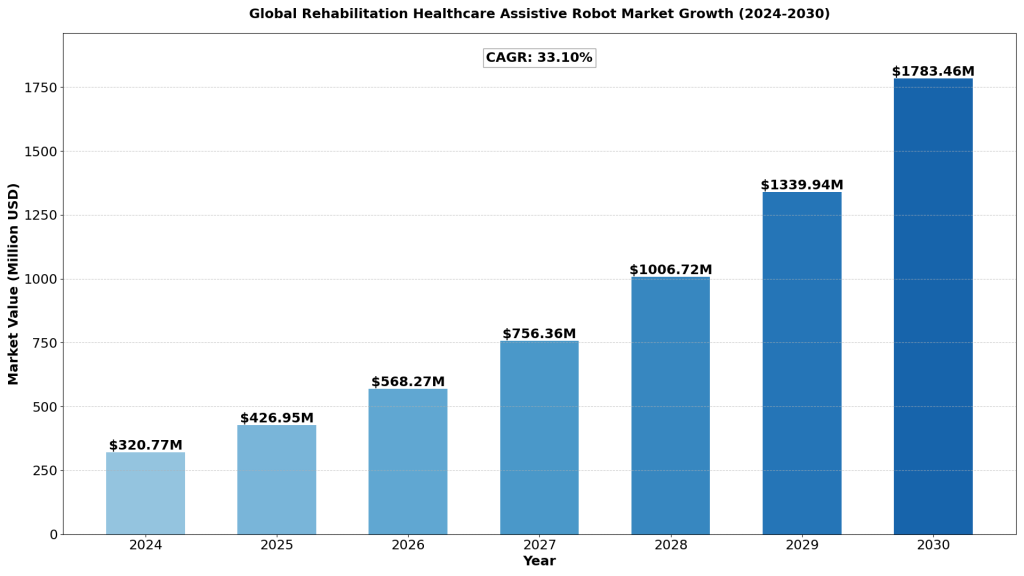
The Global Rehabilitation Healthcare Assistive Robot Market size was estimated at USD 241 million in 2023 and is projected to reach USD 1783.46 million by 2030, exhibiting a CAGR of 33.10% during the forecast period.
North America Rehabilitation Healthcare Assistive Robot market size was USD 62.80 million in 2023, at a CAGR of 28.37% during the forecast period of 2024 through 2030.
Access Your Free Sample Report Now
Rehabilitation Healthcare Assistive Robot Key Market Trends :
1. Growing Adoption of Robotics in Rehabilitation Therapy
- Rehabilitation robots are increasingly used in physical therapy to assist patients with mobility impairments, neurological conditions, and post-surgical recovery.
- These robots offer precise, repetitive movements, enabling effective and consistent therapy for conditions like stroke, spinal cord injuries, and Parkinson’s disease.
2. Integration of AI and Machine Learning
- Advanced assistive robots are integrating AI and machine learning to personalize therapy plans based on real-time patient data and progress.
- Predictive analytics and adaptive learning capabilities enable robots to adjust therapy intensity and duration to optimize patient outcomes.
3. Rising Demand for Exoskeletons
- Robotic exoskeletons are gaining traction in rehabilitation settings to help patients regain walking abilities and improve strength in limbs.
- Lightweight and portable exoskeletons are becoming more popular for both in-clinic and at-home use.
4. Aging Population Driving Market Growth
- The growing global aging population is increasing the prevalence of conditions like arthritis, stroke, and degenerative disorders, driving demand for assistive rehabilitation technologies.
- Robots are being tailored to meet the specific needs of elderly patients, offering support in mobility, balance, and daily activities.
5. Advancements in Tele-rehabilitation
- Tele-rehabilitation solutions equipped with robotic assistive devices are becoming a key trend, enabling remote monitoring and therapy sessions.
- This approach is gaining importance as it improves access to rehabilitation for patients in rural or underserved areas.
Rehabilitation Healthcare Assistive Robot Market Regional Analysis :

Get Free Sample Report of This Report
1. North America (USA, Canada, Mexico)
- USA: The largest market in the region due to advanced infrastructure, high disposable income, and technological advancements. Key industries include technology, healthcare, and manufacturing.
- Canada: Strong market potential driven by resource exports, a stable economy, and government initiatives supporting innovation.
- Mexico: A growing economy with strengths in automotive manufacturing, agriculture, and tourism, benefitting from trade agreements like the USMCA.
2. Europe (Germany, UK, France, Russia, Italy, Rest of Europe)
- Germany: The region’s industrial powerhouse with a focus on engineering, automotive, and machinery.
- UK: A hub for financial services, fintech, and pharmaceuticals, though Brexit has altered trade patterns.
- France: Strong in luxury goods, agriculture, and aerospace with significant innovation in renewable energy.
- Russia: Resource-driven economy with strengths in oil, gas, and minerals but geopolitical tensions affect growth.
- Italy: Known for fashion, design, and manufacturing, especially in luxury segments.
- Rest of Europe: Includes smaller yet significant economies like Spain, Netherlands, and Switzerland with strengths in finance, agriculture, and manufacturing.
3. Asia-Pacific (China, Japan, South Korea, India, Southeast Asia, Rest of Asia-Pacific)
- China: The largest market in the region with a focus on technology, manufacturing, and e-commerce. Rapid urbanization and middle-class growth fuel consumption.
- Japan: Technological innovation, particularly in robotics and electronics, drives the economy.
- South Korea: Known for technology, especially in semiconductors and consumer electronics.
- India: Rapidly growing economy with strengths in IT services, agriculture, and pharmaceuticals.
- Southeast Asia: Key markets like Indonesia, Thailand, and Vietnam show growth in manufacturing and tourism.
- Rest of Asia-Pacific: Emerging markets with growing investment in infrastructure and services.
4. South America (Brazil, Argentina, Colombia, Rest of South America)
- Brazil: Largest economy in the region, driven by agriculture, mining, and energy.
- Argentina: Known for agriculture exports and natural resources but faces economic instability.
- Colombia: Growing economy with strengths in oil, coffee, and flowers.
- Rest of South America: Includes Chile and Peru, which have strong mining sectors.
5. The Middle East and Africa (Saudi Arabia, UAE, Egypt, Nigeria, South Africa, Rest of MEA)
- Saudi Arabia: Oil-driven economy undergoing diversification with Vision 2030 initiatives.
- UAE: Financial hub with strengths in tourism, real estate, and trade.
- Egypt: Growing infrastructure development and tourism.
- Nigeria: Largest economy in Africa with strengths in oil and agriculture.
- South Africa: Industrialized economy with strengths in mining and finance.
- Rest of MEA: Includes smaller yet resource-rich markets like Qatar and Kenya with growing infrastructure investments.
Rehabilitation Healthcare Assistive Robot Market Segmentation :
Global Rehabilitation Healthcare Assistive Robot Market: Market Segmentation Analysis
The research report includes specific segments by region (country), manufacturers, Type, and Application. Market segmentation creates subsets of a market based on product type, end-user or application, Geographic, and other factors. By understanding the market segments, the decision-maker can leverage this targeting in the product, sales, and marketing strategies. Market segments can power your product development cycles by informing how you create product offerings for different segments.
Market Segmentation (by Type)
- Upper Limb Robot
- Lower Limb Robot
- Others
Market Segmentation (by Application)
- Stroke
- Orthopedics
- Cognitive&MotorSkills
- Sports
- Others
Rehabilitation Healthcare Assistive Robot Competitive landscape :
- Barrett Technology
- Cyberdyne
- Ekso Bionics
- Gait Tronics
- Hansen
- ReWalkRobotics
- Bionikamong
Download Your Complimentary Sample Report
Drivers
- Aging Population: The global population is aging, and with age comes a higher prevalence of chronic diseases and mobility issues. Rehabilitation healthcare assistive robots offer effective solutions for elderly individuals who require support in regaining mobility or independence. As the elderly population grows, the demand for rehabilitation robots is also expected to increase.
- Advances in Robotics and AI: Continuous advancements in artificial intelligence (AI), machine learning, and robotics are revolutionizing healthcare. These technologies enable robots to provide more personalized and effective rehabilitation, as they can adapt to patients’ needs in real time, enhancing the recovery process. Innovations like robot-assisted physical therapy are helping patients recover faster, improving the market prospects.
- Increase in Physical Disabilities: The rising number of individuals with physical disabilities due to factors like accidents, strokes, and spinal injuries is a major driver for the demand for assistive robots. These robots can help individuals regain mobility and perform activities of daily living with greater ease, driving the market forward.
- Growing Healthcare Awareness: As awareness of the benefits of rehabilitation and assistive healthcare grows, both patients and healthcare providers are increasingly turning to innovative robotic solutions. This shift toward robotic rehabilitation is propelled by the desire to improve patient outcomes, reduce human error, and enhance efficiency in healthcare settings.
- Government Support & Funding: Many governments are investing in healthcare technologies to improve patient care and reduce the strain on healthcare systems. Initiatives, grants, and public policies supporting the integration of advanced technologies like rehabilitation robots are boosting the market.
Restraints
- High Initial Cost: The cost of rehabilitation healthcare assistive robots remains a significant barrier to market growth. The price of these systems, especially the more sophisticated and AI-driven models, can be prohibitively high for smaller healthcare facilities and individuals who may not have access to adequate funding or insurance coverage.
- Lack of Skilled Workforce: Although robots are becoming more advanced, there is still a shortage of skilled professionals who can operate, maintain, and provide therapy using these robots. Training staff to work with this advanced technology is both time-consuming and costly.
- Regulatory Barriers: The rehabilitation robot market is subject to stringent regulatory approvals before products can be marketed. Navigating the complex regulatory environment can delay the introduction of new products and slow down market growth, particularly for smaller companies.
- Patient Resistance: Some patients, especially those who are older or have never been exposed to robotic technology, may be resistant to adopting robotic rehabilitation. This resistance can arise from fears about the technology, mistrust in its effectiveness, or the perceived coldness of robotic care compared to human therapists.
Opportunities
- Tele-rehabilitation and Remote Monitoring: With advancements in telemedicine and the growing acceptance of remote healthcare, rehabilitation robots can be integrated into tele-rehabilitation programs. This allows patients to receive therapy at home, providing convenience and reducing costs. Remote monitoring and feedback mechanisms also allow therapists to adjust treatments based on real-time data.
- Integration with Wearable Devices: The combination of assistive robots with wearable devices like exoskeletons, motion sensors, and rehabilitation trackers presents an opportunity for more precise and data-driven rehabilitation. This integration can lead to more personalized rehabilitation regimens and better patient outcomes.
- Expanding Applications in Healthcare Settings: While the primary focus of rehabilitation robots has been in physical therapy, there is growing interest in their use for other healthcare applications such as cognitive rehabilitation, mental health support, and stroke recovery. This expansion into diverse healthcare areas offers significant growth potential for the market.
- Personalization and AI Advancements: As AI continues to evolve, rehabilitation robots will become more personalized, learning from patients’ progress and adapting treatment protocols accordingly. The opportunity to provide tailored care to each patient opens up new potential in improving patient recovery times and outcomes.
- Collaborations and Strategic Partnerships: Collaborations between robotic manufacturers, healthcare providers, research institutions, and technology companies will drive innovation and accelerate the development of next-generation rehabilitation robots. Strategic partnerships can help share costs, combine expertise, and increase market penetration.
Challenges
- Ethical Concerns: As robotics technology becomes more integrated into healthcare, there are ethical concerns regarding the role of robots in patient care. Issues like patient privacy, consent, and the potential loss of human interaction in rehabilitation therapy are challenges that need to be addressed to ensure the ethical deployment of these technologies.
- Technological Limitations: Despite rapid advancements, rehabilitation robots still face technical challenges in terms of dexterity, sensitivity, and the ability to mimic human movement. These limitations can affect their effectiveness in some rehabilitation tasks and hinder widespread adoption.
- High Maintenance and Upkeep: Maintaining and servicing rehabilitation robots can be costly. Since these devices are technologically complex, their upkeep may require specialized knowledge and parts, leading to higher operating costs for healthcare providers.
- Inadequate Insurance Reimbursement: Many healthcare systems and insurance providers may not reimburse the cost of robotic rehabilitation therapy, making it inaccessible to certain populations. The lack of adequate insurance coverage could limit the widespread use of rehabilitation robots in clinical settings.
Key Benefits of This Market Research:
- Industry drivers, restraints, and opportunities covered in the study
- Neutral perspective on the market performance
- Recent industry trends and developments
- Competitive landscape & strategies of key players
- Potential & niche segments and regions exhibiting promising growth covered
- Historical, current, and projected market size, in terms of value
- In-depth analysis of the Rehabilitation Healthcare Assistive Robot Market
- Overview of the regional outlook of the Rehabilitation Healthcare Assistive Robot Market:
Key Reasons to Buy this Report:
- Access to date statistics compiled by our researchers. These provide you with historical and forecast data, which is analyzed to tell you why your market is set to change
- This enables you to anticipate market changes to remain ahead of your competitors
- You will be able to copy data from the Excel spreadsheet straight into your marketing plans, business presentations, or other strategic documents
- The concise analysis, clear graph, and table format will enable you to pinpoint the information you require quickly
- Provision of market value (USD Billion) data for each segment and sub-segment
- Indicates the region and segment that is expected to witness the fastest growth as well as to dominate the market
- Analysis by geography highlighting the consumption of the product/service in the region as well as indicating the factors that are affecting the market within each region
- Competitive landscape which incorporates the market ranking of the major players, along with new service/product launches, partnerships, business expansions, and acquisitions in the past five years of companies profiled
- Extensive company profiles comprising of company overview, company insights, product benchmarking, and SWOT analysis for the major market players
- The current as well as the future market outlook of the industry concerning recent developments which involve growth opportunities and drivers as well as challenges and restraints of both emerging as well as developed regions
- Includes in-depth analysis of the market from various perspectives through Porters five forces analysis
- Provides insight into the market through Value Chain
- Market dynamics scenario, along with growth opportunities of the market in the years to come
- 6-month post-sales analyst support
Customization of the Report
In case of any queries or customization requirements, please connect with our sales team, who will ensure that your requirements are met.
Interested in related market reports? Click here to explore more!
About Semiconductor Insight:
Semiconductor Insight, founded in 2016, provides comprehensive semiconductor market data and analysis to help organizations make informed decisions in the dynamic semiconductor industry. We specialize in semiconductor industry reports, offering insights into market trends, competition analysis, technical breakthroughs, and market predictions. With nearly a decade of experience, we help clients stay ahead with strategic clarity, focusing on semiconductor market share, industry trends, and the semiconductor industry outlook 2025, ensuring they are well-equipped to navigate the semiconductor industry size and evolving landscape.
FAQs

Get Sample Report PDF for Exclusive Insights
Report Sample Includes
- Table of Contents
- List of Tables & Figures
- Charts, Research Methodology, and more...
 Download Sample Report PDF