The global Pressure Controlled Heat Pipes Market size was valued at US$ 345.6 million in 2024 and is projected to reach US$ 566.96 million by 2030, at a CAGR of 8.6% during the forecast period 2024-2030.
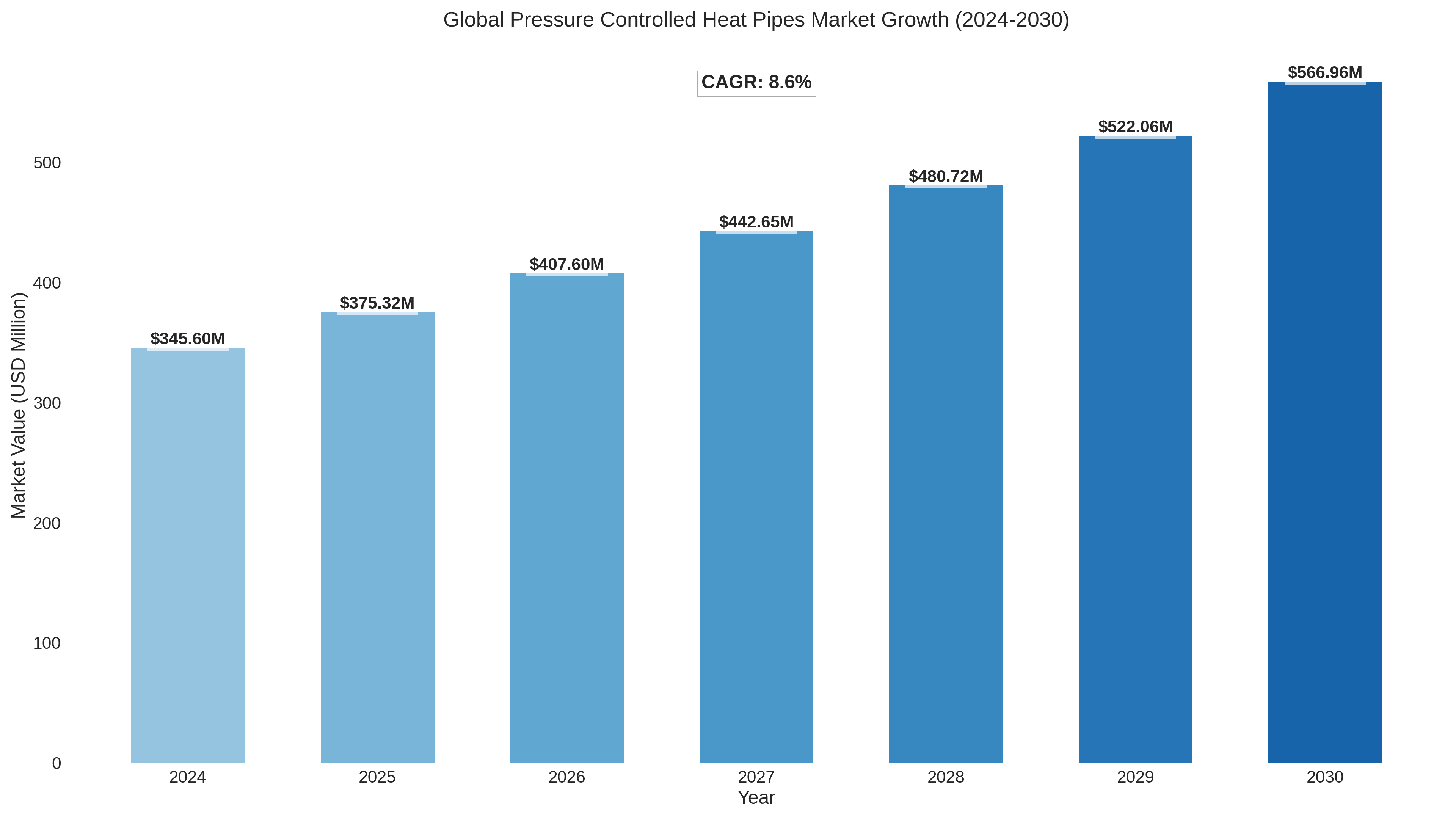
The United States Pressure Controlled Heat Pipes market size was valued at US$ 91.2 million in 2024 and is projected to reach US$ 146.5 million by 2030, at a CAGR of 8.2% during the forecast period 2024-2030.
Advanced heat transfer devices featuring pressure regulation mechanisms for optimized thermal performance. These systems provide precise temperature control in various industrial and electronic applications.
Report Overview
This report provides a deep insight into the global Pressure Controlled Heat Pipes market covering all its essential aspects. This ranges from a macro overview of the market to micro details of the market size, competitive landscape, development trend, niche market, key market drivers and challenges, SWOT analysis, value chain analysis, etc.
The analysis helps the reader to shape the competition within the industries and strategies for the competitive environment to enhance the potential profit. Furthermore, it provides a simple framework for evaluating and accessing the position of the business organization. The report structure also focuses on the competitive landscape of the Global Pressure Controlled Heat Pipes Market, this report introduces in detail the market share, market performance, product situation, operation situation, etc. of the main players, which helps the readers in the industry to identify the main competitors and deeply understand the competition pattern of the market.
In a word, this report is a must-read for industry players, investors, researchers, consultants, business strategists, and all those who have any kind of stake or are planning to foray into the Pressure Controlled Heat Pipes market in any manner.
Global Pressure Controlled Heat Pipes Market: Market Segmentation Analysis
The research report includes specific segments by region (country), manufacturers, Type, and Application. Market segmentation creates subsets of a market based on product type, end-user or application, Geographic, and other factors. By understanding the market segments, the decision-maker can leverage this targeting in the product, sales, and marketing strategies. Market segments can power your product development cycles by informing how you create product offerings for different segments.
Key Company
- Auras
- CCI
- Forcecon Tech
- Foxccon
- Wakefield Vette
- Innergy Tech
- SPC
- Dau
- Taisol
- Colmac Coil
- ACT
- Furukawa
- Aavid
- Fujikura
- High Temperature
- Precise Temperature
- Consumer Electronics
- Process Industry
- Aerospace
- North America (USA, Canada, Mexico)
- Europe (Germany, UK, France, Russia, Italy, Rest of Europe)
- Asia-Pacific (China, Japan, South Korea, India, Southeast Asia, Rest of Asia-Pacific)
- South America (Brazil, Argentina, Columbia, Rest of South America)
- The Middle East and Africa (Saudi Arabia, UAE, Egypt, Nigeria, South Africa, Rest of MEA)
- Industry drivers, restraints, and opportunities covered in the study
- Neutral perspective on the market performance
- Recent industry trends and developments
- Competitive landscape & strategies of key players
- Potential & niche segments and regions exhibiting promising growth covered
- Historical, current, and projected market size, in terms of value
- In-depth analysis of the Pressure Controlled Heat Pipes Market
- Overview of the regional outlook of the Pressure Controlled Heat Pipes Market:
- Access to date statistics compiled by our researchers. These provide you with historical and forecast data, which is analyzed to tell you why your market is set to change
- This enables you to anticipate market changes to remain ahead of your competitors
- You will be able to copy data from the Excel spreadsheet straight into your marketing plans, business presentations, or other strategic documents
- The concise analysis, clear graph, and table format will enable you to pinpoint the information you require quickly
- Provision of market value (USD Billion) data for each segment and sub-segment
- Indicates the region and segment that is expected to witness the fastest growth as well as to dominate the market
- Analysis by geography highlighting the consumption of the product/service in the region as well as indicating the factors that are affecting the market within each region
- Competitive landscape which incorporates the market ranking of the major players, along with new service/product launches, partnerships, business expansions, and acquisitions in the past five years of companies profiled
- Extensive company profiles comprising of company overview, company insights, product benchmarking, and SWOT analysis for the major market players
- The current as well as the future market outlook of the industry concerning recent developments which involve growth opportunities and drivers as well as challenges and restraints of both emerging as well as developed regions
- Includes in-depth analysis of the market from various perspectives through Porters five forces analysis
- Provides insight into the market through Value Chain
- Market dynamics scenario, along with growth opportunities of the market in the years to come
- 6-month post-sales analyst support
Customization of the Report
In case of any queries or customization requirements, please connect with our sales team, who will ensure that your requirements are met.
1. Drivers
- Growing Demand for Efficient Thermal Management: The rise in electronic device performance and miniaturization increases heat output, which creates a demand for advanced thermal management solutions. Pressure controlled heat pipes (PCHPs) offer efficient heat transfer by adjusting internal pressure based on varying temperature conditions, making them ideal for applications in high-performance electronics, aerospace, and industrial equipment.
- Expansion in Renewable Energy Sector: The use of heat pipes in solar thermal systems and geothermal energy applications is gaining traction. PCHPs can efficiently manage the heat distribution in solar concentrators and geothermal systems, helping maintain operational efficiency. The growth of renewable energy infrastructure drives demand for reliable thermal control solutions, positioning PCHPs as a key component.
- Increasing Use in Aerospace and Defense: Aerospace and defense sectors require stable thermal management systems to regulate extreme temperature fluctuations. PCHPs are highly effective for applications in spacecraft, satellites, and defense equipment where precise thermal control is crucial. The expanding aerospace and defense budgets in various countries further fuel demand for pressure controlled heat pipes.
- Rising Demand in Data Centers and Computing Applications: With the rapid growth in data centers and high-performance computing, the need for efficient and scalable cooling solutions is paramount. PCHPs offer reliable temperature control, making them suitable for these high-demand environments where heat dissipation is critical for system reliability and performance.
2. Restraints
- High Initial Manufacturing and Installation Costs: PCHPs can be cost-intensive due to the precision manufacturing required and the use of specialized materials. For industries where cost is a major factor, this can be a limiting factor. Additionally, the installation of PCHPs in complex systems may require customized designs, which further increases costs.
- Challenges with Durability and Maintenance: While PCHPs are effective thermal management solutions, they may face durability issues in specific applications, particularly in extreme conditions. Regular maintenance and potential replacements can increase operational costs, which may deter some industries from widespread adoption.
- Complexity in Integration with Legacy Systems: For existing systems, particularly in industrial settings, integrating PCHPs can be challenging due to compatibility issues with older components. This can slow down adoption, as retrofitting or upgrading existing systems to accommodate PCHPs may require extensive modifications.
3. Opportunities
- Advancements in Material Science and Nanotechnology: Innovations in materials, such as advanced alloys and nanotechnology, can enhance the efficiency and durability of PCHPs. These materials enable faster heat transfer and improve the overall performance of heat pipes, making them more attractive for high-tech and industrial applications.
- Expansion of Electric Vehicles (EVs) and Battery Technology: The growth of the electric vehicle market presents a significant opportunity for PCHPs. With the high heat output of EV batteries, PCHPs offer an efficient solution for managing battery temperature, which is essential for vehicle safety, performance, and longevity. As the EV market grows, so does the demand for innovative thermal management systems.
- Increasing Adoption in Consumer Electronics: The demand for compact, high-performance electronics continues to rise, creating opportunities for PCHPs in smartphones, laptops, and wearable technology. As these devices become more powerful, the need for advanced cooling solutions grows, making PCHPs a favorable choice for manufacturers aiming to optimize thermal management in smaller devices.
- Growing Emphasis on Sustainable and Energy-Efficient Systems: Industries are increasingly focused on sustainability and energy efficiency. PCHPs offer a passive cooling solution that consumes no power, aligning with energy-efficient goals. This makes them appealing for industries looking to reduce environmental impact and improve energy performance.
4. Challenges
- Competition from Alternative Thermal Management Solutions: PCHPs face competition from other advanced cooling technologies, such as vapor chambers, liquid cooling systems, and thermoelectric coolers. These alternatives offer distinct advantages in specific applications and may limit the market share for PCHPs, especially in applications where weight and space constraints are critical.
- Design and Manufacturing Complexity: PCHPs require precise engineering and specialized manufacturing techniques to ensure that they meet application-specific requirements. This can create bottlenecks in production, especially for customized designs, which may limit scalability and hinder rapid expansion in high-demand markets.
- Regulatory and Compliance Challenges: The heat pipe industry is subject to various regulations, particularly in applications related to aerospace, defense, and healthcare, where strict safety and performance standards are required. Ensuring compliance can be costly and complex, potentially impacting market growth for PCHPs in highly regulated sectors.
- Shortage of Skilled Workforce: The manufacturing and deployment of PCHPs require a workforce skilled in thermal management and advanced manufacturing techniques. A shortage of experienced professionals can slow the pace of innovation and limit the capacity of companies to scale their operations in response to growing market demand.

Get Sample Report PDF for Exclusive Insights
Report Sample Includes
- Table of Contents
- List of Tables & Figures
- Charts, Research Methodology, and more...
 Download Sample Report PDF