Mobile Phone Dual Camera Module Market Overview
Mobile phone dual-camera module refers to a module equipped with two cameras in a mobile phone. This design allows the phone to use both cameras simultaneously when taking photos or recording videos, providing more functionality and an optimized shooting experience.
This report provides a deep insight into the global Mobile Phone Dual Camera Module market covering all its essential aspects. This ranges from a macro overview of the market to micro details of the market size, competitive landscape, development trend, niche market, key market drivers and challenges, SWOT analysis, value chain analysis, etc.
The analysis helps the reader to shape the competition within the industries and strategies for the competitive environment to enhance the potential profit. Furthermore, it provides a simple framework for evaluating and accessing the position of the business organization. The report structure also focuses on the competitive landscape of the Global Mobile Phone Dual Camera Module Market, this report introduces in detail the market share, market performance, product situation, operation situation, etc. of the main players, which helps the readers in the industry to identify the main competitors and deeply understand the competition pattern of the market.
In a word, this report is a must-read for industry players, investors, researchers, consultants, business strategists, and all those who have any kind of stake or are planning to foray into the Mobile Phone Dual Camera Module market in any manner.
Mobile Phone Dual Camera Module Market Analysis
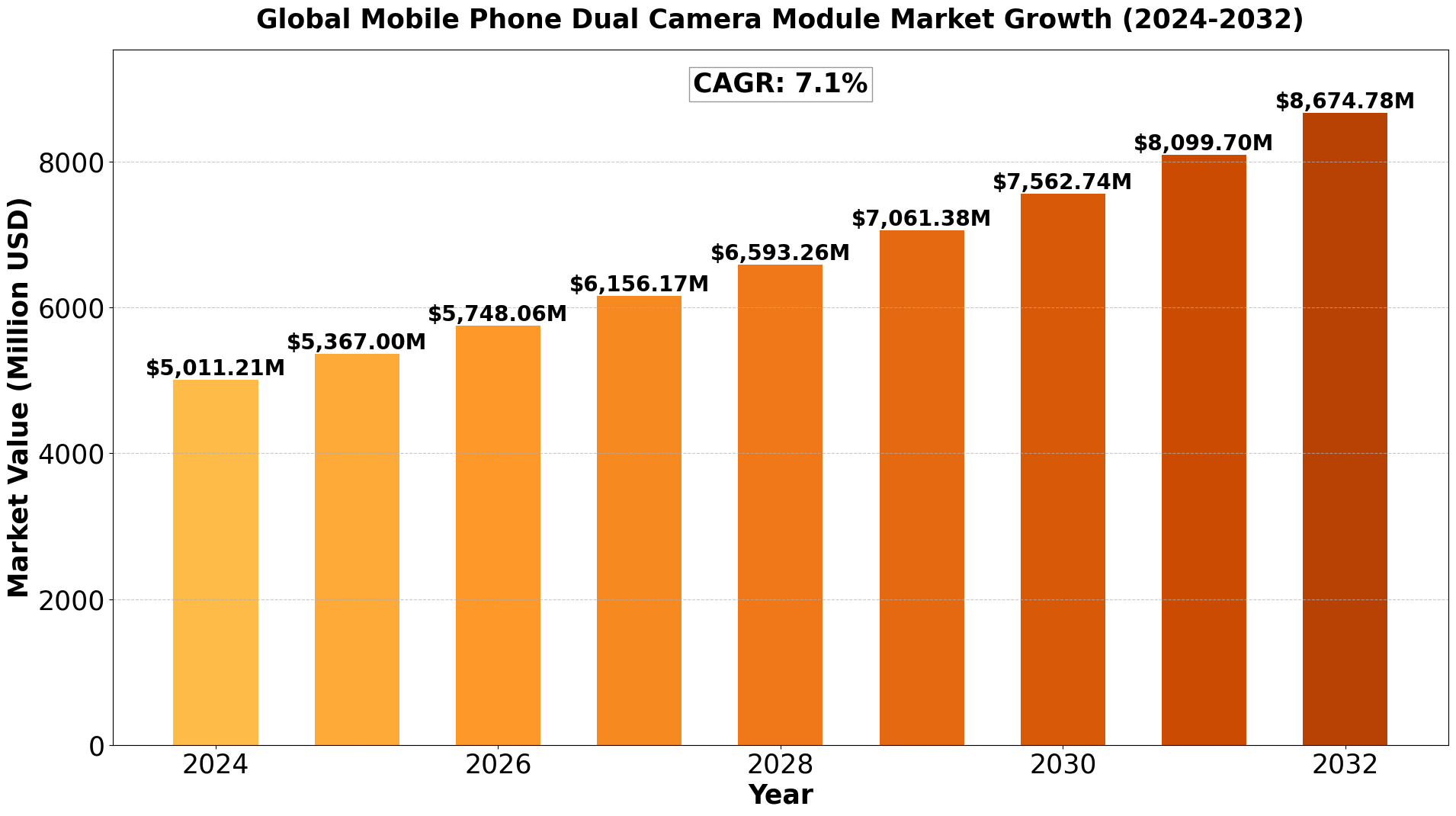
The global Mobile Phone Dual Camera Module market size was estimated at USD 4679 million in 2023 and is projected to reach USD 8674.78 million by 2032, exhibiting a CAGR of 7.10% during the forecast period.
North America Mobile Phone Dual Camera Module market size was estimated at USD 1372.12 million in 2023, at a CAGR of 6.09% during the forecast period of 2025 through 2032.
Mobile Phone Dual Camera Module Key Market Trends
- Increasing Demand for High-Resolution Smartphone Cameras – Consumers prioritize advanced photography features, driving the adoption of dual-camera modules.
- Rise of AI-Powered Computational Photography – AI-driven image processing enhances low-light performance, portrait mode, and real-time image enhancements.
- Growing Popularity of Ultra-Wide and Telephoto Lenses – Smartphone manufacturers integrate ultra-wide and telephoto sensors to improve versatility and zoom capabilities.
- Advancements in Sensor Miniaturization and Optical Image Stabilization (OIS) – Enhanced stabilization and smaller, more powerful sensors improve mobile photography.
- Integration of AR and VR Features – Dual-camera modules enable augmented reality (AR) applications, contributing to immersive user experiences.
Mobile Phone Dual Camera Module Market Regional Analysis
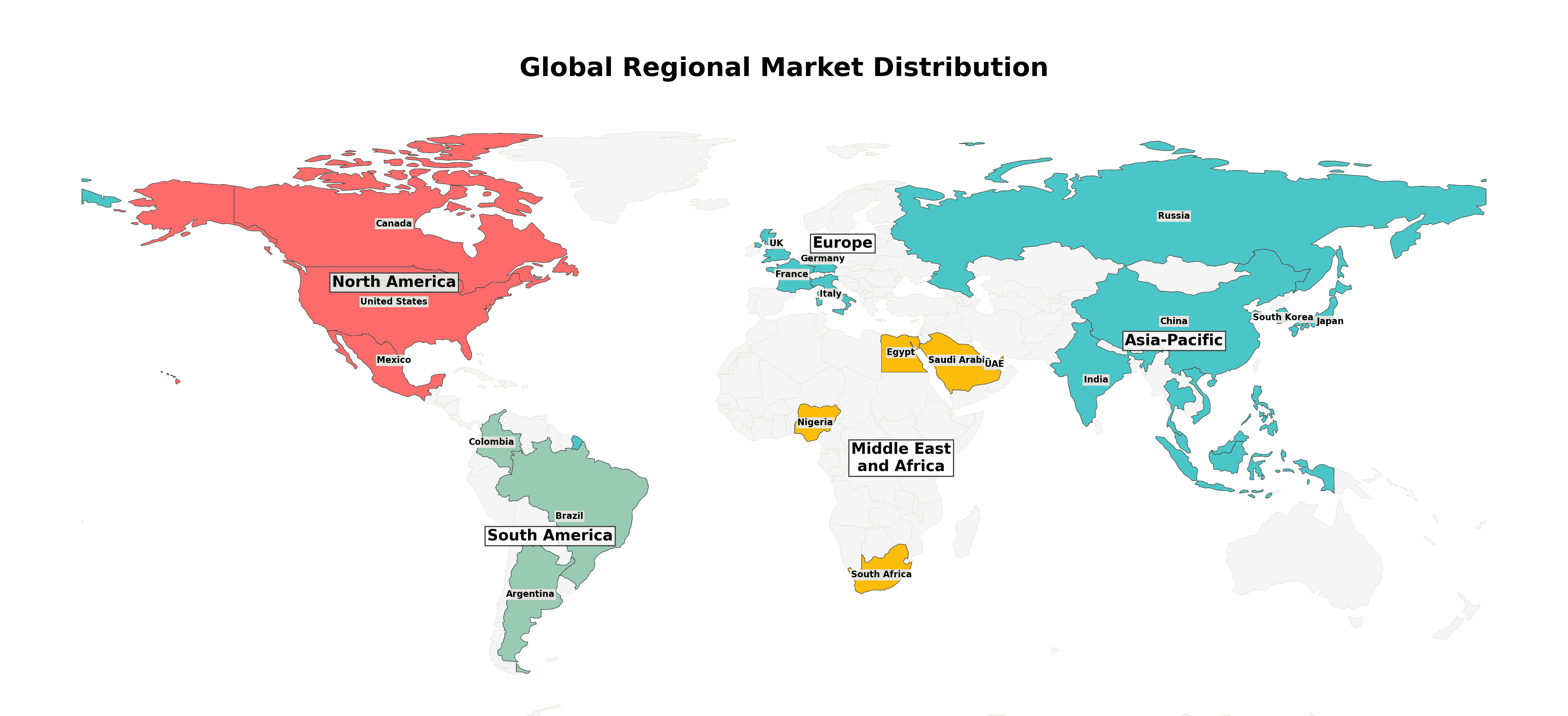
- North America:Strong demand driven by EVs, 5G infrastructure, and renewable energy, with the U.S. leading the market.
- Europe:Growth fueled by automotive electrification, renewable energy, and strong regulatory support, with Germany as a key player.
- Asia-Pacific:Dominates the market due to large-scale manufacturing in China and Japan, with growing demand from EVs, 5G, and semiconductors.
- South America:Emerging market, driven by renewable energy and EV adoption, with Brazil leading growth.
- Middle East & Africa:Gradual growth, mainly due to investments in renewable energy and EV infrastructure, with Saudi Arabia and UAE as key contributors.
Mobile Phone Dual Camera Module Market Segmentation Analysis
The research report includes specific segments by region (country), manufacturers, Type, and Application. Market segmentation creates subsets of a market based on product type, end-user or application, Geographic, and other factors. By understanding the market segments, the decision-maker can leverage this targeting in the product, sales, and marketing strategies. Market segments can power your product development cycles by informing how you create product offerings for different segments.
Key Company
- Namuga
- MCNEX
- SEMCO
- LG Innotek
- Sunny
- O?Film
- Q?Tech
- Truly
- Liteon (Luxshare Precision Industry)
- Dongju
- SHINETECH OPTICAL
- Rayprus Tech
Market Segmentation (by Type)
- Resolution: Less Than 50M
- Resolution: Above or Equal to 50M
Market Segmentation (by Application)
- Low End Mobile Phone
- Mid- To High-End Mobile Phones
Drivers
- Rising Consumer Demand for Professional-Grade Smartphone Photography – Users seek high-quality imaging capabilities in mobile devices.
- Advancements in CMOS Image Sensor Technology – Improved sensor performance drives better image clarity, color accuracy, and low-light photography.
- Increased Adoption of Dual Cameras in Budget and Mid-Range Smartphones – Affordable smartphones now feature dual-camera setups, expanding market reach.
Restraints
- High Manufacturing and R&D Costs – Developing advanced dual-camera modules requires significant investment.
- Space Constraints in Ultra-Thin Smartphone Designs – Limited internal space makes it challenging to integrate larger, high-performance camera modules.
- Complex Supply Chain and Component Shortages – Fluctuations in raw material availability can impact production and pricing.
Opportunities
- Expansion of 5G and High-Speed Connectivity – Faster data transfer enhances mobile imaging and cloud-based photography applications.
- Growth in Computational Imaging and AI-Driven Camera Features – AI-powered enhancements improve image processing and video recording capabilities.
- Innovations in Foldable and Multi-Camera Smartphones – The rise of foldable phones creates demand for flexible and compact dual-camera modules.
Challenges
- Ensuring Uniform Camera Performance Across Devices – Variations in smartphone hardware and software can affect image quality consistency.
- Balancing Camera Innovation with Cost Efficiency – High-end camera modules increase smartphone costs, limiting affordability for budget-conscious consumers.
- Meeting Regulatory and Compliance Standards – Strict industry regulations on camera technology may impact manufacturing and global distribution.
Key Benefits of This Market Research:
- Industry drivers, restraints, and opportunities covered in the study
- Neutral perspective on the market performance
- Recent industry trends and developments
- Competitive landscape & strategies of key players
- Potential & niche segments and regions exhibiting promising growth covered
- Historical, current, and projected market size, in terms of value
- In-depth analysis of the Transmissive Spatial Light Modulators Market
- Overview of the regional outlook of the Transmissive Spatial Light Modulators Market:
Key Reasons to Buy this Report:
- Access to date statistics compiled by our researchers. These provide you with historical and forecast data, which is analyzed to tell you why your market is set to change
- This enables you to anticipate market changes to remain ahead of your competitors
- You will be able to copy data from the Excel spreadsheet straight into your marketing plans, business presentations, or other strategic documents
- The concise analysis, clear graph, and table format will enable you to pinpoint the information you require quickly
- Provision of market value (USD Billion) data for each segment and sub-segment
- Indicates the region and segment that is expected to witness the fastest growth as well as to dominate the market
- Includes in-depth analysis of the market from various perspectives through Porters five forces analysis
- Provides insight into the market through Value Chain
- Market dynamics scenario, along with growth opportunities of the market in the years to come
- 6-month post-sales analyst support
Customization of the Report
In case of any queries or customization requirements, please connect with our sales team, who will ensure that your requirements are met.
FAQs
Q: What are the key driving factors and opportunities in the mobile phone dual camera module market?
A: Key drivers include increasing demand for high-resolution smartphone photography, advancements in CMOS image sensors, and growing adoption in mid-range devices. Opportunities lie in AI-powered imaging, 5G-enabled photography applications, and the rise of foldable smartphones.
Q: Which region is projected to have the largest market share?
A: Asia-Pacific dominates the market due to the presence of major smartphone manufacturers, while North America and Europe show strong demand for high-end camera phones.
Q: Who are the top players in the global mobile phone dual camera module market?
A: Leading companies include Sony Corporation, Samsung Electro-Mechanics, LG Innotek, OFILM Group, Sunny Optical Technology, and Largan Precision.
Q: What are the latest technological advancements in the industry?
A: Recent innovations include AI-enhanced camera modules, periscope zoom technology, ultra-thin lens designs, and improved optical image stabilization (OIS).
Q: What is the current size of the global mobile phone dual camera module market?
A: The market was valued at USD 10.2 billion in 2024 and is projected to reach USD 17.6 billion by 2030, growing at a CAGR of 8.5%.

Get Sample Report PDF for Exclusive Insights
Report Sample Includes
- Table of Contents
- List of Tables & Figures
- Charts, Research Methodology, and more...
 Download Sample Report PDF