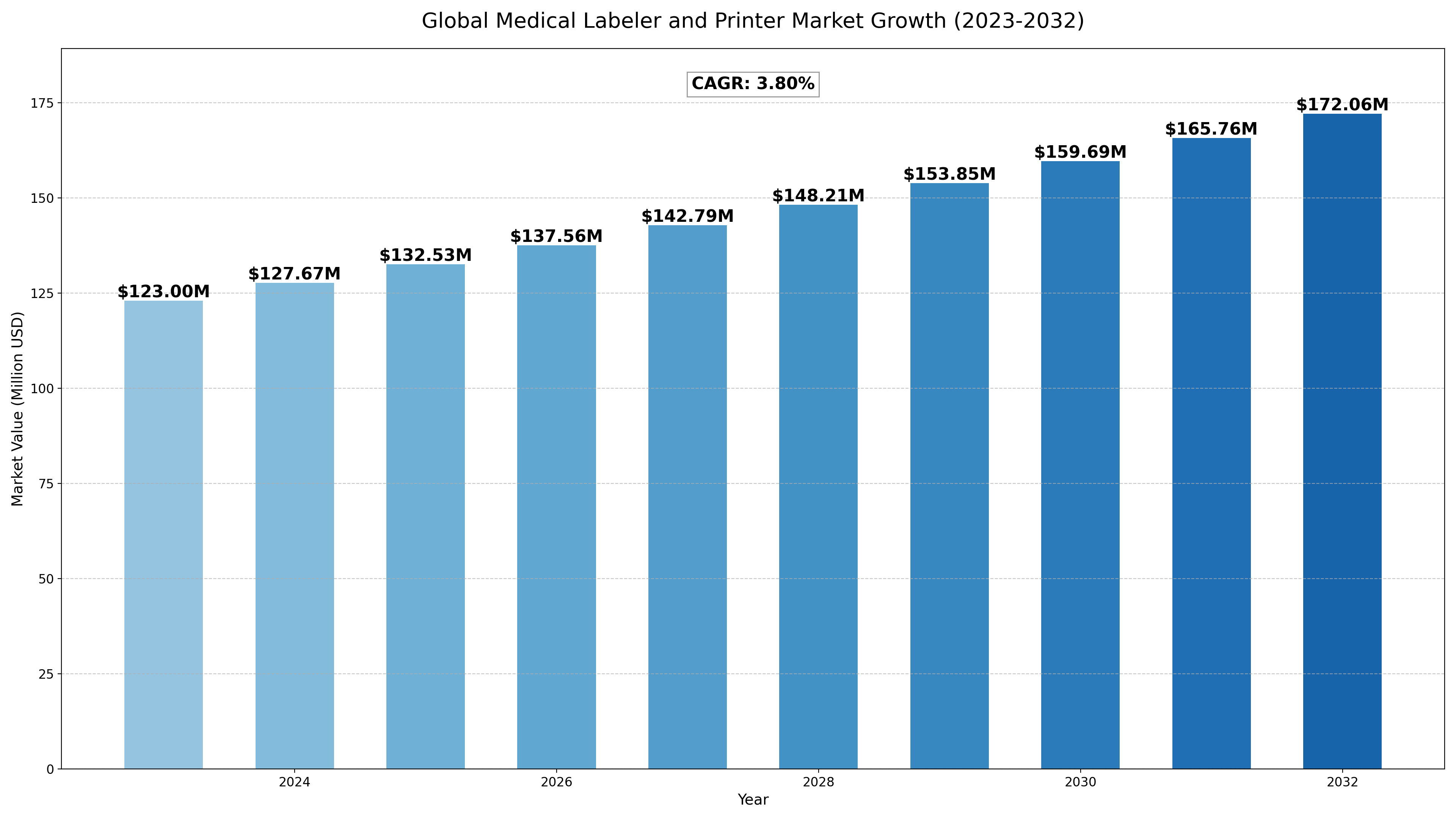
The Global Medical Labeler and Printer Market size was estimated at USD 123 million in 2023 and is projected to reach USD 172.06 million by 2032, exhibiting a CAGR of 3.80% during the forecast period.
North America Medical Labeler and Printer market size was estimated at USD 34.17 million in 2023, at a CAGR of 3.26% during the forecast period of 2025 through 2032.
A medical labeler and printer refers to specialized devices used in healthcare settings for printing and labeling medical products, equipment, and supplies. These systems are designed to meet industry regulations and standards, ensuring accurate and compliant labeling. Medical labelers and printers are commonly used to print labels for medications, patient identification, diagnostic equipment, and medical devices, often including barcodes, patient information, and safety warnings.
Report Overview
Label, instructions for use, and any other information that is related to identification, technical description, intended purpose and proper use of the medical device, but excluding shipping documents
This report provides a deep insight into the global Medical Labeler and Printer market covering all its essential aspects. This ranges from a macro overview of the market to micro details of the market size, competitive landscape, development trend, niche market, key market drivers and challenges, SWOT analysis, value chain analysis, etc.
The analysis helps the reader to shape the competition within the industries and strategies for the competitive environment to enhance the potential profit. Furthermore, it provides a simple framework for evaluating and accessing the position of the business organization. The report structure also focuses on the competitive landscape of the Global Medical Labeler and Printer Market, this report introduces in detail the market share, market performance, product situation, operation situation, etc. of the main players, which helps the readers in the industry to identify the main competitors and deeply understand the competition pattern of the market.
In a word, this report is a must-read for industry players, investors, researchers, consultants, business strategists, and all those who have any kind of stake or are planning to foray into the Medical Labeler and Printer market in any manner.
Global Medical Labeler and Printer Market: Market Segmentation Analysis
The research report includes specific segments by region (country), manufacturers, Type, and Application. Market segmentation creates subsets of a market based on product type, end-user or application, Geographic, and other factors. By understanding the market segments, the decision-maker can leverage this targeting in the product, sales, and marketing strategies. Market segments can power your product development cycles by informing how you create product offerings for different segments.
Key Company
- 3M
- Amcor
- Mondi Group
- Avery Dennison Corporation
- Lintec Corporation
- Huhtamaki Oyj
- UPM Raflatac
- CCL Industries
- Schreiner Group
- Denny Bros
- WS Packaging Group
- Resource Label Group
- Faubel & Co.Nachf
- Tapecon
- Weber Packaging Solutions
- JH Bertrand
- Coast Label
- Labeler
- Printer
- Hospitals
- Clinic
- Others
- North America (USA, Canada, Mexico)
- Europe (Germany, UK, France, Russia, Italy, Rest of Europe)
- Asia-Pacific (China, Japan, South Korea, India, Southeast Asia, Rest of Asia-Pacific)
- South America (Brazil, Argentina, Columbia, Rest of South America)
- The Middle East and Africa (Saudi Arabia, UAE, Egypt, Nigeria, South Africa, Rest of MEA)
- Industry drivers, restraints, and opportunities covered in the study
- Neutral perspective on the market performance
- Recent industry trends and developments
- Competitive landscape & strategies of key players
- Potential & niche segments and regions exhibiting promising growth covered
- Historical, current, and projected market size, in terms of value
- In-depth analysis of the Medical Labeler and Printer Market
- Overview of the regional outlook of the Medical Labeler and Printer Market:
- Access to date statistics compiled by our researchers. These provide you with historical and forecast data, which is analyzed to tell you why your market is set to change
- This enables you to anticipate market changes to remain ahead of your competitors
- You will be able to copy data from the Excel spreadsheet straight into your marketing plans, business presentations, or other strategic documents
- The concise analysis, clear graph, and table format will enable you to pinpoint the information you require quickly
- Provision of market value data for each segment and sub-segment
- Indicates the region and segment that is expected to witness the fastest growth as well as to dominate the market
- Analysis by geography highlighting the consumption of the product/service in the region as well as indicating the factors that are affecting the market within each region
- Competitive landscape which incorporates the market ranking of the major players, along with new service/product launches, partnerships, business expansions, and acquisitions in the past five years of companies profiled
- Extensive company profiles comprising of company overview, company insights, product benchmarking, and SWOT analysis for the major market players
- The current as well as the future market outlook of the industry concerning recent developments which involve growth opportunities and drivers as well as challenges and restraints of both emerging as well as developed regions
- Includes in-depth analysis of the market from various perspectives through Porters five forces analysis
- Provides insight into the market through Value Chain
- Market dynamics scenario, along with growth opportunities of the market in the years to come
- 6-month post-sales analyst support
Customization of the Report
In case of any queries or customization requirements, please connect with our sales team, who will ensure that your requirements are met.
1. Drivers
Increasing Regulatory Compliance Requirements
The healthcare industry is subject to stringent regulatory standards, especially concerning labeling accuracy, traceability, and product identification. Regulatory authorities such as the FDA (Food and Drug Administration) and ISO (International Organization for Standardization) mandate the use of precise, legible, and durable labels for medical devices, pharmaceuticals, and biological samples. This compels healthcare providers, pharmaceutical companies, and device manufacturers to adopt high-quality labelers and printers, driving market growth.
Rising Demand for Error Reduction and Patient Safety
Accurate labeling of patient information, medication details, and diagnostic samples plays a vital role in minimizing errors in healthcare delivery. Hospitals and clinical laboratories are increasingly leveraging advanced labelers and printers to enhance patient safety, reduce medication errors, and avoid mislabeling of samples. This trend boosts the demand for medical labelers and printers that support barcodes, QR codes, and RFID tags.
Technological Advancements in Printing Solutions
The development of smart printing technologies such as thermal printing, inkjet printing, and laser printing has significantly improved the efficiency and durability of medical labels. These technologies enable high-speed, on-demand printing with superior resistance to chemicals, moisture, and temperature fluctuations. The advent of mobile and cloud-connected printers further facilitates the demand for portable and on-site labeling solutions.
Expansion of Healthcare Infrastructure
The rapid expansion of healthcare facilities, diagnostic laboratories, and point-of-care testing centers in developing regions is driving demand for labelers and printers. With the increase in healthcare investments, hospitals and clinics are upgrading their equipment, including labelers and printers, to meet growing operational demands.
2. Restraints
High Initial Investment and Maintenance Costs
The initial cost of acquiring high-performance labelers and printers, especially those with advanced features such as RFID encoding, thermal transfer printing, and cloud connectivity, can be prohibitive for small and mid-sized healthcare facilities. Additionally, ongoing maintenance, software updates, and consumable costs (like ink, ribbons, and labels) add to the total cost of ownership, limiting widespread adoption.
Limited Interoperability with Legacy Systems
Healthcare facilities often face challenges in integrating new printing solutions with existing hospital information systems (HIS), electronic medical records (EMR), and laboratory information management systems (LIMS). Lack of seamless interoperability can slow the adoption of medical labelers and printers, especially in healthcare institutions with outdated IT infrastructure.
Environmental Concerns and Regulatory Restrictions on Consumables
The increasing focus on environmental sustainability has led to stricter regulations on the use of non-recyclable or hazardous materials in printing consumables. Governments and regulatory bodies are pushing for eco-friendly and sustainable labeling materials. This shift poses a challenge for manufacturers to develop compliant consumables while maintaining cost-effectiveness and performance.
3. Opportunities
Growth of Personalized Medicine and Custom Labeling Solutions
Personalized medicine, which requires custom labeling for patient-specific treatments, creates significant growth opportunities for the medical labeler and printer market. Pharmaceutical companies and compounding pharmacies require on-demand, personalized labeling solutions to support small-batch production and patient-centric care.
Adoption of RFID and Smart Labeling Technologies
The shift toward smart labeling using RFID (Radio-Frequency Identification) and NFC (Near-Field Communication) technology offers opportunities for market expansion. RFID-enabled labels enable real-time tracking, automation, and inventory management, enhancing operational efficiency in supply chains and hospital workflows. As demand for traceability and supply chain transparency increases, RFID labelers and printers are expected to gain traction.
Increasing Demand from Emerging Markets
Emerging economies in Asia-Pacific, Latin America, and the Middle East are witnessing a surge in healthcare infrastructure development. Rising investments in healthcare facilities, coupled with a growing emphasis on improving patient care standards, present lucrative growth opportunities for market players. Local manufacturing of medical devices and pharmaceuticals further drives the demand for efficient labelers and printers.
Innovation in Portable and Mobile Printing Solutions
There is a growing demand for mobile printing devices in point-of-care (POC) and home healthcare settings. Portable, lightweight, and battery-powered labelers offer healthcare professionals the ability to print labels at the patient’s bedside or in remote locations. This innovation is expected to unlock new revenue streams for manufacturers of compact, mobile-friendly printing devices.
4. Challenges
Data Privacy and Cybersecurity Risks
With the integration of IoT-enabled and cloud-connected printers, there is a growing risk of data breaches and cybersecurity threats. Cyberattacks on hospital networks can lead to compromised patient data, disruptions in labeling workflows, and compliance issues. Ensuring end-to-end security for connected labelers and printers is a critical challenge for manufacturers and healthcare institutions.
Supply Chain Disruptions and Shortages of Raw Materials
The supply chain crisis triggered by geopolitical conflicts and global pandemics has disrupted the availability of key components such as semiconductors, sensors, and electronic parts used in labelers and printers. Shortages of raw materials and supply chain delays affect production timelines and increase costs for manufacturers.
Compliance with Evolving Industry Standards
The regulatory landscape for medical device labeling is continuously evolving, with updates in standards like UDI (Unique Device Identification) and GS1 compliance. Adapting to these changes requires manufacturers to develop new software, firmware, and hardware capabilities, adding to production costs and time-to-market delays.
Resistance to Technological Change in Legacy Healthcare Facilities
Healthcare facilities, especially small and mid-sized institutions, may resist adopting modern labeling technologies due to a preference for familiar, legacy systems. Such resistance can slow the adoption of new, automated, and cloud-connected labelers and printers. Training staff and ensuring smooth transitions remain key challenges for solution providers.

Get Sample Report PDF for Exclusive Insights
Report Sample Includes
- Table of Contents
- List of Tables & Figures
- Charts, Research Methodology, and more...
 Download Sample Report PDF