Market Insights
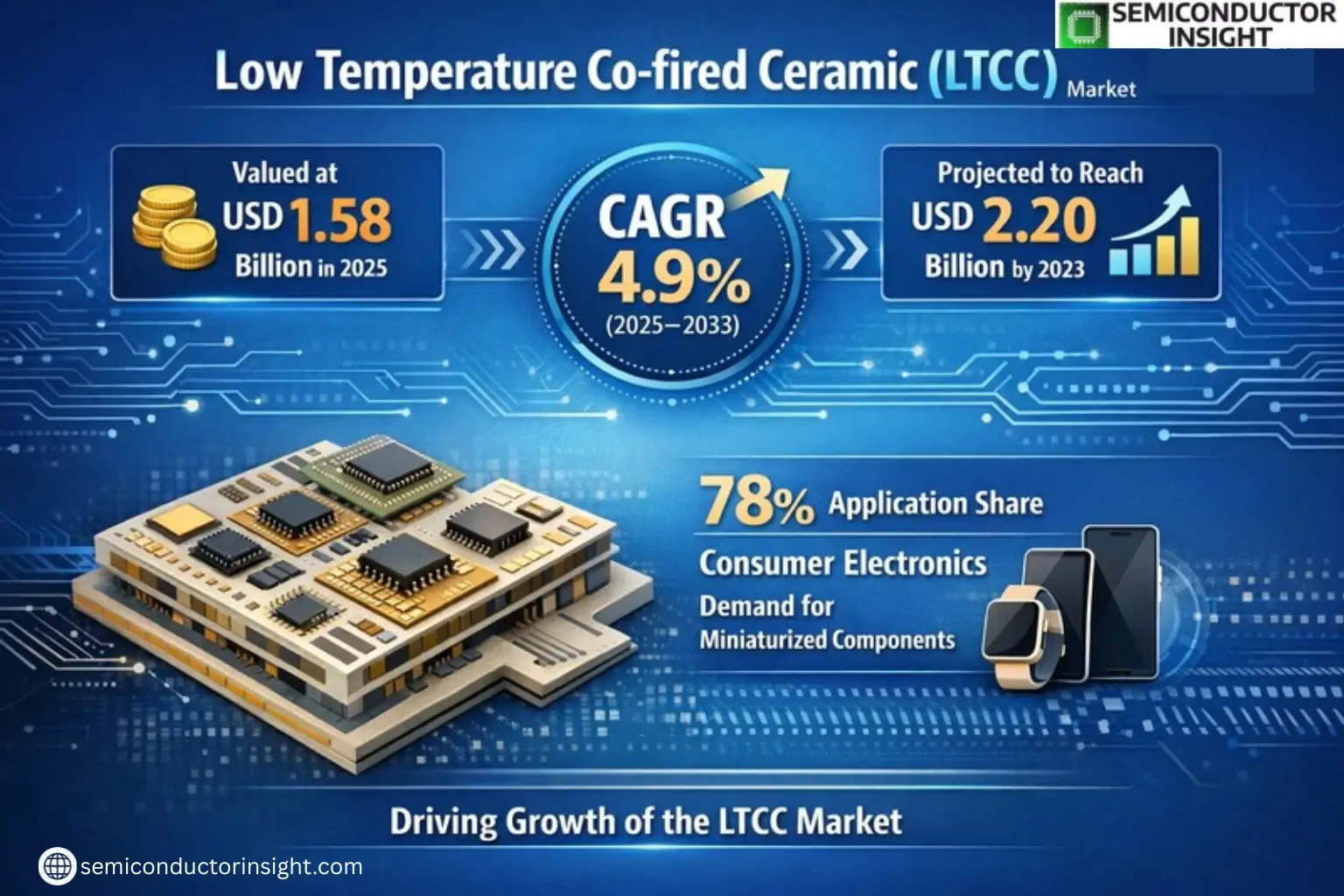
Global Low Temperature Co-fired Ceramic (LTCC) Market was valued at USD 1.58 billion in 2025 and is projected to reach USD 2.20 billion by 2033, exhibiting a CAGR of 4.9% during the forecast period.
Low Temperature Co-fired Ceramic (LTCC) substrates are multilayer ceramic materials fabricated through a firing process at temperatures between 850°C and 900°C, lower than traditional ceramics, by incorporating glass into alumina. This enables the use of low-resistance conductors for circuit patterning. Key LTCC components include LC filters, directional couplers, power splitters, and antennas, while substrates and modules cater to applications such as Bluetooth connectivity and mobile front-end modules.
The market growth is driven by increasing demand for miniaturized electronic components in consumer electronics, which accounts for 78% of the application share. Japan dominates the market with a 62% share, followed by Taiwan at 19%. The top three manufacturers Murata, Kyocera, and TDK Corporation collectively hold nearly half of the global market. Recent advancements in wireless communication technologies further bolster adoption across automotive electronics and aerospace sectors.
MARKET DRIVERS
Growing Demand in Wireless Communication
Low Temperature Co-fired Ceramic (LTCC) Market is experiencing significant growth due to increasing adoption in 5G infrastructure and IoT devices. The material’s excellent high-frequency performance makes it ideal for RF modules and antenna applications. Global 5G rollout is expected to drive over 25% of LTCC component demand by 2025.
Automotive Electronics Expansion
Modern vehicles incorporate 80+ electronic control units, many requiring LTCC substrates for harsh environment reliability. The trend toward electric vehicles and advanced driver-assistance systems (ADAS) is accelerating demand. The automotive sector accounts for approximately 18% of current LTCC applications.
Medical implant manufacturers are increasingly adopting LTCC for pacemakers and neurostimulators due to biocompatibility and hermetic sealing properties.
MARKET CHALLENGES
High Material Costs
LTCC production involves precision processes that increase manufacturing expenses by 30-40% compared to conventional PCB alternatives. The specialized ceramic materials and screen-printing techniques contribute to higher per-unit costs.
Other Challenges
Design Complexity
Multilayer LTCC circuits require extensive simulation and testing, increasing time-to-market by 15-20% compared to standard substrates.
MARKET RESTRAINTS
Competition from Alternative Technologies
Emerging technologies like organic substrates and advanced PCB laminates are capturing market share in applications where extreme temperature resistance isn’t critical. These alternatives offer 20-25% cost savings for certain consumer electronics applications.
MARKET OPPORTUNITIES
Aerospace & Defense Applications
LTCC Market is projected to see 12% annual growth in aerospace applications, particularly for radar systems and satellite communications. The material’s radiation resistance and reliability under extreme conditions make it ideal for space-grade electronics.
Medical IoT Expansion
Growing remote patient monitoring trends are driving demand for LTCC-based biosensors. The market for medical wearable components using LTCC technology is expected to exceed USD 780 million by 2027.
Low Temperature Co-fired Ceramic (LTCC) Market Trends
Steady Market Growth with 4.9% CAGR Projected
Global Low Temperature Co-fired Ceramic (LTCC) Market is expected to grow from USD 1584 million in 2025 to USD 2196 million by 2033, driven by increasing demand in consumer electronics and automotive applications. This growth represents a compound annual growth rate (CAGR) of 4.9%, demonstrating consistent expansion opportunities for manufacturers and suppliers in the LTCC sector.
Other Trends
Dominance of LTCC Components Segment
LTCC components currently hold 65% of the market share by product type, with widespread use in RF applications including LC filters, directional couplers, and power splitters. The technology’s ability to integrate multiple passive components into compact modules continues to drive adoption across various electronic applications.
Regional Market Concentration in Asia
Japan maintains its position as the largest LTCC market globally, accounting for 62% of market share, followed by Taiwan, China at 19%. This concentration reflects the strong electronics manufacturing ecosystem in these regions and the presence of leading LTCC manufacturers such as Murata, Kyocera, and TDK Corporation, which collectively hold 49% of the global market.
Consumer Electronics Drives Application Growth
Consumer electronics applications represent 78% of LTCC market usage, with growing demand for smartphone antenna modules, Bluetooth components, and power amplifier modules. The technology’s advantages in miniaturization and high-frequency performance make it particularly valuable for portable electronic devices where space constraints are critical.
Expanding Applications in Automotive Electronics
Automotive applications are emerging as a significant growth area for LTCC technology, particularly in advanced driver assistance systems (ADAS) and vehicle-to-everything (V2X) communication modules. The material’s thermal stability and reliability under harsh operating conditions position it favorably for next-generation automotive electronics solutions.
COMPETITIVE LANDSCAPE
Key Industry Players
Japan Dominates LTCC Market with 62% Share as Major Players Consolidate Positions
Murata Manufacturing, Kyocera (AVX), and TDK Corporation collectively control approximately 49% of the global LTCC market, leveraging their technological expertise and vertical integration. These Japanese giants dominate the consumer electronics segment, which accounts for 78% of LTCC applications. Their product portfolios span LTCC components (65% market share), substrates, and modules, serving 5G, IoT, and automotive applications through advanced ceramic solutions.
Taiyo Yuden and Samsung Electro-Mechanics emerge as strong competitors, focusing on high-frequency applications for telecom infrastructure. Specialist manufacturers like Yokowo and KOA (Via Electronic) concentrate on niche military/aerospace applications where reliability is critical. The Chinese market shows rapid growth with players like CETC 43rd Institute and Shenzhen Sunlord Electronics expanding production capacity for domestic supply chain needs.
List of Key LTCC Companies Profiled
- Murata Manufacturing
- Kyocera (AVX)
- TDK Corporation
- Mini-Circuits
- Taiyo Yuden
- Samsung Electro-Mechanics
- Yokowo
- KOA (Via Electronic)
- Proterial, Ltd
- Bosch
- IMST GmbH
- NEO Tech
- Niterra (NTK/NGK)
- Shenzhen Sunlord Electronics
- CETC 43rd Institute
Segment Analysis:
| Segment Category | Sub-Segments | Key Insights |
| By Type |
|
LTCC Components dominate due to their extensive use in RF applications:
|
| By Application |
|
Consumer Electronics leads with comprehensive integration:
|
| By End User |
|
OEMs drive market growth through innovation:
|
| By Material Composition |
|
Glass-Alumina Composites remain preferred choice:
|
| By Manufacturing Process |
|
Tape Casting dominates production technology:
|
Regional Analysis: Low Temperature Co-fired Ceramic (LTCC) Market
Asia-Pacific
Asia-Pacific boasts the world’s most concentrated LTCC manufacturing base, with integrated supply chains from raw materials to finished components. Clusters in Japan and China specialize in high-frequency LTCC solutions for telecommunications.
Rapid adoption of LTCC in 5G base stations and mmWave applications gives Asia-Pacific manufacturers first-mover advantage. Local firms are pioneering miniaturized LTCC solutions for wearable devices and medical implants.
Government-funded R&D initiatives focus on enhancing LTCC thermal and mechanical properties. Joint ventures between universities and corporations are developing next-generation ceramic materials with improved RF performance.
Emerging applications in electric vehicle power modules and aerospace electronics are driving LTCC market growth. Regional manufacturers are expanding production capacities to meet rising domestic and export demand.
North America
North America remains a key innovator in LTCC technology, with strong R&D capabilities in high-reliability applications. The region specializes in defense and aerospace LTCC solutions, with manufacturers developing ceramic substrates for extreme environments. Established supply chains support medical device manufacturers adopting LTCC for implantable electronics. Academic-industry collaborations are advancing materials science for improved LTCC performance parameters. Strategic focus on 6G research is creating future opportunities for millimeter-wave LTCC components.
Europe
European LTCC market growth is fueled by automotive electronics and industrial sensor applications. German and Swiss manufacturers lead in precision LTCC components for measurement and control systems. Stringent environmental regulations drive development of lead-free LTCC formulations. The region’s strong industrial automation sector creates consistent demand for robust ceramic substrates. European research institutions are pioneering green manufacturing processes for LTCC production.
Middle East & Africa
The MEA region shows emerging potential in LTCC adoption, particularly for telecommunications infrastructure. Growing investments in 5G networks are driving initial demand for RF ceramic components. Local partnerships with global LTCC suppliers are developing regional technical expertise. Oil & gas applications present niche opportunities for high-temperature LTCC sensors. Market growth remains constrained by limited local manufacturing capabilities.
South America
South America’s LTCC market is in early development stages, focusing mainly on consumer electronics imports. Brazil shows potential for localized LTCC production to serve automotive suppliers. Regional universities are establishing ceramics research programs to build technical capabilities. Limited electronics manufacturing infrastructure currently restricts broader LTCC adoption. Emerging medical device markets may drive future specialty LTCC demand.
Report Scope
This market research report provides a comprehensive analysis of the Global Low Temperature Co-fired Ceramic (LTCC) Market, covering the forecast period 2025–2033. It offers detailed insights into market dynamics, technological advancements, competitive landscape, and key trends shaping the industry.
Key focus areas of the report include:
- Market Overview: The report begins with an overview outlining its current market scenario, key growth indicators, and industry transformation drivers. It discusses macroeconomic factors, demand–supply balance, regulatory landscape, and the strategic role of LTCC in powering advancements across industries such as consumer electronics, aerospace, automotive, and telecommunications.
- Market Size & Forecast: Historical data and future projections for revenue, unit shipments, and market value across major regions and segments.
- Segmentation Analysis: Detailed breakdown by product type, technology, application, and end-user industry to identify high-growth segments and investment opportunities.
- Regional Insights: Insights into market performance across North America, Europe, Asia-Pacific, Latin America, and the Middle East & Africa, including country-level analysis where relevant.
- Competitive Landscape: Profiles of leading market participants, including their product offerings, R&D focus, manufacturing capacity, pricing strategies, and recent developments such as mergers, acquisitions, and partnerships.
- Technology Trends & Innovation: Assessment of emerging technologies, fabrication techniques, and evolving industry standards.
- Market Drivers & Restraints: Evaluation of factors driving market growth along with challenges, supply chain constraints, regulatory issues, and market-entry barriers.
- Stakeholder Insights: Insights for component suppliers, OEMs, system integrators, investors, and policymakers regarding the evolving ecosystem and strategic opportunities.
Primary and secondary research methods are employed, including interviews with industry experts, data from verified sources, and real-time market intelligence to ensure the accuracy and reliability of the insights presented.
FREQUENTLY ASKED QUESTIONS:
What is the current market size of Low Temperature Co-fired Ceramic (LTCC) Market?
-> Low Temperature Co-fired Ceramic (LTCC) Market was valued at USD 1.58 billion in 2025 and is projected to reach USD 2.20 billion by 2033, exhibiting a CAGR of 4.9% during the forecast period.
What is the growth rate of the LTCC Market?
-> The market is growing at a CAGR of 4.9% during the forecast period 2025-2033.
Which key companies operate in the LTCC Market?
-> Key players include Murata Manufacturing, Kyocera (AVX), TDK Corporation, Taiyo Yuden, Samsung Electro-Mechanics, Yokowo, and Bosch, among others.
Which product type dominates the LTCC market?
-> LTCC Components hold the dominant market share at 65% in 2025.
Which application segment leads in LTCC consumption?
-> Consumer Electronics is the largest application, accounting for 78% of the market.
Which region dominates the LTCC market?
-> Japan currently dominates with 62% market share, followed by Taiwan, China with 19%.

Get Sample Report PDF for Exclusive Insights
Report Sample Includes
- Table of Contents
- List of Tables & Figures
- Charts, Research Methodology, and more...
 Download Sample Report PDF