
MARKET INSIGHTS
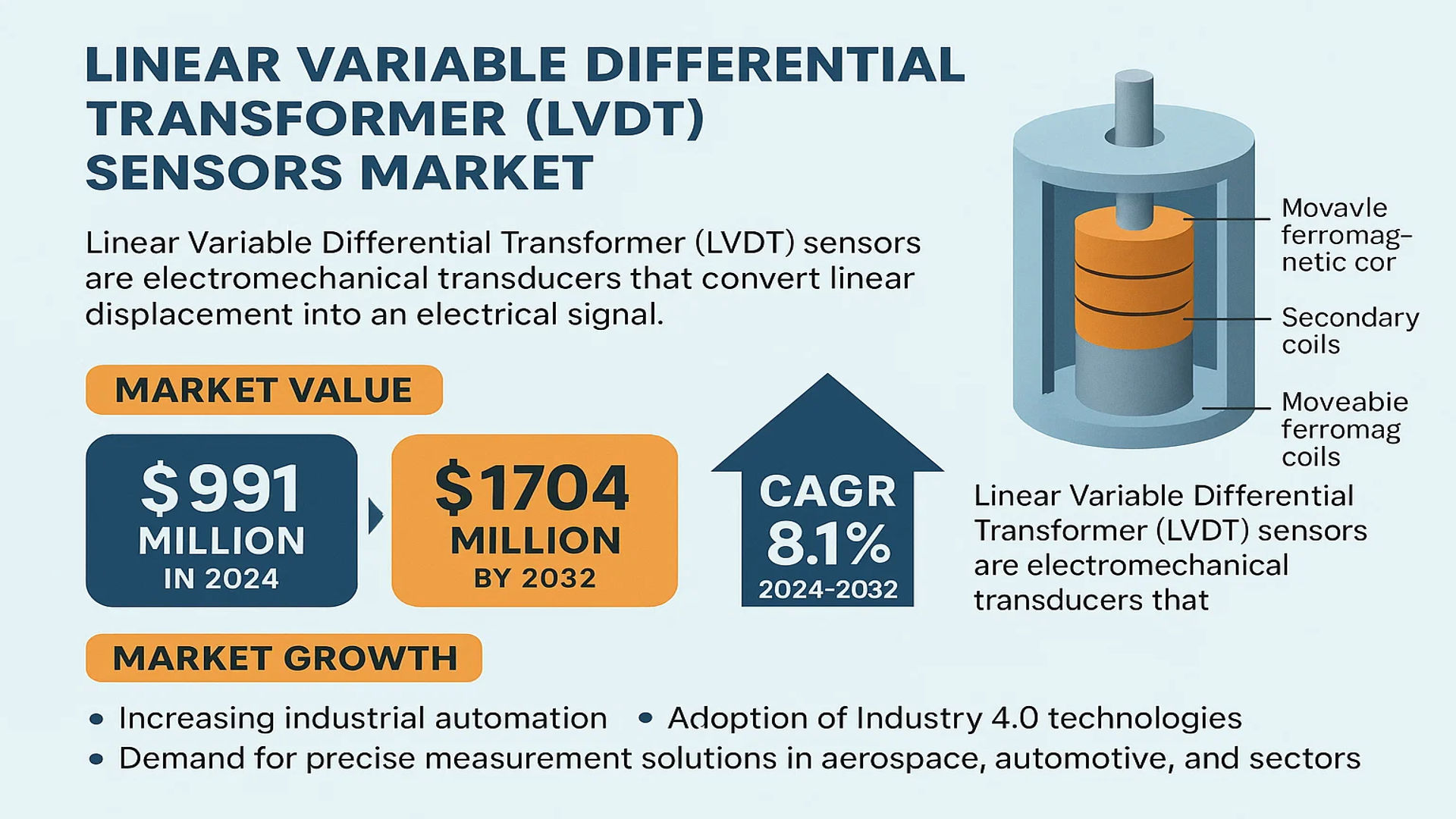
The global Linear Variable Differential Transformer (LVDT) Sensors Market was valued at 991 million in 2024 and is projected to reach US$ 1704 million by 2032, at a CAGR of 8.1% during the forecast period.
Linear Variable Differential Transformer (LVDT) sensors are electromechanical transducers that convert linear displacement into an electrical signal. These highly reliable sensors are widely used for precision measurements in applications requiring accuracy, repeatability, and robustness. LVDTs consist of a primary coil, two secondary coils, and a movable ferromagnetic core, enabling them to measure linear displacement with high resolution.
The market growth is driven by increasing industrial automation, adoption of Industry 4.0 technologies, and demand for precise measurement solutions in aerospace, automotive, and manufacturing sectors. Key players like Honeywell, TE Connectivity, and Sensata Technologies are investing in miniaturized and high-performance LVDT sensors to cater to evolving industry requirements. The aerospace and defense segment, in particular, accounts for significant demand due to stringent measurement needs in critical applications.
MARKET DYNAMICS
MARKET DRIVERS
Industrial Automation Boom Accelerates LVDT Sensor Adoption
The global industrial automation market is experiencing unprecedented growth, projected to maintain a CAGR of over 9% through 2030. This expansion directly benefits LVDT sensor demand as manufacturers increasingly integrate precision measurement capabilities into production lines. Modern CNC machines now incorporate an average of 12-15 LVDT sensors per system for tool positioning and quality control, up from just 5-7 units five years ago. The automotive sector has particularly embraced this technology, with electric vehicle battery assembly lines requiring sub-micron measurement accuracy that only LVDTs can reliably provide.
Aerospace and Defense Sector Investments Fuel Demand
Global defense spending reached record levels exceeding $2.2 trillion in 2024, with major aerospace programs driving demand for high-reliability measurement solutions. LVDTs have become the sensor of choice for flight control systems, landing gear monitoring, and actuator positioning due to their ability to maintain accuracy in extreme conditions. Recent contracts for next-generation fighter jets include specifications requiring 200-300 LVDT sensors per aircraft, demonstrating the technology’s critical role in modern aerospace platforms. This trend extends to commercial aviation as well, where predictive maintenance systems increasingly rely on LVDT data to optimize component replacement schedules.
Medical Technology Advancements Create New Application Areas
The medical equipment sector has emerged as a growth frontier for LVDT sensors, particularly in imaging systems and surgical robotics. Modern CT scanners now incorporate multiple LVDTs for precise gantry positioning, while robotic-assisted surgery systems use miniature LVDTs to provide haptic feedback to surgeons. The global surgical robotics market is projected to cross $20 billion by 2028, creating substantial opportunities for specialized medical-grade LVDT solutions that meet stringent regulatory requirements while operating in sterile environments.
MARKET RESTRAINTS
High Initial Cost Structure Limits Widespread Adoption
While LVDTs offer unparalleled precision, their premium pricing remains a barrier for cost-sensitive applications. Industrial-grade LVDT sensors typically cost 30-50% more than alternative displacement measurement technologies, with aerospace-qualified versions exceeding standard models by 200-300%. This cost differential stems from the complex winding patterns required in transformer construction and the specialized materials needed for high-temperature operation. Many small and medium-sized manufacturers consequently opt for less expensive alternatives despite the performance trade-offs.
Technical Complexity Demands Specialized Integration
Unlike simpler sensor types, LVDT systems require careful signal conditioning and proper mechanical installation to achieve specified performance. The need for AC excitation and subsequent demodulation adds complexity to system design, often requiring additional circuitry or specialized interface modules. Many industrial maintenance teams lack the expertise to properly troubleshoot LVDT-based systems, leading some end-users to select alternative technologies with simpler support requirements. This challenge is particularly acute in emerging markets where technical training infrastructure lags behind sensor adoption rates.
MARKET CHALLENGES
Competition from Emerging Sensing Technologies
The sensor landscape is rapidly evolving, with newer technologies like MEMS-based solutions and optical encoders encroaching on traditional LVDT applications. These alternatives offer digital outputs, smaller form factors, and in some cases, lower power consumption – advantages that resonate with designers of portable and battery-powered equipment. While LVDTs maintain superiority in harsh environments and high-accuracy applications, manufacturers must continuously innovate to maintain market position as competing technologies improve their performance characteristics.
Supply Chain Vulnerabilities for Specialty Materials
LVDT production relies on specialized materials including high-permeability magnetic alloys and precision-wound coils. Supply disruptions for any component can create significant production bottlenecks, as seen during recent shortages of electrical steel used in transformer cores. Many manufacturers maintain just 2-3 qualified suppliers for critical materials, creating vulnerability to geopolitical disruptions and raw material price volatility. This challenge has prompted leading producers to invest in vertical integration strategies and alternative material development programs.
MARKET OPPORTUNITIES
Smart Factory Initiatives Open New Application Horizons
The proliferation of Industry 4.0 implementations creates substantial opportunities for enhanced LVDT solutions with integrated diagnostics and connectivity features. Modern smart factories increasingly demand sensors that provide not only measurement data but also equipment health information and predictive maintenance insights. Forward-thinking LVDT manufacturers are responding by developing versions with embedded condition monitoring capabilities that can detect winding degradation or mechanical wear before they impact measurement accuracy. This evolution aligns perfectly with the growing industrial IoT ecosystem.
Miniaturization Trends Enable New Market Segments
Ongoing advancements in micro-manufacturing techniques are enabling production of LVDT sensors measuring less than 3mm in diameter while maintaining sub-micron accuracy. These miniature versions are finding applications in semiconductor manufacturing equipment, micro-positioning stages, and medical devices where space constraints previously prohibited LVDT use. The market for ultra-compact LVDTs is projected to grow at nearly double the overall market rate as these new application areas continue to expand.
Renewable Energy Sector Presents Growth Potential
As wind turbine installations continue their global expansion, LVDT sensors are becoming critical components in pitch control systems and drivetrain monitoring applications. Each modern wind turbine typically incorporates 5-10 LVDTs for various measurement tasks, with offshore installations requiring particularly robust versions capable of withstanding harsh marine environments. Similar opportunities exist in solar tracking systems and hydroelectric plant monitoring, creating a diversified growth vector beyond traditional industrial applications.
LINEAR VARIABLE DIFFERENTIAL TRANSFORMER (LVDT) SENSORS MARKET TRENDS
Industry 4.0 Adoption to Bolster LVDT Sensor Demand in Automation
The integration of Linear Variable Differential Transformer (LVDT) sensors into automated systems is accelerating, driven by the rapid adoption of Industry 4.0 principles across manufacturing and industrial sectors. LVDTs provide high-resolution, reliable displacement and position measurements, making them indispensable in robotics, CNC machinery, and motion control systems. With smart factories requiring real-time feedback mechanisms for precision manufacturing, the demand for LVDT sensors in automation applications is projected to grow at a CAGR of 8.1% over the next decade. Recent advancements in signal conditioning electronics and wireless connectivity have further enhanced their functionality in IoT-enabled industrial environments.
Other Trends
Aerospace & Defense Drive High-Performance LVDT Demand
The aerospace and defense sector accounts for a significant share of the global LVDT sensor market, valued at $991 million in 2024. These sensors play a critical role in flight control systems, landing gear monitoring, and structural health assessments due to their ability to perform under extreme temperatures and vibrations. With increasing defense budgets worldwide—particularly in the US, China, and EU nations—the demand for ruggedized LVDT variants optimized for aerospace applications has surged. New developments in miniaturized LVDTs with enhanced EMI resistance are enabling compact integration into next-generation aircraft and spacecraft.
Technological Evolution Enhancing Sensor Capabilities
Manufacturers are focusing on material innovations and design optimizations to expand LVDT applications. The emergence of wear-resistant coatings and corrosion-resistant alloys has extended sensor lifespans in harsh industrial environments, while novel core designs improve linearity and reduce hysteresis errors below 0.1% FS. Additionally, the development of DC-operated LVDTs—now holding 35% market share—is addressing power consumption challenges in portable instruments and battery-powered systems. These technological improvements are enabling LVDTs to compete effectively against emerging non-contact measurement technologies in critical applications.
COMPETITIVE LANDSCAPE
Key Industry Players
Market Leaders Focus on Precision Innovations and Industry 4.0 Integration
The global LVDT sensors market features a dynamic competitive environment with established multinational corporations and specialized sensor manufacturers vying for market share. Honeywell International Inc. leads the sector, commanding approximately 18% of the global market in 2024. The company’s dominance stems from its comprehensive product range that serves critical aerospace, industrial automation, and energy applications where measurement accuracy is paramount.
TE Connectivity and Ametek Inc. follow closely, collectively holding nearly 25% of market revenue. These players have strengthened their positions through continuous R&D investments, with TE Connectivity launching six new high-temperature LVDT models in Q3 2023 specifically designed for aerospace hydraulic systems. Similarly, Ametek’s 2022 acquisition of a German precision sensor firm expanded its capabilities in industrial automation solutions.
Medium-sized innovators like Micro-Epsilon and WayCon Positionsmesstechnik are carving out specialized niches. Micro-Epsilon recently introduced a miniaturized LVDT series with ±0.1% linearity for medical robotics applications, while WayCon has gained traction in Europe’s renewable energy sector with its corrosion-resistant LVDTs for wind turbine pitch control systems.
The competitive intensity is further evidenced by strategic moves from established players. Sensata Technologies and Curtiss-Wright have formed a technology partnership to develop next-generation LVDTs with embedded IoT capabilities, responding to the growing demand for smart factory solutions. Additionally, Omega Engineering has expanded its Asian manufacturing footprint to better serve the region’s booming automation sector.
List of Key LVDT Sensor Manufacturers Profiled
- Honeywell International Inc. (U.S.)
- TE Connectivity (Switzerland)
- Sensata Technologies (U.S.)
- Curtiss-Wright Corporation (U.S.)
- G.W. Lisk Company (U.S.)
- Ametek Inc. (U.S.)
- Micro-Epsilon Messtechnik (Germany)
- Meggitt PLC (U.K.)
- Omega Engineering (U.S.)
- Sensonics Ltd. (U.K.)
- Monitran Ltd. (U.K.)
- RDP Electronics (U.K.)
- Inelta Sensorsysteme (Germany)
- WayCon Positionsmesstechnik (Germany)
- Active Sensors LLC (U.S.)
Segment Analysis:
By Type
AC LVDTs Dominate the Market Due to Their High Accuracy and Robust Performance in Industrial Applications
The market is segmented based on type into:
- AC LVDTs
- Subtypes: High-temperature, submersible, and others
- DC LVDTs
- Subtypes: Miniature, high-accuracy, and others
By Application
Aerospace & Defense Segment Leads Due to Critical Need for Precision Measurement in Harsh Environments
The market is segmented based on application into:
- Aerospace & Defense
- Automotive
- Industrial Equipment
- Medical Equipment
- Consumer Electronics
- Others
By Operating Principle
Standard LVDTs Maintain Market Dominance with Wide Adoption Across Multiple Industries
The market is segmented based on operating principle into:
- Standard LVDTs
- Gage LVDTs
- Differential LVDTs
- Others
By End-User Industry
Manufacturing Sector Holds Significant Share Due to Increasing Automation Adoption
The market is segmented based on end-user industry into:
- Manufacturing
- Oil & Gas
- Energy & Power
- Automotive
- Aerospace
- Others
Regional Analysis: Linear Variable Differential Transformer (LVDT) Sensors Market
Asia-Pacific
The Asia-Pacific region dominates the LVDT sensor market, driven by rapid industrialization, expanding manufacturing sectors, and strong government investments in automation. Countries like China, Japan, and South Korea lead with their robust automotive, aerospace, and electronics industries, which extensively utilize LVDTs for precision measurement. China alone contributes over 40% of the regional market share due to its expansive industrial base and emphasis on smart manufacturing under its Made in China 2025 initiative. However, India is emerging as a high-growth market with increasing adoption in defense and renewable energy sectors. Cost competitiveness and localized production further strengthen the region’s market position.
North America
North America holds a significant share of the LVDT market, propelled by advanced aerospace, defense, and automotive industries. The U.S. leads in adoption due to stringent quality standards in aerospace (e.g., FAA regulations) and heavy R&D investments in automation. The region’s focus on Industry 4.0 and predictive maintenance technologies is driving demand for high-precision LVDT sensors, particularly in robotics and energy sectors. Canada follows with steady growth in industrial automation, while Mexico benefits from its manufacturing hubs supplying the automotive sector. Regulatory standards and technological advancements continue to shape market dynamics here.
Europe
Europe remains a key player in the LVDT market, supported by its strong automotive and aerospace industries, particularly in Germany, France, and the U.K. The region’s stringent regulations on safety and precision in industrial equipment fuel the demand for reliable LVDT solutions. Additionally, the EU’s focus on sustainability and energy efficiency has spurred innovations in miniaturized and low-power LVDT sensors. Germany, with its thriving industrial automation sector, accounts for the largest regional revenue share. Meanwhile, Eastern European countries are witnessing gradual growth, driven by increasing FDI in manufacturing and automation.
South America
The LVDT market in South America is nascent but growing, primarily fueled by Brazil’s automotive and oil & gas sectors. While economic volatility and limited technological infrastructure slow adoption, Brazil and Argentina show potential with increasing investments in industrial automation. The region’s reliance on imported LVDT sensors, however, creates pricing challenges. Infrastructure projects and renewable energy initiatives present future opportunities, but market expansion depends on economic stability and local manufacturing development.
Middle East & Africa
This region is in the early stages of LVDT adoption, with growth concentrated in the UAE, Saudi Arabia, and South Africa. The oil & gas industry drives demand for robust LVDT sensors in harsh environments, while limited industrial diversification restricts broader usage. Investments in smart city projects and infrastructure (e.g., NEOM in Saudi Arabia) could accelerate market growth. Nonetheless, geopolitical uncertainties and reliance on imports pose hurdles for long-term scalability.
Report Scope
This market research report provides a comprehensive analysis of the Global Linear Variable Differential Transformer (LVDT) Sensors market, covering the forecast period 2024–2032. It offers detailed insights into market dynamics, technological advancements, competitive landscape, and key trends shaping the industry.
Key focus areas of the report include:
- Market Size & Forecast: Historical data and future projections for revenue, unit shipments, and market value across major regions and segments. The Global LVDT Sensors market was valued at USD 991 million in 2024 and is projected to reach USD 1704 million by 2032, growing at a CAGR of 8.1%.
- Segmentation Analysis: Detailed breakdown by product type (AC LVDTs, DC LVDTs), application (Automotive, Aerospace & Defense, Consumer Electronics, Medical Equipment, Industrial Equipment), and end-user industry to identify high-growth segments.
- Regional Outlook: Insights into market performance across North America, Europe, Asia-Pacific, Latin America, and the Middle East & Africa, including country-level analysis. Asia-Pacific holds the largest market share, driven by industrial automation and manufacturing growth.
- Competitive Landscape: Profiles of leading market participants including Honeywell, TE Connectivity, Sensata Technologies, and Ametek, covering product portfolios, R&D investments, and strategic initiatives.
- Technology Trends & Innovation: Assessment of emerging technologies such as miniaturized LVDT sensors, Industry 4.0 integration, and advanced materials for harsh environment applications.
- Market Drivers & Restraints: Analysis of factors including industrial automation growth, aerospace sector demand, and challenges like supply chain disruptions and raw material price volatility.
- Stakeholder Analysis: Strategic insights for sensor manufacturers, system integrators, OEMs, and investors regarding market opportunities and competitive positioning.
The report employs primary and secondary research methodologies, including expert interviews, company financials analysis, and market data validation from authoritative sources to ensure accuracy and reliability.
FREQUENTLY ASKED QUESTIONS:
What is the current market size of Global LVDT Sensors Market?
->Linear Variable Differential Transformer (LVDT) Sensors Market was valued at 991 million in 2024 and is projected to reach US$ 1704 million by 2032, at a CAGR of 8.1% during the forecast period.
Which key companies operate in Global LVDT Sensors Market?
-> Key players include Honeywell, TE Connectivity, Sensata Technologies, Curtiss-Wright, G.W. Lisk, Ametek, and Micro-Epsilon, among others.
What are the key growth drivers?
-> Key growth drivers include industrial automation, aerospace & defense applications, and Industry 4.0 adoption.
Which region dominates the market?
-> Asia-Pacific leads the market, while North America remains strong in high-precision aerospace applications.
What are the emerging trends?
-> Emerging trends include miniaturization, wireless LVDT sensors, and integration with IoT platforms.
Get Sample Report PDF for Exclusive Insights
Report Sample Includes
- Table of Contents
- List of Tables & Figures
- Charts, Research Methodology, and more...
 Download Sample Report PDF


