LED Wafer and Chip Market Analysis:
The global LED Wafer and Chip Market size was valued at US$ 18.76 billion in 2024 and is projected to reach US$ 28.45 billion by 2032, at a CAGR of 5.3% during the forecast period 2025-2032
LED Wafer and Chip Market Overview
The LED Wafer and Chip Market encompasses the manufacturing and commercialization of wafers and chips used in Light Emitting Diodes (LEDs). LED wafers serve as the substrate on which the LED is built, typically made from materials like sapphire, silicon carbide (SiC), or gallium nitride (GaN). These wafers are sliced into chips, which are then further processed and packaged for integration into lighting devices.
LED chips are the actual light-emitting components that are embedded in various lighting applications ranging from residential and commercial lighting to electronics, automotive headlights, and aerospace signaling systems. The wafer and chip form the core of the LED’s functionality, dictating brightness, efficiency, and longevity.
This market forms a critical part of the global semiconductor and optoelectronics industries, with strong interdependence on innovations in fabrication technology, substrate engineering, and miniaturization trends.
This report provides a deep insight into the global LED Wafer and Chip Market, covering all its essential aspects. This ranges from a macro-overview of the market to micro details of the market size, competitive landscape, development trend, niche market, key market drivers and challenges, SWOT analysis, value chain analysis, etc.
The analysis helps the reader to shape the competition within the industries and strategies for the competitive environment to enhance the potential profit. Furthermore, it provides a simple framework for evaluating and assessing the position of the business organization. The report structure also focuses on the competitive landscape of the Global LED Wafer and Chip Market. This report introduces in detail the market share, market performance, product situation, operation situation, etc., of the main players, which helps the readers in the industry to identify the main competitors and deeply understand the competition pattern of the market.
In a word, this report is a must-read for industry players, investors, researchers, consultants, business strategists, and all those who have any kind of stake or are planning to foray into the LED Wafer and Chip Market in any manner.
LED Wafer and Chip Key Market Trends :
-
Growing Demand for Energy-Efficient Lighting
LED wafers and chips are increasingly adopted due to their energy-saving capabilities, replacing traditional lighting in homes, vehicles, and industries. -
Miniaturization in Consumer Electronics
Demand for compact and lightweight electronic devices is pushing the need for smaller, high-efficiency LED components. -
Rising Automotive Applications
Advanced LED lighting is becoming standard in modern vehicles, contributing significantly to market growth. -
Increasing Investment in Smart Cities
Smart street lighting and intelligent display systems are boosting LED wafer and chip installations. -
Shift Towards GaN-Based LEDs
Gallium Nitride-based LEDs are gaining traction for their higher efficiency and longer lifespan compared to traditional materials.
LED Wafer and Chip Market Regional Analysis :
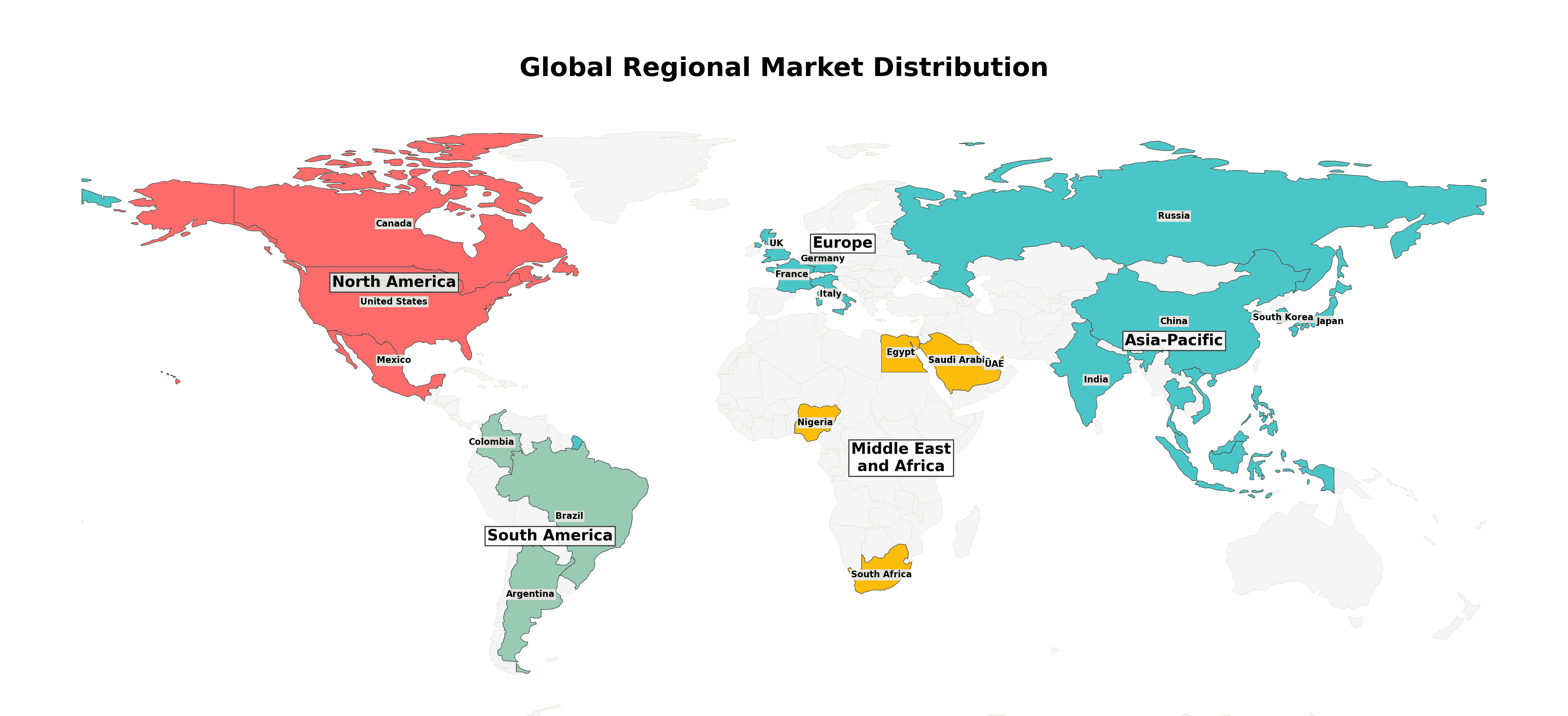
- North America:Strong demand driven by EVs, 5G infrastructure, and renewable energy, with the U.S. leading the market.
- Europe:Growth fueled by automotive electrification, renewable energy, and strong regulatory support, with Germany as a key player.
- Asia-Pacific:Dominates the market due to large-scale manufacturing in China and Japan, with growing demand from EVs, 5G, and semiconductors.
- South America:Emerging market, driven by renewable energy and EV adoption, with Brazil leading growth.
- Middle East & Africa:Gradual growth, mainly due to investments in renewable energy and EV infrastructure, with Saudi Arabia and UAE as key contributors.
LED Wafer and Chip Market Segmentation :
The research report includes specific segments by region (country), manufacturers, Type, and Application. Market segmentation creates subsets of a market based on product type, end-user or application, Geographic, and other factors. By understanding the market segments, the decision-maker can leverage this targeting in the product, sales, and marketing strategies. Market segments can power your product development cycles by informing how you create product offerings for different segments.
Market Segmentation (by Application)
- Electronic Products
- Car
- Space
- Other
Market Segmentation (by Type)
- LED Wafer
- LED Chip
Key Company
- Nichia
- SAMSUNG
- EPISTAR
- Cree
- Osram
- PHILIPS Lumileds
- SSC
- LG Innotek
- Toyoda Gosei
- Semileds
- Hewlett Packard
- Lumination
- Bridgelux
Drivers
-
Growing Demand for Energy-Efficient Products
Rising energy costs and government initiatives to reduce carbon footprints are driving the demand for LED-based lighting systems. -
Expansion of Automotive and Consumer Electronics Sectors
Wider use of LEDs in automotive lighting, smartphones, TVs, and wearables is fueling market growth. -
Advancement in LED Technology
Ongoing innovations in chip architecture and wafer materials are enhancing performance, reducing heat, and increasing durability.
Restraints
-
High Initial Investment Costs
Despite long-term savings, the upfront cost of LED wafer and chip manufacturing can deter small-scale producers. -
Supply Chain Disruptions
Geopolitical tensions and reliance on specific regions for raw materials can impact the production cycle and availability. -
Technical Limitations in Heat Dissipation
LED chips can face efficiency drops due to thermal management challenges, especially in high-power applications.
Opportunities
-
Adoption in Smart Lighting and IoT Devices
LED integration in smart homes and IoT-connected devices presents new revenue avenues for manufacturers. -
Rising Demand in Emerging Economies
Developing countries are adopting LED lighting at a fast pace due to energy-saving initiatives and infrastructure upgrades. -
Use in Aerospace and Industrial Applications
Specialized applications in aerospace, healthcare, and industrial sectors are opening up high-margin segments.
Challenges
-
Intense Competition and Price Pressure
Presence of numerous global and regional players leads to aggressive pricing, impacting profit margins. -
Rapid Technological Changes
Constant advancements require companies to invest heavily in R&D to stay competitive. -
Environmental Concerns Related to E-Waste
Improper disposal of LED chips and wafers may contribute to electronic waste, raising sustainability concerns.
FAQs
Q1. What are the key driving factors and opportunities in the LED Wafer and Chip Market?
A1. Key drivers include energy efficiency demand, electronics growth, and automotive adoption. Opportunities lie in smart lighting, emerging markets, and aerospace applications.
Q2. Which region is projected to have the largest market share?
A2. Asia-Pacific, especially China, Japan, and South Korea, is expected to dominate the market due to strong manufacturing and consumer electronics demand.
Q3. Who are the top players in the global LED Wafer and Chip Market?
A3. Key companies include Nichia, SAMSUNG, EPISTAR, Cree, Osram, PHILIPS Lumileds, LG Innotek, and Bridgelux.
Q4. What are the latest technological advancements in the industry?
A4. Advancements include GaN-based LEDs, miniaturized chip designs, and integration of smart features in lighting systems.
Q5. What is the current size of the global LED Wafer and Chip Market?
A5. The market size is valued at US$ 18.76 billion in 2024 and is projected to reach US$ 28.45 billion by 2032.

Get Sample Report PDF for Exclusive Insights
Report Sample Includes
- Table of Contents
- List of Tables & Figures
- Charts, Research Methodology, and more...
 Download Sample Report PDF