Introduction
Laser Direct Structuring (LDS) Antenna is an advanced technology used to create intricate, high-performance antennas directly onto plastic or other non-metallic substrates. This process involves the use of a laser to selectively activate specific areas of a plastic surface, allowing for the direct deposition of metal in those regions. The resulting antenna structures are highly precise, lightweight, and capable of supporting a wide range of frequencies, making them ideal for applications in compact electronic devices. LDS antennas are commonly used in industries such as telecommunications, automotive, and consumer electronics, where space-saving and high-efficiency solutions are critical.
This technology is becoming increasingly important in the semiconductor industry, where miniaturization and efficient integration of components are key trends. The semiconductor market is witnessing a growing demand for advanced solutions like Laser Direct Structuring (LDS) Antennas that offer both performance and compactness. According to the latest semiconductor industry analysis, the Laser Direct Structuring (LDS) Antenna Market is expected to grow significantly in the coming years. The Laser Direct Structuring (LDS) Antenna Market size is anticipated to expand as this technology gains traction across various sectors. The Laser Direct Structuring (LDS) Antenna Market share will likely see shifts as key players innovate and develop more efficient and cost-effective solutions. As demand continues to rise, the Laser Direct Structuring (LDS) Antenna Market growth is forecasted to be strong, with projections for the Laser Direct Structuring (LDS) Antenna Market forecast 2025 indicating a continued upward trend. Leading Laser Direct Structuring (LDS) Antenna Market companies are expected to play a pivotal role in driving this growth, especially within the semiconductor Laser Direct Structuring (LDS) Antenna Market, by developing cutting-edge, integrated antenna solutions for next-generation electronic devices.
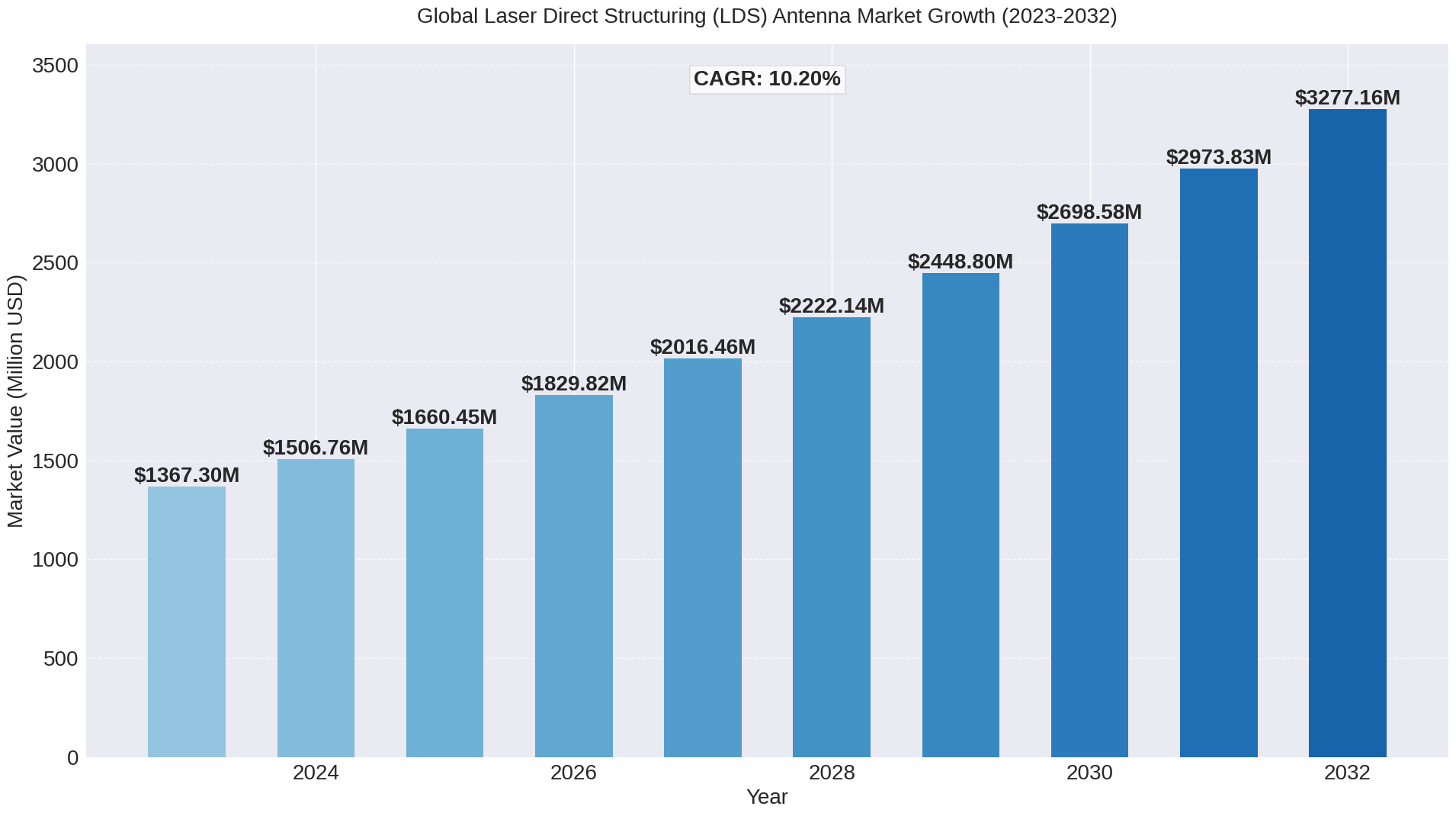
The Global Laser Direct Structuring (LDS) Antenna Market size was estimated at USD 1367.30 million in 2023 and is projected to reach USD 3277.16 million by 2032, exhibiting a CAGR of 10.20% during the forecast period.
North America Laser Direct Structuring (LDS) Antenna market size was estimated at USD 421.30 million in 2023, at a CAGR of 8.74% during the forecast period of 2025 through 2032.
Report Overview
Laser Direct Structuring (LDS) Antenna is an antenna product by using Laser Direct Structuring (LDS) Technology. Laser Direct Structuring (LDS) Technology offers flexibility and geometric 3D design freedom in making antenna products. Laser Direct Structuring (LDS) Antenna manufacturing process combines both mechanical structures and electronic circuits into a single 3D part. Signal quality and RF performance are improved with Laser Direct Structuring (LDS) Antennas and greater design possibilities are available. Most of the LDS process uses a thermoplastic material which has already been doped with a metal-plastic additive. This report mainly covers the Laser Direct Structuring (LDS) Antenna product type.
This report provides a deep insight into the global Laser Direct Structuring (LDS) Antenna market covering all its essential aspects. This ranges from a macro overview of the market to micro details of the market size, competitive landscape, development trend, niche market, key market drivers and challenges, SWOT analysis, value chain analysis, etc.
The analysis helps the reader to shape the competition within the industries and strategies for the competitive environment to enhance the potential profit. Furthermore, it provides a simple framework for evaluating and accessing the position of the business organization. The report structure also focuses on the competitive landscape of the Global Laser Direct Structuring (LDS) Antenna Market, this report introduces in detail the market share, market performance, product situation, operation situation, etc. of the main players, which helps the readers in the industry to identify the main competitors and deeply understand the competition pattern of the market.
In a word, this report is a must-read for industry players, investors, researchers, consultants, business strategists, and all those who have any kind of stake or are planning to foray into the Laser Direct Structuring (LDS) Antenna market in any manner.
Global Laser Direct Structuring (LDS) Antenna Market: Market Segmentation Analysis
The research report includes specific segments by region (country), manufacturers, Type, and Application. Market segmentation creates subsets of a market based on product type, end-user or application, Geographic, and other factors. By understanding the market segments, the decision-maker can leverage this targeting in the product, sales, and marketing strategies. Market segments can power your product development cycles by informing how you create product offerings for different segments.
Click Here to Download Your Free Sample Report
Key Company
- Molex (Koch Industries)
- Shenzhen Sunway Communication
- Amphenol
- TE Connectivity
- Pulse Electronics (Yageo)
- Galtronics (Baylin Technologies)
- Huizhou Speed Wireless Technology
- Skycross
- SelectConnect (Arlington Plating)
- Luxshare Precision Industry
- Inpaq
- Tongda
Market Segmentation (by Type)
- Main Antenna
- Bluetooth Antenna
- WIFI Antenna
- GPS Antenna
- NFC Antenna
Market Segmentation (by Application)
- Smartphones
- Wearables
- Laptops/Tablets
- Gaming Consoles and Accessories
- Healthcare
- Automotive
- Networking
Geographic Segmentation
- North America (USA, Canada, Mexico)
- Europe (Germany, UK, France, Russia, Italy, Rest of Europe)
- Asia-Pacific (China, Japan, South Korea, India, Southeast Asia, Rest of Asia-Pacific)
- South America (Brazil, Argentina, Columbia, Rest of South America)
- The Middle East and Africa (Saudi Arabia, UAE, Egypt, Nigeria, South Africa, Rest of MEA)
Key Benefits of This Market Research:
- Industry drivers, restraints, and opportunities covered in the study
- Neutral perspective on the market performance
- Recent industry trends and developments
- Competitive landscape & strategies of key players
- Potential & niche segments and regions exhibiting promising growth covered
- Historical, current, and projected market size, in terms of value
- In-depth analysis of the Laser Direct Structuring (LDS) Antenna Market
- Overview of the regional outlook of the Laser Direct Structuring (LDS) Antenna Market:
Key Reasons to Buy this Report:
- Access to date statistics compiled by our researchers. These provide you with historical and forecast data, which is analyzed to tell you why your market is set to change
- This enables you to anticipate market changes to remain ahead of your competitors
- You will be able to copy data from the Excel spreadsheet straight into your marketing plans, business presentations, or other strategic documents
- The concise analysis, clear graph, and table format will enable you to pinpoint the information you require quickly
- Provision of market value data for each segment and sub-segment
- Indicates the region and segment that is expected to witness the fastest growth as well as to dominate the market
- Analysis by geography highlighting the consumption of the product/service in the region as well as indicating the factors that are affecting the market within each region
- Competitive landscape which incorporates the market ranking of the major players, along with new service/product launches, partnerships, business expansions, and acquisitions in the past five years of companies profiled
- Extensive company profiles comprising of company overview, company insights, product benchmarking, and SWOT analysis for the major market players
- The current as well as the future market outlook of the industry concerning recent developments which involve growth opportunities and drivers as well as challenges and restraints of both emerging as well as developed regions
- Includes in-depth analysis of the market from various perspectives through Porters five forces analysis
- Provides insight into the market through Value Chain
- Market dynamics scenario, along with growth opportunities of the market in the years to come
- 6-month post-sales analyst support
Click Here to Download Your Free Sample Report
Customization of the Report
In case of any queries or customization requirements, please connect with our sales team, who will ensure that your requirements are met.
Drivers:
- Miniaturization of Electronic Devices: As electronic devices become more compact and lightweight, the demand for smaller, high-performance antennas is increasing. LDS technology enables the creation of intricate, three-dimensional antenna structures directly on plastic substrates, supporting the trend of miniaturization in consumer electronics, automotive, and IoT devices.
- Enhanced Performance and Design Flexibility: LDS technology offers superior flexibility in antenna design, allowing manufacturers to create complex, multi-functional antenna structures with optimized performance. This capability is particularly beneficial in applications like smartphones, wearables, and autonomous vehicles, where high efficiency and reduced size are critical.
- Growing IoT and 5G Adoption: The proliferation of the Internet of Things (IoT) devices and the rollout of 5G networks is driving demand for more advanced antenna solutions. LDS antennas, with their ability to be integrated seamlessly into the device structure, are ideal for 5G devices that require high-frequency, high-performance antennas.
- Cost-Effective Manufacturing: LDS technology eliminates the need for additional antenna assembly steps, reducing the overall manufacturing costs. By directly structuring antennas on plastic components, manufacturers can streamline the production process and lower material costs, making it an attractive option for companies aiming to optimize production efficiency.
- Demand in Automotive Applications: The automotive sector, especially with the rise of connected cars and autonomous vehicles, requires antennas that can be integrated into various parts of the vehicle, such as dashboards, rearview mirrors, and door handles. LDS technology allows for the development of compact, robust antennas that can be embedded into the vehicle’s plastic parts, offering both functionality and aesthetic integration.
Restraints:
- High Initial Setup Costs: The adoption of LDS technology requires specialized equipment and processes, which may lead to high upfront costs for manufacturers. This can be a significant barrier for small and medium-sized enterprises (SMEs) that are hesitant to invest in these expensive tools.
- Material Compatibility: LDS technology is most effective on specific types of plastic materials that are capable of being treated with the laser process. The limited range of materials that can be used in LDS might restrict its adoption in certain applications where other materials are more suitable.
- Complexity in Scaling Production: While LDS offers design flexibility, scaling the process for mass production while maintaining consistency and quality can be challenging. Large-scale production may face difficulties in ensuring uniformity across all manufactured antennas, which can lead to yield losses.
- Competition from Alternative Antenna Technologies: While LDS antennas offer many advantages, they face competition from traditional metal antennas, as well as other emerging technologies, such as flexible antennas. These alternatives may offer more mature or cost-effective solutions in certain use cases, limiting the growth of LDS antennas in some market segments.
Opportunities:
- Expanding in 5G and Future Wireless Networks: The ongoing rollout of 5G networks and the future development of 6G provide a significant opportunity for the LDS antenna market. As these networks require more sophisticated antenna designs to handle higher frequencies and data throughput, LDS technology can meet these demands with compact, high-performance antennas embedded directly in devices.
- Integration with Smart Packaging and Wearables: The increasing demand for wearable devices and smart packaging opens up new applications for LDS antennas. The ability to integrate antennas into the body of a product without taking up additional space aligns with the requirements of the wearable and IoT markets, offering significant growth potential.
- Automotive Industry Growth: The shift toward autonomous vehicles, which require multiple connectivity solutions, presents a major opportunity for LDS antennas. Automotive applications demand compact, reliable, and durable antennas that can be seamlessly integrated into the car’s structure, which is a key strength of LDS technology.
- Advancements in Materials and Technology: Continued research and development in LDS materials and laser technology could lead to improved processes, such as enhanced precision, faster processing times, and the ability to use a wider variety of materials. These advancements could reduce manufacturing costs and expand the range of potential applications for LDS antennas.
Challenges:
- Technological Complexity: The laser direct structuring process requires high precision and the ability to handle intricate designs. As technology evolves, maintaining process accuracy while scaling production can be challenging. Manufacturers need to ensure consistent quality and reliability, particularly for high-frequency applications.
- Supply Chain and Material Sourcing: The supply chain for LDS-compatible materials is relatively specialized, and disruptions in the availability or cost of these materials could affect the growth of the LDS antenna market. Manufacturers must rely on a steady supply of compatible substrates and other materials to ensure the smooth production of LDS antennas.
- Regulatory and Certification Challenges: As LDS antennas are used in industries like automotive and aerospace, ensuring that the antennas meet industry-specific certifications and regulatory standards can be a lengthy and complex process. Manufacturers must navigate these regulations to ensure compliance, particularly in markets with stringent requirements.
- Evolving Consumer Demands: Consumer expectations are continuously evolving, particularly in the mobile and wearable device sectors. Manufacturers must adapt to rapidly changing design trends and requirements while ensuring that LDS antennas can meet these dynamic demands in terms of performance, size, and integration.
Interested in related market reports? Click here to explore more!
About Semiconductor Insight:
At Semiconductor Insight, we are dedicated to delivering in-depth semiconductor market research and analysis that empowers businesses to make informed decisions in this rapidly evolving industry. With a focus on providing comprehensive semiconductor research, we uncover trends, opportunities, and challenges shaping the global semiconductor market. Our meticulously crafted semiconductor market reports offer actionable insights, including market forecasts, competitive analysis, and technological advancements, ensuring our clients stay ahead in the highly competitive semiconductor landscape.

Get Sample Report PDF for Exclusive Insights
Report Sample Includes
- Table of Contents
- List of Tables & Figures
- Charts, Research Methodology, and more...
 Download Sample Report PDF