
InGaAs Image Detector Chips Market Overview
Short wave infrared detectors have important application value and prospects in fields such as space remote sensing, night vision, temperature measurement, etc. Currently, in addition to using traditional mercury cadmium telluride and antimonide infrared materials, indium gallium arsenic (InGaAs) material is considered an excellent material for making short wave infrared detectors. The cutoff wavelength of short wave infrared detectors made of it is about 1.7 ? m. It has advantages such as high absorption coefficient, high mobility, and high detection rate.
This report provides a deep insight into the global InGaAs Image Detector Chips market covering all its essential aspects. This ranges from a macro overview of the market to micro details of the market size, competitive landscape, development trend, niche market, key market drivers and challenges, SWOT analysis, value chain analysis, etc.
The analysis helps the reader to shape the competition within the industries and strategies for the competitive environment to enhance the potential profit. Furthermore, it provides a simple framework for evaluating and accessing the position of the business organization. The report structure also focuses on the competitive landscape of the Global InGaAs Image Detector Chips Market, this report introduces in detail the market share, market performance, product situation, operation situation, etc. of the main players, which helps the readers in the industry to identify the main competitors and deeply understand the competition pattern of the market.
In a word, this report is a must-read for industry players, investors, researchers, consultants, business strategists, and all those who have any kind of stake or are planning to foray into the InGaAs Image Detector Chips market in any manner.
InGaAs Image Detector Chips Market Analysis:
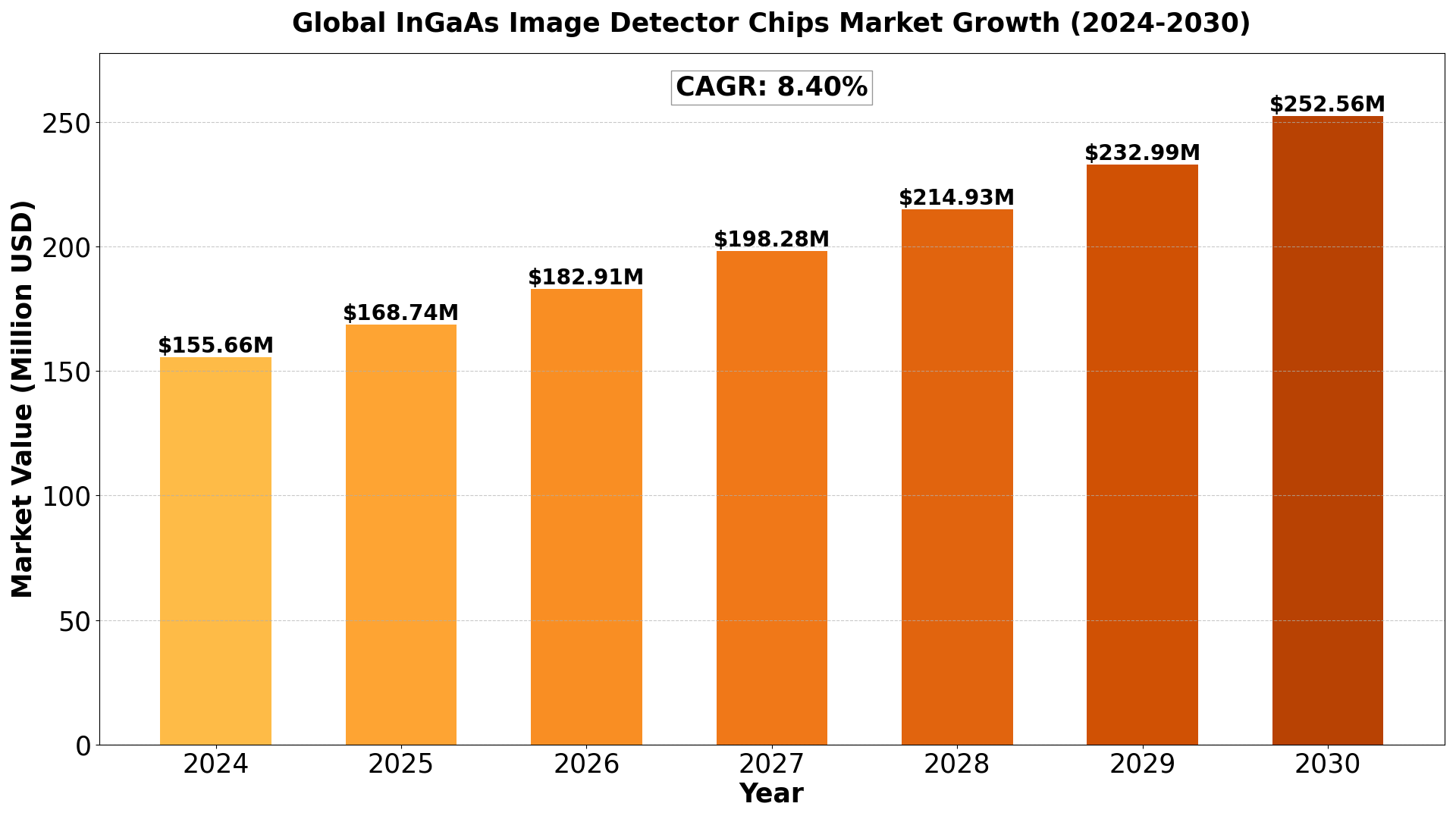
The Global InGaAs Image Detector Chips Market size was estimated at USD 143.60 million in 2023 and is projected to reach USD 252.56 million by 2030, exhibiting a CAGR of 8.40% during the forecast period.
North America InGaAs Image Detector Chips market size was USD 37.42 million in 2023, at a CAGR of 7.20% during the forecast period of 2024 through 2030.
InGaAs Image Detector Chips Key Market Trends :
1. Increasing Demand for SWIR Imaging Applications
InGaAs image detector chips are increasingly being used in SWIR imaging systems, which offer several advantages, including the ability to see through smoke, fog, or dust and detect heat signatures. These detectors are essential in military and defense applications for night vision, target identification, and security surveillance. Additionally, SWIR imaging is increasingly applied in industrial applications like process control, material sorting, and quality inspection, driving the demand for InGaAs image detector chips.
2. Growth in Industrial and Automotive Applications
In industries such as semiconductors, aerospace, and automotive, the use of InGaAs image detectors is expanding for machine vision and quality control. These detectors can be used to inspect microelectronics for defects during manufacturing processes, as well as for material inspection and safety monitoring in automotive applications, where non-visible light detection is critical for autonomous vehicles and advanced driver-assistance systems (ADAS).
3. Advancements in Medical Imaging
In the medical imaging field, InGaAs image detectors are increasingly being used for non-invasive diagnostic procedures. They are employed in applications such as vascular imaging, disease diagnosis, and endoscopy. Their ability to capture high-quality images in the infrared spectrum enhances early-stage detection of various health conditions, including cancer, vascular diseases, and neurological disorders. The growing focus on early diagnosis and minimally invasive procedures is fueling the demand for these chips in healthcare.
4. Expansion in Scientific Research and Spectroscopy
InGaAs image detector chips are gaining popularity in the field of scientific research, particularly in areas like spectroscopy and material analysis. They are used in laboratories for tasks such as chemical analysis, environmental testing, and optical metrology. The ability of these chips to detect a broad range of wavelengths in the infrared spectrum allows for precise material characterization and enhances the performance of spectroscopy equipment.
5. Miniaturization and Cost Reduction
Recent advancements in semiconductor manufacturing technology have made it possible to miniaturize InGaAs image detector chips, while also reducing their costs. This trend is enabling the adoption of these high-performance sensors in a wider variety of consumer electronics and portable devices. For instance, InGaAs image detectors are now being integrated into smartphones, drones, and handheld devices for a range of imaging applications, including security, inspection, and augmented reality.
InGaAs Image Detector Chips Market Regional Analysis :
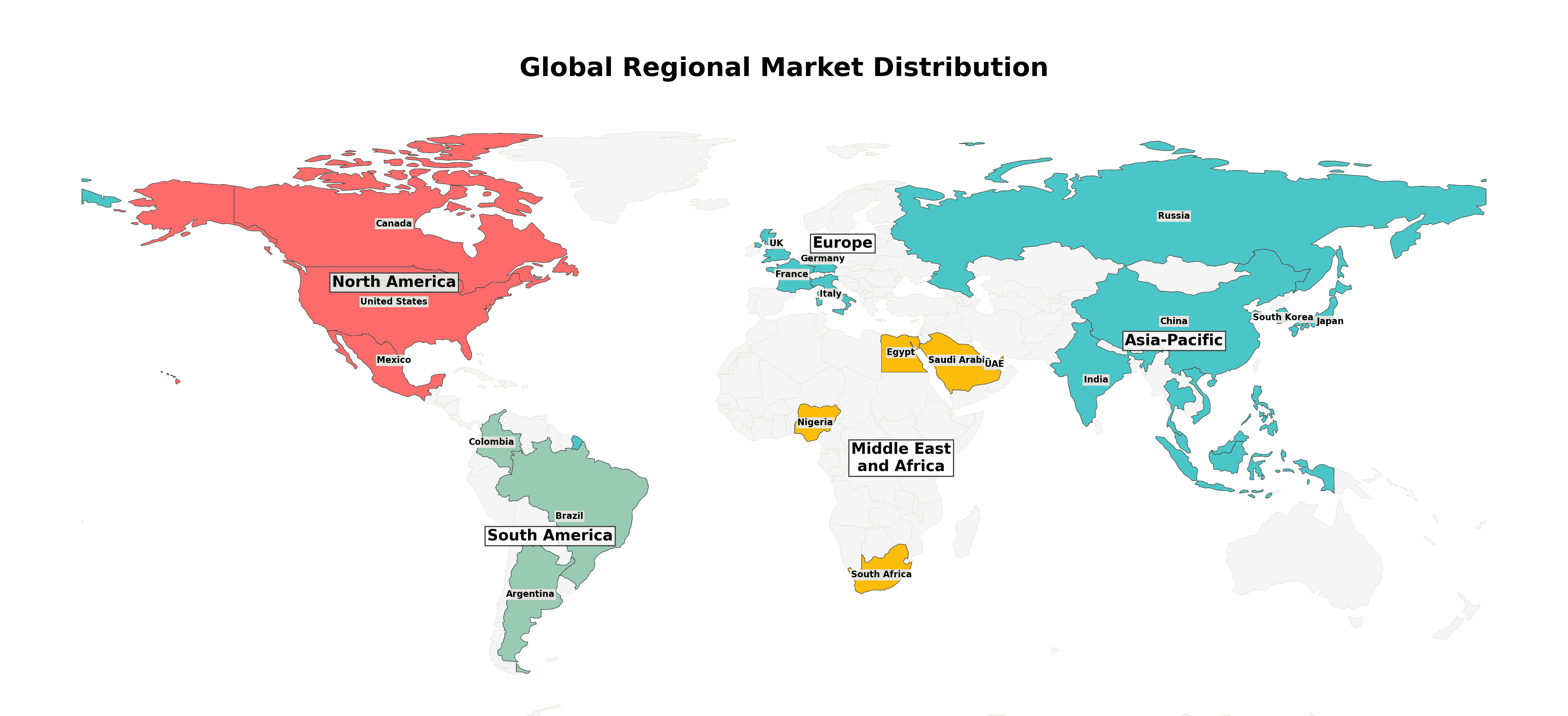
1. North America (USA, Canada, Mexico)
- USA: The largest market in the region due to advanced infrastructure, high disposable income, and technological advancements. Key industries include technology, healthcare, and manufacturing.
- Canada: Strong market potential driven by resource exports, a stable economy, and government initiatives supporting innovation.
- Mexico: A growing economy with strengths in automotive manufacturing, agriculture, and tourism, benefitting from trade agreements like the USMCA.
2. Europe (Germany, UK, France, Russia, Italy, Rest of Europe)
- Germany: The region’s industrial powerhouse with a focus on engineering, automotive, and machinery.
- UK: A hub for financial services, fintech, and pharmaceuticals, though Brexit has altered trade patterns.
- France: Strong in luxury goods, agriculture, and aerospace with significant innovation in renewable energy.
- Russia: Resource-driven economy with strengths in oil, gas, and minerals but geopolitical tensions affect growth.
- Italy: Known for fashion, design, and manufacturing, especially in luxury segments.
- Rest of Europe: Includes smaller yet significant economies like Spain, Netherlands, and Switzerland with strengths in finance, agriculture, and manufacturing.
3. Asia-Pacific (China, Japan, South Korea, India, Southeast Asia, Rest of Asia-Pacific)
- China: The largest market in the region with a focus on technology, manufacturing, and e-commerce. Rapid urbanization and middle-class growth fuel consumption.
- Japan: Technological innovation, particularly in robotics and electronics, drives the economy.
- South Korea: Known for technology, especially in semiconductors and consumer electronics.
- India: Rapidly growing economy with strengths in IT services, agriculture, and pharmaceuticals.
- Southeast Asia: Key markets like Indonesia, Thailand, and Vietnam show growth in manufacturing and tourism.
- Rest of Asia-Pacific: Emerging markets with growing investment in infrastructure and services.
4. South America (Brazil, Argentina, Colombia, Rest of South America)
- Brazil: Largest economy in the region, driven by agriculture, mining, and energy.
- Argentina: Known for agriculture exports and natural resources but faces economic instability.
- Colombia: Growing economy with strengths in oil, coffee, and flowers.
- Rest of South America: Includes Chile and Peru, which have strong mining sectors.
5. The Middle East and Africa (Saudi Arabia, UAE, Egypt, Nigeria, South Africa, Rest of MEA)
- Saudi Arabia: Oil-driven economy undergoing diversification with Vision 2030 initiatives.
- UAE: Financial hub with strengths in tourism, real estate, and trade.
- Egypt: Growing infrastructure development and tourism.
- Nigeria: Largest economy in Africa with strengths in oil and agriculture.
- South Africa: Industrialized economy with strengths in mining and finance.
- Rest of MEA: Includes smaller yet resource-rich markets like Qatar and Kenya with growing infrastructure investments.
InGaAs Image Detector Chips Market Segmentation :
The research report includes specific segments by region (country), manufacturers, Type, and Application. Market segmentation creates subsets of a market based on product type, end-user or application, Geographic, and other factors. By understanding the market segments, the decision-maker can leverage this targeting in the product, sales, and marketing strategies. Market segments can power your product development cycles by informing how you create product offerings for different segments.
Key Company
- Hamamatsu
- SCD
- Lynred
- I3system
- CETC (NO.44 Institute)
- Sensors Unlimited
- Jiwu Optoelectronic
- Sony
- OSI Optoelectronics
- GHOPTO
- NORINCO GROUP (Kunming Institute of Physics)
- ZKDX
- XenICs
- Xi’an Leading Optoelectronic Technology
Market Segmentation (by Type)
- InGaAs SWIR Linear Arrays
- InGaAs SWIR Area Arrays
Market Segmentation (by Application)
- Military
- Surveillance
- Induatrial
- Medical
- Scientific Research
- Other Application
Drivers
- Increasing Demand for SWIR Imaging: InGaAs image detector chips are widely used in SWIR imaging applications, including defense, aerospace, medical imaging, industrial inspection, and environmental monitoring. The demand for SWIR imaging is driven by the need for high-quality imaging in low-light, night-vision, and surveillance applications, where traditional visible light imaging fails. As these applications grow, so does the demand for InGaAs image detectors.
- Advancements in Imaging Technology: Technological advancements in InGaAs materials and image sensor designs are enhancing the performance of image detector chips. Improvements such as higher sensitivity, better resolution, faster response times, and improved thermal management are making InGaAs detectors more attractive for use in a variety of demanding imaging applications. These advancements contribute to the overall growth of the market.
- Growing Demand for High-Resolution Imaging: The need for high-resolution infrared imaging in industries like surveillance, quality control, and scientific research is a key driver. InGaAs image detector chips are known for their ability to deliver high-resolution images even under challenging lighting conditions, making them ideal for applications like non-destructive testing, material analysis, and optical sorting.
- Military and Defense Applications: InGaAs image detectors are widely used in military and defense applications, such as night-vision systems, surveillance, and target detection. The ability of these sensors to detect low levels of infrared light makes them invaluable in operations that take place in darkness or in poor visibility conditions. As defense budgets grow and the demand for advanced imaging systems increases, the market for InGaAs image detectors is expanding.
- Growth in Industrial and Automotive Applications: Industries like automotive, manufacturing, and robotics are increasingly utilizing InGaAs image detector chips for applications like machine vision, quality inspection, and autonomous vehicles. The need for precise, high-speed, and accurate imaging in these industries is fueling the demand for SWIR imaging technologies.
Restraints
- High Cost of InGaAs Image Detectors: One of the primary challenges in the market is the relatively high cost of InGaAs image detector chips. These chips are more expensive compared to other image sensors, such as CCD (charge-coupled device) or CMOS-based sensors. The high cost of InGaAs detectors can be a barrier to adoption, especially in price-sensitive markets or for small and medium-sized enterprises (SMEs).
- Limited Availability of SWIR Light Sources: The performance of SWIR detectors, including InGaAs image detectors, is heavily dependent on the availability of suitable light sources in the SWIR spectrum. While there are SWIR light sources like LEDs and lasers, they are not as widely used or as easily accessible as visible light sources. The limited availability and cost of SWIR light sources can hinder the deployment of InGaAs detectors in some applications.
- Complexity in Integration: Integrating InGaAs image detectors into existing imaging systems or products can be challenging. The complexity of system integration, including the need for specialized optics, data processing hardware, and calibration, may slow down the adoption of InGaAs detectors in some markets. This integration challenge can also increase the overall cost of deployment.
- Reliability in Harsh Environments: InGaAs detectors are sensitive to environmental conditions such as extreme temperatures, humidity, and vibrations. While advancements have been made to enhance the durability and reliability of these detectors, they can still be vulnerable to harsh environmental conditions. This could be a concern for industries like outdoor surveillance, defense, and aerospace, where equipment is exposed to tough operating environments.
Opportunities
- Expanding Applications in Medical Imaging: The medical imaging sector is beginning to explore the use of SWIR imaging for non-invasive diagnostic techniques. InGaAs image detector chips can be used to detect tissue anomalies, monitor blood flow, and even analyze the chemical composition of biological tissues. The increasing demand for non-invasive, high-resolution imaging in medical diagnostics presents a growing opportunity for InGaAs detectors.
- Adoption of SWIR Imaging in Agriculture: InGaAs image detector chips are being explored for agricultural applications, such as crop monitoring, pest detection, and soil analysis. SWIR imaging can provide insights into plant health, water content, and disease detection, making it a valuable tool for precision agriculture. As the agricultural industry increasingly turns to technology for improved productivity and sustainability, the demand for SWIR imaging solutions is likely to rise.
- Integration with AI and Machine Learning: The integration of InGaAs image detectors with artificial intelligence (AI) and machine learning (ML) algorithms has significant potential. AI-powered image analysis can enhance the ability of SWIR imaging systems to detect patterns, make decisions, and automate processes in real time. This integration can further expand the use of InGaAs detectors in industries such as manufacturing, quality control, and autonomous vehicles.
- Growth in Autonomous Vehicle Technology: Autonomous vehicles rely on various sensors for navigation, object detection, and safety. InGaAs image detectors, with their ability to work in low-light and challenging visibility conditions, are becoming essential in the development of sensors for autonomous vehicles. As the adoption of autonomous vehicles increases, there will be growing demand for advanced imaging systems that include SWIR detectors.
- Miniaturization and Cost Reduction: As manufacturing techniques for InGaAs detectors improve, there is potential for miniaturization of these image sensor chips, making them more suitable for consumer electronics, portable devices, and wearables. Miniaturization, combined with advancements in production techniques, could lead to lower costs, making InGaAs detectors more accessible to a broader range of industries and applications.
Challenges
- Competition from Other Infrared Technologies: The InGaAs image detector market faces competition from other infrared technologies, such as thermal infrared sensors and CMOS-based infrared detectors. While InGaAs detectors excel in the SWIR spectrum, other technologies may offer advantages in certain applications, such as lower cost or broader wavelength coverage. This competition can limit the market share of InGaAs detectors in some segments.
- Technical Barriers in High-Speed Imaging: While InGaAs image detectors offer excellent sensitivity in the SWIR range, they may face challenges when used in high-speed imaging applications. Achieving high frame rates and minimal lag in imaging systems that require real-time processing, such as industrial automation or robotics, can be challenging for InGaAs detectors. Overcoming these barriers is crucial for expanding the market.
- Dependence on Semiconductor Industry: InGaAs detectors rely on the availability and quality of raw materials, particularly semiconductor-grade indium, gallium, and arsenide. Fluctuations in the availability and pricing of these materials, along with challenges in semiconductor manufacturing, can impact the cost and production capacity of InGaAs image detectors.
- Environmental Sensitivity and Calibration Needs: InGaAs image detectors often require calibration and maintenance, particularly in environments that involve extreme temperature changes or vibrations. Ensuring consistent performance and minimizing the need for recalibration in real-world applications presents a challenge for manufacturers and users alike.
Key Benefits of This Market Research:
- Industry drivers, restraints, and opportunities covered in the study
- Neutral perspective on the market performance
- Recent industry trends and developments
- Competitive landscape & strategies of key players
- Potential & niche segments and regions exhibiting promising growth covered
- Historical, current, and projected market size, in terms of value
- In-depth analysis of the InGaAs Image Detector Chips Market
- Overview of the regional outlook of the InGaAs Image Detector Chips Market:
Key Reasons to Buy this Report:
- Access to date statistics compiled by our researchers. These provide you with historical and forecast data, which is analyzed to tell you why your market is set to change
- This enables you to anticipate market changes to remain ahead of your competitors
- You will be able to copy data from the Excel spreadsheet straight into your marketing plans, business presentations, or other strategic documents
- The concise analysis, clear graph, and table format will enable you to pinpoint the information you require quickly
- Provision of market value (USD Billion) data for each segment and sub-segment
- Indicates the region and segment that is expected to witness the fastest growth as well as to dominate the market
- Analysis by geography highlighting the consumption of the product/service in the region as well as indicating the factors that are affecting the market within each region
- Competitive landscape which incorporates the market ranking of the major players, along with new service/product launches, partnerships, business expansions, and acquisitions in the past five years of companies profiled
- Extensive company profiles comprising of company overview, company insights, product benchmarking, and SWOT analysis for the major market players
- The current as well as the future market outlook of the industry concerning recent developments which involve growth opportunities and drivers as well as challenges and restraints of both emerging as well as developed regions
- Includes in-depth analysis of the market from various perspectives through Porters five forces analysis
- Provides insight into the market through Value Chain
- Market dynamics scenario, along with growth opportunities of the market in the years to come
- 6-month post-sales analyst support
Customization of the Report
In case of any queries or customization requirements, please connect with our sales team, who will ensure that your requirements are met.
FAQs
Q1. What is the InGaAs Image Detector Chips market?
A1. The InGaAs Image Detector Chips market involves the production and sale of image detector chips made from Indium Gallium Arsenide (InGaAs) that are used in imaging applications, particularly in the near-infrared (NIR) and short-wave infrared (SWIR) spectrum for industries like security, automotive, medical diagnostics, and industrial automation.
Q2. What is the current market size and forecast for the InGaAs Image Detector Chips market until 2030?
A2. The market size was estimated at USD 143.60 million in 2023 and is projected to reach USD 252.56 million by 2030, exhibiting a CAGR of 8.40% during the forecast period.
Q3. What are the key growth drivers in the InGaAs Image Detector Chips market?
A3. Key growth drivers include the increasing demand for advanced imaging technologies in security and surveillance, automotive applications like autonomous driving, medical imaging, and industrial quality control, as well as the growing adoption of SWIR and NIR detection in various applications.
Q4. Which regions dominate the InGaAs Image Detector Chips market?
A4. North America, Europe, and Asia-Pacific are dominant regions in the InGaAs Image Detector Chips market, driven by strong demand in the U.S., Germany, Japan, and China for various high-tech applications such as defense, industrial automation, and medical imaging.
Q5. What are the emerging trends in the InGaAs Image Detector Chips market?
A5. Emerging trends include the development of smaller, more efficient image detectors with higher sensitivity, integration of image sensors with AI and machine learning for advanced analysis, and expanding use of InGaAs image detectors in new applications like environmental monitoring and agricultural inspections.

Get Sample Report PDF for Exclusive Insights
Report Sample Includes
- Table of Contents
- List of Tables & Figures
- Charts, Research Methodology, and more...
 Download Sample Report PDF


