
The Global High Reliability Semiconductor Market size was valued at US$ 4.56 billion in 2024 and is projected to reach US$ 7.24 billion by 2030, at a CAGR of 8.0% during the forecast period 2024-2030.
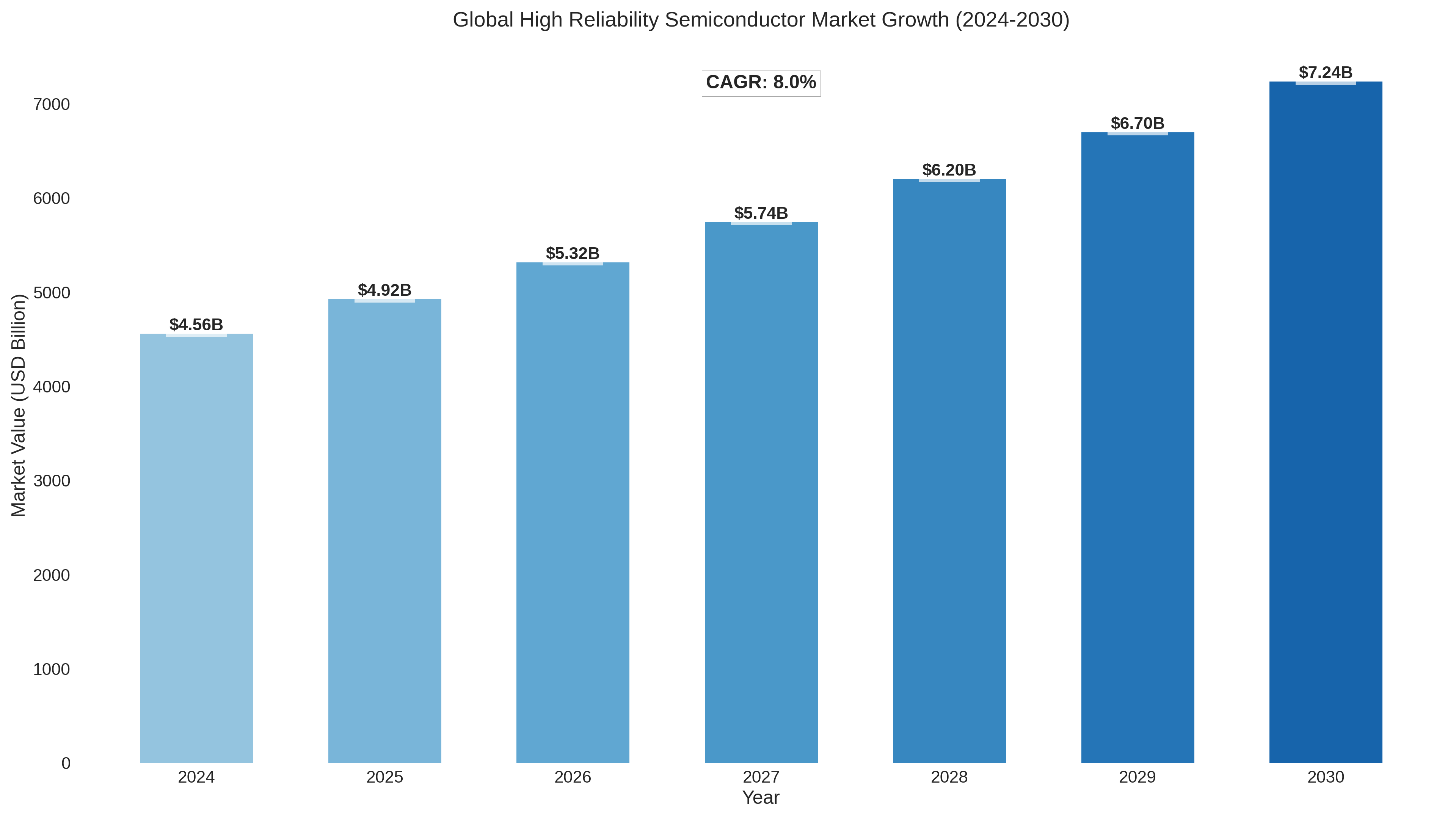
The United States High Reliability Semiconductor market size was valued at US$ 1.19 billion in 2024 and is projected to reach US$ 1.84 billion by 2030, at a CAGR of 7.5% during the forecast period 2024-2030.
Semiconductor devices engineered for mission-critical applications requiring exceptional reliability and performance under extreme conditions. These components undergo rigorous testing and qualification for aerospace, medical, and military applications.
Report Overview
High Reliability Semiconductors include Qualified Products List (QPL) and non-QPL rectifiers, transient voltage suppression (TVS) and Zener diodes in axial and surface-mount packages, as well as assemblies in catalog and custom configurations.
This report provides a deep insight into the global High Reliability Semiconductor market covering all its essential aspects. This ranges from a macro overview of the market to micro details of the market size, competitive landscape, development trend, niche market, key market drivers and challenges, SWOT analysis, value chain analysis, etc.
The analysis helps the reader to shape the competition within the industries and strategies for the competitive environment to enhance the potential profit. Furthermore, it provides a simple framework for evaluating and accessing the position of the business organization. The report structure also focuses on the competitive landscape of the Global High Reliability Semiconductor Market, this report introduces in detail the market share, market performance, product situation, operation situation, etc. of the main players, which helps the readers in the industry to identify the main competitors and deeply understand the competition pattern of the market.
In a word, this report is a must-read for industry players, investors, researchers, consultants, business strategists, and all those who have any kind of stake or are planning to foray into the High Reliability Semiconductor market in any manner.
Global High Reliability Semiconductor Market: Market Segmentation Analysis
The research report includes specific segments by region (country), manufacturers, Type, and Application. Market segmentation creates subsets of a market based on product type, end-user or application, Geographic, and other factors. By understanding the market segments, the decision-maker can leverage this targeting in the product, sales, and marketing strategies. Market segments can power your product development cycles by informing how you create product offerings for different segments.
Key Company
- Digitron Semiconductors
- Infineon Technologies
- Semtech Corporation
- Teledyne Technologies
- Microsemi
- KCB Solutions
- ROHM Group
- ICs
- DC-DC Converters
- Voltage Regulators
- Power Transistors
- Diodes
- Other
- Aerospace
- Military
- Defense
- Other
- North America (USA, Canada, Mexico)
- Europe (Germany, UK, France, Russia, Italy, Rest of Europe)
- Asia-Pacific (China, Japan, South Korea, India, Southeast Asia, Rest of Asia-Pacific)
- South America (Brazil, Argentina, Columbia, Rest of South America)
- The Middle East and Africa (Saudi Arabia, UAE, Egypt, Nigeria, South Africa, Rest of MEA)
- Industry drivers, restraints, and opportunities covered in the study
- Neutral perspective on the market performance
- Recent industry trends and developments
- Competitive landscape & strategies of key players
- Potential & niche segments and regions exhibiting promising growth covered
- Historical, current, and projected market size, in terms of value
- In-depth analysis of the High Reliability Semiconductor Market
- Overview of the regional outlook of the High Reliability Semiconductor Market:
- Access to date statistics compiled by our researchers. These provide you with historical and forecast data, which is analyzed to tell you why your market is set to change
- This enables you to anticipate market changes to remain ahead of your competitors
- You will be able to copy data from the Excel spreadsheet straight into your marketing plans, business presentations, or other strategic documents
- The concise analysis, clear graph, and table format will enable you to pinpoint the information you require quickly
- Provision of market value (USD Billion) data for each segment and sub-segment
- Indicates the region and segment that is expected to witness the fastest growth as well as to dominate the market
- Analysis by geography highlighting the consumption of the product/service in the region as well as indicating the factors that are affecting the market within each region
- Competitive landscape which incorporates the market ranking of the major players, along with new service/product launches, partnerships, business expansions, and acquisitions in the past five years of companies profiled
- Extensive company profiles comprising of company overview, company insights, product benchmarking, and SWOT analysis for the major market players
- The current as well as the future market outlook of the industry concerning recent developments which involve growth opportunities and drivers as well as challenges and restraints of both emerging as well as developed regions
- Includes in-depth analysis of the market from various perspectives through Porters five forces analysis
- Provides insight into the market through Value Chain
- Market dynamics scenario, along with growth opportunities of the market in the years to come
- 6-month post-sales analyst support
Customization of the Report
In case of any queries or customization requirements, please connect with our sales team, who will ensure that your requirements are met.
1. Drivers
- Increasing Demand for Semiconductor Components in Aerospace and Defense: One of the primary drivers of the high-reliability semiconductor market is the growing need for advanced electronic components in the aerospace and defense sectors. These industries require semiconductors that can operate in extreme conditions, such as high temperatures, radiation exposure, and electromagnetic interference. High-reliability semiconductors are designed to meet these rigorous requirements, driving demand in applications like satellite systems, military equipment, and unmanned aerial vehicles (UAVs).
- Expansion of Automotive Electronics: With the growing adoption of electric vehicles (EVs) and the increasing complexity of automotive electronics, the demand for high-reliability semiconductors has surged. Automotive systems such as advanced driver-assistance systems (ADAS), powertrains, battery management systems, and autonomous driving features require highly reliable and durable semiconductor components. As automakers integrate more electronics into their vehicles for safety, efficiency, and connectivity, high-reliability semiconductors become critical for ensuring the longevity and performance of these systems under harsh automotive environments.
- Growth of Industrial Automation and IoT: The rise of Industry 4.0 and the increasing penetration of Internet of Things (IoT) devices across industries are fueling the demand for high-reliability semiconductors. Automated manufacturing processes, robotics, and smart infrastructure require components that can deliver high performance and remain functional over extended periods of use, even in demanding industrial settings. This has created a strong demand for semiconductors that are not only reliable but also capable of functioning in high-stress environments.
- Technological Advancements in Semiconductor Manufacturing: The development of more advanced semiconductor technologies has led to the creation of high-reliability semiconductors that offer superior performance. With advancements in materials, packaging techniques, and manufacturing processes, semiconductor companies can produce components that are more robust and reliable. These innovations allow for the creation of semiconductors that meet the needs of industries requiring high reliability, contributing to market growth.
- Rise in Renewable Energy and Power Management Systems: The increasing focus on renewable energy sources such as solar and wind power, along with the growing need for efficient power management, is driving the demand for high-reliability semiconductors. Components used in power conversion systems, grid management, and energy storage systems must meet stringent reliability standards to ensure uninterrupted operation over long periods. High-reliability semiconductors play a crucial role in ensuring the stability and efficiency of these systems, boosting their adoption across energy sectors.
2. Restraints
- High Manufacturing Costs: One of the key challenges facing the high-reliability semiconductor market is the high cost of manufacturing these components. The production of high-reliability semiconductors often involves specialized materials, more stringent testing protocols, and enhanced packaging techniques to ensure durability and performance under extreme conditions. These additional manufacturing costs can make high-reliability semiconductors more expensive than standard semiconductors, limiting their widespread adoption, particularly in cost-sensitive applications.
- Complex Qualification and Certification Processes: High-reliability semiconductors must undergo rigorous qualification and certification processes to ensure they meet the reliability standards required for critical applications. These processes are time-consuming and costly, which can delay product launches and increase the overall development cycle. The complexity of these certification processes, particularly in highly regulated industries like aerospace and medical devices, can act as a barrier to entry for smaller players in the market.
- Technological Limitations and Integration Challenges: While high-reliability semiconductors are essential for critical applications, integrating them into existing systems can be challenging. Compatibility with legacy systems, as well as the technological limitations of older infrastructure, can create integration difficulties. Additionally, the rapid pace of technological advancement means that companies need to continuously update their semiconductor designs to maintain reliability and performance, which adds complexity to product development and system integration.
- Supply Chain Issues and Material Shortages: The semiconductor industry has faced significant supply chain disruptions in recent years, exacerbated by factors like geopolitical tensions, the COVID-19 pandemic, and raw material shortages. High-reliability semiconductors require specific materials that may not be as readily available as those used in standard semiconductors, making the supply chain more vulnerable to interruptions. These challenges can result in delays, price increases, and difficulty in meeting market demand.
3. Opportunities
- Growing Demand for Autonomous Vehicles and Electric Cars: The automotive industry’s shift toward electric vehicles (EVs) and autonomous driving technology represents a significant opportunity for the high-reliability semiconductor market. EVs require reliable and durable semiconductors for critical systems such as power management, charging infrastructure, and battery control. Similarly, autonomous vehicles depend on high-reliability semiconductors for safety systems, sensor processing, and real-time data analysis. As these markets continue to expand, the demand for high-reliability semiconductors will grow in tandem.
- Advancements in 5G Networks and Communication Systems: The rollout of 5G networks is expected to create numerous opportunities for the high-reliability semiconductor market. The infrastructure required to support 5G communication, including base stations, antennas, and data centers, relies heavily on semiconductors that can operate reliably over long periods and in harsh environmental conditions. As the adoption of 5G accelerates worldwide, there will be a growing need for high-reliability semiconductors to support these systems.
- Expanding Use in Medical Devices and Healthcare: High-reliability semiconductors are gaining traction in the medical device market, where the demand for precision, durability, and long-term performance is critical. Applications in medical imaging systems, patient monitoring, diagnostic equipment, and surgical robots require semiconductors that can operate reliably in sensitive environments. The growth of telemedicine, remote monitoring, and advanced medical devices provides ample opportunities for high-reliability semiconductor manufacturers to expand their market presence.
- Emerging Opportunities in Space and Satellite Technologies: Space exploration and satellite communication systems require semiconductors that can withstand extreme temperatures, radiation, and other harsh conditions. As the space industry continues to grow, particularly with the increasing number of private companies involved in space exploration and satellite deployment, there is a significant opportunity for high-reliability semiconductors to support these applications.
- Expansion in Renewable Energy and Smart Grids: The transition to renewable energy sources and the growing adoption of smart grid technologies present additional opportunities for high-reliability semiconductors. These technologies require reliable and durable semiconductors for power conversion, energy storage, and grid management systems. As the demand for renewable energy and energy efficiency grows, so too will the need for high-reliability semiconductors to support these innovations.
4. Challenges
- Intense Competition in the Semiconductor Industry: The high-reliability semiconductor market faces significant competition, both from established players and new entrants. As semiconductor technology advances, the market is becoming increasingly crowded, with numerous companies vying for market share. Competing on factors like cost, performance, and reliability will be key to gaining a competitive advantage. Price pressure from low-cost alternatives and alternative technologies could pose challenges for companies in the high-reliability segment.
- Evolving Regulatory Requirements: Industries that rely on high-reliability semiconductors, such as aerospace, defense, and healthcare, are subject to strict regulatory requirements that can change over time. Companies must continuously monitor and adapt to evolving regulations to remain compliant. This regulatory complexity can increase costs, slow product development, and add to the challenges faced by semiconductor manufacturers.
- Sustainability Concerns and Environmental Impact: As with many other sectors, the semiconductor industry is facing increasing pressure to reduce its environmental impact. High-reliability semiconductors, in particular, may involve materials and manufacturing processes that raise sustainability concerns. The industry is being urged to adopt more environmentally friendly practices, which may require significant investments in new technologies, production methods, and materials.

Get Sample Report PDF for Exclusive Insights
Report Sample Includes
- Table of Contents
- List of Tables & Figures
- Charts, Research Methodology, and more...
 Download Sample Report PDF





