MARKET INSIGHTS
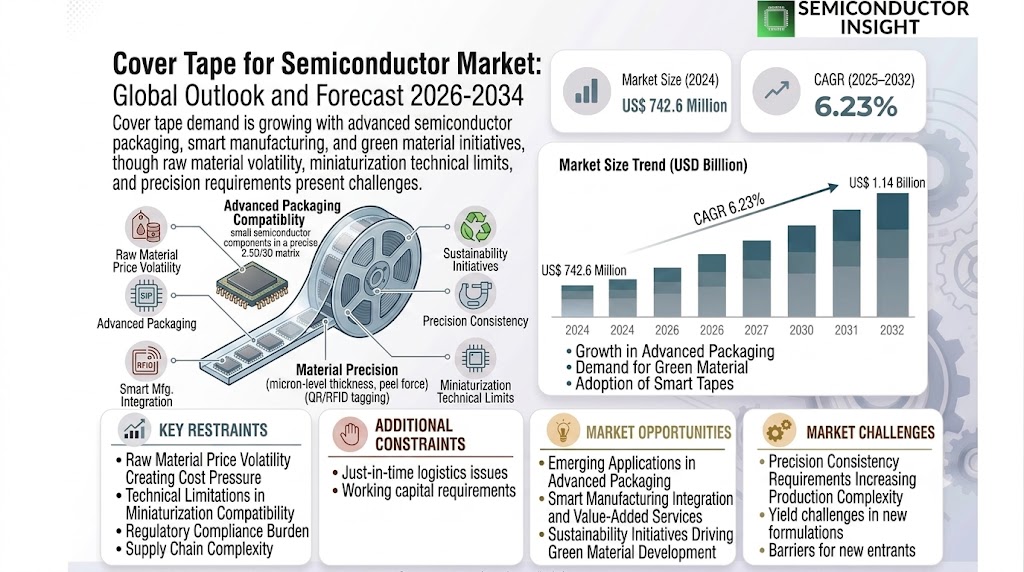
The global Cover Tape for Semiconductor Market size was valued at US$ 742.6 million in 2024 and is projected to reach US$ 1.14 billion by 2032, at a CAGR of 6.23% during the forecast period 2025-2032. The Asia-Pacific region dominated the market with over 68% revenue share in 2023, driven by concentrated semiconductor manufacturing activities in China, Taiwan, South Korea, and Japan.
Cover tapes are specialized packaging materials designed to protect semiconductor components and passive devices during Surface-Mount Technology (SMT) processes. These tapes serve critical functions including anti-static protection (ESD shielding), component retention, and contamination prevention during automated handling. The market offers two primary variants: heat-activated tapes that bond through thermal processing and pressure-sensitive tapes utilizing adhesive technologies.
Market growth is propelled by the semiconductor industry’s expansion, particularly in advanced packaging applications like fan-out wafer-level packaging (FO-WLP) and 3D IC stacking. However, material innovation faces challenges due to stringent requirements for high-temperature resistance (up to 300°C) and ultra-low outgassing properties. Leading manufacturers like 3M and Shin-Etsu are investing in nanotechnology-enhanced tapes to address emerging packaging demands, while regional players focus on cost-competitive solutions for mainstream applications.
MARKET DYNAMICS
MARKET DRIVERS
Rising Semiconductor Production to Fuel Cover Tape Demand
The global semiconductor industry is experiencing unprecedented growth, with production volumes increasing by over 15% annually since 2021. This rapid expansion directly correlates with higher demand for protective packaging solutions like cover tapes. As semiconductor manufacturers scale up operations to meet the needs of 5G deployment, IoT adoption, and artificial intelligence applications, the requirement for reliable SMD/SMT process materials becomes critical. Cover tapes play an essential role in preventing component damage during transport and automated placement, making them indispensable in modern electronics manufacturing ecosystems.
Advancements in ESD Protection Technologies Driving Innovation
Electrostatic discharge (ESD) protection has become a top priority in semiconductor packaging, with losses from ESD damage estimated at billions annually. Modern cover tapes incorporate advanced anti-static properties that meet stringent ANSI/ESD S20.20 standards, protecting sensitive components throughout the supply chain. The shift toward smaller semiconductor geometries below 7nm has intensified the need for superior ESD safeguards, prompting manufacturers to develop next-generation cover tapes with enhanced conductive layers and discharge mechanisms. This technological evolution is creating new market opportunities while raising performance benchmarks across the industry.
Automation in Electronics Manufacturing Accelerating Adoption
As surface-mount technology (SMT) lines achieve faster placement speeds exceeding 100,000 components per hour, the precision requirements for carrier tapes and cover tapes have intensified significantly. Modern high-speed pick-and-place machines demand packaging materials that offer flawless peel consistency and dimensional stability. This has driven cover tape manufacturers to invest heavily in polymer science innovations, developing products with precisely calibrated tack levels that maintain reliability across varying temperature and humidity conditions. The automation boom in Asia-Pacific electronics hubs particularly underscores this demand driver.
➤ Leading manufacturers have reported 30-40% increases in cover tape orders from automotive electronics suppliers as vehicle electrification accelerates globally.
MARKET RESTRAINTS
Raw Material Price Volatility Creating Cost Pressure
The cover tape manufacturing process relies heavily on specialized polymers and adhesives, with raw material costs constituting approximately 60-70% of total production expenses. Recent fluctuations in petrochemical pricing, coupled with supply chain disruptions affecting polymer availability, have squeezed manufacturer margins significantly. Some premium anti-static formulations require rare conductive materials that have seen price increases exceeding 25% in the past year alone. This cost pressure comes at a time when electronics manufacturers are demanding lower prices due to their own margin challenges, creating a difficult negotiation landscape for cover tape suppliers.
Technical Limitations in Miniaturization Compatibility
As semiconductor packaging evolves toward smaller 01005 (0.4 x 0.2mm) and even 008004 components, traditional cover tape designs face physical limitations in maintaining reliable sealing and peel performance. The ultra-small components require correspondingly narrow carrier tapes that push the boundaries of existing material science. Some manufacturers report reject rates up to 15% when attempting to adapt conventional cover tapes to these emerging micro-component formats. This technical challenge is particularly acute for heat-activated tapes, where precise temperature control becomes increasingly difficult at miniature scales.
Additional Constraints
Regulatory Compliance Burden
The semiconductor industry’s growing emphasis on halogen-free and environmentally sustainable packaging materials has forced cover tape manufacturers to reformulate many products. Meeting multiple regional environmental regulations while maintaining performance standards requires substantial R&D investment that smaller players struggle to afford.
Supply Chain Complexity
Just-in-time delivery expectations combined with globalized production networks create logistical challenges for cover tape distribution. The need to maintain inventory across multiple regional hubs ties up working capital and increases operational costs.
MARKET OPPORTUNITIES
Emerging Applications in Advanced Packaging Creating New Demand
The semiconductor industry’s shift toward advanced packaging architectures like 2.5D and 3D IC integration presents significant opportunities for cover tape innovation. These next-generation packaging approaches require specialized handling solutions that protect delicate interconnects and through-silicon vias during transport and assembly. Early adopters developing tapes specifically for chiplet-based designs are capturing premium pricing in this nascent market segment. The advanced packaging market is projected to maintain 20%+ annual growth through 2025, creating substantial adjacent opportunities for specialized cover tape applications.
Smart Manufacturing Integration Enabling Value-Added Services
The Industry 4.0 transformation in electronics manufacturing enables cover tape suppliers to differentiate through data integration capabilities. Embedding QR codes or RFID tags in tape materials allows for full traceability through the production chain while providing valuable process analytics. Several leading manufacturers have begun offering these intelligent tape systems as part of comprehensive smart factory solutions, creating new revenue streams beyond basic material supply. This trend aligns perfectly with the semiconductor industry’s digital transformation priorities.
Sustainability Initiatives Driving Green Material Development
Growing environmental consciousness among major electronics brands is spurring demand for recyclable and biodegradable cover tape solutions. While traditional cover tapes were considered single-use industrial waste, new bio-based polymer formulations now allow for closed-loop material recovery. Several manufacturers have secured coveted eco-certifications for these sustainable alternatives, commanding 15-20% price premiums in environmentally sensitive markets. The circular economy movement presents particularly strong opportunities in European and North American markets where ESG compliance is becoming a procurement priority.
MARKET CHALLENGES
Precision Consistency Requirements Increasing Production Complexity
Modern SMT lines demand cover tapes with micron-level thickness consistency and peel force tolerances within ±5% of specifications across entire production runs. Achieving this level of precision requires sophisticated extrusion and coating equipment that represents substantial capital investment. Many manufacturers report yield challenges when scaling up new formulations, with initial production batches often failing to meet the exacting standards of tier-1 electronics producers. The compounding effect of tighter tolerances across multiple performance parameters creates formidable technical barriers for market entrants.
Regional Capacity Imbalances Creating Supply/Demand Mismatches
While semiconductor production has concentrated in Asia-Pacific regions covering Taiwan, South Korea and China, cover tape manufacturing remains more geographically dispersed. This imbalance creates logistical challenges, as just-in-time delivery expectations clash with longer international shipping timelines. Some Asian semiconductor fabs maintain 60-90 days of cover tape inventory to mitigate supply risks, absorbing working capital that could otherwise fund production expansion. The situation is particularly acute for specialized tapes required for automotive-grade components, where qualification cycles limit supplier flexibility.
Competitive Pressures
The market has seen increasing price competition as Chinese domestic manufacturers achieve quality parity with international suppliers at 20-30% lower price points. This has forced global players to accelerate operational efficiency initiatives while simultaneously investing in higher-margin specialty products.
COVER TAPE FOR SEMICONDUCTOR MARKET TRENDS
Increasing Demand for Miniaturized Electronics Accelerates Market Growth
The global cover tape for semiconductor market is experiencing robust growth due to the rising demand for miniaturized electronic components and the continuous expansion of surface-mount technology (SMT) applications. As semiconductors and passive components shrink in size to meet the needs of IoT devices, wearables, and 5G infrastructure, the precision requirements for packaging materials like cover tapes have intensified. With the semiconductor industry projected to grow at a CAGR of over 6% through 2028, component manufacturers are increasingly adopting high-performance cover tapes that offer superior ESD protection and heat resistance while maintaining ultra-thin profiles.
Other Trends
Material Innovation for Advanced Protection
Leading manufacturers are developing next-generation polymer composites with enhanced thermal and electrical properties to meet evolving industry standards. Recent breakthroughs include thermally-conductive cover tapes that dissipate heat during reflow soldering processes, reducing component failures. The development of anti-static materials with surface resistivity below 10^9 ohms/sq has become particularly crucial for high-frequency applications in automotive electronics and telecommunications equipment. This innovation wave is driving premiumization in the market, with high-specification tapes now commanding 15-20% price premiums over conventional alternatives.
Geographic Shifts in Semiconductor Manufacturing
The relocation of semiconductor production to Southeast Asia is reshaping regional demand patterns for cover tapes. With over 60% of global semiconductor packaging now concentrated in China, Taiwan, and South Korea, local tape suppliers are expanding production capacities to meet Just-In-Time delivery requirements. Meanwhile, North American and European manufacturers are focusing on specialty tapes for defense and aerospace applications, creating parallel demand streams. This geographic diversification is prompting global players to establish regional technical support centers, with 3M and Shin-Etsu recently inaugurating application labs in Singapore and Penang to serve key fabrication clusters.
COMPETITIVE LANDSCAPE
Key Industry Players
Market Leaders Focus on Product Innovation and Geographic Expansion
The global cover tape for semiconductor market features a moderately consolidated competitive landscape, with multinational corporations dominating alongside regional specialists. 3M emerges as a frontrunner, leveraging its diversified industrial portfolio and strong distribution network across North America and Asia-Pacific. The company’s leadership stems from its continuous R&D investments in advanced anti-static solutions tailored for semiconductor packaging.
Japanese giant Shin-Etsu maintains significant market share through its proprietary polymer technologies, particularly in heat-activated tapes for high-temperature applications. Meanwhile, Advantek and ZheJiang Jiemei have carved substantial niches by offering cost-competitive pressure-sensitive solutions that cater to passive component manufacturers.
Recent industry movements highlight strategic expansions – Furukawa Electric Group augmented its production capacity by 30% in 2023 to meet growing demand from Southeast Asian semiconductor hubs. Similarly, Asahi Kasei launched a new ESD-protective tape series last quarter, specifically designed for next-generation chip packaging processes.
The mid-market segment remains dynamic, with players like Lasertek and U-PAK differentiating through customized tape solutions. These companies are increasingly forming technology partnerships with semiconductor packaging firms to develop application-specific products, thereby boosting their competitive positioning.
List of Key Cover Tape Manufacturers Profiled
- 3M (U.S.)
- Shin-Etsu (Japan)
- ZheJiang Jiemei (China)
- Advantek (U.S.)
- Lasertek (Taiwan)
- U-PAK (China)
- ROTHE (Germany)
- C-Pak (South Korea)
- Accu Tech Plastics (U.S.)
- Asahi Kasei (Japan)
- ACTECH (U.S.)
- Advanced Component Taping (U.K.)
- Furukawa Electric Group (Japan)
Segment Analysis:
By Type
Heat Activated Type Dominates Market Share Due to Superior Adhesion Properties in SMD/SMT Processes
The market is segmented based on type into:
- Heat Activated Type
- Pressure Sensitive Type
By Application
Semiconductor (IC) Segment Leads Market Demand Owing to Increased Chip Production Worldwide
The market is segmented based on application into:
- Semiconductor (IC)
- Passive Components
By Material Composition
Polyester-Based Cover Tapes Maintain Market Dominance for Their Durability and ESD Protection
The market is segmented based on material composition into:
- Polyester-based
- Polypropylene-based
- Polyethylene-based
By End-User Industry
Consumer Electronics Sector Accounts for Largest Share Due to High Demand for Smart Devices
The market is segmented based on end-user industry into:
- Consumer Electronics
- Automotive
- Telecommunications
- Industrial
- Medical
Regional Analysis: Global Cover Tape for Semiconductor Market
North America
The North American market for semiconductor cover tapes is driven by high-tech manufacturing demand and stringent ESD (electrostatic discharge) protection standards. The U.S. and Canada, with robust semiconductor fabrication and packaging industries, prioritize anti-static cover tapes for SMD/SMT processes. The push for miniaturization in electronics and advancements in 5G and IoT technologies further stimulate demand. Key players like 3M and Advantek dominate due to their R&D investments in heat-activated and pressure-sensitive tapes. However, fluctuating raw material costs and supply chain constraints pose challenges, albeit mitigated by localized production strategies.
Europe
Europe’s market thrives on strict EU regulations governing static-sensitive component packaging, emphasizing sustainability and recyclability. Germany and the UK lead in adopting high-performance cover tapes, supported by thriving automotive and industrial electronics sectors. The shift toward electric vehicles (EVs) has amplified demand for passive component packaging solutions. Shin-Etsu and ROTHE are prominent suppliers, leveraging partnerships with semiconductor foundries. Yet, slower adoption in Eastern Europe—due to cost sensitivity—hinders region-wide growth, though innovation in low-cost, eco-friendly tapes is bridging this gap.
Asia-Pacific
As the largest and fastest-growing market, Asia-Pacific accounts for over 60% of global semiconductor production, fueled by China, Japan, and South Korea. ZheJiang Jiemei and Furukawa Electric Group capitalize on dense manufacturing hubs like Taiwan’s TSMC and South Korea’s Samsung. The proliferation of consumer electronics and EVs drives demand for heat-activated tapes, while India’s budding semiconductor ecosystem presents untapped potential. However, price volatility and competition from local manufacturers intensify market fragmentation, necessitating differentiation through customized tape solutions.
South America
South America’s market remains nascent but promising, with Brazil and Argentina gradually expanding semiconductor assembly operations. Limited domestic production forces reliance on imports, creating opportunities for global players like Asahi Kasei and U-PAK. Economic instability and low industrialization delay large-scale adoption, though initiatives to boost electronics manufacturing—such as Brazil’s tax incentives for tech sectors—are accelerating demand. Pressure-sensitive tapes dominate due to ease of use, but growth hinges on stabilizing supply chains and FDI inflows.
Middle East & Africa
The MEA region shows modest growth, with the UAE and Saudi Arabia investing in diversification beyond oil into tech infrastructure. While semiconductor fabrication is limited, re-export activities and assembly plants in free zones drive cover tape demand. Lasertek and C-Pak are emerging suppliers, though market penetration faces hurdles like low regulatory oversight and fragmented distribution networks. Long-term prospects are tied to smart city projects and regional partnerships to localize electronics production.
Report Scope
This market research report provides a comprehensive analysis of the Global and regional Cover Tape for Semiconductor markets, covering the forecast period 2025–2032. It offers detailed insights into market dynamics, technological advancements, competitive landscape, and key trends shaping the industry.
Key focus areas of the report include:
- Market Size & Forecast: Historical data and future projections for revenue, unit shipments, and market value across major regions and segments.
- Segmentation Analysis: Detailed breakdown by product type (Heat Activated vs Pressure Sensitive), application (Semiconductor ICs vs Passive Components), and end-user industry.
- Regional Outlook: Insights into market performance across North America, Europe, Asia-Pacific, Latin America, and the Middle East & Africa, with emphasis on semiconductor manufacturing hubs.
- Competitive Landscape: Profiles of 16 key market participants including 3M, Shin-Etsu, and Furukawa Electric Group, covering their product portfolios and strategic developments.
- Technology Trends: Analysis of anti-static solutions, ESD protection advancements, and innovations in SMD/SMT packaging technologies.
- Market Drivers & Restraints: Evaluation of semiconductor industry growth, miniaturization trends, and raw material supply challenges.
- Stakeholder Analysis: Strategic insights for semiconductor manufacturers, packaging specialists, and investors in the electronics supply chain.
The research employs a rigorous methodology combining primary interviews with industry leaders and analysis of verified market data from semiconductor industry associations and financial reports.
FREQUENTLY ASKED QUESTIONS:
What is the current market size of Global Cover Tape for Semiconductor Market?
-> Cover Tape for Semiconductor Market size was valued at US$ 742.6 million in 2024 and is projected to reach US$ 1.14 billion by 2032, at a CAGR of 6.23% during the forecast period 2025-2032.
Which key companies operate in Global Cover Tape for Semiconductor Market?
-> Market leaders include 3M, Shin-Etsu, Furukawa Electric Group, Asahi Kasei, and ZheJiang Jiemei, which collectively hold over 65% market share.
What are the key growth drivers?
-> Primary drivers include rising semiconductor production, increasing adoption of SMT technology, and growing demand for advanced packaging solutions in electronics manufacturing.
Which region dominates the market?
-> Asia-Pacific accounts for 72% of global demand, driven by semiconductor manufacturing in China, Taiwan, South Korea, and Japan.
What are the emerging trends?
-> Emerging trends include development of ultra-thin cover tapes, integration of smart tracking features, and sustainable material innovations to meet ESG requirements.
Get Sample Report PDF for Exclusive Insights
Report Sample Includes
- Table of Contents
- List of Tables & Figures
- Charts, Research Methodology, and more...