Automotive Tandem OLED Display Market Insights
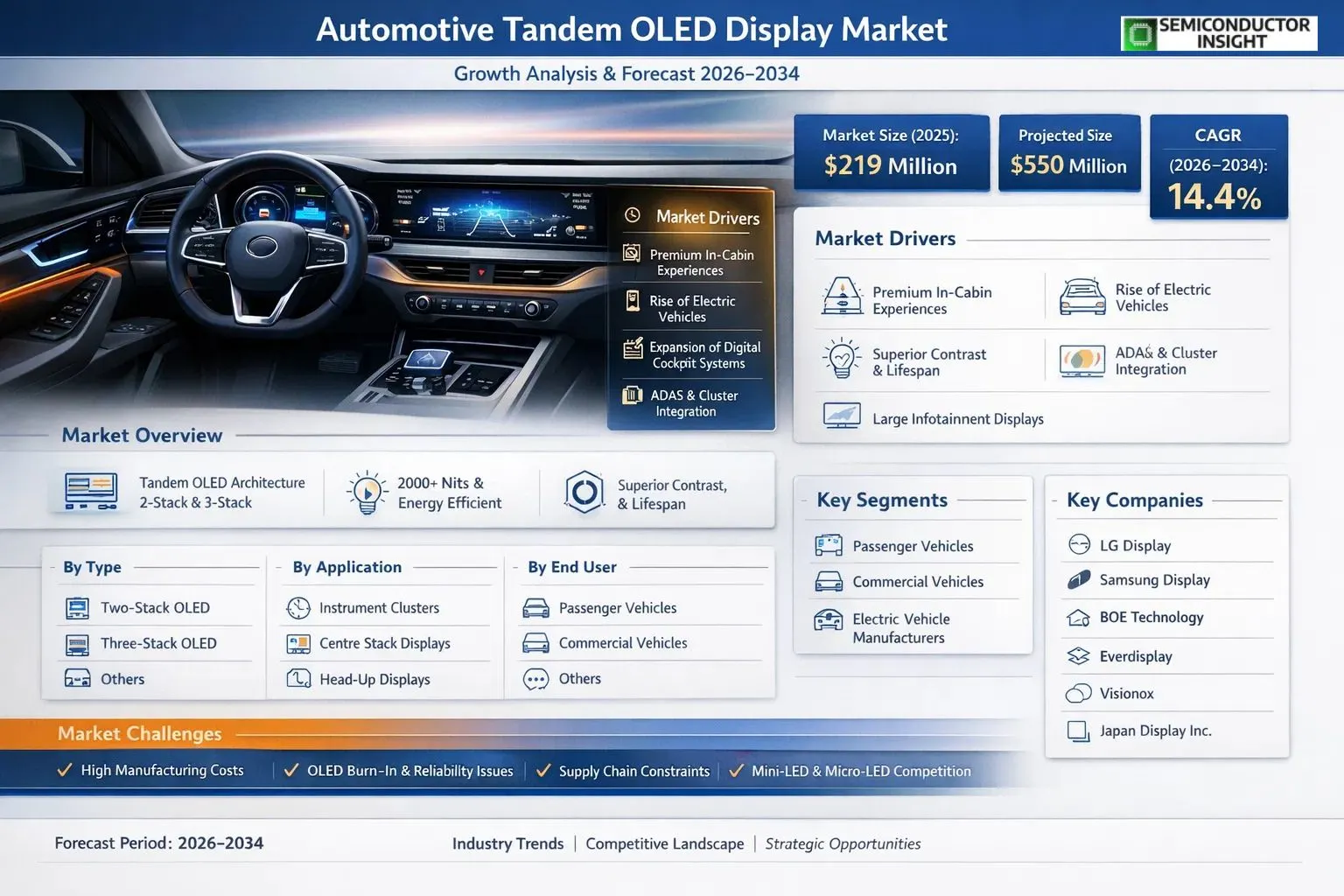
Global Automotive Tandem OLED Display market size was valued at USD 219 million in 2025. The market is projected to grow from USD 249 million in 2026 to USD 550 million by 2034, exhibiting a CAGR of 14.4% during the forecast period.
Tandem OLED displays are a type of OLED technology where multiple layers of organic material are stacked to improve performance, particularly in terms of brightness, efficiency, and lifespan. The stacking of multiple OLED layers allows for enhanced control over light emission and overall display characteristics, making them especially well-suited for demanding automotive environments where durability and visual clarity are critical requirements. These displays are categorized into Two-Stack Tandem OLED, Three-Stack Tandem OLED, and other advanced configurations, each offering distinct performance advantages depending on the application.
The market is witnessing strong momentum driven by the rapid adoption of advanced in-vehicle display systems, growing consumer demand for premium digital cockpit experiences, and the accelerating shift toward electric and connected vehicles globally. Furthermore, increasing integration of large-format infotainment and instrument cluster displays in both passenger and commercial vehicles is significantly expanding the addressable market. Key manufacturers actively shaping the competitive landscape include LG, Samsung, BOE, Everdisplay, and Visionox, among others, all of whom are investing heavily in next-generation tandem OLED panel development tailored specifically for automotive-grade applications.
MARKET DRIVERS
Rising Demand for Premium In-Cabin Display Experiences
The Automotive Tandem OLED Display Market is experiencing accelerated growth driven by the automotive industry’s rapid shift toward digitalized cockpit environments. Original equipment manufacturers (OEMs) are increasingly integrating high-brightness, energy-efficient display technologies to meet evolving consumer expectations for immersive in-vehicle experiences. Tandem OLED technology, which stacks multiple emissive layers to dramatically boost luminance output, is gaining traction as a superior alternative to conventional single-stack OLED and LCD panels in automotive applications. The ability to achieve peak brightness levels exceeding 2,000 nits while maintaining excellent contrast ratios and wide color gamuts makes tandem OLED panels especially suited for cockpit displays exposed to high ambient light conditions.
Growth of Electric Vehicles and Next-Generation Infotainment Systems
The global transition toward electric vehicles (EVs) is serving as a significant catalyst for the automotive tandem OLED display segment. EV platforms, unburdened by traditional internal combustion engine architectures, afford designers greater flexibility in integrating expansive, curved, and multi-panel display configurations throughout the cabin. Leading EV manufacturers are deploying large-format displays as central interface elements, and tandem OLED’s combination of thin form factor, flexibility, and superior image quality positions it as a preferred technology for these next-generation infotainment and driver information systems. Investment in software-defined vehicle platforms further amplifies the need for high-performance displays capable of rendering complex graphical interfaces with precision.
➤ Tandem OLED panels offer approximately twice the brightness of conventional single-stack OLED displays at comparable power consumption levels, a critical performance advantage for automotive daylight-readable applications.
Regulatory momentum toward enhanced driver assistance systems (ADAS) and digital instrument clusters is also reinforcing market expansion. As automotive safety standards evolve globally, the demand for high-resolution, reliable, and sunlight-readable display panels continues to rise. The automotive tandem OLED display market stands to benefit substantially from these regulatory and technology convergence trends, with tier-1 display suppliers scaling up production capacity to serve growing OEM demand across luxury, premium, and increasingly mainstream vehicle segments.
MARKET CHALLENGES
High Manufacturing Complexity and Cost Barriers in Automotive Tandem OLED Production
Despite its compelling performance attributes, the automotive tandem OLED display market faces substantial challenges rooted in manufacturing complexity. The tandem architecture requires precise deposition of multiple organic emissive layers with charge generation layers (CGLs) in between, significantly increasing process complexity compared to single-stack OLED manufacturing. This added complexity translates into higher capital expenditure requirements for production facilities and more stringent yield management protocols. As a result, per-unit display costs remain notably elevated relative to established LCD and conventional OLED alternatives, constraining adoption primarily to luxury and high-end vehicle segments and slowing penetration into volume mainstream automotive production.
Other Challenges
Long-Term Reliability and Burn-In Concerns
Automotive-grade displays must meet demanding reliability standards, including extended operational lifespans, wide temperature range performance, and resistance to vibration and humidity. While tandem OLED technology demonstrably extends panel lifetime compared to single-stack OLED by distributing luminance load across multiple emissive units, residual concerns regarding differential aging and image retention in static-heavy automotive UI environments remain a challenge. Display suppliers and OEMs are investing significantly in accelerated aging protocols and pixel refresh algorithms to address these durability requirements within the automotive tandem OLED display ecosystem.
Supply Chain Concentration and Material Availability
The production of tandem OLED panels relies on a concentrated supply chain for specialized organic materials, encapsulation films, and precision deposition equipment. Geographic concentration of key suppliers and limited alternative sourcing options introduce supply chain vulnerability. Disruptions , whether from geopolitical factors, raw material shortages, or equipment lead time extensions , can materially impact the ability of display manufacturers to scale production in alignment with growing automotive customer demand.
MARKET RESTRAINTS
Premium Cost Structure Limiting Mass Market Penetration
One of the most significant restraints facing the automotive tandem OLED display market is the persistently elevated cost structure associated with tandem OLED panel manufacturing. The multi-layer deposition process demands specialized vacuum deposition equipment, ultra-high-purity organic materials, and advanced encapsulation technologies, all of which contribute to a cost base that remains considerably higher than competing display technologies. For cost-sensitive mainstream vehicle programs, this pricing differential presents a formidable barrier to adoption, and OEMs in volume segments continue to favor large-format LCD or standard OLED solutions where total display system costs are a critical purchasing criterion.
Competition from Emerging Display Technologies
The automotive tandem OLED display market also contends with intensifying competition from alternative advanced display technologies, including mini-LED LCD, micro-LED, and next-generation quantum dot displays. Mini-LED backlit LCD panels have made significant strides in brightness, contrast, and cost-efficiency, offering a credible value proposition for automotive infotainment applications without the manufacturing complexities inherent to OLED. Meanwhile, micro-LED technology, though currently at an earlier commercialization stage, promises superior brightness and longevity that could challenge tandem OLED’s competitive positioning in premium automotive segments over the medium to long term. The pace of advancement across competing technologies creates an environment of continuous competitive pressure on tandem OLED suppliers to demonstrate sustained differentiation.
MARKET OPPORTUNITIES
Expansion of Curved and Pillar-to-Pillar Display Architectures in Luxury Vehicles
Significant market opportunities exist for the automotive tandem OLED display market within the growing segment of curved, flexible, and pillar-to-pillar display architectures being adopted in luxury and ultra-premium vehicles. Tandem OLED’s inherent flexibility as a thin-film emissive technology enables the realization of flowing, seamlessly integrated display surfaces that conform to complex cabin geometries , a design objective increasingly prioritized by prestige OEMs. As luxury automakers pursue differentiated interior experiences as a core brand attribute, the ability of tandem OLED panels to deliver both outstanding visual performance and design freedom positions this technology favorably for expanded penetration in high-value vehicle programs globally.
Autonomous and Semi-Autonomous Vehicle Development Creating New Display Real Estate
The progressive development of autonomous and semi-autonomous vehicle platforms presents a transformative opportunity for the automotive tandem OLED display market. As driving automation levels advance, the functional role of in-cabin displays is expected to expand substantially , evolving from driver-centric information delivery toward occupant-facing entertainment, productivity, and communication interfaces. This paradigm shift will drive demand for multiple high-quality display panels per vehicle, increased total display area per cabin, and enhanced image quality requirements across all seating positions. Tandem OLED’s combination of high brightness, wide viewing angles, thin profile, and design flexibility positions it as a compelling technology to capture this emerging and rapidly growing application space within the future automotive display ecosystem.
MAIN TITLE HERE () Trends
Rising Demand for High-Performance In-Vehicle Displays Accelerates Tandem OLED Adoption
The automotive display landscape is undergoing a significant transformation, with tandem OLED technology emerging as a preferred solution for next-generation vehicle interiors. Unlike conventional single-layer OLED panels, tandem OLED displays stack multiple organic emitting layers, delivering superior brightness, extended operational lifespan, and improved energy efficiency , qualities that are increasingly essential for automotive-grade applications. As automakers intensify their focus on premium cabin experiences, the automotive tandem OLED display market is witnessing accelerating uptake across both passenger and commercial vehicle segments. The technology’s ability to perform consistently under wide temperature ranges and high ambient light conditions makes it particularly well-suited to the demanding requirements of automotive environments.
Other Trends
Shift Toward Multi-Stack Architectures in OEM Specifications
A prominent trend shaping the automotive tandem OLED display market is the growing preference among original equipment manufacturers for two-stack and three-stack tandem configurations. Two-stack tandem OLED panels are gaining traction for central information displays and instrument clusters, while three-stack variants are being evaluated for applications requiring even higher luminance levels. Leading display manufacturers including LG, Samsung, BOE, Visionox, and Everdisplay are actively scaling production capabilities to meet evolving OEM specifications that prioritize longevity and consistent brightness retention over the vehicle’s lifetime.
Asia-Pacific as the Dominant Production and Consumption Hub
Asia-Pacific, led by China, Japan, and South Korea, continues to dominate both the production and deployment of automotive tandem OLED displays. Chinese panel makers are aggressively investing in tandem OLED manufacturing lines to reduce dependence on Korean suppliers, while Japanese and Korean firms retain a competitive edge through advanced process know-how. This regional dynamic is fostering intensified competition and driving incremental improvements in panel yield rates and cost efficiency, both of which are critical to broader market penetration.
Integration with Advanced Driver-Assistance and Cockpit Digitalization Trends
The broader shift toward software-defined vehicles and fully digitalized cockpits is serving as a key structural driver for the automotive tandem OLED display market. Automakers are consolidating multiple traditional analog controls into expansive, curved, or flexible display surfaces , a design direction that aligns naturally with the form-factor flexibility of OLED technology. Furthermore, as advanced driver-assistance systems demand high-contrast, low-latency visual feedback interfaces, tandem OLED’s fast response times and deep black levels present a compelling advantage. North America and Europe are emerging as significant demand centers alongside Asia, as premium vehicle penetration rises and regulatory frameworks increasingly support digital cockpit standardization across model lines.
COMPETITIVE LANDSCAPE
Key Industry Players
Automotive Tandem OLED Display Market – Competitive Dynamics, Leading Innovators, and Strategic Positioning
Automotive Tandem OLED Display market, valued at approximately USD 219 million in 2025 and projected to reach USD 550 million by 2034 at a CAGR of 14.4%, is characterized by a highly concentrated competitive environment dominated by a handful of technologically advanced display manufacturers. LG Display and Samsung Display stand at the forefront of this market, leveraging decades of OLED R&D investment and robust automotive-grade manufacturing capabilities. LG Display, in particular, has been a pioneering force in automotive OLED adoption, supplying tandem OLED panels to several premium automakers with solutions offering superior brightness, extended operational lifespan, and enhanced energy efficiency , attributes critical to in-vehicle cockpit displays. Samsung Display complements this leadership with its proprietary tandem stacking architectures, targeting both passenger vehicles and next-generation EV instrument clusters. Together, these two South Korean giants accounted for a significant share of the top five players’ combined global revenue in 2025, reinforcing their status as the primary architects of market standards in tandem OLED panel technology for automotive applications.
Beyond the dominant South Korean players, China-based manufacturers such as BOE Technology Group, Everdisplay Optronics, and Visionox have emerged as formidable competitors, aggressively scaling their tandem OLED production capacity and forging partnerships with domestic and international automakers. BOE, the world’s largest display panel manufacturer by shipment volume, has made substantial inroads into the automotive segment through investments in flexible and rigid tandem OLED lines tailored for dashboard and center console applications. Visionox and Everdisplay, though smaller in scale, are actively differentiating through competitive pricing strategies and localized supply chain advantages, particularly targeting the fast-growing Chinese automotive OEM ecosystem. Meanwhile, Japanese firms such as Japan Display Inc. (JDI) and specialty OLED technology enablers continue to explore niche opportunities in Three-Stack Tandem OLED configurations, which promise even greater luminance efficiency for high-ambient-light automotive environments. The competitive landscape is further shaped by ongoing mergers, capacity expansions, and technology licensing agreements, as players across Asia vie for design wins with global Tier-1 automotive suppliers and OEM partners through 2034.
List of Key Automotive Tandem OLED Display Companies Profiled
- LG Display Co., Ltd.
- Samsung Display Co., Ltd.
- BOE Technology Group Co., Ltd.
- Everdisplay Optronics (Shanghai) Co., Ltd.
- Visionox Technology Co., Ltd.
- Japan Display Inc. (JDI)
- Tianma Microelectronics Co., Ltd.
- Sharp Corporation (Foxconn Group)
- JOLED Inc.
- Truly Semiconductors Ltd.
- Futaba Corporation
- Wisechip Semiconductor Inc.
Segment Analysis:
| Segment Category | Sub-Segments | Key Insights |
| By Type |
|
Two-Stack Tandem OLED currently leads the automotive tandem OLED display market by type, owing to its well-established manufacturing processes and cost-effective production relative to more complex multi-stack configurations.
|
| By Application |
|
Centre Stack Infotainment Display represents the dominant application segment within the automotive tandem OLED display market, driven by the growing consumer and automaker preference for large-format, visually immersive in-cabin entertainment and navigation interfaces.
|
| By End User |
|
Passenger Vehicle manufacturers constitute the leading end-user segment for automotive tandem OLED displays, as the premium and luxury passenger car segment has been at the forefront of adopting advanced display technologies to differentiate their vehicle interiors and enhance occupant experience.
|
| By Display Size |
|
10 to 15 Inches is the leading display size segment in the automotive tandem OLED display market, as this range strikes an ideal balance between information visibility, ergonomic usability, and physical integration within standard vehicle interior architectures.
|
| By Sales Channel |
|
Original Equipment Manufacturer (OEM) channel dominates the automotive tandem OLED display market’s sales channel segment, as the highly specialized nature of automotive-grade display integration necessitates direct collaboration between display technology providers and vehicle manufacturers during the vehicle design and development phase.
|
Regional Analysis: Automotive Tandem OLED Display Market
Asia-Pacific
China’s position as the world’s largest electric vehicle market directly fuels demand for advanced in-cabin display solutions, including automotive tandem OLED displays. Domestic OEM brands are competing intensely on interior technology, making high-brightness, energy-efficient tandem OLED panels a preferred choice for flagship models. Local panel manufacturers are scaling production capabilities, reducing dependency on imports and strengthening the overall regional supply ecosystem.
South Korea serves as a critical production nucleus for automotive-grade tandem OLED panels, with leading display manufacturers investing in next-generation fabrication lines tailored for vehicular applications. The country’s deep expertise in OLED technology, spanning mobile and television displays, is being strategically redirected toward the automotive segment, offering automakers globally access to high-quality, reliable tandem OLED solutions with proven manufacturing scalability.
Japan’s automotive industry is renowned for its exacting quality and engineering standards, making it a natural adopter of tandem OLED display technology, which offers superior durability and luminance consistency. Japanese OEMs are integrating these displays into premium and luxury vehicle lines, prioritizing long operational lifespans and resistance to harsh temperature variations , technical demands that tandem OLED architecture addresses more effectively than single-stack alternatives.
Southeast Asian nations, including India, Thailand, and Vietnam, are emerging as important growth frontiers within the Asia-Pacific automotive tandem OLED display market. Rising middle-class income levels, expanding domestic automotive production, and increasing consumer appetite for technology-rich vehicle interiors are collectively building a foundation for accelerated tandem OLED adoption in the region’s mid-to-premium vehicle segments over the coming forecast years.
North America
North America represents a significant and strategically important market for automotive tandem OLED displays, shaped by consumer preferences for premium vehicle experiences and the accelerating transition toward electrification. The United States, in particular, is witnessing strong momentum as luxury and electric vehicle manufacturers prioritize immersive cockpit displays as a central element of brand differentiation. The region benefits from a concentration of technology-forward automakers and Tier-1 suppliers actively collaborating on next-generation human-machine interface solutions. While North America does not yet host large-scale tandem OLED panel manufacturing, its influence as a demand-side driver remains substantial. Regulatory frameworks encouraging advanced driver assistance systems and integrated infotainment architectures further create favorable conditions for tandem OLED display adoption. As consumer expectations around in-cabin digital experiences continue to rise, North American automakers are expected to increasingly specify tandem OLED panels in both flagship and aspirational vehicle tiers through the 2026–2034 period.
Europe
Europe occupies a pivotal role in Automotive Tandem OLED Display market, underpinned by the continent’s legacy of automotive engineering excellence and its strong commitment to sustainable, premium mobility. German, French, and Scandinavian automakers are among the most active adopters of advanced display technologies, as they seek to elevate interior quality while meeting stringent energy efficiency targets aligned with EU electrification mandates. The European market’s emphasis on craftsmanship and user-centric design makes tandem OLED displays particularly attractive, given their superior contrast, color fidelity, and reduced power consumption relative to conventional display technologies. Regional OEMs are collaborating with Asian display suppliers to secure reliable access to automotive-grade tandem OLED panels, while European research institutions continue to explore localized production opportunities. The evolving regulatory landscape around vehicle safety and HMI standards further shapes display integration strategies across the region.
South America
South America’s participation in the automotive tandem OLED display market remains in a nascent but gradually evolving stage, with Brazil leading regional adoption trends. The market is primarily influenced by the importation of premium and near-premium vehicles featuring tandem OLED displays as standard or optional equipment. Economic variability and infrastructure challenges have historically tempered the pace of advanced technology adoption in the automotive sector; however, growing urbanization, expanding middle-class demographics, and increasing consumer awareness of in-vehicle technology are gradually shifting market dynamics. As global automakers introduce electrified and technology-rich models into South American lineups, exposure to automotive tandem OLED display technology is expected to broaden, laying the groundwork for sustained regional growth during the latter part of the forecast period extending through 2034.
Middle East & Africa
The Middle East and Africa region presents a distinctive demand profile for the automotive tandem OLED display market, characterized by a bifurcated landscape of high-end luxury vehicle consumption in Gulf Cooperation Council nations and a largely price-sensitive mass market across sub-Saharan Africa. Countries such as the United Arab Emirates and Saudi Arabia demonstrate strong appetite for premium automotive technology, making them receptive markets for vehicles equipped with advanced tandem OLED display systems. Affluent consumers in these markets place considerable value on cutting-edge cabin technology, driving import volumes of luxury vehicles that increasingly feature tandem OLED instrumentation and infotainment displays. While the broader African continent continues to prioritize vehicle affordability, ongoing urbanization trends and expanding digital infrastructure signal longer-term potential for premium automotive technology penetration, including tandem OLED displays, as the market matures through the 2026–2034 forecast horizon.
Report Scope
This market research report provides a comprehensive analysis of the Automotive Tandem OLED Display Market, covering the forecast period 2026–2034. It offers detailed insights into market dynamics, technological advancements, competitive landscape, and key trends shaping the industry.
Key focus areas of the report include:
- Market Overview: The report begins with an overview outlining its current market scenario, key growth indicators, and industry transformation drivers. It discusses macroeconomic factors, demand–supply balance, regulatory landscape, and the strategic role of semiconductors in powering advancements across industries such as automotive, telecommunications, consumer electronics, and industrial automation.
- Market Size & Forecast: Historical data and future projections for revenue, unit shipments, and market value across major regions and segments.
- Segmentation Analysis: Detailed breakdown by product type, technology, application, and end-user industry to identify high-growth segments and investment opportunities.
- Regional Insights: Insights into market performance across North America, Europe, Asia-Pacific, Latin America, and the Middle East & Africa, including country-level analysis where relevant.
- Competitive Landscape: Profiles of leading market participants, including their product offerings, R&D focus, manufacturing capacity, pricing strategies, and recent developments such as mergers, acquisitions, and partnerships.
- Technology Trends & Innovation: Assessment of emerging technologies, integration of AI/IoT, semiconductor design trends, fabrication techniques, and evolving industry standards.
- Market Drivers & Restraints: Evaluation of factors driving market growth along with challenges, supply chain constraints, regulatory issues, and market-entry barriers.
- Stakeholder Insights: Insights for component suppliers, OEMs, system integrators, investors, and policymakers regarding the evolving ecosystem and strategic opportunities.
Primary and secondary research methods are employed, including interviews with industry experts, data from verified sources, and real-time market intelligence to ensure the accuracy and reliability of the insights presented.
FREQUENTLY ASKED QUESTIONS:
What is the current market size of Automotive Tandem OLED Display Market?
-> Global Automotive Tandem OLED Display Market was valued at USD 219 million in 2025 and is expected to reach USD 550 million by 2034.
Which key companies operate in Automotive Tandem OLED Display Market?
-> Key players include LG, Samsung, BOE, Everdisplay, and Visionox, among others.
What are the key growth drivers?
-> Key growth drivers include increasing demand for enhanced display performance in automotive applications, technological advancements in OLED stacking, and rising adoption in passenger and commercial vehicles.
Which region dominates the market?
-> Asia is a significant market with China and Japan being key contributors, while North America also holds considerable market share.
What are the emerging trends?
-> Emerging trends include development of multi-stack Tandem OLED technologies, integration with advanced automotive infotainment systems, and focus on improving display lifespan and efficiency.

Get Sample Report PDF for Exclusive Insights
Report Sample Includes
- Table of Contents
- List of Tables & Figures
- Charts, Research Methodology, and more...
 Download Sample Report PDF