Automotive Grade Lidar Sensor Market Overview
Lidar (also called LIDAR, LiDAR, and LADAR) is a surveying method that measures distance to a target by illuminating that target with a pulsed laser light, and measuring the reflected pulses with a sensor. Differences in laser return times and wavelengths can then be used to make digital 3D-representations of the target. The name lidar, sometimes considered an acronym of Light Detection and Ranging (sometimes Light Imaging, Detection, And Ranging), was originally a portmanteau of light and radar.
This report provides a deep insight into the global Automotive Grade Lidar Sensor market covering all its essential aspects. This ranges from a macro overview of the market to micro details of the market size, competitive landscape, development trend, niche market, key market drivers and challenges, SWOT analysis, value chain analysis, etc.
The analysis helps the reader to shape the competition within the industries and strategies for the competitive environment to enhance the potential profit. Furthermore, it provides a simple framework for evaluating and accessing the position of the business organization. The report structure also focuses on the competitive landscape of the Global Automotive Grade Lidar Sensor Market, this report introduces in detail the market share, market performance, product situation, operation situation, etc. of the main players, which helps the readers in the industry to identify the main competitors and deeply understand the competition pattern of the market.
In a word, this report is a must-read for industry players, investors, researchers, consultants, business strategists, and all those who have any kind of stake or are planning to foray into the Automotive Grade Lidar Sensor market in any manner.
Automotive Grade Lidar Sensor Market Analysis:
The Global Automotive Grade Lidar Sensor Market size was estimated at USD 103.40 million in 2023 and is projected to reach USD 128.00 million by 2032, exhibiting a CAGR of 2.40% during the forecast period.
North America Automotive Grade Lidar Sensor market size was estimated at USD 28.06 million in 2023, at a CAGR of 2.06% during the forecast period of 2025 through 2032.
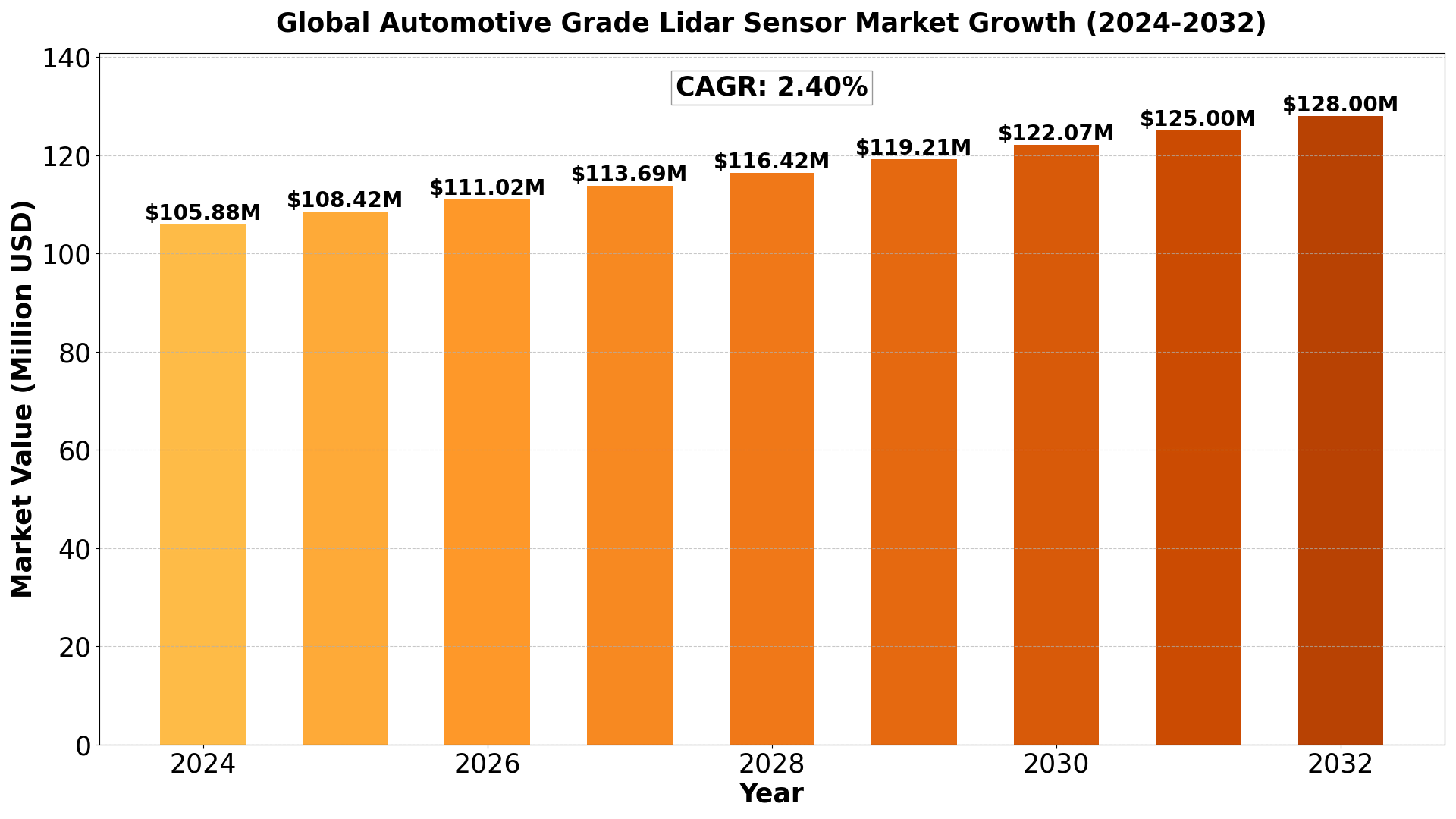
Automotive Grade Lidar Sensor Key Market Trends :
- Rising Demand for EVs
The growth of electric vehicles (EVs) is driving the demand for advanced lidar sensors in the automotive sector for better autonomous driving and safety features. - Increasing 5G Infrastructure
The expansion of 5G infrastructure is fueling the demand for lidar sensors, especially for their applications in self-driving and smart vehicle technologies. - Focus on Automotive Electrification
Automotive electrification is pushing the development and integration of lidar sensors to enhance vehicle safety, navigation, and energy efficiency. - Growing Adoption in Renewable Energy
Lidar sensors are increasingly used in renewable energy sectors like wind energy for precise measurements, contributing to market growth. - Technological Advancements in Lidar Technology
Innovations in solid-state and mechanical lidar systems are improving sensor performance, reliability, and cost-efficiency, making them more accessible to a broader market.
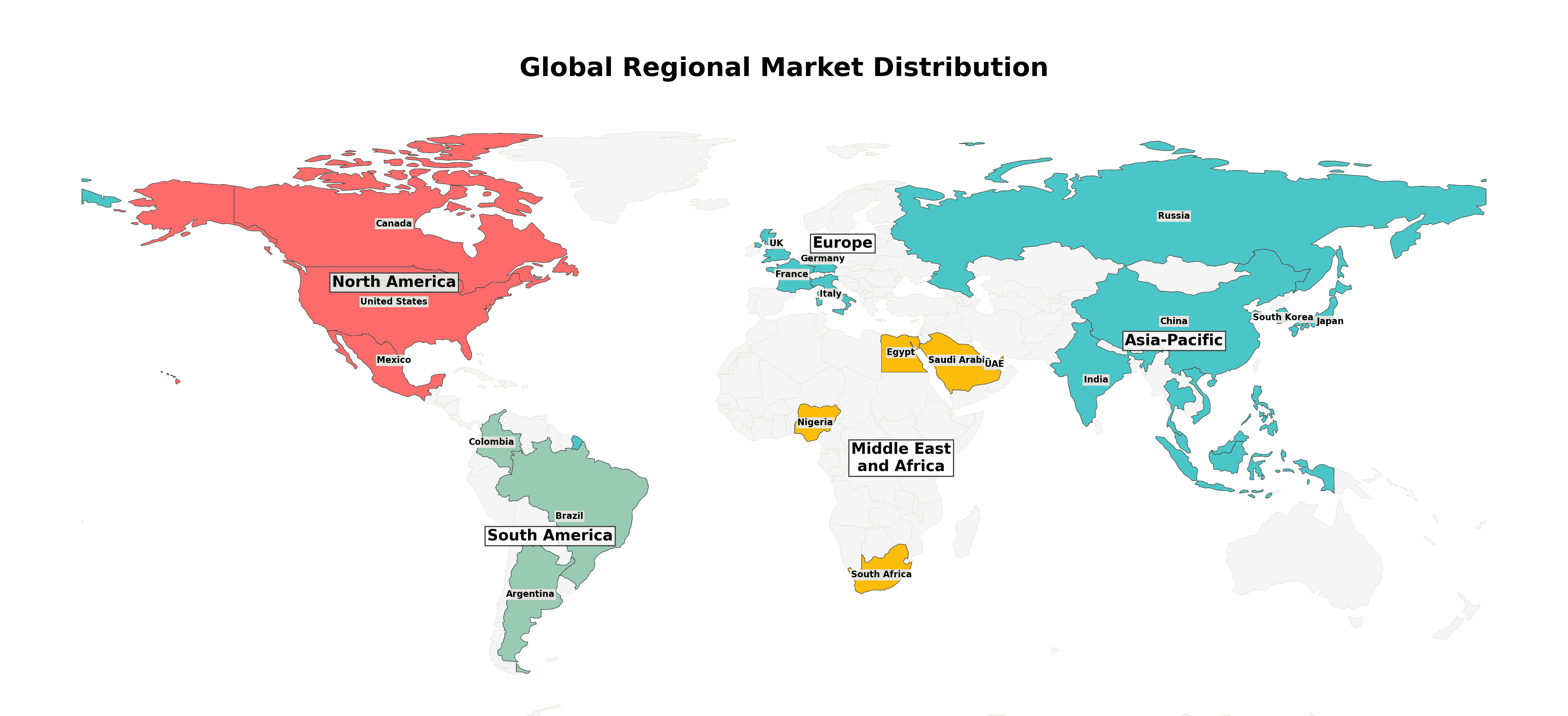
Automotive Grade Lidar Sensor Market Regional Analysis :
-
North America:
Strong demand driven by EVs, 5G infrastructure, and renewable energy, with the U.S. leading the market.
-
Europe:
Growth fueled by automotive electrification, renewable energy, and strong regulatory support, with Germany as a key player.
-
Asia-Pacific:
Dominates the market due to large-scale manufacturing in China and Japan, with growing demand from EVs, 5G, and semiconductors.
-
South America:
Emerging market, driven by renewable energy and EV adoption, with Brazil leading growth.
-
Middle East & Africa:
Gradual growth, mainly due to investments in renewable energy and EV infrastructure, with Saudi Arabia and UAE as key contributors.
Automotive Grade Lidar Sensor Market Segmentation :
The research report includes specific segments by region (country), manufacturers, Type, and Application. Market segmentation creates subsets of a market based on product type, end-user or application, Geographic, and other factors. By understanding the market segments, the decision-maker can leverage this targeting in the product, sales, and marketing strategies. Market segments can power your product development cycles by informing how you create product offerings for different segments.
Key Company
- Velodyne
- ibeo
- Quanergy Systems
- Leddartech
- Trilumina
- Luminar
- Phantom Intelligence
- Hesai Tech
- Leishen
Market Segmentation (by Type)
- Solid State Lidar
- Mechanical/Scanning Lidar
Market Segmentation (by Application)
- OEM
- Research
Drivers
- Increased Adoption of Autonomous Vehicles
The rise in autonomous vehicle adoption is a major driver for the automotive-grade LiDAR sensor market. LiDAR technology plays a critical role in providing accurate, high-resolution 3D maps for navigation, enhancing the safety and reliability of self-driving cars. - Stringent Safety Regulations
Governments and regulatory bodies worldwide are implementing stringent safety standards, which are propelling the demand for advanced driver assistance systems (ADAS). LiDAR sensors, known for their precision in detecting obstacles and pedestrians, are becoming a critical component of these systems. - Technological Advancements
Continuous innovation in LiDAR technology, such as the development of solid-state LiDAR, has significantly reduced costs, improved durability, and increased adoption rates among OEMs. These advancements make LiDAR sensors more suitable for mass production in the automotive sector.
Restraints
- High Cost of LiDAR Sensors
Despite advancements in technology, LiDAR sensors remain relatively expensive compared to other sensor technologies like radar and cameras. This cost factor can hinder their adoption, particularly in mid-range and budget vehicles. - Integration Challenges
Integrating LiDAR sensors into vehicles poses significant challenges in terms of design, space, and compatibility with other systems. These technical hurdles can delay deployment and increase production costs. - Limited Scalability in Low-Cost Vehicles
While luxury and high-end vehicles are increasingly equipped with LiDAR, the technology’s adoption in low-cost vehicles remains limited due to budget constraints, impacting its overall market penetration.
Opportunities
- Expansion in Emerging Markets
Emerging markets in Asia-Pacific, such as India and China, are witnessing rapid growth in automotive manufacturing and sales. As consumer preferences shift toward safety and advanced features, these regions present significant opportunities for LiDAR sensor manufacturers. - Partnerships and Collaborations
Collaborations between LiDAR manufacturers, OEMs, and technology providers can accelerate innovation and reduce costs, paving the way for broader adoption. Partnerships aimed at integrating LiDAR with AI and machine learning for enhanced functionalities are particularly promising. - Shift Toward Electric Vehicles (EVs)
The growing popularity of EVs is creating a new avenue for LiDAR sensors, as these vehicles often come equipped with advanced safety and navigation systems that rely on LiDAR technology.
Challenges
- Competition from Alternative Technologies
LiDAR faces stiff competition from other sensor technologies like cameras and radar, which are less expensive and already widely used in the automotive industry. The perception that LiDAR is not essential for ADAS in lower levels of autonomy remains a challenge. - Weather and Environmental Limitations
LiDAR performance can be adversely affected by extreme weather conditions such as rain, fog, and snow, which poses a reliability issue for automotive applications. - Regulatory and Standardization Issues
The lack of universal standards for LiDAR usage in automotive applications can lead to inconsistencies in implementation, slowing the market’s growth.
Key Benefits of This Market Research:
- Industry drivers, restraints, and opportunities covered in the study
- Neutral perspective on the market performance
- Recent industry trends and developments
- Competitive landscape & strategies of key players
- Potential & niche segments and regions exhibiting promising growth covered
- Historical, current, and projected market size, in terms of value
- In-depth analysis of the Automotive Grade Lidar Sensor Market
- Overview of the regional outlook of the Automotive Grade Lidar Sensor Market:
Key Reasons to Buy this Report:
- Access to date statistics compiled by our researchers. These provide you with historical and forecast data, which is analyzed to tell you why your market is set to change
- This enables you to anticipate market changes to remain ahead of your competitors
- You will be able to copy data from the Excel spreadsheet straight into your marketing plans, business presentations, or other strategic documents
- The concise analysis, clear graph, and table format will enable you to pinpoint the information you require quickly
- Provision of market value data for each segment and sub-segment
- Indicates the region and segment that is expected to witness the fastest growth as well as to dominate the market
- Includes in-depth analysis of the market from various perspectives through Porters five forces analysis
- Provides insight into the market through Value Chain
- Market dynamics scenario, along with growth opportunities of the market in the years to come
- 6-month post-sales analyst support
Customization of the Report
In case of any queries or customization requirements, please connect with our sales team, who will ensure that your requirements are met.
FAQs
Q: What are the key driving factors and opportunities in the Automotive Grade Lidar Sensor market?
A: Key drivers include the growth of electric vehicles (EVs), advancements in autonomous driving technologies, and the need for high-precision sensors. Opportunities arise from the expansion of 5G infrastructure and the increasing demand for renewable energy solutions.
Q: Which region is projected to have the largest market share in the Automotive Grade Lidar Sensor market?
A: North America is projected to hold the largest market share, driven by strong demand in the EV sector and advancements in 5G infrastructure.
Q: Who are the top players in the global Automotive Grade Lidar Sensor market?
A: Leading players include Velodyne, ibeo, Quanergy Systems, Leddartech, Trilumina, Luminar, Phantom Intelligence, Hesai Tech, and Leishen.
Q: What are the latest technological advancements in the Automotive Grade Lidar Sensor industry?
A: Key advancements include the development of solid-state lidar sensors, mechanical scanning lidar systems, and improvements in sensor accuracy, range, and cost-efficiency.
Q: What is the current size of the global Automotive Grade Lidar Sensor market?
A: The global market size was estimated at USD 103.40 million in 2023 and is projected to reach USD 128.00 million by 2032, with a CAGR of 2.40% during the forecast period.
Get Sample Report PDF for Exclusive Insights
Report Sample Includes
- Table of Contents
- List of Tables & Figures
- Charts, Research Methodology, and more...
 Download Sample Report PDF