Glazed Ceramic Substrates Market Insights
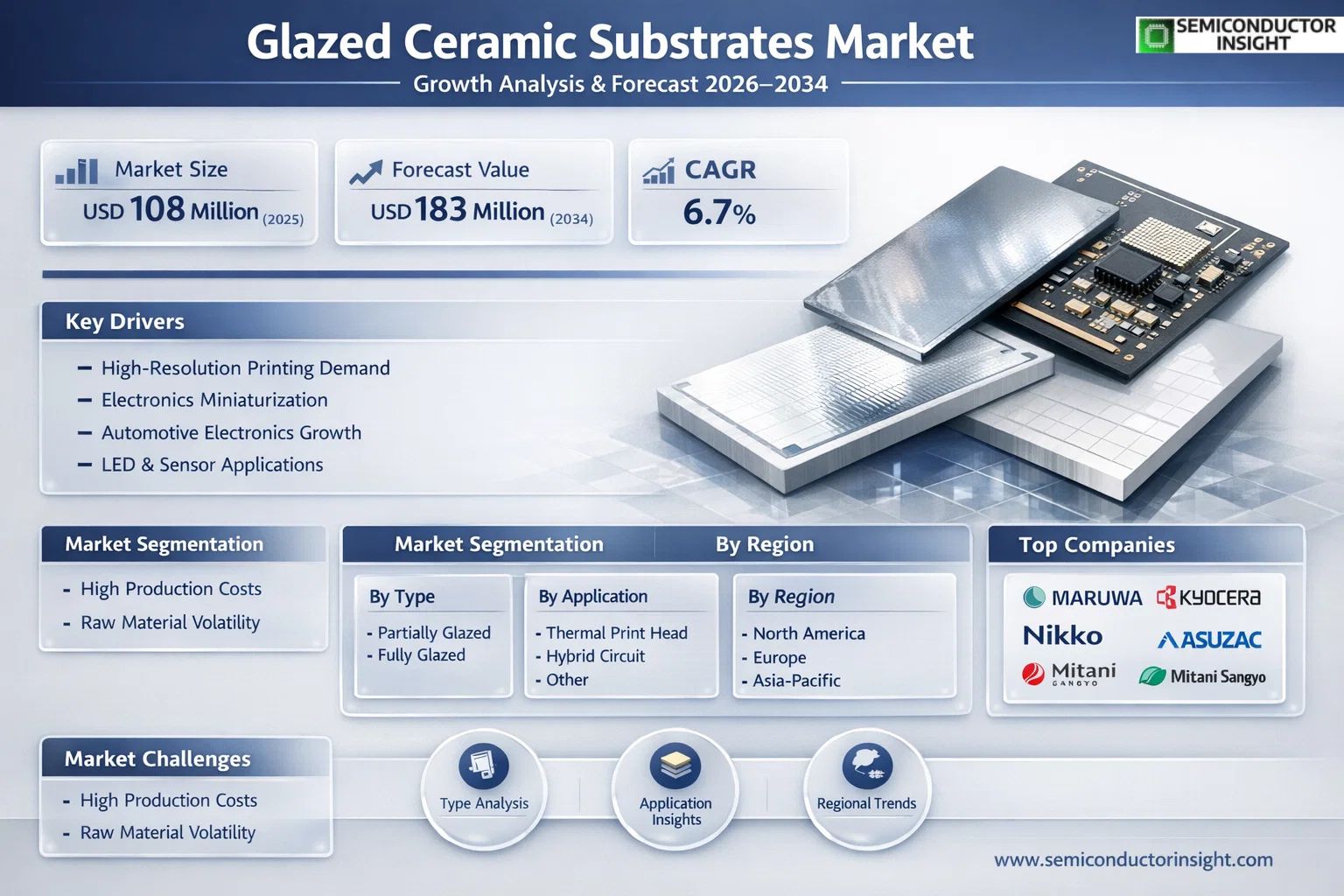
Global Glazed Ceramic Substrates market size was valued at USD 108 million in 2025. The market is projected to grow from USD 115.2 million in 2026 to USD 183 million by 2034, exhibiting a CAGR of 6.7% during the forecast period.
Glazed ceramic substrates are specialized components featuring a glass-like coating applied to a ceramic base, which provides an exceptionally smooth, non-porous, and electrically insulating surface. These substrates are engineered for superior flatness and minimal surface defects, making them ideal for demanding applications such as thermal printheads (TPH) and hybrid circuits where precise deposition of conductive inks or thin-film materials is critical.
The market growth is primarily driven by the increasing demand for high-resolution printing across various sectors, including industrial labeling, medical imaging, and point-of-sale systems. Furthermore, the expansion of electronics miniaturization and the need for reliable substrates in automotive sensors and LED packaging contribute significantly to market expansion. Key industry players like MARUWA Co., Ltd., Kyocera Corporation, and Nikko Company are actively investing in advanced manufacturing technologies to enhance substrate performance. For instance, recent developments focus on achieving ultra-fine via structures and improved thermal management properties to meet the evolving requirements of next-generation electronic devices.
MARKET DRIVERS
Electronics Miniaturization and Performance Demands
The relentless push for smaller, more powerful electronic devices is a primary driver for the Glazed Ceramic Substrates Market. These substrates provide exceptional electrical insulation, thermal management, and mechanical stability essential for high-density circuits used in smartphones, advanced sensors, and 5G infrastructure components.
Growth in Automotive Electrification
The automotive industry’s transition to electric and hybrid vehicles significantly boosts demand. Glazed ceramic substrates are critical in power modules, battery management systems, and LED lighting due to their ability to withstand high temperatures and provide reliable electrical isolation in harsh environments.
➤ Global market for advanced automotive electronics, a key application area, is projected to grow at a compound annual rate of approximately 8% over the next five years, directly fueling substrate demand.
Furthermore, expanding investments in telecommunications infrastructure and the Internet of Things (IoT) create sustained, long-term demand for the reliable performance characteristics offered by glazed ceramic substrates.
MARKET CHALLENGES
High Production Costs and Raw Material Volatility
Manufacturing glazed ceramic substrates involves high-temperature sintering and precision processes, leading to significant capital expenditure and energy consumption. Fluctuations in the prices of key raw materials, such as alumina and specialized glass frits, directly impact production costs and profit margins for manufacturers.
Other Challenges
Competition from Alternative Substrate Technologies
The market faces competition from organic laminates and direct bonded copper (DBC) substrates in certain cost-sensitive applications. Demonstrating superior long-term reliability and performance in extreme conditions is essential for glazed ceramics to maintain market share.
Technical and Supply Chain Complexities
Achieving flawless glazing for large-area or complex-shaped substrates presents technical hurdles. Additionally, the specialized nature of the supply chain for high-purity materials can lead to vulnerabilities and require sophisticated inventory management.
MARKET RESTRAINTS
Capital-Intensive Market Entry
The high barrier to entry, characterized by the need for advanced manufacturing facilities and deep technical expertise, limits the number of new competitors. This restraint can slow innovation and consolidation among a few key players, potentially affecting price competition and regional supply diversity in the Glazed Ceramic Substrates Market.
End-Industry Cyclicality
Demand is closely tied to the cyclical performance of key end-user industries like consumer electronics and automotive. Economic downturns or sector-specific slumps can lead to reduced orders and inventory corrections, presenting a significant restraint on stable market growth.
MARKET OPPORTUNITIES
Expansion in Renewable Energy and Power Electronics
The rapid growth of renewable energy systems (solar, wind) and industrial power electronics presents a major opportunity. Glazed ceramic substrates are ideal for high-voltage, high-power applications in inverters and converters, where durability and insulation are paramount.
Advancements in Material Science and 3D Structuring
Innovation in ceramic compositions and additive manufacturing techniques allows for the production of substrates with engineered thermal pathways and integrated 3D features. This enables new designs for next-generation radio-frequency devices and micro-electromechanical systems (MEMS), opening new application frontiers for the Glazed Ceramic Substrates Market.
Strategic Focus on High-Growth Geographic Regions
Targeting manufacturing hubs in the Asia-Pacific region, particularly for automotive and consumer electronics, offers substantial growth potential. Establishing local production or strong partnerships can capture the rising demand in these evolving markets.
Glazed Ceramic Substrates Market Trends
Advancements in High-Resolution Printing Applications
A key trend shaping the Glazed Ceramic Substrates Market is the increasing demand driven by high-resolution printing applications. The superior flatness and minimal surface defects of glazed substrates make them optimal for advanced thermal printheads. As printing technology advances towards greater precision, the need for these high-quality ceramic components is growing. Manufacturers are focusing on enhancing surface uniformity and defect reduction to meet the stringent requirements of next-generation printer heads across various industrial and consumer printing segments. This technical evolution is a primary growth driver for the market, with applications expanding into specialized and high-value printing arenas.
Other Trends
Type Segment Evolution
The market segment for Partially Glazed Substrates is exhibiting notable evolution. While fully glazed variants offer complete surface coverage, partially glazed options provide distinct advantages in certain hybrid circuit and specialized electronic applications by allowing selective conductivity. The development within this segment reflects a trend towards more application-specific substrate solutions. Manufacturers are tailoring glazing techniques to deliver precise performance characteristics, catering to diverse needs across the thermal print head and hybrid circuit application landscapes.
Regional Market Dynamics
Analysis of the Glazed Ceramic Substrates Market indicates significant regional dynamics, with Asia positioned as a critical manufacturing and consumption hub. The concentration of key manufacturers in countries like Japan and the expanding electronics manufacturing base in China and Southeast Asia influence global supply chains and innovation pathways. North America remains a significant market, particularly for high-end applications in advanced printing and electronics. These regional shifts affect competitive strategies, supply logistics, and the pace of technological adoption across Global Glazed Ceramic Substrates Market.
Consolidation and Competitive Landscape Focus
The competitive landscape is characterized by the presence of established global manufacturers such as MARUWA, Nikko, and Kyocera. A trend towards strategic focus on core competencies and technological specialization is observed. Companies are investing in process improvements and capacity enhancements to secure their positions. This environment encourages continuous refinement of product offerings and reinforces the importance of reliability and technical support in the Glazed Ceramic Substrates Market, shaping how manufacturers engage with downstream industries including electronics and advanced printing.
COMPETITIVE LANDSCAPE
Key Industry Players
A specialized market characterized by significant technological barriers and regional manufacturing expertise
Global glazed ceramic substrates market is considered a consolidated and highly technical niche, dominated by a handful of established Japanese manufacturers who leverage deep expertise in advanced ceramics and precision engineering. MARUWA Co., Ltd. is widely recognized as a leading player, renowned for its high-performance alumina and aluminum nitride substrates that deliver the superior flatness and minimal surface defects required for next-generation thermal printheads. Close competitors such as Kyocera Corporation and Nikko Company also command substantial market shares, benefiting from vertically integrated operations and strong R&D investments. Global top five players collectively held a significant revenue share in 2025, underlining the high barriers to entry and the critical importance of quality, consistency, and long-standing relationships with electronics manufacturers.
Beyond the dominant Japanese tier, other significant players carve out roles by servicing specific regional demands or application niches. Manufacturers like ASUZAC Fine Ceramics Co., Ltd. and Mitani Sangyo Co., Ltd. are key suppliers with strong technical capabilities. The market also sees participation from specialized ceramics producers in other regions, particularly in China and South Korea, which are growing to meet local demand for hybrid circuits and consumer electronics. Competition is intensifying as the demand for high-resolution printing and miniaturized hybrid circuits grows, pushing all manufacturers to innovate in glaze formulations and substrate properties to gain a competitive edge in terms of thermal management, electrical insulation, and durability.
List of Key Glazed Ceramic Substrates Companies Profiled
- MARUWA Co., Ltd.
- Kyocera Corporation
- Nikko Company
- ASUZAC Fine Ceramics Co., Ltd.
- Mitani Sangyo Co., Ltd.
- Nippon Carbide Industries Co., Inc.
- CeramTec GmbH
- CoorsTek, Inc.
- Rogers Corporation
- Murata Manufacturing Co., Ltd.
- Chaozhou Three-Circle (Group) Co., Ltd.
- Hebei Sinopack Electronic Technology Co., Ltd.
- Ningbo Jingqi Electronic Technology Co., Ltd.
- Entegris, Inc.
- Tokuyama Corporation
Segment Analysis:
| Segment Category | Sub-Segments | Key Insights |
| By Type |
|
Partially Glazed Substrates represent a significant area of market focus due to their balanced cost-performance profile. This segmentation allows manufacturers to tailor surface properties for specific circuit and adhesion needs, which is critical for hybrid applications. The segment’s prominence is driven by its ability to offer superior flatness in designated areas while maintaining structural integrity, making it a preferred engineering solution. Continuous innovation in glazing patterns is enhancing thermal management and electrical performance, addressing the evolving demands of high-precision electronic components. |
| By Application |
|
Thermal Print Head is the dominant application segment, underpinned by the essential role of these substrates in modern high-resolution printing technologies. The glazed surface provides the exceptional flatness and minimal defect profile required for precise ink deposition and consistent print quality. This foundational characteristic supports the trend towards faster, more reliable printers across industrial, commercial, and consumer markets. Furthermore, the drive for advanced printing solutions in labeling, ticketing, and digital fabrication is fostering material innovation to enhance durability and thermal conductivity within this core application. |
| By End User |
|
Electronics Manufacturing serves as the primary end-user industry, acting as the central hub for demand. This sector integrates glazed ceramic substrates into critical components for various downstream products, from printers to sophisticated hybrid circuits. The segment’s leadership is reinforced by stringent quality requirements and the continuous miniaturization of electronic devices, which demand substrates with high dimensional stability and excellent insulation properties. Collaboration between substrate manufacturers and electronics designers is intensifying to develop customized solutions for next-generation applications, securing this segment’s pivotal role in the value chain. |
| By Glaze Property |
|
Superior Flatness & Smoothness is the paramount property segment, fundamentally distinguishing glazed from standard ceramic substrates. This characteristic is non-negotiable for applications like thermal print heads, where microscopic surface imperfections can drastically affect performance and yield. The market’s technical trajectory is heavily focused on perfecting glazing processes to achieve near-atomic-level smoothness across larger substrate areas, a key differentiator for manufacturers. This relentless pursuit of perfection is a major driver of R&D investments, as it directly correlates with end-product reliability and performance in high-tech assemblies. |
| By Manufacturing Sophistication |
|
High-Precision Custom manufacturing is the leading sophistication segment, reflecting the market’s shift towards application-specific engineering. This trend is propelled by the need for substrates that meet exact geometric tolerances and functional coatings for specialized hybrid circuits and advanced sensors. Leading suppliers are competing on their capability to provide such tailored solutions, which command higher value and foster stronger client partnerships. The expertise required for precise glaze formulation, controlled firing, and intricate post-processing creates significant barriers to entry, consolidating the market position of established, technologically adept players. |
Regional Analysis: Glazed Ceramic Substrates Market
Asia-Pacific
The concentration of global electronics assembly, from PCBs to final products, creates a captive, high-volume market for Glazed Ceramic Substrates. Local substrate manufacturers work in close technical collaboration with device makers, allowing for rapid prototyping and customization to meet specific circuit design and thermal management needs.
National initiatives like “Made in China 2025” and support for semiconductor self-sufficiency directly benefit the advanced materials sector, including the Glazed Ceramic Substrates Market. Policies fostering electric vehicle adoption and smart grid development create stable, long-term demand drivers for critical components built on these substrates.
Proximity to raw material processing and a dense network of specialized component suppliers result in shorter lead times and competitive pricing. This ecosystem is difficult to replicate elsewhere, giving Asia-Pacific-based users of Glazed Ceramic Substrates a distinct advantage in time-to-market and cost-efficiency for their final products.
Regional market leaders are heavily investing in R&D for substrates suited to high-frequency 5G/6G applications, wide-bandgap semiconductor packaging, and miniaturized medical devices. This forward-looking approach ensures the Glazed Ceramic Substrates Market here evolves to capture value from the most advanced electronic trends.
North America
North America represents a high-value, innovation-driven segment of the Glazed Ceramic Substrates Market. Demand is primarily fueled by cutting-edge aerospace, defense, telecommunications, and medical technology sectors, where performance and reliability override cost considerations. The region is a leader in specifying and adopting substrates for advanced packaging of power semiconductors, particularly those using silicon carbide and gallium nitride. A strong culture of R&D, supported by significant investment from both private entities and defense agencies, drives the development of substrates with exceptional thermal conductivity, mechanical strength, and fine-line printing capabilities. While manufacturing volume may be lower than Asia-Pacific, the region’s influence on global technical standards and its focus on mission-critical applications make it a vital and high-margin market for specialized Glazed Ceramic Substrates.
Europe
The European Glazed Ceramic Substrates Market is characterized by a strong industrial and automotive heritage, leading to robust demand for substrates in automotive electronics, industrial automation, and energy management. Stringent regulations on vehicle emissions and safety are accelerating the adoption of electric and hybrid vehicles, which extensively use power electronics modules built on reliable ceramic substrates. Furthermore, the region’s leadership in industrial IoT and precision manufacturing equipment requires durable substrates for sensors and control units operating in harsh environments. European manufacturers are noted for their expertise in high-precision, small-to-medium batch production, catering to specialized applications with stringent quality certifications. The push for energy efficiency and renewable energy integration also supports steady market growth for substrates used in solar inverters and power conversion systems.
South America
The South American market for Glazed Ceramic Substrates is presently in a developing phase, with growth largely tied to industrial modernization and investments in basic infrastructure. Key demand arises from the automotive sector, as global manufacturers establish production facilities in the region, and from the need for consumer electronics assembly. However, market dynamics are often influenced by economic volatility and currency fluctuations, which can impact capital investment in new manufacturing lines that utilize these advanced components. The regional focus is primarily on cost-effective, reliable substrates for applications in power supplies, lighting, and basic automotive electronics, with limited local production. Market growth is expected to correlate with broader economic stability and increased foreign direct investment in technology manufacturing.
Middle East & Africa
The Glazed Ceramic Substrates Market in the Middle East & Africa is nascent but showing potential in specific niches. In the Middle East, investment in telecommunications infrastructure, including 5G deployment, and diversification into industrial and technology parks is generating demand. The oil & gas industry’s need for robust sensing and monitoring equipment in extreme conditions also presents a specialized application area. In Africa, the market is largely import-dependent, driven by the assembly of consumer electronics and telecommunications equipment. Growth is gradual, linked to urbanization, electrification projects, and the slow build-out of digital infrastructure. The region currently represents a longer-term opportunity as industrialization progresses and local technical expertise in advanced electronics manufacturing develops.
Report Scope
This market research report provides a comprehensive analysis of the Glazed Ceramic Substrates Market , covering the forecast period 2026–2034. It offers detailed insights into market dynamics, technological advancements, competitive landscape, and key trends shaping the industry.
Key focus areas of the report include:
- Market Overview: The report begins with an overview outlining its current market scenario, key growth indicators, and industry transformation drivers. It discusses macroeconomic factors, demand–supply balance, regulatory landscape, and the strategic role of semiconductors in powering advancements across industries such as automotive, telecommunications, consumer electronics, and industrial automation.
- Market Size & Forecast: Historical data and future projections for revenue, unit shipments, and market value across major regions and segments.
- Segmentation Analysis: Detailed breakdown by product type, technology, application, and end-user industry to identify high-growth segments and investment opportunities.
- Regional Insights: Insights into market performance across North America, Europe, Asia-Pacific, Latin America, and the Middle East & Africa, including country-level analysis where relevant.
- Competitive Landscape: Profiles of leading market participants, including their product offerings, R&D focus, manufacturing capacity, pricing strategies, and recent developments such as mergers, acquisitions, and partnerships.
- Technology Trends & Innovation: Assessment of emerging technologies, integration of AI/IoT, semiconductor design trends, fabrication techniques, and evolving industry standards.
- Market Drivers & Restraints: Evaluation of factors driving market growth along with challenges, supply chain constraints, regulatory issues, and market-entry barriers.
- Stakeholder Insights: Insights for component suppliers, OEMs, system integrators, investors, and policymakers regarding the evolving ecosystem and strategic opportunities.
Primary and secondary research methods are employed, including interviews with industry experts, data from verified sources, and real-time market intelligence to ensure the accuracy and reliability of the insights presented.
FREQUENTLY ASKED QUESTIONS:
What is the current market size of Glazed Ceramic Substrates Market?
-> Global Glazed Ceramic Substrates market was valued at USD 108 million in 2025 and is projected to reach USD 183 million by 2034, growing at a CAGR of 6.7% during the forecast period.
Which key companies operate in Glazed Ceramic Substrates Market?
-> Key players in Global market include MARUWA, Nikko, Kyocera, ASUZAC, and Mitani Sangyo, among others. In 2025, Global top five players held a significant share of the revenue.
What are the key growth drivers?
-> A key driver is the demand for high-resolution thermal printheads in advanced printing applications, as glazed ceramic substrates offer superior flatness and fewer surface defects ideal for such uses.
Which are the major application segments?
-> Major application segments include Thermal Print Head, Hybrid Circuit, and Other applications.
What are the main product types in this market?
-> The market is segmented by type into Partially Glazed Substrates and Fully Glazed Substrates.

Get Sample Report PDF for Exclusive Insights
Report Sample Includes
- Table of Contents
- List of Tables & Figures
- Charts, Research Methodology, and more...
 Download Sample Report PDF