Glass Substrate for AR/MR Waveguide Market, Trends, Business Strategies 2026-2034

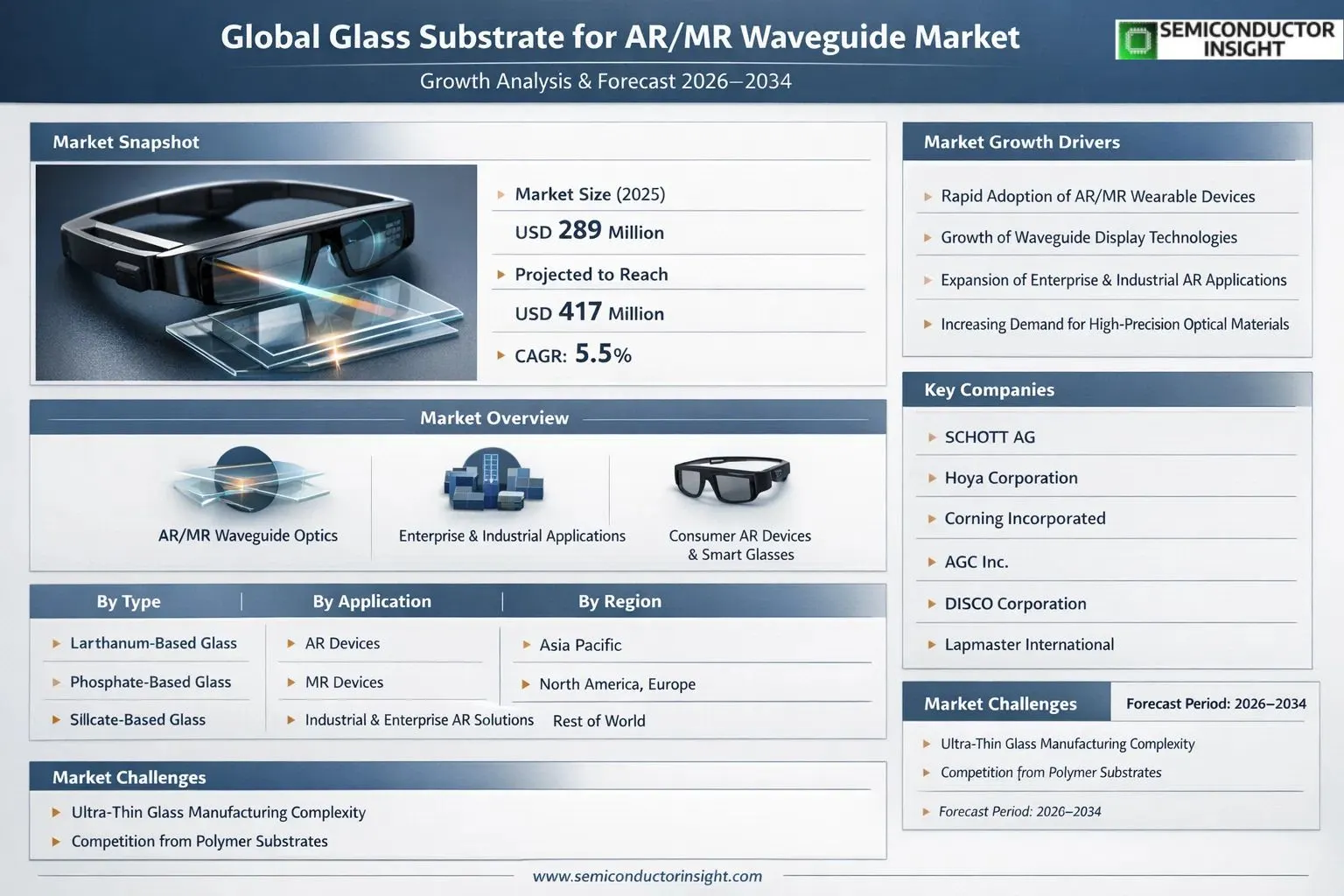
Global Glass Substrate for AR/MR Waveguide Market was valued at USD 289 million in 2025 and is expected to reach USD 417 million by 2034, growing at a CAGR of 5.5% during the forecast period.

PDF Icon Download Sample Report PDF
  • Quick Dispatch

    All Orders

  • Secure Payment

    100% Secure Payment

Price range: $1,500.00 through $4,250.00

Clear

Glass Substrate for AR/MR Waveguide Market Insights

Global Glass Substrate for AR/MR Waveguide market size was valued at USD 289 million in 2025. The market is projected to grow from USD 305 million in 2026 to USD 417 million by 2034, exhibiting a CAGR of 5.5% during the forecast period.

The AR/MR Waveguide Glass Substrate is a high-precision optical material specifically engineered for augmented reality and mixed reality waveguide systems, characterized by high transmittance, high refractive index, and excellent thermal stability. Functioning as the core carrier for light propagation and image projection, the substrate employs micro- and nano-structured surface processing to efficiently guide and control light, minimizing optical loss and distortion while ensuring image clarity and an immersive visual experience in wearable devices. In 2024, the production of AR/MR waveguide glass substrates reached 5 million pieces, with an average unit price of USD 60 per piece, an annual capacity per production line of approximately 20,000 pieces, and an average gross margin of approximately 49%.

The market is gaining strong momentum driven by the rapid adoption of AR/MR devices across gaming, education and training, remote collaboration, and industrial design applications. Demand for high-performance optical substrates continues to intensify as device manufacturers push the boundaries of clarity, durability, and field-of-view performance. Furthermore, innovations in nanofabrication precision and optical integration are proving essential to meet increasingly stringent requirements. Key players operating across the value chain include upstream optical glass material manufacturers such as SCHOTT and Hoya, precision processing specialists such as DISCO and Lapmaster, and downstream AR/MR device leaders including Apple, Microsoft, and Magic Leap, collectively shaping the competitive and technological landscape of this evolving market.
Glass Substrate for AR/MR Waveguide Market Insights

MARKET DRIVERS

Accelerating Adoption of Augmented and Mixed Reality Devices Fueling Demand for Precision Glass Substrates

The rapid commercialization of augmented reality and mixed reality headsets has emerged as a primary catalyst for growth in Glass Substrate for AR/MR Waveguide Market. As leading technology companies intensify investment in next-generation wearable computing platforms, the demand for ultra-thin, optically precise glass substrates that enable waveguide-based display systems has risen considerably. These substrates serve as the foundational layer for diffractive and reflective waveguide optics, which are essential for projecting digital imagery seamlessly onto the real-world field of view. The growing consumer and enterprise appetite for immersive spatial computing experiences has translated directly into sustained procurement of high-specification glass materials tailored for waveguide fabrication.

Enterprise and Industrial Deployment of AR Headsets Driving Sustained Market Expansion

Beyond consumer applications, enterprise sectors including manufacturing, logistics, healthcare, and defense have significantly expanded deployment of AR/MR headsets for workforce productivity, remote assistance, and simulation-based training. This industrial adoption has created a consistent and volume-driven demand pipeline for glass substrates used in AR/MR waveguide systems. Manufacturers operating in these verticals require waveguide optics that maintain dimensional stability, thermal resistance, and optical homogeneity under demanding field conditions, all of which are properties directly dependent on substrate glass quality. The expansion of smart factory initiatives and Industry 4.0 frameworks across North America, Europe, and Asia-Pacific has further reinforced enterprise-led procurement activity in this market.

The convergence of high-refractive-index glass formulations with precision nanoimprint and wafer-level lithography processes is enabling waveguide manufacturers to achieve sub-micron grating fidelity, a technical threshold that is increasingly specified by leading AR/MR device OEMs as a baseline qualification criterion for glass substrate suppliers.

Continued advancements in glass composition engineering, particularly the development of substrates with refractive indices exceeding 1.8 and Abbe numbers optimized for visible spectrum uniformity, are enabling waveguide designers to achieve wider field-of-view performance and reduced chromatic aberration in compact form factors. These material innovations are actively broadening the addressable performance envelope of AR/MR waveguide glass substrates, encouraging device manufacturers to transition from polymer-based alternatives to glass-based solutions wherever optical fidelity and environmental durability are prioritized design objectives.

MARKET CHALLENGES

Complex Manufacturing Processes and Low Yield Rates Presenting Significant Production Challenges

One of the most pressing challenges confronting Glass Substrate for AR/MR Waveguide Market is the inherent complexity of manufacturing ultra-thin glass substrates with the optical and dimensional tolerances required for waveguide applications. Achieving surface roughness values in the sub-nanometer range, maintaining thickness uniformity across large substrate panels, and ensuring freedom from internal stress or birefringence requires specialized melting, forming, and polishing processes that are capital-intensive and difficult to scale. Production yield rates for waveguide-grade glass remain notably lower than those achieved in standard display glass manufacturing, contributing to elevated per-unit costs that constrain adoption, particularly among cost-sensitive consumer device manufacturers.

Other Challenges

High Capital Investment Requirements

The establishment or upgrade of glass melting and precision forming facilities capable of producing waveguide-grade substrates demands substantial capital expenditure in specialized furnace technology, clean-room polishing infrastructure, and metrology equipment. This financial barrier limits the number of qualified substrate suppliers globally, creating supply concentration risks for waveguide manufacturers that are dependent on a narrow pool of technically capable glass producers. Smaller and emerging waveguide developers face particular difficulty in securing long-term supply agreements at commercially viable pricing, as leading glass substrate producers tend to prioritize volume commitments from established device OEMs.

Integration Complexity with Waveguide Fabrication Processes

Glass substrates intended for diffractive waveguide applications must be compatible with downstream nanofabrication processes including nanoimprint lithography, electron beam lithography, and physical vapor deposition of grating structures. Achieving consistent adhesion, etch selectivity, and thermal compatibility between the glass substrate and the applied grating materials introduces process integration challenges that require close collaboration between glass suppliers and waveguide manufacturers. Variability in surface chemistry, coefficient of thermal expansion, and sub-surface damage characteristics across substrate batches can introduce defects during grating fabrication, affecting device optical performance and reducing overall manufacturing efficiency across the AR/MR waveguide glass substrate supply chain.

MARKET RESTRAINTS

Competition from Polymer-Based Waveguide Substrates Limiting Glass Market Penetration

Despite the superior optical properties of glass, Glass Substrate for AR/MR Waveguide Market faces a meaningful restraint from the parallel development of high-performance polymer and polycarbonate substrates, which offer advantages in weight reduction, impact resistance, and formability. Several waveguide manufacturers and device OEMs have invested in polymer waveguide technologies that can be fabricated using injection molding or roll-to-roll processes, enabling lower-cost, higher-volume production pathways. While polymer substrates have historically been limited in optical quality and environmental stability, ongoing material science advances have narrowed the performance gap in certain application segments, particularly in lower-resolution consumer AR eyewear, where absolute optical precision is a less critical design constraint than device weight and wearability comfort.

Supply Chain Concentration and Geopolitical Risks Constraining Market Stability

The global supply of waveguide-grade glass substrates is currently concentrated among a limited number of specialty glass manufacturers with the technical capability to meet the stringent optical and dimensional specifications required by the AR/MR waveguide industry. This supply concentration creates vulnerability to geopolitical disruptions, trade policy changes, and logistics bottlenecks that can introduce lead time volatility and pricing pressure into the market. The geographic clustering of advanced glass manufacturing capacity in specific regions means that regional disruptions, whether from regulatory, energy, or logistical sources, can have disproportionate impact on the availability of qualified substrates for waveguide producers operating on globally distributed supply chains.

MARKET OPPORTUNITIES

Emergence of Consumer AR Eyewear as a High-Volume Growth Segment for Waveguide Glass Substrates

The anticipated transition of augmented reality from enterprise-focused devices toward mainstream consumer eyewear form factors represents a substantial volume opportunity for Glass Substrate for AR/MR Waveguide Market. As technology platforms mature and device prices decline toward mass-market thresholds, the addressable unit volumes for waveguide-based AR optics are projected to increase by orders of magnitude relative to current shipment levels. This volume inflection would drive significant demand for glass substrates that can be produced consistently at scale while maintaining the optical characteristics required for consumer-grade waveguide performance. Glass substrate suppliers that invest in process automation, panel size scaling, and yield improvement ahead of this volume ramp will be positioned to capture disproportionate market share as consumer AR adoption accelerates.

Development of Next-Generation High-Refractive-Index Glass Formulations Opening New Application Segments

Ongoing research and development activity focused on engineering glass compositions with higher refractive indices, improved transmission characteristics in the visible spectrum, and enhanced compatibility with advanced nanofabrication processes is creating opportunity for differentiated product positioning within Glass Substrate for AR/MR Waveguide Market. Substrates with refractive indices in the range of 1.8 to 2.1 enable waveguide designers to achieve wider eye-box geometries and greater field-of-view performance without proportional increases in device form factor, addressing key ergonomic and optical performance requirements that are central to the commercial viability of next-generation AR/MR headsets. Glass producers that successfully commercialize such advanced substrate formulations will access premium pricing tiers and establish strategic supply relationships with leading waveguide technology developers globally.

Expansion of Defense and Aerospace AR Applications Creating Specialized Demand for High-Performance Glass Substrates

Defense and aerospace agencies across multiple regions are advancing procurement programs for AR/MR-enabled situational awareness systems, heads-up display platforms, and pilot assistance technologies that require waveguide optics fabricated on glass substrates meeting military-grade environmental and optical performance specifications. This specialized application segment represents a high-value opportunity for AR/MR waveguide glass substrate suppliers capable of meeting elevated qualification standards related to temperature cycling resistance, radiation hardness, and long-term optical stability. Defense procurement cycles, while longer than commercial timelines, provide predictable demand visibility and support premium pricing structures that can underpin the economics of investing in advanced glass substrate development programs targeted at mission-critical wearable optics platforms.

Trends

Rising Adoption of AR/MR Devices Fueling Demand for High-Performance Glass Substrates

Glass Substrate for AR/MR Waveguide Market is experiencing significant momentum as augmented reality and mixed reality technologies transition from niche applications into mainstream commercial and industrial use. The accelerating deployment of AR/MR headsets and smart glasses across sectors such as gaming, enterprise collaboration, remote training, and industrial design has created sustained demand for precision-engineered optical glass substrates. These substrates serve as the foundational carrier for light propagation and image projection within waveguide systems, making their optical quality and structural integrity critical to end-device performance. Manufacturers are responding by investing in advanced nanofabrication capabilities and high-refractive-index glass materials to meet increasingly stringent optical specifications.

Other Trends

Shift Toward High Refractive Index Glass Formulations

One of the most prominent trends shaping Glass Substrate for AR/MR Waveguide Market is the growing preference for lanthanum-based and phosphate-based glass types, which offer superior refractive indices essential for compact, lightweight waveguide designs. Higher refractive index materials enable thinner substrate profiles without compromising light-guiding efficiency, directly supporting the consumer electronics industry’s push toward sleeker wearable form factors. Silicate-based glass continues to hold relevance for cost-sensitive applications, but premium segments are increasingly aligned with advanced glass chemistries that deliver enhanced transmittance and thermal stability.

Precision Manufacturing and Yield Optimization as Competitive Differentiators

Midstream processing capabilities , encompassing precision cutting, polishing, optical coating, and rigorous inspection , are emerging as key differentiators among Glass Substrate for AR/MR Waveguide suppliers. With average gross margins in the industry reported at approximately 49%, manufacturers are under pressure to optimize yield rates and reduce material waste across production lines. Companies with established expertise in micro- and nano-structured surface processing are gaining competitive advantage, as these techniques are directly tied to minimizing optical loss, controlling distortion, and ensuring consistent image clarity across large production volumes.

Upstream Material Innovation and Strategic Supply Chain Development

Upstream suppliers of high-purity optical glass materials, including globally recognized players such as SCHOTT and Hoya, are intensifying research efforts to develop next-generation substrate materials with improved optical homogeneity and thermal resistance. Simultaneously, downstream device manufacturers , including major technology companies deploying AR and MR platforms , are deepening supply chain partnerships to secure reliable access to high-specification glass substrates. This vertical integration dynamic is encouraging greater collaboration between material scientists, substrate fabricators, and device OEMs, positioning Glass Substrate for AR/MR Waveguide Market for sustained technological advancement and supply chain resilience through the coming years.

COMPETITIVE LANDSCAPE

Key Industry Players

Glass Substrate for AR/MR Waveguide Market: Competitive Dynamics and Leading Manufacturers Shaping the Optical Frontier

Glass Substrate for AR/MR Waveguide market, valued at approximately USD 289 million in 2025 and projected to reach USD 417 million by 2034 at a CAGR of 5.5%, is characterized by a highly specialized and technically demanding competitive landscape. The market is currently dominated by a select group of advanced optical glass manufacturers with deep expertise in high-refractive-index materials, nanofabrication, and precision surface processing. SCHOTT AG stands as one of the most prominent players, leveraging decades of optical glass innovation to supply high-transmittance, thermally stable substrates engineered for waveguide light propagation. Equally influential, Hoya Corporation commands a significant market share through its advanced lanthanum-based and phosphate-based glass formulations that meet the stringent refractive index thresholds , including n≥1.9 , demanded by next-generation AR and MR optical systems. These leading incumbents benefit from vertically integrated supply chains, proprietary glass compositions, and long-standing partnerships with downstream device manufacturers such as Apple, Microsoft, and Magic Leap, reinforcing substantial barriers to entry for new competitors.

Beyond the top-tier players, several niche yet strategically significant manufacturers are increasingly shaping the competitive dynamics of this market. Companies such as Corning Incorporated and AGC Inc. bring substantial materials science capabilities and global manufacturing scale, positioning them as formidable contenders in the silicate-based and specialty glass substrate segments. Precision processing specialists like DISCO Corporation and Lapmaster International contribute critical midstream capabilities , including ultra-thin wafer dicing, chemical mechanical polishing (CMP), and nanoscale surface finishing , that directly influence optical yield and substrate quality. Emerging players from Asia-Pacific, particularly from China and Japan, are rapidly scaling their production capacities, with average annual capacity per production line estimated at approximately 20,000 pieces and average gross margins near 49%, intensifying price competition while spurring ongoing innovation in optical coating, micro-nanostructure fabrication, and substrate thickness optimization across the market.

List of Key Glass Substrate for AR/MR Waveguide Companies Profiled

Segment Analysis:

Segment Category Sub-Segments Key Insights
By Type
  • Lanthanum-Based Glass Type
  • Phosphate-Based Glass Type
  • Silicate-Based Glass Type
  • Others
Lanthanum-Based Glass is the leading segment within Glass Substrate for AR/MR Waveguide Market, owing to its superior optical characteristics that are uniquely suited to demanding waveguide architectures.

  • Lanthanum-based glass delivers an exceptionally high refractive index combined with low dispersion, enabling compact waveguide designs that are critical for slim, lightweight AR/MR headsets and smart glasses.
  • Its outstanding thermal and chemical stability ensures long-term performance reliability under the variable environmental conditions encountered in wearable devices, making it a preferred choice among premium device manufacturers.
  • The compatibility of lanthanum-based glass with advanced nano-structuring and precision coating processes gives manufacturers the ability to achieve the tight optical tolerances required for high-fidelity image projection and minimal light loss in waveguide systems.
By Application
  • Augmented Reality (AR) Devices
  • Mixed Reality (MR) Devices
  • Industrial & Enterprise AR Solutions
  • Others
Augmented Reality (AR) Devices represent the dominant application segment, driven by the rapid proliferation of consumer and enterprise AR hardware across multiple sectors.

  • AR devices such as smart glasses and heads-up displays require high-transmittance, precisely engineered glass substrates to achieve seamless overlay of digital content onto real-world environments, placing stringent demands on substrate optical quality and surface uniformity.
  • The surge in AR adoption for industrial design, remote collaboration, education, and training has accelerated the need for waveguide substrates that can maintain image clarity and color fidelity over extended usage cycles in diverse operational environments.
  • Leading consumer technology companies, including Apple and Microsoft, are driving innovation in AR form factors that demand thinner and lighter waveguide glass substrates, pushing substrate manufacturers toward advanced material formulations and precision fabrication capabilities.
By End User
  • Consumer Electronics Manufacturers
  • Enterprise & Industrial Sector
  • Defense & Aerospace
  • Healthcare & Medical
Consumer Electronics Manufacturers lead the end-user landscape, propelled by aggressive investment in next-generation AR/MR wearable products targeting mass-market audiences.

  • Major consumer electronics brands are pursuing increasingly compact and aesthetically refined AR headsets and glasses, necessitating waveguide glass substrates that combine high optical performance with reduced thickness and weight without compromising structural integrity.
  • The competitive pressure among consumer device makers to deliver immersive visual experiences is spurring continuous collaboration with substrate suppliers to co-develop proprietary glass compositions and surface treatment technologies tailored to specific product architectures.
  • Growing consumer interest in AR-enabled gaming, social interaction, and navigation applications is creating sustained and diversified demand, ensuring that consumer electronics manufacturers remain the principal volume buyers of advanced waveguide glass substrates over the forecast period.
By Refractive Index
  • Low Refractive Index (n < 1.7)
  • Medium Refractive Index (n 1.7–1.9)
  • High Refractive Index (n > 1.9)
High Refractive Index (n > 1.9) glass substrates hold a prominent position in the market, as next-generation waveguide designs increasingly demand superior light-guiding efficiency and compactness.

  • High refractive index substrates enable a wider field of view and greater light coupling efficiency within waveguide structures, which is a critical performance requirement for immersive AR/MR user experiences in both consumer and professional-grade devices.
  • Achieving refractive indices above 1.9 requires advanced glass compositions and stringent manufacturing controls, positioning suppliers with the relevant material science expertise as key strategic partners for leading AR/MR device developers.
  • As device miniaturization trends continue, the demand for high refractive index substrates is expected to grow, since they allow thinner waveguide layers while preserving the optical path length necessary for effective holographic and diffractive grating performance.
By Thickness
  • Ultra-Thin (< 0.5 mm)
  • Standard Thin (0.5 mm – 1.0 mm)
  • Thick (> 1.0 mm)
Ultra-Thin (< 0.5 mm) glass substrates are emerging as the most strategically significant thickness segment, reflecting the overarching industry drive toward lighter and less obtrusive AR/MR wearable form factors.

  • Ultra-thin substrates are essential for enabling the sleek, eyeglass-like designs that are increasingly demanded by both consumer and enterprise markets, where user comfort and social acceptability of wearable devices are key adoption drivers.
  • Producing ultra-thin waveguide glass substrates with consistent optical quality and mechanical robustness poses significant manufacturing challenges, rewarding suppliers with advanced precision polishing, cutting, and inspection capabilities with a strong competitive differentiation.
  • The growing integration of multi-layer waveguide stacks in high-performance AR/MR systems further amplifies the importance of ultra-thin substrates, as each additional layer must contribute minimal weight and thickness while maintaining full optical functionality across the visible spectrum.

Regional Analysis: Glass Substrate for AR/MR Waveguide Market

Asia-Pacific

Asia-Pacific stands as the dominant force in Glass Substrate for AR/MR Waveguide market, driven by a confluence of advanced manufacturing infrastructure, robust government-backed technology initiatives, and a rapidly expanding consumer electronics ecosystem. Countries such as Japan, South Korea, China, and Taiwan have cultivated deep expertise in precision optics and specialty glass manufacturing, positioning the region as an indispensable production hub for waveguide-grade substrates. The presence of leading display technology conglomerates and vertically integrated supply chains enables faster prototyping and cost-efficient scaling, which is critical as demand for augmented and mixed reality devices accelerates across both enterprise and consumer segments. Government programs promoting smart manufacturing, Industry 4.0 adoption, and extended reality technologies further amplify regional investment in optical-grade glass development. Additionally, a large pool of skilled engineers and an expanding base of AR/MR application developers in sectors such as automotive, healthcare, and industrial training are reinforcing Asia-Pacific’s strategic significance. The region’s ability to align high-volume glass substrate production with evolving waveguide design requirements gives it a sustained competitive edge in the global landscape.
Manufacturing Excellence & Supply Chain Depth
Asia-Pacific’s glass substrate for AR/MR waveguide market benefits immensely from decades of accumulated expertise in specialty glass fabrication. Regional manufacturers have honed capabilities in producing ultra-thin, high-refractive-index glass with the dimensional precision required for waveguide optics. Integrated supply chains linking raw material suppliers, glass processors, and device assemblers minimize lead times and support the rapid iteration demanded by next-generation AR/MR platform developers.
Technology Innovation & R&D Investment
Sustained investment in optical materials research across Japan, South Korea, and China is accelerating the development of next-generation waveguide glass substrates with enhanced light transmission and reduced optical aberration. University-industry collaborations and government-funded research programs are cultivating a pipeline of innovations, including nano-structured glass surfaces and novel ion-exchange processes tailored for high-performance AR/MR waveguide applications.
Enterprise & Consumer Demand Drivers
The rapid proliferation of AR/MR applications across manufacturing, logistics, and healthcare sectors in Asia-Pacific is generating strong demand for reliable waveguide glass substrates. Consumer appetite for lightweight, stylish smart glasses in China and South Korea is prompting device makers to specify increasingly refined substrate materials, pushing regional glass manufacturers to continuously elevate product performance and optical clarity standards.
Regulatory & Government Support Frameworks
Proactive regulatory frameworks and national digitalization strategies across Asia-Pacific are fostering a favorable environment for glass substrate innovation. China’s extended reality development roadmap, Japan’s Society 5.0 vision, and South Korea’s digital new deal collectively drive institutional support for advanced optical materials. These policy backdrops reduce commercial risk for investors and attract multinational technology companies seeking partnership opportunities in the AR/MR waveguide ecosystem.

North America
North America represents a pivotal region in Glass Substrate for AR/MR Waveguide Market, anchored by the United States’ position as a global leader in augmented and mixed reality technology development. A mature ecosystem of AR/MR headset developers, defense contractors, and enterprise software providers generates consistent and sophisticated demand for high-performance waveguide glass substrates. The presence of world-class research universities and national laboratories fosters continuous innovation in optical materials science, supporting the advancement of substrate properties such as refractive index precision and surface flatness. Strong venture capital activity and strategic corporate investments are accelerating the commercialization of novel waveguide glass technologies. Additionally, the U.S. defense sector’s growing reliance on AR-enabled training and situational awareness systems creates a reliable, high-value demand channel for premium glass substrate solutions. Canada’s emerging photonics research community further broadens the region’s innovation capacity, reinforcing North America’s long-term strategic relevance in this evolving market.

Europe
Europe holds a distinguished position in Glass Substrate for AR/MR Waveguide Market, supported by a legacy of precision optics manufacturing excellence in countries such as Germany, France, and the United Kingdom. European specialty glass producers bring centuries of craftsmanship in optical-grade materials, which translates directly into competitive advantages in producing waveguide substrates with exceptional homogeneity and minimal defect density. The region’s robust industrial base in automotive, aerospace, and medical technology sectors is generating rising demand for AR/MR solutions, consequently driving the need for reliable and high-quality glass substrates. European Union initiatives focused on digital sovereignty and advanced manufacturing competitiveness are channeling funding toward optical materials research and production modernization. Collaborative frameworks between academic institutions and industry players in Germany’s photonics corridor and the UK’s semiconductor and photonics ecosystem are nurturing a strong pipeline of waveguide glass innovations aligned with evolving AR/MR device architectures.

South America
South America occupies an emerging position within Glass Substrate for AR/MR Waveguide market, with its growth trajectory shaped primarily by technology adoption trends in Brazil and, to a lesser extent, Argentina and Chile. While the region currently lacks a significant domestic production base for waveguide-grade specialty glass, increasing importation of AR/MR devices and growing investment in digital transformation across industrial and healthcare sectors are gradually cultivating foundational demand. Brazil’s expanding technology startup ecosystem and government-backed innovation programs are beginning to attract attention from global optical materials suppliers seeking to establish regional footholds. As AR/MR penetration deepens in sectors such as remote training, mining, and agribusiness, the strategic importance of reliable glass substrate supply chains within South America is expected to rise, offering long-term commercial opportunities for both local and international market participants.

Middle East & Africa
The Middle East and Africa region represents an early-stage but increasingly noteworthy frontier in Glass Substrate for AR/MR Waveguide Market. Gulf Cooperation Council nations, particularly the United Arab Emirates and Saudi Arabia, are driving regional momentum through ambitious smart city initiatives, large-scale digital infrastructure investment, and growing adoption of extended reality technologies across sectors such as construction, energy, and tourism. Government-led programs such as Saudi Vision 2030 and UAE’s national innovation agenda are positioning the region as a testing ground for cutting-edge AR/MR applications, indirectly stimulating demand for advanced waveguide glass substrates. Africa, while at a nascent stage, is witnessing increased interest in AR-enabled educational and healthcare solutions, suggesting a gradual emergence of demand over the medium to long term. Strategic partnerships between regional technology integrators and global glass substrate suppliers will be instrumental in shaping this market’s future growth pathway.

Report Scope

This market research report provides a comprehensive analysis of Glass Substrate for AR/MR Waveguide Market, covering the forecast period 2026–2034. It offers detailed insights into market dynamics, technological advancements, competitive landscape, and key trends shaping the industry.

Key focus areas of the report include:

  • Market Overview: The report begins with an overview outlining its current market scenario, key growth indicators, and industry transformation drivers. It discusses macroeconomic factors, demand–supply balance, regulatory landscape, and the strategic role of optical substrates in powering advancements across industries such as augmented reality, mixed reality, consumer electronics, and industrial automation.
  • Market Size & Forecast: Historical data and future projections for revenue, unit shipments, and market value across major regions and segments.
  • Segmentation Analysis: Detailed breakdown by product type, refractive index, thickness, and application to identify high-growth segments and investment opportunities.
  • Regional Insights: Insights into market performance across North America, Europe, Asia-Pacific, Latin America, and the Middle East & Africa, including country-level analysis where relevant.
  • Competitive Landscape: Profiles of leading market participants, including their product offerings, R&D focus, manufacturing capacity, pricing strategies, and recent developments such as mergers, acquisitions, and partnerships.
  • Technology Trends & Innovation: Assessment of emerging technologies, integration of nanofabrication precision, optical integration trends, fabrication techniques, and evolving industry standards.
  • Market Drivers & Restraints: Evaluation of factors driving market growth along with challenges, supply chain constraints, regulatory issues, and market-entry barriers.
  • Stakeholder Insights: Insights for component suppliers, OEMs, system integrators, investors, and policymakers regarding the evolving ecosystem and strategic opportunities.

Primary and secondary research methods are employed, including interviews with industry experts, data from verified sources, and real-time market intelligence to ensure the accuracy and reliability of the insights presented.

FREQUENTLY ASKED QUESTIONS:

What is the current market size of Glass Substrate for AR/MR Waveguide Market?

-> Global Glass Substrate for AR/MR Waveguide Market was valued at USD 289 million in 2025 and is expected to reach USD 417 million by 2034, growing at a CAGR of 5.5% during the forecast period.

Which key companies operate in Glass Substrate for AR/MR Waveguide Market?

-> Key players include upstream manufacturers such as DISCO, Lapmaster, SCHOTT, and Hoya, along with downstream application companies such as Apple, Microsoft, and Magic Leap, among others.

What are the key growth drivers?

-> Key growth drivers include rapid adoption of AR/MR devices in gaming, education and training, remote collaboration, and industrial design, as well as innovations in material quality, nanofabrication precision, and optical integration to meet stringent requirements for clarity, durability, and manufacturability.

Which region dominates the market?

-> Asia-Pacific is among the fastest-growing regions driven by strong manufacturing capabilities and technology adoption, while North America remains a significant market supported by leading AR/MR device companies such as Apple and Microsoft.

What are the emerging trends?

-> Emerging trends include micro- and nano-structured surface processing, high refractive index glass substrates, advanced optical coatings, and integration of lanthanum-based, phosphate-based, and silicate-based glass types to enhance light propagation efficiency and image clarity in next-generation AR/MR wearable devices.

Glass Substrate for AR/MR Waveguide Market, Trends, Business Strategies 2026-2034

Get Sample Report PDF for Exclusive Insights

Report Sample Includes

  • Table of Contents
  • List of Tables & Figures
  • Charts, Research Methodology, and more...

PDF Icon Download Sample Report PDF
SKU: 9961cb688c44
Category:
License Type

Corporate License, Excel License, PDF and Excel Databook License

Download Sample Report

Table of Content

1 Introduction to Research & Analysis Reports
1.1 Glass Substrate for AR/MR Waveguide Market Definition
1.2 Market Segments
1.2.1 Segment by Diameters
1.2.2 Segment by Refractive Index
1.2.3 Segment by Thickness
1.2.4 Segment by Size
1.2.5 Segment by Application
1.3 Global Glass Substrate for AR/MR Waveguide Market Overview
1.4 Features & Benefits of This Report
1.5 Methodology & Sources of Information
1.5.1 Research Methodology
1.5.2 Research Process
1.5.3 Base Year
1.5.4 Report Assumptions & Caveats
2 Global Glass Substrate for AR/MR Waveguide Overall Market Size
2.1 Global Glass Substrate for AR/MR Waveguide Market Size: 2025 VS 2034
2.2 Global Glass Substrate for AR/MR Waveguide Market Size, Prospects & Forecasts: 2021-2034
2.3 Global Glass Substrate for AR/MR Waveguide Sales: 2021-2034
3 Company Landscape
3.1 Top Glass Substrate for AR/MR Waveguide Players in Global Market
3.2 Top Global Glass Substrate for AR/MR Waveguide Companies Ranked by Revenue
3.3 Global Glass Substrate for AR/MR Waveguide Revenue by Companies
3.4 Global Glass Substrate for AR/MR Waveguide Sales by Companies
3.5 Global Glass Substrate for AR/MR Waveguide Price by Manufacturer (2021-2026)
3.6 Top 3 and Top 5 Glass Substrate for AR/MR Waveguide Companies in Global Market, by Revenue in 2025
3.7 Global Manufacturers Glass Substrate for AR/MR Waveguide Product Type
3.8 Tier 1, Tier 2, and Tier 3 Glass Substrate for AR/MR Waveguide Players in Global Market
3.8.1 List of Global Tier 1 Glass Substrate for AR/MR Waveguide Companies
3.8.2 List of Global Tier 2 and Tier 3 Glass Substrate for AR/MR Waveguide Companies
4 Sights by Diameters
4.1 Overview
4.1.1 Segment by Diameters – Global Glass Substrate for AR/MR Waveguide Market Size Markets, 2025 & 2034
4.1.2 Lanthanum-Based Glass Type
4.1.3 Phosphate-Based Glass Type
4.1.4 Silicate-Based Glass Type
4.1.5 Others
4.2 Segment by Diameters – Global Glass Substrate for AR/MR Waveguide Revenue & Forecasts
4.2.1 Segment by Diameters – Global Glass Substrate for AR/MR Waveguide Revenue, 2021-2026
4.2.2 Segment by Diameters – Global Glass Substrate for AR/MR Waveguide Revenue, 2027-2034
4.2.3 Segment by Diameters – Global Glass Substrate for AR/MR Waveguide Revenue Market Share, 2021-2034
4.3 Segment by Diameters – Global Glass Substrate for AR/MR Waveguide Sales & Forecasts
4.3.1 Segment by Diameters – Global Glass Substrate for AR/MR Waveguide Sales, 2021-2026
4.3.2 Segment by Diameters – Global Glass Substrate for AR/MR Waveguide Sales, 2027-2034
4.3.3 Segment by Diameters – Global Glass Substrate for AR/MR Waveguide Sales Market Share, 2021-2034
4.4 Segment by Diameters – Global Glass Substrate for AR/MR Waveguide Price (Manufacturers Selling Prices), 2021-2034
5 Sights by Refractive Index
5.1 Overview
5.1.1 Segment by Refractive Index – Global Glass Substrate for AR/MR Waveguide Market Size Markets, 2025 & 2034
5.1.2 n<1.8 5.1.3 1.8?n?1.9 5.1.4 n>1.9
5.2 Segment by Refractive Index – Global Glass Substrate for AR/MR Waveguide Revenue & Forecasts
5.2.1 Segment by Refractive Index – Global Glass Substrate for AR/MR Waveguide Revenue, 2021-2026
5.2.2 Segment by Refractive Index – Global Glass Substrate for AR/MR Waveguide Revenue, 2027-2034
5.2.3 Segment by Refractive Index – Global Glass Substrate for AR/MR Waveguide Revenue Market Share, 2021-2034
5.3 Segment by Refractive Index – Global Glass Substrate for AR/MR Waveguide Sales & Forecasts
5.3.1 Segment by Refractive Index – Global Glass Substrate for AR/MR Waveguide Sales, 2021-2026
5.3.2 Segment by Refractive Index – Global Glass Substrate for AR/MR Waveguide Sales, 2027-2034
5.3.3 Segment by Refractive Index – Global Glass Substrate for AR/MR Waveguide Sales Market Share, 2021-2034
5.4 Segment by Refractive Index – Global Glass Substrate for AR/MR Waveguide Price (Manufacturers Selling Prices), 2021-2034
6 Sights by Thickness
6.1 Overview
6.1.1 Segment by Thickness – Global Glass Substrate for AR/MR Waveguide Market Size Markets, 2025 & 2034
6.1.2 Thickness<0.3mm
6.1.3 0.3mm?Thickness?0.7mm
6.1.4 Others
6.2 Segment by Thickness – Global Glass Substrate for AR/MR Waveguide Revenue & Forecasts
6.2.1 Segment by Thickness – Global Glass Substrate for AR/MR Waveguide Revenue, 2021-2026
6.2.2 Segment by Thickness – Global Glass Substrate for AR/MR Waveguide Revenue, 2027-2034
6.2.3 Segment by Thickness – Global Glass Substrate for AR/MR Waveguide Revenue Market Share, 2021-2034
6.3 Segment by Thickness – Global Glass Substrate for AR/MR Waveguide Sales & Forecasts
6.3.1 Segment by Thickness – Global Glass Substrate for AR/MR Waveguide Sales, 2021-2026
6.3.2 Segment by Thickness – Global Glass Substrate for AR/MR Waveguide Sales, 2027-2034
6.3.3 Segment by Thickness – Global Glass Substrate for AR/MR Waveguide Sales Market Share, 2021-2034
6.4 Segment by Thickness – Global Glass Substrate for AR/MR Waveguide Price (Manufacturers Selling Prices), 2021-2034
7 Sights by Size
7.1 Overview
7.1.1 Segment by Size – Global Glass Substrate for AR/MR Waveguide Market Size Markets, 2025 & 2034
7.1.2 300mm (12 inch)
7.1.3 200mm (8 inch)
7.1.4 150mm (6 inch)
7.2 Segment by Size – Global Glass Substrate for AR/MR Waveguide Revenue & Forecasts
7.2.1 Segment by Size – Global Glass Substrate for AR/MR Waveguide Revenue, 2021-2026
7.2.2 Segment by Size – Global Glass Substrate for AR/MR Waveguide Revenue, 2027-2034
7.2.3 Segment by Size – Global Glass Substrate for AR/MR Waveguide Revenue Market Share, 2021-2034
7.3 Segment by Size – Global Glass Substrate for AR/MR Waveguide Sales & Forecasts
7.3.1 Segment by Size – Global Glass Substrate for AR/MR Waveguide Sales, 2021-2026
7.3.2 Segment by Size – Global Glass Substrate for AR/MR Waveguide Sales, 2027-2034
7.3.3 Segment by Size – Global Glass Substrate for AR/MR Waveguide Sales Market Share, 2021-2034
7.4 Segment by Size – Global Glass Substrate for AR/MR Waveguide Price (Manufacturers Selling Prices), 2021-2034
8 Sights by Application
8.1 Overview
8.1.1 Segment by Application – Global Glass Substrate for AR/MR Waveguide Market Size, 2025 & 2034
8.1.2 Augmented Reality Devices
8.1.3 Mixed Reality Devices
8.1.4 Others
8.2 Segment by Application – Global Glass Substrate for AR/MR Waveguide Revenue & Forecasts
8.2.1 Segment by Application – Global Glass Substrate for AR/MR Waveguide Revenue, 2021-2026
8.2.2 Segment by Application – Global Glass Substrate for AR/MR Waveguide Revenue, 2027-2034
8.2.3 Segment by Application – Global Glass Substrate for AR/MR Waveguide Revenue Market Share, 2021-2034
8.3 Segment by Application – Global Glass Substrate for AR/MR Waveguide Sales & Forecasts
8.3.1 Segment by Application – Global Glass Substrate for AR/MR Waveguide Sales, 2021-2026
8.3.2 Segment by Application – Global Glass Substrate for AR/MR Waveguide Sales, 2027-2034
8.3.3 Segment by Application – Global Glass Substrate for AR/MR Waveguide Sales Market Share, 2021-2034
8.4 Segment by Application – Global Glass Substrate for AR/MR Waveguide Price (Manufacturers Selling Prices), 2021-2034
9 Sights Region
9.1 By Region – Global Glass Substrate for AR/MR Waveguide Market Size, 2025 & 2034
9.2 By Region – Global Glass Substrate for AR/MR Waveguide Revenue & Forecasts
9.2.1 By Region – Global Glass Substrate for AR/MR Waveguide Revenue, 2021-2026
9.2.2 By Region – Global Glass Substrate for AR/MR Waveguide Revenue, 2027-2034
9.2.3 By Region – Global Glass Substrate for AR/MR Waveguide Revenue Market Share, 2021-2034
9.3 By Region – Global Glass Substrate for AR/MR Waveguide Sales & Forecasts
9.3.1 By Region – Global Glass Substrate for AR/MR Waveguide Sales, 2021-2026
9.3.2 By Region – Global Glass Substrate for AR/MR Waveguide Sales, 2027-2034
9.3.3 By Region – Global Glass Substrate for AR/MR Waveguide Sales Market Share, 2021-2034
9.4 North America
9.4.1 By Country – North America Glass Substrate for AR/MR Waveguide Revenue, 2021-2034
9.4.2 By Country – North America Glass Substrate for AR/MR Waveguide Sales, 2021-2034
9.4.3 United States Glass Substrate for AR/MR Waveguide Market Size, 2021-2034
9.4.4 Canada Glass Substrate for AR/MR Waveguide Market Size, 2021-2034
9.4.5 Mexico Glass Substrate for AR/MR Waveguide Market Size, 2021-2034
9.5 Europe
9.5.1 By Country – Europe Glass Substrate for AR/MR Waveguide Revenue, 2021-2034
9.5.2 By Country – Europe Glass Substrate for AR/MR Waveguide Sales, 2021-2034
9.5.3 Germany Glass Substrate for AR/MR Waveguide Market Size, 2021-2034
9.5.4 France Glass Substrate for AR/MR Waveguide Market Size, 2021-2034
9.5.5 U.K. Glass Substrate for AR/MR Waveguide Market Size, 2021-2034
9.5.6 Italy Glass Substrate for AR/MR Waveguide Market Size, 2021-2034
9.5.7 Russia Glass Substrate for AR/MR Waveguide Market Size, 2021-2034
9.5.8 Nordic Countries Glass Substrate for AR/MR Waveguide Market Size, 2021-2034
9.5.9 Benelux Glass Substrate for AR/MR Waveguide Market Size, 2021-2034
9.6 Asia
9.6.1 By Region – Asia Glass Substrate for AR/MR Waveguide Revenue, 2021-2034
9.6.2 By Region – Asia Glass Substrate for AR/MR Waveguide Sales, 2021-2034
9.6.3 China Glass Substrate for AR/MR Waveguide Market Size, 2021-2034
9.6.4 Japan Glass Substrate for AR/MR Waveguide Market Size, 2021-2034
9.6.5 South Korea Glass Substrate for AR/MR Waveguide Market Size, 2021-2034
9.6.6 Southeast Asia Glass Substrate for AR/MR Waveguide Market Size, 2021-2034
9.6.7 India Glass Substrate for AR/MR Waveguide Market Size, 2021-2034
9.7 South America
9.7.1 By Country – South America Glass Substrate for AR/MR Waveguide Revenue, 2021-2034
9.7.2 By Country – South America Glass Substrate for AR/MR Waveguide Sales, 2021-2034
9.7.3 Brazil Glass Substrate for AR/MR Waveguide Market Size, 2021-2034
9.7.4 Argentina Glass Substrate for AR/MR Waveguide Market Size, 2021-2034
9.8 Middle East & Africa
9.8.1 By Country – Middle East & Africa Glass Substrate for AR/MR Waveguide Revenue, 2021-2034
9.8.2 By Country – Middle East & Africa Glass Substrate for AR/MR Waveguide Sales, 2021-2034
9.8.3 Turkey Glass Substrate for AR/MR Waveguide Market Size, 2021-2034
9.8.4 Israel Glass Substrate for AR/MR Waveguide Market Size, 2021-2034
9.8.5 Saudi Arabia Glass Substrate for AR/MR Waveguide Market Size, 2021-2034
9.8.6 UAE Glass Substrate for AR/MR Waveguide Market Size, 2021-2034
10 Manufacturers & Brands Profiles
10.1 Hoya
10.1.1 Hoya Company Summary
10.1.2 Hoya Business Overview
10.1.3 Hoya Glass Substrate for AR/MR Waveguide Major Product Offerings
10.1.4 Hoya Glass Substrate for AR/MR Waveguide Sales and Revenue in Global (2021-2026)
10.1.5 Hoya Key News & Latest Developments
10.2 Corning
10.2.1 Corning Company Summary
10.2.2 Corning Business Overview
10.2.3 Corning Glass Substrate for AR/MR Waveguide Major Product Offerings
10.2.4 Corning Glass Substrate for AR/MR Waveguide Sales and Revenue in Global (2021-2026)
10.2.5 Corning Key News & Latest Developments
10.3 Schott
10.3.1 Schott Company Summary
10.3.2 Schott Business Overview
10.3.3 Schott Glass Substrate for AR/MR Waveguide Major Product Offerings
10.3.4 Schott Glass Substrate for AR/MR Waveguide Sales and Revenue in Global (2021-2026)
10.3.5 Schott Key News & Latest Developments
10.4 AGC
10.4.1 AGC Company Summary
10.4.2 AGC Business Overview
10.4.3 AGC Glass Substrate for AR/MR Waveguide Major Product Offerings
10.4.4 AGC Glass Substrate for AR/MR Waveguide Sales and Revenue in Global (2021-2026)
10.4.5 AGC Key News & Latest Developments
10.5 Nippon Electric Glass (NEG)
10.5.1 Nippon Electric Glass (NEG) Company Summary
10.5.2 Nippon Electric Glass (NEG) Business Overview
10.5.3 Nippon Electric Glass (NEG) Glass Substrate for AR/MR Waveguide Major Product Offerings
10.5.4 Nippon Electric Glass (NEG) Glass Substrate for AR/MR Waveguide Sales and Revenue in Global (2021-2026)
10.5.5 Nippon Electric Glass (NEG) Key News & Latest Developments
10.6 Hubei New Huaguang Information Materials
10.6.1 Hubei New Huaguang Information Materials Company Summary
10.6.2 Hubei New Huaguang Information Materials Business Overview
10.6.3 Hubei New Huaguang Information Materials Glass Substrate for AR/MR Waveguide Major Product Offerings
10.6.4 Hubei New Huaguang Information Materials Glass Substrate for AR/MR Waveguide Sales and Revenue in Global (2021-2026)
10.6.5 Hubei New Huaguang Information Materials Key News & Latest Developments
10.7 Zhejiang Lante Optics
10.7.1 Zhejiang Lante Optics Company Summary
10.7.2 Zhejiang Lante Optics Business Overview
10.7.3 Zhejiang Lante Optics Glass Substrate for AR/MR Waveguide Major Product Offerings
10.7.4 Zhejiang Lante Optics Glass Substrate for AR/MR Waveguide Sales and Revenue in Global (2021-2026)
10.7.5 Zhejiang Lante Optics Key News & Latest Developments
10.8 PlanOptik
10.8.1 PlanOptik Company Summary
10.8.2 PlanOptik Business Overview
10.8.3 PlanOptik Glass Substrate for AR/MR Waveguide Major Product Offerings
10.8.4 PlanOptik Glass Substrate for AR/MR Waveguide Sales and Revenue in Global (2021-2026)
10.8.5 PlanOptik Key News & Latest Developments
11 Global Glass Substrate for AR/MR Waveguide Production Capacity, Analysis
11.1 Global Glass Substrate for AR/MR Waveguide Production Capacity, 2021-2034
11.2 Glass Substrate for AR/MR Waveguide Production Capacity of Key Manufacturers in Global Market
11.3 Global Glass Substrate for AR/MR Waveguide Production by Region
12 Key Market Trends, Opportunity, Drivers and Restraints
12.1 Market Opportunities & Trends
12.2 Market Drivers
12.3 Market Restraints
13 Glass Substrate for AR/MR Waveguide Supply Chain Analysis
13.1 Glass Substrate for AR/MR Waveguide Industry Value Chain
13.2 Glass Substrate for AR/MR Waveguide Upstream Market
13.3 Glass Substrate for AR/MR Waveguide Downstream and Clients
13.4 Marketing Channels Analysis
13.4.1 Marketing Channels
13.4.2 Glass Substrate for AR/MR Waveguide Distributors and Sales Agents in Global
14 Conclusion
15 Appendix
15.1 Note
15.2 Examples of Clients
15.3 DisclaimerList of Tables
Table 1. Key Players of Glass Substrate for AR/MR Waveguide in Global Market
Table 2. Top Glass Substrate for AR/MR Waveguide Players in Global Market, Ranking by Revenue (2025)
Table 3. Global Glass Substrate for AR/MR Waveguide Revenue by Companies, (US$, Mn), 2021-2026
Table 4. Global Glass Substrate for AR/MR Waveguide Revenue Share by Companies, 2021-2026
Table 5. Global Glass Substrate for AR/MR Waveguide Sales by Companies, (K Pcs), 2021-2026
Table 6. Global Glass Substrate for AR/MR Waveguide Sales Share by Companies, 2021-2026
Table 7. Key Manufacturers Glass Substrate for AR/MR Waveguide Price (2021-2026) & (US$/Pcs)
Table 8. Global Manufacturers Glass Substrate for AR/MR Waveguide Product Type
Table 9. List of Global Tier 1 Glass Substrate for AR/MR Waveguide Companies, Revenue (US$, Mn) in 2025 and Market Share
Table 10. List of Global Tier 2 and Tier 3 Glass Substrate for AR/MR Waveguide Companies, Revenue (US$, Mn) in 2025 and Market Share
Table 11. Segment by Diameters – Global Glass Substrate for AR/MR Waveguide Revenue, (US$, Mn), 2025 & 2034
Table 12. Segment by Diameters – Global Glass Substrate for AR/MR Waveguide Revenue (US$, Mn), 2021-2026
Table 13. Segment by Diameters – Global Glass Substrate for AR/MR Waveguide Revenue (US$, Mn), 2027-2034
Table 14. Segment by Diameters – Global Glass Substrate for AR/MR Waveguide Sales (K Pcs), 2021-2026
Table 15. Segment by Diameters – Global Glass Substrate for AR/MR Waveguide Sales (K Pcs), 2027-2034
Table 16. Segment by Refractive Index – Global Glass Substrate for AR/MR Waveguide Revenue, (US$, Mn), 2025 & 2034
Table 17. Segment by Refractive Index – Global Glass Substrate for AR/MR Waveguide Revenue (US$, Mn), 2021-2026
Table 18. Segment by Refractive Index – Global Glass Substrate for AR/MR Waveguide Revenue (US$, Mn), 2027-2034
Table 19. Segment by Refractive Index – Global Glass Substrate for AR/MR Waveguide Sales (K Pcs), 2021-2026
Table 20. Segment by Refractive Index – Global Glass Substrate for AR/MR Waveguide Sales (K Pcs), 2027-2034
Table 21. Segment by Thickness – Global Glass Substrate for AR/MR Waveguide Revenue, (US$, Mn), 2025 & 2034
Table 22. Segment by Thickness – Global Glass Substrate for AR/MR Waveguide Revenue (US$, Mn), 2021-2026
Table 23. Segment by Thickness – Global Glass Substrate for AR/MR Waveguide Revenue (US$, Mn), 2027-2034
Table 24. Segment by Thickness – Global Glass Substrate for AR/MR Waveguide Sales (K Pcs), 2021-2026
Table 25. Segment by Thickness – Global Glass Substrate for AR/MR Waveguide Sales (K Pcs), 2027-2034
Table 26. Segment by Size – Global Glass Substrate for AR/MR Waveguide Revenue, (US$, Mn), 2025 & 2034
Table 27. Segment by Size – Global Glass Substrate for AR/MR Waveguide Revenue (US$, Mn), 2021-2026
Table 28. Segment by Size – Global Glass Substrate for AR/MR Waveguide Revenue (US$, Mn), 2027-2034
Table 29. Segment by Size – Global Glass Substrate for AR/MR Waveguide Sales (K Pcs), 2021-2026
Table 30. Segment by Size – Global Glass Substrate for AR/MR Waveguide Sales (K Pcs), 2027-2034
Table 31. Segment by Application – Global Glass Substrate for AR/MR Waveguide Revenue, (US$, Mn), 2025 & 2034
Table 32. Segment by Application – Global Glass Substrate for AR/MR Waveguide Revenue, (US$, Mn), 2021-2026
Table 33. Segment by Application – Global Glass Substrate for AR/MR Waveguide Revenue, (US$, Mn), 2027-2034
Table 34. Segment by Application – Global Glass Substrate for AR/MR Waveguide Sales, (K Pcs), 2021-2026
Table 35. Segment by Application – Global Glass Substrate for AR/MR Waveguide Sales, (K Pcs), 2027-2034
Table 36. By Region – Global Glass Substrate for AR/MR Waveguide Revenue, (US$, Mn), 2025 & 2034
Table 37. By Region – Global Glass Substrate for AR/MR Waveguide Revenue, (US$, Mn), 2021-2026
Table 38. By Region – Global Glass Substrate for AR/MR Waveguide Revenue, (US$, Mn), 2027-2034
Table 39. By Region – Global Glass Substrate for AR/MR Waveguide Sales, (K Pcs), 2021-2026
Table 40. By Region – Global Glass Substrate for AR/MR Waveguide Sales, (K Pcs), 2027-2034
Table 41. By Country – North America Glass Substrate for AR/MR Waveguide Revenue, (US$, Mn), 2021-2026
Table 42. By Country – North America Glass Substrate for AR/MR Waveguide Revenue, (US$, Mn), 2027-2034
Table 43. By Country – North America Glass Substrate for AR/MR Waveguide Sales, (K Pcs), 2021-2026
Table 44. By Country – North America Glass Substrate for AR/MR Waveguide Sales, (K Pcs), 2027-2034
Table 45. By Country – Europe Glass Substrate for AR/MR Waveguide Revenue, (US$, Mn), 2021-2026
Table 46. By Country – Europe Glass Substrate for AR/MR Waveguide Revenue, (US$, Mn), 2027-2034
Table 47. By Country – Europe Glass Substrate for AR/MR Waveguide Sales, (K Pcs), 2021-2026
Table 48. By Country – Europe Glass Substrate for AR/MR Waveguide Sales, (K Pcs), 2027-2034
Table 49. By Region – Asia Glass Substrate for AR/MR Waveguide Revenue, (US$, Mn), 2021-2026
Table 50. By Region – Asia Glass Substrate for AR/MR Waveguide Revenue, (US$, Mn), 2027-2034
Table 51. By Region – Asia Glass Substrate for AR/MR Waveguide Sales, (K Pcs), 2021-2026
Table 52. By Region – Asia Glass Substrate for AR/MR Waveguide Sales, (K Pcs), 2027-2034
Table 53. By Country – South America Glass Substrate for AR/MR Waveguide Revenue, (US$, Mn), 2021-2026
Table 54. By Country – South America Glass Substrate for AR/MR Waveguide Revenue, (US$, Mn), 2027-2034
Table 55. By Country – South America Glass Substrate for AR/MR Waveguide Sales, (K Pcs), 2021-2026
Table 56. By Country – South America Glass Substrate for AR/MR Waveguide Sales, (K Pcs), 2027-2034
Table 57. By Country – Middle East & Africa Glass Substrate for AR/MR Waveguide Revenue, (US$, Mn), 2021-2026
Table 58. By Country – Middle East & Africa Glass Substrate for AR/MR Waveguide Revenue, (US$, Mn), 2027-2034
Table 59. By Country – Middle East & Africa Glass Substrate for AR/MR Waveguide Sales, (K Pcs), 2021-2026
Table 60. By Country – Middle East & Africa Glass Substrate for AR/MR Waveguide Sales, (K Pcs), 2027-2034
Table 61. Hoya Company Summary
Table 62. Hoya Glass Substrate for AR/MR Waveguide Product Offerings
Table 63. Hoya Glass Substrate for AR/MR Waveguide Sales (K Pcs), Revenue (US$, Mn) and Average Price (US$/Pcs) & (2021-2026)
Table 64. Hoya Key News & Latest Developments
Table 65. Corning Company Summary
Table 66. Corning Glass Substrate for AR/MR Waveguide Product Offerings
Table 67. Corning Glass Substrate for AR/MR Waveguide Sales (K Pcs), Revenue (US$, Mn) and Average Price (US$/Pcs) & (2021-2026)
Table 68. Corning Key News & Latest Developments
Table 69. Schott Company Summary
Table 70. Schott Glass Substrate for AR/MR Waveguide Product Offerings
Table 71. Schott Glass Substrate for AR/MR Waveguide Sales (K Pcs), Revenue (US$, Mn) and Average Price (US$/Pcs) & (2021-2026)
Table 72. Schott Key News & Latest Developments
Table 73. AGC Company Summary
Table 74. AGC Glass Substrate for AR/MR Waveguide Product Offerings
Table 75. AGC Glass Substrate for AR/MR Waveguide Sales (K Pcs), Revenue (US$, Mn) and Average Price (US$/Pcs) & (2021-2026)
Table 76. AGC Key News & Latest Developments
Table 77. Nippon Electric Glass (NEG) Company Summary
Table 78. Nippon Electric Glass (NEG) Glass Substrate for AR/MR Waveguide Product Offerings
Table 79. Nippon Electric Glass (NEG) Glass Substrate for AR/MR Waveguide Sales (K Pcs), Revenue (US$, Mn) and Average Price (US$/Pcs) & (2021-2026)
Table 80. Nippon Electric Glass (NEG) Key News & Latest Developments
Table 81. Hubei New Huaguang Information Materials Company Summary
Table 82. Hubei New Huaguang Information Materials Glass Substrate for AR/MR Waveguide Product Offerings
Table 83. Hubei New Huaguang Information Materials Glass Substrate for AR/MR Waveguide Sales (K Pcs), Revenue (US$, Mn) and Average Price (US$/Pcs) & (2021-2026)
Table 84. Hubei New Huaguang Information Materials Key News & Latest Developments
Table 85. Zhejiang Lante Optics Company Summary
Table 86. Zhejiang Lante Optics Glass Substrate for AR/MR Waveguide Product Offerings
Table 87. Zhejiang Lante Optics Glass Substrate for AR/MR Waveguide Sales (K Pcs), Revenue (US$, Mn) and Average Price (US$/Pcs) & (2021-2026)
Table 88. Zhejiang Lante Optics Key News & Latest Developments
Table 89. PlanOptik Company Summary
Table 90. PlanOptik Glass Substrate for AR/MR Waveguide Product Offerings
Table 91. PlanOptik Glass Substrate for AR/MR Waveguide Sales (K Pcs), Revenue (US$, Mn) and Average Price (US$/Pcs) & (2021-2026)
Table 92. PlanOptik Key News & Latest Developments
Table 93. Glass Substrate for AR/MR Waveguide Capacity of Key Manufacturers in Global Market, 2024-2026 (K Pcs)
Table 94. Global Glass Substrate for AR/MR Waveguide Capacity Market Share of Key Manufacturers, 2024-2026
Table 95. Global Glass Substrate for AR/MR Waveguide Production by Region, 2021-2026 (K Pcs)
Table 96. Global Glass Substrate for AR/MR Waveguide Production by Region, 2027-2034 (K Pcs)
Table 97. Glass Substrate for AR/MR Waveguide Market Opportunities & Trends in Global Market
Table 98. Glass Substrate for AR/MR Waveguide Market Drivers in Global Market
Table 99. Glass Substrate for AR/MR Waveguide Market Restraints in Global Market
Table 100. Glass Substrate for AR/MR Waveguide Raw Materials
Table 101. Glass Substrate for AR/MR Waveguide Raw Materials Suppliers in Global Market
Table 102. Typical Glass Substrate for AR/MR Waveguide Downstream
Table 103. Glass Substrate for AR/MR Waveguide Downstream Clients in Global Market
Table 104. Glass Substrate for AR/MR Waveguide Distributors and Sales Agents in Global Market

List of Figures
Figure 1. Glass Substrate for AR/MR Waveguide Product Picture
Figure 2. Glass Substrate for AR/MR Waveguide Segment by Diameters in 2025
Figure 3. Glass Substrate for AR/MR Waveguide Segment by Refractive Index in 2025
Figure 4. Glass Substrate for AR/MR Waveguide Segment by Thickness in 2025
Figure 5. Glass Substrate for AR/MR Waveguide Segment by Size in 2025
Figure 6. Glass Substrate for AR/MR Waveguide Segment by Application in 2025
Figure 7. Global Glass Substrate for AR/MR Waveguide Market Overview: 2025
Figure 8. Key Caveats
Figure 9. Global Glass Substrate for AR/MR Waveguide Market Size: 2025 VS 2034 (US$, Mn)
Figure 10. Global Glass Substrate for AR/MR Waveguide Revenue: 2021-2034 (US$, Mn)
Figure 11. Glass Substrate for AR/MR Waveguide Sales in Global Market: 2021-2034 (K Pcs)
Figure 12. The Top 3 and 5 Players Market Share by Glass Substrate for AR/MR Waveguide Revenue in 2025
Figure 13. Segment by Diameters – Global Glass Substrate for AR/MR Waveguide Revenue, (US$, Mn), 2025 & 2034
Figure 14. Segment by Diameters – Global Glass Substrate for AR/MR Waveguide Revenue Market Share, 2021-2034
Figure 15. Segment by Diameters – Global Glass Substrate for AR/MR Waveguide Sales Market Share, 2021-2034
Figure 16. Segment by Diameters – Global Glass Substrate for AR/MR Waveguide Price (US$/Pcs), 2021-2034
Figure 17. Segment by Refractive Index – Global Glass Substrate for AR/MR Waveguide Revenue, (US$, Mn), 2025 & 2034
Figure 18. Segment by Refractive Index – Global Glass Substrate for AR/MR Waveguide Revenue Market Share, 2021-2034
Figure 19. Segment by Refractive Index – Global Glass Substrate for AR/MR Waveguide Sales Market Share, 2021-2034
Figure 20. Segment by Refractive Index – Global Glass Substrate for AR/MR Waveguide Price (US$/Pcs), 2021-2034
Figure 21. Segment by Thickness – Global Glass Substrate for AR/MR Waveguide Revenue, (US$, Mn), 2025 & 2034
Figure 22. Segment by Thickness – Global Glass Substrate for AR/MR Waveguide Revenue Market Share, 2021-2034
Figure 23. Segment by Thickness – Global Glass Substrate for AR/MR Waveguide Sales Market Share, 2021-2034
Figure 24. Segment by Thickness – Global Glass Substrate for AR/MR Waveguide Price (US$/Pcs), 2021-2034
Figure 25. Segment by Size – Global Glass Substrate for AR/MR Waveguide Revenue, (US$, Mn), 2025 & 2034
Figure 26. Segment by Size – Global Glass Substrate for AR/MR Waveguide Revenue Market Share, 2021-2034
Figure 27. Segment by Size – Global Glass Substrate for AR/MR Waveguide Sales Market Share, 2021-2034
Figure 28. Segment by Size – Global Glass Substrate for AR/MR Waveguide Price (US$/Pcs), 2021-2034
Figure 29. Segment by Application – Global Glass Substrate for AR/MR Waveguide Revenue, (US$, Mn), 2025 & 2034
Figure 30. Segment by Application – Global Glass Substrate for AR/MR Waveguide Revenue Market Share, 2021-2034
Figure 31. Segment by Application – Global Glass Substrate for AR/MR Waveguide Sales Market Share, 2021-2034
Figure 32. Segment by Application -Global Glass Substrate for AR/MR Waveguide Price (US$/Pcs), 2021-2034
Figure 33. By Region – Global Glass Substrate for AR/MR Waveguide Revenue, (US$, Mn), 2025 & 2034
Figure 34. By Region – Global Glass Substrate for AR/MR Waveguide Revenue Market Share, 2021 VS 2025 VS 2034
Figure 35. By Region – Global Glass Substrate for AR/MR Waveguide Revenue Market Share, 2021-2034
Figure 36. By Region – Global Glass Substrate for AR/MR Waveguide Sales Market Share, 2021-2034
Figure 37. By Country – North America Glass Substrate for AR/MR Waveguide Revenue Market Share, 2021-2034
Figure 38. By Country – North America Glass Substrate for AR/MR Waveguide Sales Market Share, 2021-2034
Figure 39. United States Glass Substrate for AR/MR Waveguide Revenue, (US$, Mn), 2021-2034
Figure 40. Canada Glass Substrate for AR/MR Waveguide Revenue, (US$, Mn), 2021-2034
Figure 41. Mexico Glass Substrate for AR/MR Waveguide Revenue, (US$, Mn), 2021-2034
Figure 42. By Country – Europe Glass Substrate for AR/MR Waveguide Revenue Market Share, 2021-2034
Figure 43. By Country – Europe Glass Substrate for AR/MR Waveguide Sales Market Share, 2021-2034
Figure 44. Germany Glass Substrate for AR/MR Waveguide Revenue, (US$, Mn), 2021-2034
Figure 45. France Glass Substrate for AR/MR Waveguide Revenue, (US$, Mn), 2021-2034
Figure 46. U.K. Glass Substrate for AR/MR Waveguide Revenue, (US$, Mn), 2021-2034
Figure 47. Italy Glass Substrate for AR/MR Waveguide Revenue, (US$, Mn), 2021-2034
Figure 48. Russia Glass Substrate for AR/MR Waveguide Revenue, (US$, Mn), 2021-2034
Figure 49. Nordic Countries Glass Substrate for AR/MR Waveguide Revenue, (US$, Mn), 2021-2034
Figure 50. Benelux Glass Substrate for AR/MR Waveguide Revenue, (US$, Mn), 2021-2034
Figure 51. By Region – Asia Glass Substrate for AR/MR Waveguide Revenue Market Share, 2021-2034
Figure 52. By Region – Asia Glass Substrate for AR/MR Waveguide Sales Market Share, 2021-2034
Figure 53. China Glass Substrate for AR/MR Waveguide Revenue, (US$, Mn), 2021-2034
Figure 54. Japan Glass Substrate for AR/MR Waveguide Revenue, (US$, Mn), 2021-2034
Figure 55. South Korea Glass Substrate for AR/MR Waveguide Revenue, (US$, Mn), 2021-2034
Figure 56. Southeast Asia Glass Substrate for AR/MR Waveguide Revenue, (US$, Mn), 2021-2034
Figure 57. India Glass Substrate for AR/MR Waveguide Revenue, (US$, Mn), 2021-2034
Figure 58. By Country – South America Glass Substrate for AR/MR Waveguide Revenue Market Share, 2021-2034
Figure 59. By Country – South America Glass Substrate for AR/MR Waveguide Sales, Market Share, 2021-2034
Figure 60. Brazil Glass Substrate for AR/MR Waveguide Revenue, (US$, Mn), 2021-2034
Figure 61. Argentina Glass Substrate for AR/MR Waveguide Revenue, (US$, Mn), 2021-2034
Figure 62. By Country – Middle East & Africa Glass Substrate for AR/MR Waveguide Revenue, Market Share, 2021-2034
Figure 63. By Country – Middle East & Africa Glass Substrate for AR/MR Waveguide Sales, Market Share, 2021-2034
Figure 64. Turkey Glass Substrate for AR/MR Waveguide Revenue, (US$, Mn), 2021-2034
Figure 65. Israel Glass Substrate for AR/MR Waveguide Revenue, (US$, Mn), 2021-2034
Figure 66. Saudi Arabia Glass Substrate for AR/MR Waveguide Revenue, (US$, Mn), 2021-2034
Figure 67. UAE Glass Substrate for AR/MR Waveguide Revenue, (US$, Mn), 2021-2034
Figure 68. Global Glass Substrate for AR/MR Waveguide Production Capacity (K Pcs), 2021-2034
Figure 69. The Percentage of Production Glass Substrate for AR/MR Waveguide by Region, 2025 VS 2034
Figure 70. Glass Substrate for AR/MR Waveguide Industry Value Chain
Figure 71. Marketing Channels