Glass Glazed Substrates Market Insights
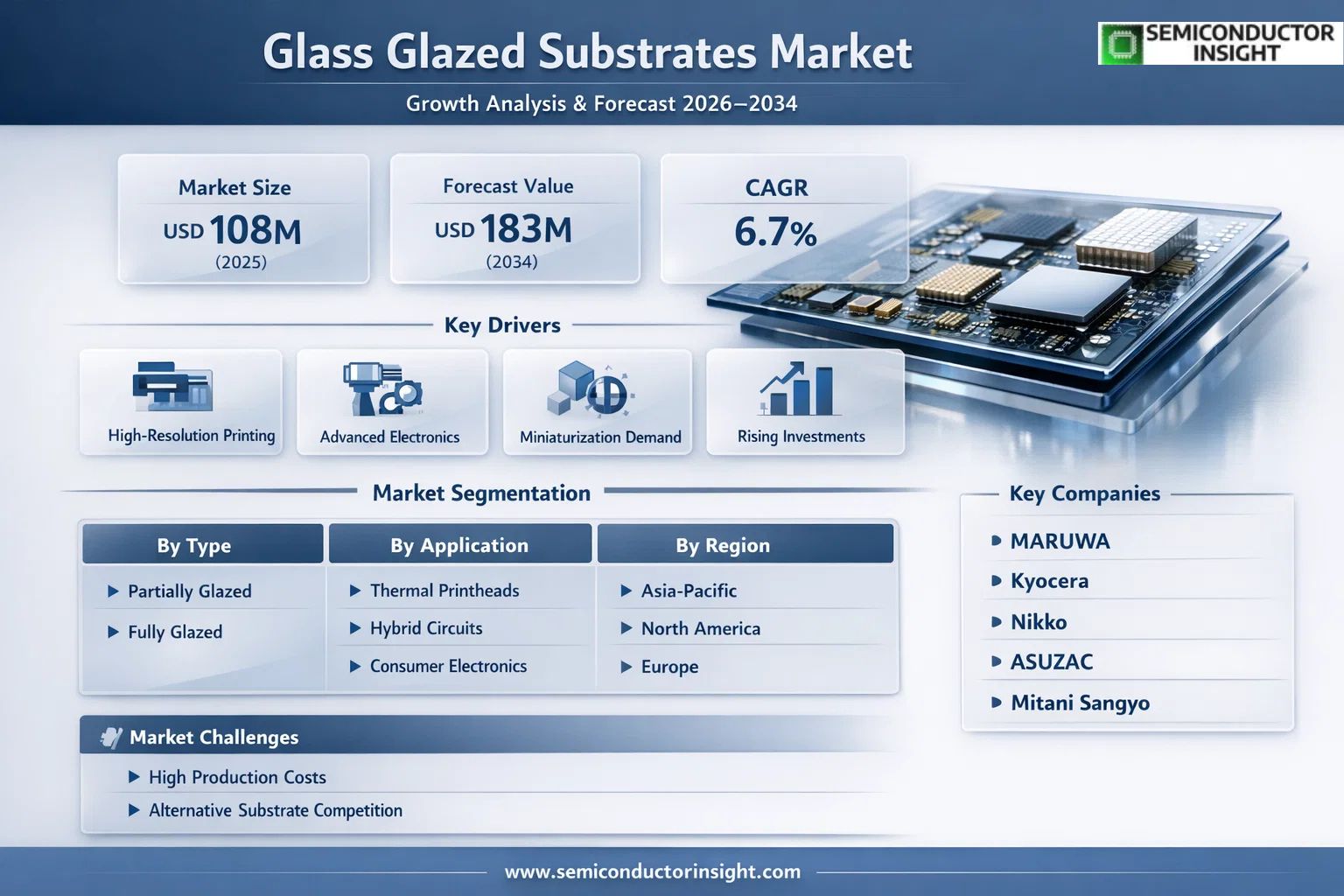
Global Glass Glazed Substrates market size was valued at USD 108 million in 2025. The market is projected to grow from USD 115.6 million in 2026 to USD 183 million by 2034, exhibiting a CAGR of 6.7% during the forecast period.
Glass glazed substrates are specialized ceramic components featuring a vitreous, glass-like surface coating fired onto a base material, typically alumina. These substrates are engineered for superior flatness and minimal surface defects, which is critical for high-precision applications. Their primary function is to serve as an ideal platform for increasingly high-resolution printer heads, particularly thermal printheads used in advanced printing and imaging equipment. Furthermore, they are essential in hybrid circuits and other electronic applications where a smooth, insulating, and durable base is required.
The market growth is primarily driven by the relentless demand for higher print quality and miniaturization in electronics, which necessitates components with exceptional dimensional stability and surface perfection. The expansion of digital printing across industrial, commercial, and packaging sectors acts as a significant catalyst. However, the market faces challenges from alternative substrate technologies and the high precision manufacturing costs associated with these specialized ceramics. Key players like MARUWA, Nikko, and Kyocera dominate the landscape through continuous R&D focused on enhancing substrate performance for next-generation applications, ensuring their products meet the stringent requirements of modern microelectronics and precision printing.
MARKET DRIVERS
Demand for Advanced Display Technologies
The robust growth of the Glass Glazed Substrates Market is primarily propelled by the escalating demand for high-resolution, flexible displays in consumer electronics. These substrates form the critical foundation for OLED and Micro-LED panels used in smartphones, televisions, and wearables, enabling superior brightness and energy efficiency compared to traditional backlit LCDs. The pursuit of thinner, lighter, and foldable device form factors directly accelerates the adoption of advanced Glass Glazed Substrates.
Expansion of Semiconductor Packaging
Beyond displays, the market is driven by innovations in semiconductor packaging, particularly for advanced integrated circuits. Glass Glazed Substrates offer excellent dimensional stability, superior electrical insulation, and fine-line patterning capabilities essential for high-performance computing, 5G infrastructure, and artificial intelligence hardware. This expansion beyond traditional display applications is creating a significant secondary growth vector for the market.
➤ The transition to higher pixel densities and compact form factors in AR/VR devices is fundamentally dependent on the thermal and mechanical properties of specialized Glass Glazed Substrates.
Furthermore, government and private investments in domestic semiconductor and advanced display manufacturing capabilities globally are providing strong tailwinds for the entire supply chain, including substrate producers. This strategic focus on supply chain resilience and technological sovereignty is a key long-term driver for the Glass Glazed Substrates Market.
MARKET CHALLENGES
High Material and Manufacturing Complexity
A primary challenge in the Glass Glazed Substrates Market is the significant cost and technical complexity involved in production. Manufacturing ultra-thin, flaw-free glass with precise thermal expansion properties requires substantial capital investment in specialized melting, forming, and finishing equipment. Furthermore, the downstream processes, such as thin-film transistor (TFT) deposition and photolithography, demand extremely clean environments, adding to operational expenses and limiting economies of scale for new entrants.
Other Challenges
Supply Chain Fragility for Raw Materials
The production of high-purity, specialty glass relies on consistent access to specific rare earth elements and other refined materials. Geopolitical tensions and trade restrictions can disrupt this supply, causing price volatility and production delays for Glass Glazed Substrates.
Intense Competition from Alternative Substrates
Despite their advantages, Glass Glazed Substrates face competition from flexible plastic polymers (like PI and PET) in certain flexible display applications and from silicon in some advanced packaging fields. This competition pressures providers to continuously innovate while managing cost.
MARKET RESTRAINTS
Capital Intensive Nature and High Entry Barriers
The Glass Glazed Substrates Market is characterized by exceptionally high barriers to entry, which acts as a major restraint on widespread competition and rapid supply expansion. The industry is dominated by a handful of large, vertically integrated manufacturers due to the multi-billion-dollar investments required for new fabrication plants (fabs). This concentration can lead to longer lead times for capacity expansion during demand surges and creates a reliance on a limited number of suppliers for OEMs, potentially stifling competitive pricing dynamics and innovation pace from new players.
MARKET OPPORTUNITIES
Next-Generation Automotive Displays and Lighting
A substantial opportunity lies in the automotive sector’s electrification and digitalization. The trend towards larger, curved, and interactive digital dashboards, heads-up displays (HUDs), and ambient lighting systems presents a new high-growth avenue for the Glass Glazed Substrates Market. These applications require substrates that can withstand harsh automotive environments, including wide temperature fluctuations and vibrations, while enabling sophisticated optical functionalities like transparent displays.
Emergence of Mini/Micro-LED for Consumer Electronics
The commercialization of Mini-LED and Micro-LED display technologies represents a major forward-looking opportunity. These technologies offer unparalleled brightness, contrast, and longevity, but they require substrates with exceptional thermal management and dimensional precision to accommodate millions of microscopic LEDs. Glass Glazed Substrates are uniquely positioned to meet these stringent requirements, potentially opening up significant market share as these next-generation displays move toward mass adoption in premium televisions and professional monitors.
Global Glass Glazed Substrates Market Trends
Accelerating Demand for Advanced Thermal Printing Technology
A primary driver in the Glass Glazed Substrates market is the robust and sustained demand for advanced thermal printheads. These substrates are the critical foundation for high-resolution printer heads, offering superior flatness and minimized surface defects. Their intrinsic properties are essential for the precise ink ejection and consistent print quality demanded by modern commercial printing, industrial labeling, and medical imaging applications. As these end-use industries push for higher-resolution output, the technical specifications of the Glass Glazed Substrates must correspondingly advance, creating a cycle of innovation and requirement for premium quality materials from key suppliers like MARUWA, Kyocera, and Nikko, which collectively dominate the supply landscape.
Other Trends
Precision Electronics Integration
Beyond thermal printing, the functional integration of Glass Glazed Substrates into hybrid circuits and other precision electronic components represents a significant growth vector. The material’s excellent electrical insulation and thermal stability allow for the reliable mounting of delicate semiconductor devices and conductive pastes. This trend is closely linked to miniaturization in electronics and the need for substrates that can withstand high-temperature processing during manufacturing while maintaining dimensional stability. The “Fully Glazed Substrates” segment is particularly critical for applications requiring a complete insulating barrier over the aluminum oxide base, whereas “Partially Glazed Substrates” offer design flexibility for specific circuit architectures.
Geographic Market Concentration and Supply Chain Dynamics
The market remains geographically concentrated, with Asia as the epicenter for both production and consumption. Key manufacturing and innovation hubs in Japan, South Korea, and, increasingly, China, underscore this regional strength. This concentration creates a competitive advantage in terms of integrated supply chains for downstream electronics and printer assembly but also presents logistical considerations for global customers. Concurrently, a trend of strategic collaboration and capacity expansion among the top manufacturers is ongoing to meet rising global demand. Supply chain resilience for high-purity raw materials remains a focal point for industry participants aiming to mitigate potential risks and ensure consistent product quality for Global Glass Glazed Substrates market.
COMPETITIVE LANDSCAPE
Key Industry Players
A Consolidated Market Powered by Niche Applications
Global Glass Glazed Substrates market is characterized by a high degree of consolidation, with the top five manufacturers accounting for a significant majority of Global revenue as of recent assessments. This market structure is driven by the advanced technical requirements for substrates used in high-resolution thermal printheads and hybrid circuits, necessitating significant expertise in ceramic and glass-ceramic material science, precision glazing, and surface finishing. MARUWA, Nikko, Kyocera, and ASUZAC are established leaders, leveraging their deep-rooted capabilities in fine ceramics and electronics components to dominate supply. These companies compete on the basis of product purity, defect-free surface flatness, thermal stability, and reliability, which are critical for end-use applications in printing and advanced electronics. The market is propelled by the demand for higher print resolutions and more compact electronic circuits, pushing manufacturers toward continuous R&D in glazing technologies and material formulations.
Beyond the dominant tier, several other significant players operate successfully by focusing on specialized niches or regional markets. Companies like Mitani Sangyo and NGK SPARK PLUG contribute with specialized material compositions and fabrication techniques. Meanwhile, manufacturers such as Nippon Electric Glass and Asahi Glass Co. (AGC) bring core competencies from the broader glass industry to innovate in substrate performance. The competitive landscape also includes firms like CoorsTek and Murata Manufacturing, which offer integrated component solutions where glass glazed substrates are a key enabler. This competitive environment, while concentrated, is dynamic, with ongoing efforts in strategic collaborations, capacity expansions in the Asia-Pacific region, and development of substrates for emerging applications beyond traditional thermal printing.
List of Key Glass Glazed Substrates Companies Profiled
- MARUWA Co., Ltd.
- Kyocera Corporation
- Nikko Company
- ASUZAC Inc.
- Mitani Sangyo Co., Ltd.
- NGK SPARK PLUG CO., LTD.
- Nippon Electric Glass Co., Ltd.
- AGC Inc.
- CoorsTek, Inc.
- Murata Manufacturing Co., Ltd.
- Corning Incorporated
- Vishay Intertechnology, Inc.
- KOA Corporation
- Taiyo Yuden Co., Ltd.
Segment Analysis:
| Segment Category | Sub-Segments | Key Insights |
| By Type |
|
Partially Glazed Substrates is the leading segment, catering to applications requiring specific electrical isolation properties combined with open conductive areas. Its design flexibility makes it highly preferred for complex circuitry. The balance between glazed and exposed substrate areas allows for tailored thermal and electrical performance, which is critical in advanced manufacturing. This segment benefits from strong demand in cost-sensitive, high-performance applications where full glazing is not a functional necessity. |
| By Application |
|
Thermal Print Head is the dominant application, driven by the essential role of glass glazed substrates in high-resolution printing technology. The superior flatness and minimal surface defects of these substrates are critical for the precise operation and longevity of modern thermal print heads. This segment’s growth is underpinned by continuous advancements in commercial and industrial printing, requiring more reliable and efficient components. The material’s stability under thermal cycling further solidifies its position as the preferred choice in this demanding application. |
| By End User |
|
Electronics Manufacturing represents the leading end-user segment, leveraging these substrates for core components in various devices. Manufacturers value the material for its excellent electrical insulation, thermal management capabilities, and dimensional stability, which are paramount for miniaturization and performance in modern electronics. The segment’s leadership is reinforced by the pervasive integration of hybrid circuits and thermal print mechanisms across multiple industries, from automotive to medical devices, creating a consistent and sophisticated demand pipeline. |
| By Material Complexity |
|
Advanced Ceramic Composites are emerging as a key focus area, offering enhanced performance for next-generation applications. These materials provide superior thermal conductivity and mechanical strength compared to traditional options, allowing for operation in more extreme environments. Their development is driven by the need for greater reliability in high-power and high-frequency applications. The innovation in this segment is a primary factor enabling the broader adoption of glass glazed substrates in cutting-edge electronic and industrial systems. |
| By Innovation Focus |
|
Surface Finish & Flatness is the paramount area of innovation, as it directly dictates the performance in precision applications like thermal print heads. Leading manufacturers are investing heavily in process technologies to achieve near-perfect surface quality, which reduces defects and improves print resolution and component yield. This focus not only meets existing industry benchmarks but also enables the development of future high-density printing and microelectronic applications. Continuous improvement in this domain is a critical competitive differentiator and a major driver for market advancement. |
Regional Analysis: Glass Glazed Substrates Market
Asia-Pacific
As Global center for flat-panel display assembly, the region’s demand for large-format and ultra-high-definition Glass Glazed Substrates is unparalleled, with panel makers requiring consistent, defect-free glass for high-yield production lines.
Rapid integration of new display architectures like OLED and microLED, which depend on thermally stable and ultra-smooth glass substrates, is a key driver, supported by local R&D and strong partnerships between glass makers and device OEMs.
The presence of integrated glass manufacturers, coating specialists, and precision cutting services creates a highly efficient ecosystem, reducing lead times and costs for electronics brands sourcing Glass Glazed Substrates.
Massive local markets for smartphones, tablets, and automotive displays ensure sustained, high-volume demand, pushing substrate suppliers to innovate in areas like thinness, strength, and optical clarity for premium devices.
North America
North America holds a significant position in the Glass Glazed Substrates Market, characterized by high-value, specialized demand. The region’s strength lies in advanced R&D and early adoption of cutting-edge technologies requiring precision glass. Key demand centers include the defense and aerospace sectors for ruggedized displays, the medical device industry for diagnostic imaging equipment, and the burgeoning field of AR/VR headsets. North American market dynamics are shaped by a focus on proprietary, high-performance Glass Glazed Substrates with specific optical, thermal, or chemical-resistant properties, often developed through close collaboration between niche glass manufacturers and technology firms. While not a volume manufacturing hub, the region drives premium innovation and sets performance benchmarks.
Europe
The European market for Glass Glazed Substrates is driven by a strong industrial and automotive manufacturing base with an emphasis on quality and engineering excellence. Demand is robust from the automotive sector for advanced instrument clusters and heads-up displays, which require durable, optically perfect substrates. Furthermore, Europe’s presence in high-end industrial equipment, scientific instrumentation, and architectural glass applications supports a steady demand for specialized, coated Glass Glazed Substrates. The regional market is influenced by stringent environmental and safety regulations, pushing manufacturers toward sustainable production processes and the development of eco-friendly glass compositions and coatings, aligning with broader regional sustainability goals.
South America
The Glass Glazed Substrates Market in South America is a developing landscape, currently characterized by import dependency for high-tech applications. Local demand is primarily driven by the consumer electronics aftermarket, television assembly, and construction sectors for architectural and decorative glass. Market growth is closely tied to regional economic stability and investments in local manufacturing capabilities. While large-scale display production is limited, there is growing interest in establishing basic processing lines for Glass Glazed Substrates to serve regional appliance and automotive industries, reducing reliance on overseas suppliers and creating a foundation for future market development.
Middle East & Africa
The Middle East & Africa region represents an emerging segment of the Glass Glazed Substrates Market, with growth pockets driven by infrastructure development and digitalization efforts. In the Middle East, demand stems from large-scale commercial projects requiring high-quality architectural glazing and digital signage. In Africa, the market is nascent, with potential linked to the gradual expansion of consumer electronics retail and telecommunications infrastructure. The regional dynamics are defined by strategic investments in technology hubs and smart city projects, which are expected to gradually increase the specification and adoption of high-performance Glass Glazed Substrates for public displays and commercial applications over the long term.
Report Scope
This market research report provides a comprehensive analysis of the Glass Glazed Substrates Market , covering the forecast period 2026–2034. It offers detailed insights into market dynamics, technological advancements, competitive landscape, and key trends shaping the industry.
Key focus areas of the report include:
- Market Overview: The report begins with an overview outlining its current market scenario, key growth indicators, and industry transformation drivers. It discusses macroeconomic factors, demand–supply balance, regulatory landscape, and the strategic role of semiconductors in powering advancements across industries such as automotive, telecommunications, consumer electronics, and industrial automation.
- Market Size & Forecast: Historical data and future projections for revenue, unit shipments, and market value across major regions and segments.
- Segmentation Analysis: Detailed breakdown by product type, technology, application, and end-user industry to identify high-growth segments and investment opportunities.
- Regional Insights: Insights into market performance across North America, Europe, Asia-Pacific, Latin America, and the Middle East & Africa, including country-level analysis where relevant.
- Competitive Landscape: Profiles of leading market participants, including their product offerings, R&D focus, manufacturing capacity, pricing strategies, and recent developments such as mergers, acquisitions, and partnerships.
- Technology Trends & Innovation: Assessment of emerging technologies, integration of AI/IoT, semiconductor design trends, fabrication techniques, and evolving industry standards.
- Market Drivers & Restraints: Evaluation of factors driving market growth along with challenges, supply chain constraints, regulatory issues, and market-entry barriers.
- Stakeholder Insights: Insights for component suppliers, OEMs, system integrators, investors, and policymakers regarding the evolving ecosystem and strategic opportunities.
Primary and secondary research methods are employed, including interviews with industry experts, data from verified sources, and real-time market intelligence to ensure the accuracy and reliability of the insights presented.
FREQUENTLY ASKED QUESTIONS:
What is the current market size of Glass Glazed Substrates Market?
-> Global Glass Glazed Substrates Market was valued at USD 108 million in 2025 and is projected to reach USD 183 million by 2034, growing at a CAGR of 6.7% during the forecast period.
Which key companies operate in Glass Glazed Substrates Market?
-> Key players include MARUWA, Nikko, Kyocera, ASUZAC, and Mitani Sangyo, among others. In 2025, Global top five players held a significant revenue share.
What are the key growth drivers?
-> Key growth drivers include demand for high-resolution printer heads, superior flatness and fewer surface defects ideal for thermal printheads, and adoption in advanced printing applications.
Which region dominates the market?
->Asia region, particularly markets like China and Japan, is a major consumer and producer, with significant market activity also in North America (U.S.) and Europe.
What are the emerging trends?
-> Emerging trends include advancements in substrate technology for hybrid circuits, increasing application in thermal print heads, and development of partially and fully glazed substrate variants.

Get Sample Report PDF for Exclusive Insights
Report Sample Includes
- Table of Contents
- List of Tables & Figures
- Charts, Research Methodology, and more...