Genomic Computing Chip Market Insights
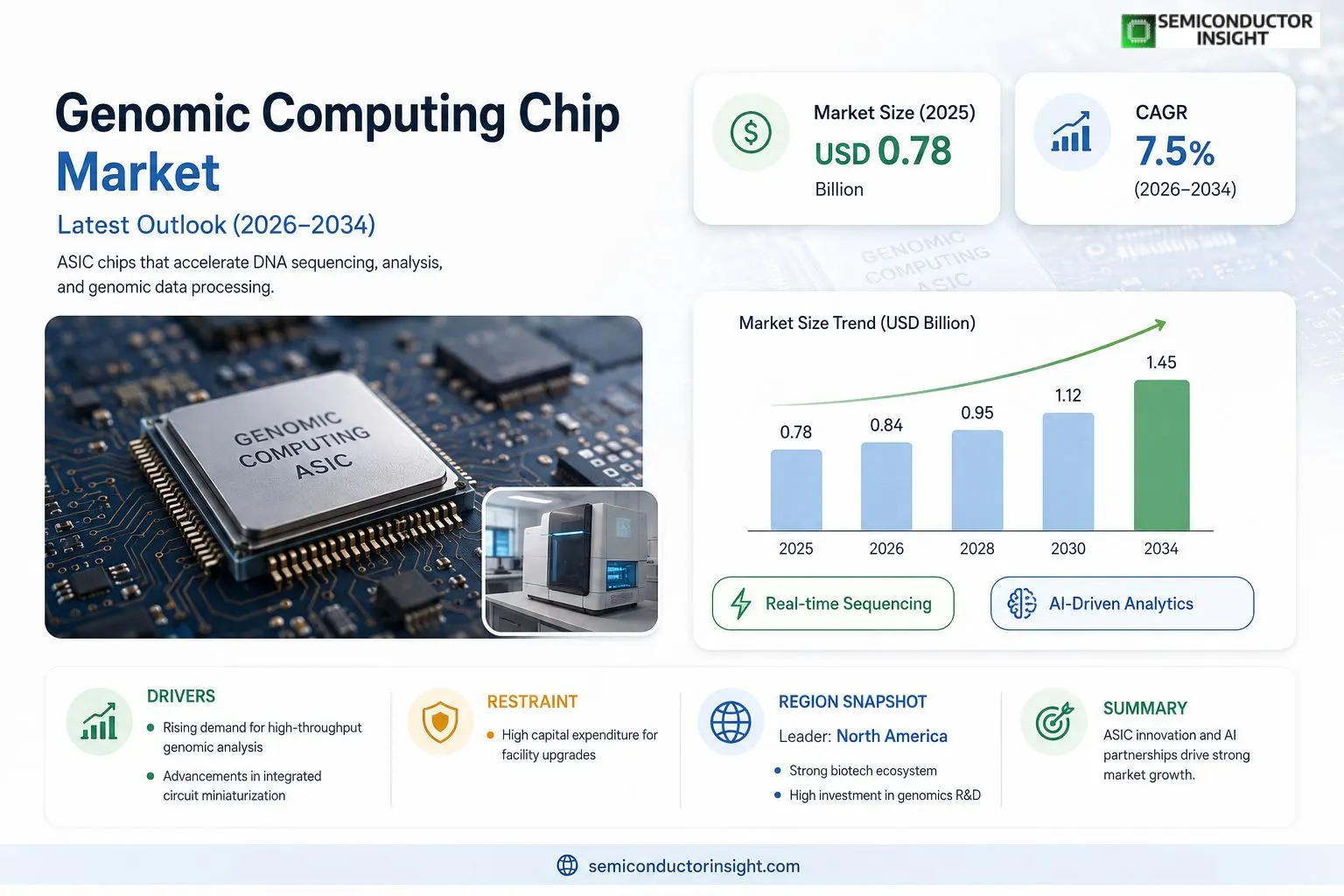
Global Genomic Computing Chip market size was valued at USD 0.78 billion in 2025. The market is projected to grow from USD 0.84 billion in 2026 to USD 1.45 billion by 2034, exhibiting a CAGR of 7.5% during the forecast period.
Genomic computing chips are application‑specific integrated circuits (ASICs) engineered to accelerate DNA sequencing, analysis, and synthetic biology workflows. These chips combine high‑throughput parallel processing cores, low‑latency memory architectures, and optimized data‑transfer pathways that enable real‑time base calling and variant detection while consuming less power than general‑purpose processors.The market is experiencing rapid expansion because biotech firms are investing heavily in next‑generation sequencing platforms and AI‑driven analytics. Rising demand for precision medicine and large‑scale population genomics projects further fuels adoption of dedicated silicon solutions. Key players such as Illumina (NovaSeq X series), Thermo Fisher Scientific (Ion Torrent™ chips), BGI (MGI DNBSEQ™) and Roche continuously enhance chip architectures and form strategic alliances,e.g., Illumina’s partnership with NVIDIA announced in March 2024,to improve computational efficiency and lower assay costs.
MARKET DRIVERS
Rising Demand for High‑Throughput Genomic Analysis
Genomic Computing Chip Market is being propelled by the escalating need for rapid, large‑scale DNA sequencing in personalized medicine, agricultural genomics, and infectious disease surveillance. Laboratories are shifting from legacy platforms to chip‑based solutions that deliver higher data density with lower reagent consumption, thereby accelerating research timelines.
Advancements in Integrated Circuit Miniaturization
Continuous improvements in CMOS and nanofabrication technologies enable chips to integrate thousands of processing units on a single die. This miniaturization reduces power requirements and supports on‑chip analytics, making genomic workflows more portable and cost‑effective for point‑of‑care applications.
➤ Genomic Computing Chips allow real‑time data interpretation directly at the sequencing instrument, shortening the decision‑making cycle for clinicians and researchers.
Adoption is further reinforced by partnerships between semiconductor manufacturers and biotech firms, creating ecosystems that streamline software‑hardware integration. As a result, Genomic Computing Chip Market is set to sustain robust expansion over the next decade.
MARKET CHALLENGES
Technical Complexity and Validation
Designing chips that reliably process complex genomic datasets demands sophisticated algorithms and rigorous validation protocols. Ensuring consistency across diverse sample types remains a bottleneck, particularly for emerging clinical applications where regulatory confidence is essential.
Other Challenges
Regulatory Hurdles
Regulatory agencies require comprehensive evidence of analytical accuracy and clinical utility. The time‑intensive clearance pathways can delay market entry, especially for novel chip architectures that lack precedent in existing guidelines.
MARKET RESTRAINTS
High Capital Expenditure for Facility Upgrades
Implementing next‑generation genomic computing chips often requires substantial investment in specialized cleanrooms, high‑precision lithography tools, and advanced testing infrastructure. Smaller biotech firms may struggle to allocate such resources, limiting broader market penetration.
MARKET OPPORTUNITIES
Expansion into Point‑of‑Care Diagnostics
The convergence of portable sequencing devices with integrated computing chips opens new avenues for rapid, on‑site genetic testing in remote or resource‑limited settings. This opportunity aligns with global health initiatives seeking to deploy real‑time surveillance tools for emerging pathogens, positioning Genomic Computing Chip Market for significant growth in decentralized healthcare.
Genomic Computing Chip Market Trends
Accelerated DNA Sequencing Through ASIC Design
Genomic Computing Chip Market is being reshaped by application‑specific integrated circuits that fuse high‑throughput parallel cores with low‑latency memory fabrics. These ASICs enable real‑time base calling and variant detection while consuming a fraction of the power required by conventional processors. By embedding optimized data‑transfer pathways directly on silicon, chip manufacturers reduce latency and improve throughput for next‑generation sequencing platforms. The resulting efficiency gains are driving wider adoption in precision‑medicine initiatives and large‑scale population genomics projects, where rapid data turnaround is a decisive competitive advantage.
Other Trends
Strategic Partnerships Enhancing Compute Efficiency
Key players are reinforcing Genomic Computing Chip Market through collaborations that blend hardware expertise with bio‑informatics know‑how. Illumina’s alliance with NVIDIA, announced in early 2024, integrates GPU‑accelerated algorithms into its NovaSeq X series, delivering faster analytical pipelines. Thermo Fisher Scientific and BGI have pursued joint development programs to harmonize Ion Torrent™ and MGI DNBSEQ™ chip architectures, while Roche’s partnership network focuses on co‑designing silicon solutions for synthetic biology workflows. These strategic ties shorten development cycles, lower assay costs, and expand the ecosystem of compatible software tools, reinforcing the market’s growth trajectory.
AI‑Driven Analytics Integration
Artificial‑intelligence models are increasingly embedded within genomic chips, allowing on‑device inference that accelerates pattern recognition in massive sequencing datasets. By off‑loading machine‑learning workloads to dedicated compute blocks, manufacturers reduce data movement and improve energy efficiency, a critical factor for large‑scale laboratory deployments. This integration supports advanced applications such as real‑time pathogen surveillance and adaptive clinical decision support. As AI algorithms mature and become more tightly coupled with silicon, Genomic Computing Chip Market is expected to see further differentiation among vendors that can deliver seamless, low‑latency analytics alongside raw sequencing performance.
COMPETITIVE LANDSCAPEKey Industry Players
Competitive Landscape of Genomic Computing Chip Market
Genomic Computing Chip Market is dominated by a handful of large‑scale biotech and semiconductor firms that integrate application‑specific integrated circuits (ASICs) into next‑generation sequencing platforms. Illumina leads with its NovaSeq X series, leveraging high‑throughput ASIC designs to accelerate base‑calling pipelines. Thermo Fisher Scientific follows closely with Ion Torrent™ chips that combine proprietary semiconductor technology with optimized chemistry. BGI’s MGI DNBSEQ™ platform and Roche’s integrated sequencing solutions also command significant market share, each advancing chip architectures to reduce power consumption and latency. Strategic alliances, such as Illumina’s partnership with NVIDIA announced in March 2024, underscore a trend toward hybrid hardware‑software ecosystems that enhance computational efficiency and lower assay costs, reinforcing a concentration of power among these tier‑one players.Beyond the dominant tier, a diverse set of niche innovators contributes specialized capabilities that broaden the market’s competitive fabric. Pacific Biosciences focuses on long‑read sequencing chips that enable high‑accuracy structural variant detection. Oxford Nanopore Technologies provides portable nanopore ASICs that support real‑time, field‑deployable genomics. Twist Bioscience’s silicon‑based DNA synthesis chips intersect with computing workloads, while QIAGEN integrates custom ASICs into its sample‑to‑insight solutions. Guardant Health, Adaptive Biotechnologies, and Sentaurus Therapeutics each embed proprietary chips within liquid‑biopsy and immune‑repertoire platforms, targeting precision‑medicine applications. These players, though smaller in revenue, drive differentiation through unique form factors, low‑cost designs, and vertical integration with bioinformatics pipelines, fostering incremental innovation across the ecosystem.
List of Key Genomic Computing Chip Companies Profiled
- Illumina
- Thermo Fisher Scientific
- BGI (MGI)
- Roche
- Pacific Biosciences
- Oxford Nanopore Technologies
- Twist Bioscience
- QIAGEN
- Guardant Health
- Adaptive Biotechnologies
- Sentaurus Therapeutics
- NVIDIA
Segment Analysis:
| Segment Category | Sub-Segments | Key Insights |
| By Type |
|
ASICs
|
| By Application |
|
Whole‑genome sequencing
|
| By End User |
|
Biotechnology firms
|
| By Technology Integration |
|
AI‑enhanced analytics
|
| By Deployment Model |
|
Hybrid cloud ecosystems
|
Regional Analysis: North America
North America
The continuous evolution of DNA sequencing technologies is a key driver for the adoption of specialized computing chips. Faster and more accurate sequencing generates larger datasets, necessitating powerful processing capabilities.
With the increasing volume of sensitive genomic data, ensuring robust security measures and adhering to strict privacy regulations are paramount considerations for businesses in North America.
Strong partnerships between research institutions and technology companies are fostering innovation and accelerating the development of next-generation genomic computing chips in North America.
The growing trend towards cloud computing is facilitating access to powerful genomic computing resources, making advanced chip technologies more accessible to a wider range of users in North America.
Europe
Europe’s Genomic Computing Chip Market is exhibiting steady growth, propelled by increasing investments in life sciences and a focus on precision medicine. Several countries in Europe are actively supporting research and development initiatives in genomics, creating a favorable environment for innovation. The region’s strong emphasis on data privacy and security is influencing the development of secure and compliant genomic computing solutions. While the pace of adoption might be slightly slower compared to North America, Europe presents a significant long-term opportunity for chip manufacturers catering to the European healthcare and research sectors. The concentration of pharmaceutical giants and research hubs across Europe further strengthens the market potential.
Asia-Pacific
The Asia-Pacific region represents a high-growth market for Genomic Computing Chip Market. Countries like China, Japan, and South Korea are witnessing rapid advancements in genomics research and diagnostics, driven by increasing healthcare spending and a growing awareness of personalized medicine. The region’s large population and rising prevalence of genetic diseases contribute to the demand for genomic analysis. Government initiatives promoting biotechnology and digital health are further fueling market expansion. However, challenges related to data infrastructure and regulatory harmonization need to be addressed for sustained growth.
South America
South America’s Genomic Computing Chip Market is in its nascent stages but holds promising potential. Increasing investments in healthcare and biotechnology in countries like Brazil and Argentina are creating initial demand for genomic computing solutions. The growing focus on disease diagnostics and personalized treatment options is expected to drive market growth in the coming years. However, the region faces challenges related to limited infrastructure, regulatory complexities, and affordability of advanced technologies.
Middle East & Africa
The Middle East & Africa region presents a relatively smaller market for Genomic Computing Chip Market compared to other regions. However, increasing investments in healthcare infrastructure and a growing focus on genetic research in countries like the UAE and South Africa are expected to drive gradual market expansion. The region’s rising healthcare expenditure and increasing awareness of genetic disorders are contributing factors to this growth. Addressing challenges related to limited research capabilities and regulatory frameworks will be crucial for unlocking the full potential of this market.
Report Scope
This market research report provides a comprehensive analysis of the Genomic Computing Chip Market , covering the forecast period 2026–2034. It offers detailed insights into market dynamics, technological advancements, competitive landscape, and key trends shaping the industry.
Key focus areas of the report include:
- Market Overview: The report begins with an overview outlining its current market scenario, key growth indicators, and industry transformation drivers. It discusses macroeconomic factors, demand–supply balance, regulatory landscape, and the strategic role of semiconductors in powering advancements across industries such as automotive, telecommunications, consumer electronics, and industrial automation.
- Market Size & Forecast: Historical data and future projections for revenue, unit shipments, and market value across major regions and segments.
- Segmentation Analysis: Detailed breakdown by product type, technology, application, and end-user industry to identify high-growth segments and investment opportunities.
- Regional Insights: Insights into market performance across North America, Europe, Asia-Pacific, Latin America, and the Middle East & Africa, including country-level analysis where relevant.
- Competitive Landscape: Profiles of leading market participants, including their product offerings, R&D focus, manufacturing capacity, pricing strategies, and recent developments such as mergers, acquisitions, and partnerships.
- Technology Trends & Innovation: Assessment of emerging technologies, integration of AI/IoT, semiconductor design trends, fabrication techniques, and evolving industry standards.
- Market Drivers & Restraints: Evaluation of factors driving market growth along with challenges, supply chain constraints, regulatory issues, and market-entry barriers.
- Stakeholder Insights: Insights for component suppliers, OEMs, system integrators, investors, and policymakers regarding the evolving ecosystem and strategic opportunities.
Primary and secondary research methods are employed, including interviews with industry experts, data from verified sources, and real-time market intelligence to ensure the accuracy and reliability of the insights presented.
FREQUENTLY ASKED QUESTIONS:
What is the current market size of Genomic Computing Chip Market?
-> Genomic Computing Chip Market was valued at USD 0.78 billion in 2025 and is expected to reach USD 1.45 billion by 2034.
Which key companies operate in Genomic Computing Chip Market?
-> Key players include Illumina (NovaSeq X series), Thermo Fisher Scientific (Ion Torrent™ chips), BGI (MGI DNBSEQ™), Roche, among others.
What are the key growth drivers?
-> Key growth drivers include heavy biotech investment in next‑generation sequencing platforms, AI‑driven analytics, rising demand for precision medicine, and large‑scale population genomics projects.
Which region dominates the market?
-> The reference does not specify a dominant region.
What are the emerging trends?
-> Emerging trends include advancements in ASIC design for lower power consumption, integration of AI for real‑time base calling, and strategic alliances between chip manufacturers and AI hardware providers.
Get Sample Report PDF for Exclusive Insights
Report Sample Includes
- Table of Contents
- List of Tables & Figures
- Charts, Research Methodology, and more...
 Download Sample Report PDF