Generative AI Market Insights
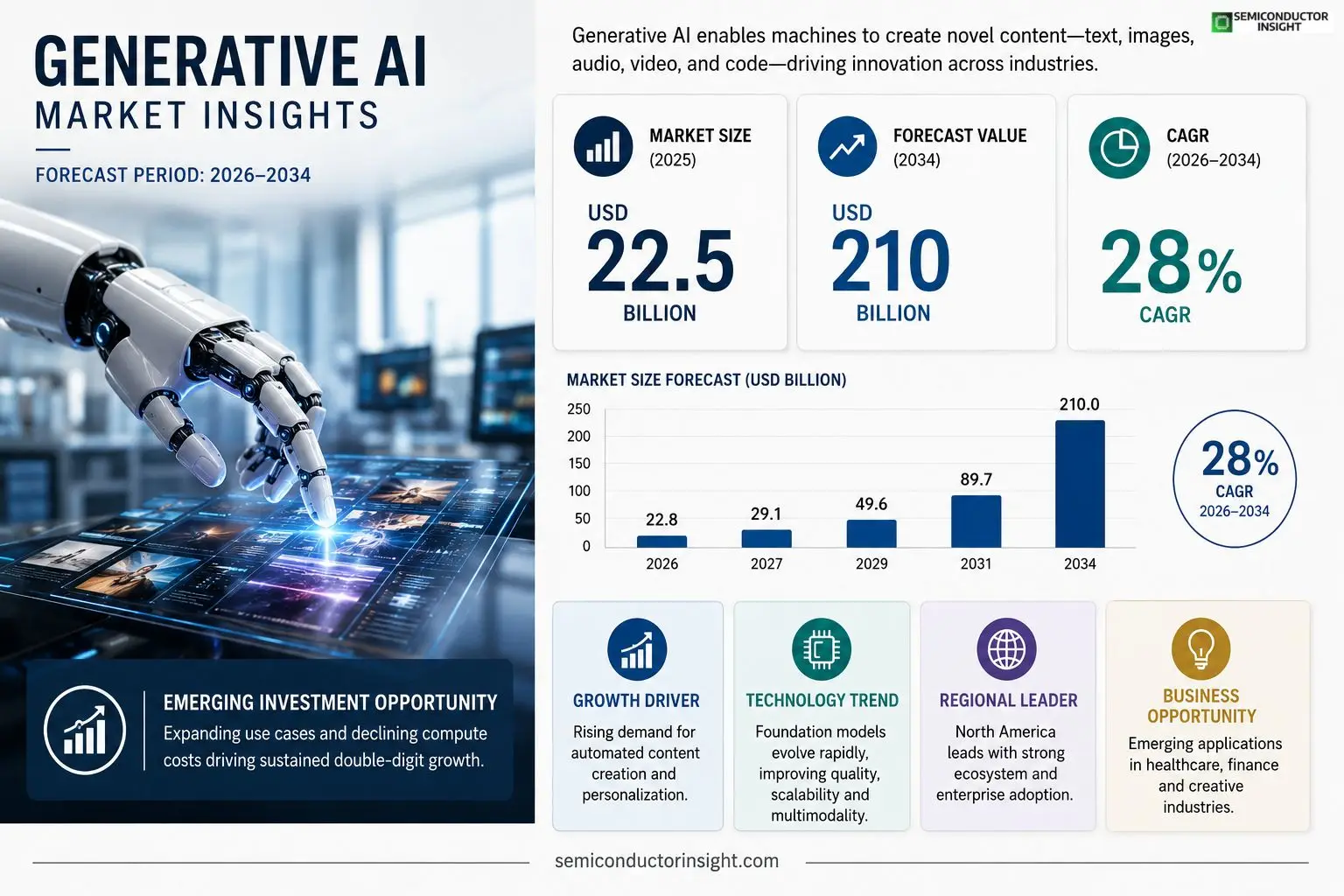
Global Generative AI market size was valued at USD 22.5 billion in 2025.The market is projected to grow from USD 22.8 billion in 2026 to USD 210 billion by 2034, exhibiting a CAGR of 28% during the forecast period.
Generative artificial intelligence refers to algorithms,primarily large language models, diffusion models and transformer‑based architectures,that can create novel content such as text, images, audio, video or code based on learned patterns.
This technology enables machines to synthesize realistic outputs that were previously exclusive to human creators, driving new applications across creative design, software development and personalized marketing.
MARKET DRIVERS
Rising Demand for Automated Content Creation
Enterprises across media, marketing and e‑learning are adopting Generative AI Market to accelerate content production, reduce cycle times and lower costs. Automation of text, image and video generation enables firms to meet personalized consumer expectations at scale.
Strategic Investments by Technology Leaders
Major cloud providers and semiconductor companies are allocating multi‑billion‑dollar budgets to advance foundation models, expanding compute capacity and fostering ecosystem partnerships. These investments reinforce the confidence of venture capital and enterprise buyers in long‑term growth of Generative AI Market.
➤ Generative AI Market is expected to grow at a double‑digit compound annual growth rate over the next decade, driven by expanding use cases and falling compute costs.
Combined, the surge in demand for AI‑generated assets and deep pockets of industry leaders create a virtuous cycle that accelerates research, deployment and revenue generation for Generative AI Market.
MARKET CHALLENGES
Talent Shortage and Computational Costs
Developing and fine‑tuning large generative models requires highly specialized AI researchers and engineers, a talent pool that is currently limited. At the same time, the energy‑intensive training processes increase operational expenses, making it difficult for smaller firms to compete.
Other Challenges
Regulatory Uncertainty
Policymakers worldwide are still defining frameworks for synthetic media, intellectual property and responsible AI. This regulatory ambiguity can delay product launches and elevate compliance costs for participants in Generative AI Market.
MARKET RESTRAINTS
High Infrastructure Expenses
Deploying large‑scale generative models demands high‑performance GPUs or specialized AI accelerators, along with robust data center cooling and power provisioning. The capital intensity restricts entry for startups and can slow the pace of innovation within Generative AI Market.
MARKET OPPORTUNITIES
Emerging Applications in Healthcare
AI‑generated molecular designs, radiology report summarization and personalized patient education are creating new revenue streams. As healthcare providers adopt compliant generative solutions, Generative AI Market stands to capture substantial value from improved diagnostics, drug discovery acceleration and cost‑effective patient engagement.
Generative AI Market Trends
Enterprise Integration Accelerates
Generative AI Market is witnessing a rapid shift as large enterprises embed generative models into core workflows. Companies are leveraging text‑generation engines to automate routine report drafting, while diffusion‑based image synthesis tools streamline product design cycles. This operational embedment reduces time‑to‑market for new offerings and frees skilled talent to focus on higher‑value creative tasks. Adoption is reinforced by improved model reliability, expanded API ecosystems, and the emergence of industry‑specific fine‑tuned models that respect data privacy constraints. As a result, cross‑functional teams are reporting measurable efficiency gains, indicating that enterprise‑level deployment has become a decisive growth lever for Generative AI Market.
Other Trends
Creative Industries Adoption
The creative sector is adopting generative techniques at an unprecedented pace. Advertising agencies use prompt‑driven copy tools to generate campaign concepts in minutes, while film studios experiment with AI‑crafted storyboards that accelerate pre‑production. Music producers employ AI‑assisted composition to explore novel melodic structures, and fashion designers rely on AI‑generated visual patterns to expand their collections. These applications are driven by models that can produce high‑fidelity outputs aligned with brand aesthetics, allowing creators to iterate faster without compromising artistic intent. The trend reflects a broader cultural acceptance of AI as a collaborative partner rather than a replacement, reinforcing the market’s expansion into creative domains.
Regulatory and Ethical Frameworks Evolve
Regulatory scrutiny is intensifying as policymakers seek to balance innovation with societal safeguards. Organizations are implementing responsible AI safeguards, including provenance tracking for generated content and bias mitigation protocols. Industry consortia are publishing best‑practice guidelines that standardize model evaluation criteria and transparency disclosures. These emerging frameworks are shaping procurement decisions, prompting vendors to certify compliance and offer explainability features. By integrating ethical considerations early in the development cycle, companies not only reduce legal risk but also build stakeholder trust, positioning Generative AI Market for sustainable, long‑term adoption across regulated industries.
COMPETITIVE LANDSCAPEKey Industry Players
Generative AI Market: A Rapidly Expanding Landscape
Generative AI Market is currently anchored by a small group of platform leaders that combine robust model families, extensive data pipelines, and deep integration with cloud ecosystems. OpenAI remains the most visible pioneer, with its GPT series powering a wide range of enterprise and consumer applications. Microsoft’s strategic investment and Azure‑based deployment model amplify OpenAI’s reach, creating a de‑facto standard for large‑scale language services. Google DeepMind leverages the Transformer architecture across its Gemini models, while Anthropic focuses on safety‑centric instruction‑tuned models that are increasingly adopted by regulated industries. These titans shape the market’s pricing dynamics, drive the majority of venture capital inflows, and set the benchmark for model performance, creating a tiered structure where smaller innovators must either specialize in niche verticals or forge partnership pathways to compete.Beyond the top tier, a diverse set of niche players contributes critical innovations that broaden the generative AI ecosystem. Meta AI pushes multimodal research through its LLaMA and ImageBind initiatives, targeting social media and immersive content creation. Adobe integrates generative diffusion models into its Creative Cloud suite, enabling designers to generate assets on demand. IBM Watson emphasizes enterprise‑grade compliance and fine‑tuned domain models for financial services. Amazon Web Services offers Bedrock, a managed service that aggregates multiple model providers for scalable inference. Nvidia supplies the GPU infrastructure that underpins most training workloads, while Stability AI, Cohere, Hugging Face, Baidu, Salesforce, and Oracle deliver specialized APIs, open‑source repositories, or localized language capabilities that address regional and industry‑specific needs.
List of Key Generative AI Companies Profiled
- OpenAI
- Microsoft
- Google DeepMind
- Anthropic
- Meta AI
- Adobe
- IBM Watson
- Amazon Web Services (AWS)
- Nvidia
- Stability AI
- Cohere
- Hugging Face
- Baidu
- Salesforce
- Oracle
Segment Analysis:
| Segment Category | Sub-Segments | Key Insights |
| By Type |
|
Foundation Models
|
| By Application |
|
Creative Content Generation
|
| By End User |
|
Enterprises
|
| By Deployment Mode |
|
Cloud‑Based Services
|
| By Industry Vertical |
|
Media & Entertainment
|
Regional Analysis: North America
United States
The application of Generative AI in enterprise content creation is experiencing rapid growth. Businesses are leveraging these tools to automate tasks such as generating marketing copy, drafting reports, and creating training materials. This leads to significant efficiency gains and frees up human employees for more strategic work.
Generative AI is revolutionizing the drug discovery process by accelerating the identification of potential drug candidates and optimizing molecular structures. This technology significantly reduces the time and cost associated with traditional drug development, offering promising advancements in healthcare.
Generative AI tools are increasingly being used to automate various stages of software development, including code generation, testing, and debugging. This results in faster development cycles and improved software quality, enabling faster innovation in the tech sector.
The financial sector is exploring the use of Generative AI for sophisticated financial modeling, risk assessment, and fraud detection. Its ability to analyze vast datasets quickly is proving valuable in complex financial decision-making.
Europe
Europe is steadily gaining traction in Generative AI Market, with countries like the UK, Germany, and France leading the charge. The emphasis here is on responsible AI development, with a strong focus on ethical considerations and data privacy regulations. Investment is concentrated in areas like AI-powered design, personalized customer experiences, and process optimization. While adoption rates are slightly lower than in the US, the European market offers a unique opportunity for companies focused on building trustworthy and compliant Generative AI solutions. The regulatory environment, particularly the EU AI Act, is shaping the development and deployment of these technologies, emphasizing transparency and accountability. This focus on ethical AI is a key differentiator for the European market, fostering a more cautious yet innovative approach to Generative AI adoption.
Asia-Pacific
Asia-Pacific presents a dynamic and rapidly expanding market for Generative AI. Countries like China, Japan, and South Korea are investing heavily in AI research and development, driven by government support and a strong domestic technology sector. The application of Generative AI is diverse, spanning across industries like manufacturing, healthcare, and entertainment. China, in particular, is showcasing significant advancements in areas like AI-generated art and content, while Japan is leveraging Generative AI for industrial automation and smart city initiatives. The market is characterized by fierce competition, with both local and international players vying for dominance. The availability of large datasets and a growing pool of AI talent are fueling the rapid growth of Generative AI Market in this region.
South America
Generative AI Market in South America is in its early stages of development but holds considerable potential. Brazil and Argentina are emerging as key markets, driven by increasing internet penetration and a growing awareness of AI’s capabilities. The initial focus is on applications like customer service chatbots, personalized marketing, and content generation for local businesses. Challenges include limited access to advanced computing infrastructure and a shortage of skilled AI professionals. However, the region’s large population and increasing adoption of digital technologies present a significant growth opportunity for Generative AI solutions. As infrastructure improves and talent develops, Generative AI Market in South America is poised for substantial expansion.
Middle East & Africa
The Middle East & Africa region represents a nascent but promising market for Generative AI. The technology adoption rate is growing rapidly, driven by government initiatives to diversify economies and invest in digital transformation. Key applications include healthcare diagnostics, financial modeling, and smart infrastructure development. The region’s focus is on solving specific local challenges, such as improving healthcare access and optimizing resource management. Challenges include limited availability of high-quality data and the need for specialized AI expertise. However, the region’s significant investments in technology and a youthful population position it for substantial growth in Generative AI Market over the coming years.
Report Scope
This market research report provides a comprehensive analysis of the Generative AI Market , covering the forecast period 2026–2034. It offers detailed insights into market dynamics, technological advancements, competitive landscape, and key trends shaping the industry.
Key focus areas of the report include:
- Market Overview: The report begins with an overview outlining its current market scenario, key growth indicators, and industry transformation drivers. It discusses macroeconomic factors, demand–supply balance, regulatory landscape, and the strategic role of semiconductors in powering advancements across industries such as automotive, telecommunications, consumer electronics, and industrial automation.
- Market Size & Forecast: Historical data and future projections for revenue, unit shipments, and market value across major regions and segments.
- Segmentation Analysis: Detailed breakdown by product type, technology, application, and end-user industry to identify high-growth segments and investment opportunities.
- Regional Insights: Insights into market performance across North America, Europe, Asia-Pacific, Latin America, and the Middle East & Africa, including country-level analysis where relevant.
- Competitive Landscape: Profiles of leading market participants, including their product offerings, R&D focus, manufacturing capacity, pricing strategies, and recent developments such as mergers, acquisitions, and partnerships.
- Technology Trends & Innovation: Assessment of emerging technologies, integration of AI/IoT, semiconductor design trends, fabrication techniques, and evolving industry standards.
- Market Drivers & Restraints: Evaluation of factors driving market growth along with challenges, supply chain constraints, regulatory issues, and market-entry barriers.
- Stakeholder Insights: Insights for component suppliers, OEMs, system integrators, investors, and policymakers regarding the evolving ecosystem and strategic opportunities.
Primary and secondary research methods are employed, including interviews with industry experts, data from verified sources, and real-time market intelligence to ensure the accuracy and reliability of the insights presented.
FREQUENTLY ASKED QUESTIONS:
What is the current market size of Generative AI Market?
-> Generative AI Market was valued at USD 22.5 billion in 2025 and is expected to reach USD 210 billion by 2034.
Which key companies operate in Generative AI Market?
-> Key players include Axalta Coating Systems, AkzoNobel, BASF SE, PPG, Sherwin-Williams, and 3M, among others.
What are the key growth drivers?
-> Key growth drivers include railway infrastructure investments, urbanization, and demand for durable coatings.
Which region dominates the market?
-> Asia-Pacific is the fastest-growing region, while Europe remains a dominant market.
What are the emerging trends?
-> Emerging trends include bio-based coatings, smart coatings, and sustainable rail solutions.
Get Sample Report PDF for Exclusive Insights
Report Sample Includes
- Table of Contents
- List of Tables & Figures
- Charts, Research Methodology, and more...
 Download Sample Report PDF