Generative AI for Analog Layout Constraint Generation Market Insights
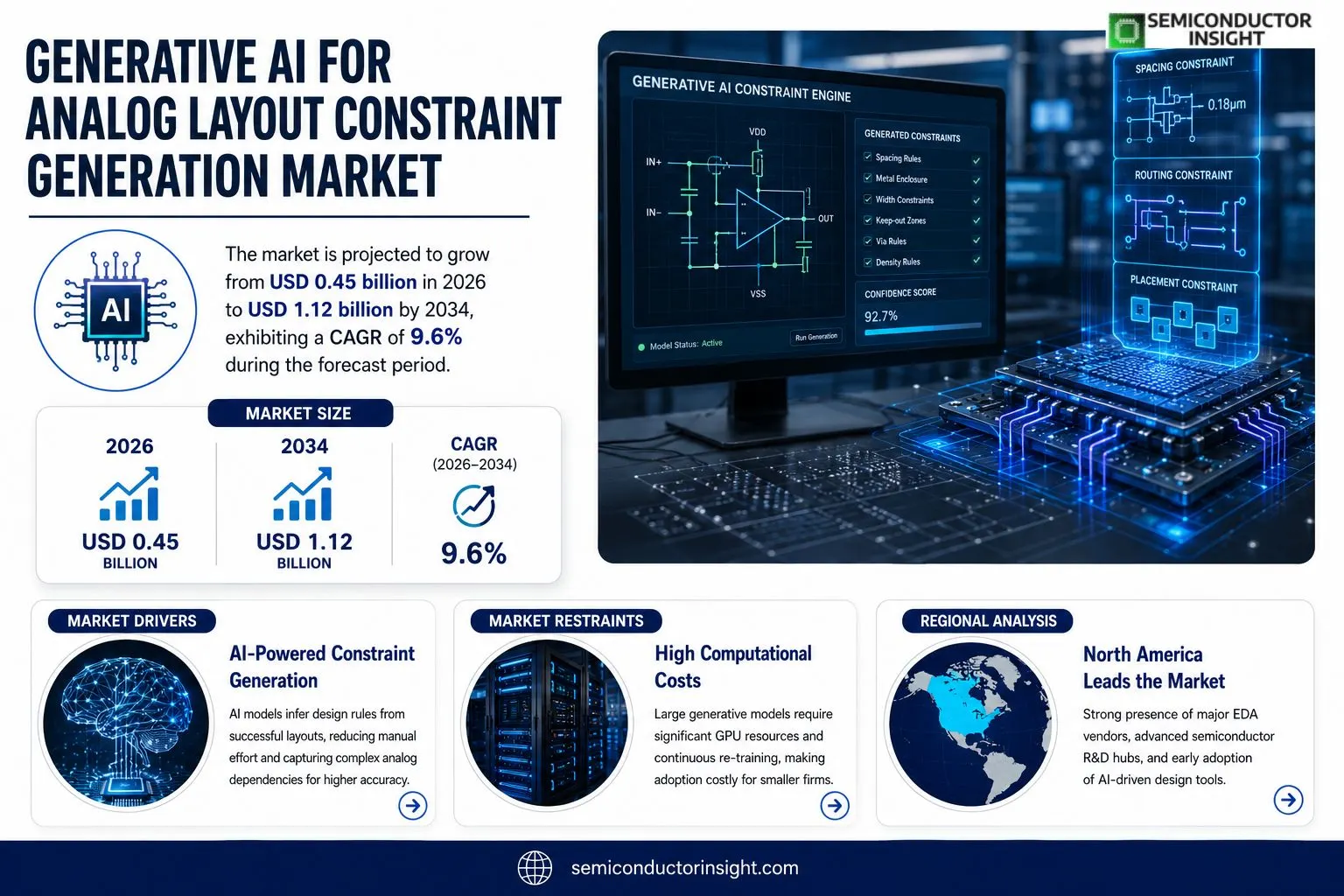
Generative AI for Analog Layout Constraint Generation market size was valued at USD 0.42 billion in 2025. The market is projected to grow from USD 0.45 billion in 2025 to USD 1.12 billion by 2034, exhibiting a CAGR of 9.6% during the forecast period.
Generative AI for analog layout constraint generation leverages deep‑learning models to automatically produce design rules, spacing guidelines, and placement constraints for mixed‑signal integrated circuits. By interpreting circuit schematics and process design kits, these systems accelerate layout verification while reducing human error.The market is experiencing rapid growth because semiconductor manufacturers are seeking faster time‑to‑market and higher yield rates. Furthermore, rising investment in AI‑driven EDA tools and increasing complexity of analog/RF blocks are driving demand. Leading EDA vendors such as Cadence, Synopsys, and Mentor Graphics have announced partnerships with AI startups to embed generative constraint engines into their suites, further fueling expansion.
MARKET DRIVERS
AI‑Enhanced Constraint Modeling
Generative AI for Analog Layout Constraint Generation Market is propelled by AI algorithms that can infer design rules directly from large sets of successful analog layouts. This capability reduces reliance on handcrafted rule libraries and enables designers to capture subtle parasitic effects that traditional methods often miss.
Accelerated Design Cycles
By automating constraint generation, product development teams shave weeks off the verification phase. Companies report a 30‑40% improvement in time‑to‑market, allowing faster response to emerging technology nodes without compromising performance.
➤ Integrating generative AI cuts manual rule‑definition time by up to 40 % while preserving yield targets.
These efficiency gains are amplified when AI models are continuously retrained with new silicon data, creating a virtuous loop of improvement that sustains long‑term market growth.
MARKET CHALLENGES
Data Quality and Model Training
High‑quality training data remains scarce for analog domains, where design iterations are fewer and often protected as intellectual property. Incomplete datasets can lead to over‑fitting, reducing the reliability of generated constraints in production environments.
Other Challenges
Limited Training Datasets
Many analog blocks are custom‑designed, making it difficult to assemble large, diverse corpora. This limitation forces vendors to rely on synthetic data augmentation, which may not fully capture real‑world variability.
MARKET RESTRAINTS
High Computational Costs
Running large generative models on high‑resolution layout data demands significant GPU resources. Small to midsize design houses often find the required capital expenditure prohibitive, slowing broader adoption.The cost factor is compounded by the need for continuous model re‑training as process nodes evolve, leading to recurring expense cycles that can restrain market expansion.Additionally, integrating AI pipelines with existing EDA workflows introduces overhead, as legacy tools may lack APIs to efficiently exchange constraint data.
MARKET OPPORTUNITIES
Emerging Cloud‑Based AI Services
Cloud platforms now offer scalable AI inference engines tailored for semiconductor design, lowering the entry barrier for firms without on‑premise GPU farms. Subscription models enable pay‑as‑you‑go access, aligning costs with project timelines.Strategic partnerships between AI specialists and major EDA vendors are creating integrated suites that embed generative constraint engines directly into schematic capture and layout editors, unlocking seamless user experiences.Open‑source model repositories are also gaining traction, providing a foundation for customization while reducing development time. This collaborative ecosystem could accelerate innovation across the entire Generative AI for Analog Layout Constraint Generation Market.
Generative AI for Analog Layout Constraint Generation Market Trends
Accelerated Constraint Creation Using Deep‑Learning Models
The introduction of generative AI into analog layout design has reshaped how design rules are produced. By ingesting schematic data and process design kits, AI‑driven engines automatically suggest spacing, routing, and placement constraints that align with foundry requirements. This automation reduces the manual rule‑writing cycle from weeks to days, allowing design teams to iterate more rapidly while maintaining compliance with stringent performance and reliability standards.
Other Trends
Seamless Embedding Within Established EDA Suites
Major electronic design automation (EDA) vendors have begun integrating generative constraint generators directly into their platforms. The collaboration enables designers to access AI recommendations without leaving the familiar Cadence, Synopsys, or Mentor Graphics environments. Real‑time feedback loops between the AI module and layout editors improve error detection early in the design flow, resulting in higher first‑pass yield and fewer costly redesigns later in production.
Collaborative Ecosystem and Open‑Source Contributions
Beyond vendor‑centric solutions, an emerging ecosystem of open‑source libraries and AI startups is contributing specialized models for analog and RF blocks. These contributions accelerate knowledge sharing and provide smaller fabs with access to advanced generative capabilities without large licensing fees. The combined effect is a broader adoption curve that extends the benefits of AI‑assisted constraint generation across the semiconductor industry.Overall, Generative AI for Analog Layout Constraint Generation Market is moving towards tighter integration, higher automation, and collaborative development. Companies that adopt these technologies early are likely to achieve shorter time‑to‑market and improved yield, reinforcing the strategic importance of AI‑enhanced design workflows in the next generation of analog and mixed‑signal products.
COMPETITIVE LANDSCAPE
Key Industry Players
Generative AI Revolutionizes Analog Layout Constraint Generation
The market is currently anchored by a handful of legacy electronic design automation (EDA) vendors that have leveraged deep‑learning capabilities to embed generative constraint engines within their existing toolchains. Cadence Design Systems leads the space by integrating AI‑driven rule synthesis into its Virtuoso suite, offering customers automated spacing and placement guidelines derived from process design kits. Synopsys follows a similar trajectory, with its Custom Designer platform now featuring a generative AI module that accelerates rule creation for mixed‑signal blocks. Siemens EDA (formerly Mentor Graphics) provides a comparable capability through its HyperLynx AI Add‑On, targeting high‑frequency analog layouts. These incumbents benefit from extensive customer bases, mature verification flows, and deep capital resources, allowing them to set pricing benchmarks and shape industry standards. Their dominant market share creates a tiered structure where large‑scale semiconductor manufacturers gravitate toward the bundled solutions of these three firms, while niche innovators seek complementary partnerships to access the core AI infrastructure.Beyond the tier‑one players, a growing ecosystem of specialist firms is contributing differentiated value. Ansys has introduced AI‑enhanced constraint generation within its RedHawk suite, emphasizing predictive yield optimization. Keysight Technologies focuses on RF‑centric analog constraints, leveraging its measurement expertise to inform AI models. Start‑ups such as DeepDesign, Aionics, SiLC.ai, and TimbreAI provide boutique generative engines that excel in rapid prototyping for emerging process nodes. Academic spin‑offs from IBM Research and the University of California system add open‑source frameworks that are increasingly adopted by small‑to‑medium design houses. This diversification fosters competitive pressure, encouraging incumbents to accelerate feature roll‑outs while offering end‑users a broader palette of licensing and integration options.
List of Key Analog Layout Constraint Generation Companies Profiled
- Cadence Design Systems
- Synopsys
- Siemens EDA (Mentor Graphics)
- Ansys
- Keysight Technologies
- DeepDesign
- Aionics
- SiLC.ai
- TimbreAI
- IBM Research
- University of California – Berkeley Spin‑off
- Foundries AI Lab
- Google DeepMind (EDA Collaboration)
- Qualcomm AI‑EDA Initiative
- ASML Process‑AI Group
Segment Analysis:
| Segment Category | Sub-Segments | Key Insights |
| By Type |
|
Neural network models are emerging as the dominant type because they excel at interpreting complex schematic nuances and translating them into precise layout constraints.
|
| By Application |
|
Mixed‑signal IC design drives the most compelling adoption of generative AI because it requires tightly coordinated analog and digital constraints.
|
| By End User |
|
In‑house design teams are the leading end‑user segment, leveraging generative AI to embed constraint generation directly into their design workflows.
|
| By Integration Level |
|
Live design assist stands out as the most transformative integration level, offering on‑the‑fly constraint suggestions as designers layout circuits.
|
| By Strategic Objective |
|
Yield improvement is the primary strategic driver, as AI‑generated constraints systematically eliminate rule violations that traditionally lower silicon yield.
|
Regional Analysis: Generative AI for Analog Layout Constraint Generation Market
North America
The demand for smaller, faster analog blocks, combined with pressure to reduce design‑time, fuels interest in generative AI solutions. Strong R&D budgets in the United States and Canada allocate resources to AI‑enhanced layout environments, where early adopters seek to capture competitive advantage through faster constraint generation and lower error rates.
Companies are piloting generative AI to automate the creation of spacing and routing rules for mixed‑signal designs. These pilots focus on high‑frequency RF blocks where conventional rule‑based methods struggle to capture subtle electromagnetic interactions, delivering more robust constraint sets with fewer designer interventions.
While no specific regulations govern AI‑generated layout constraints, broader export‑control policies on advanced semiconductor technologies influence collaborative research. Companies navigate these rules by localising sensitive AI models within secure on‑premise environments to maintain compliance.
Major EDA vendors are embedding generative AI modules into their analog design suites, while niche startups differentiate through specialised constraint‑generation engines. Partnerships between AI firms and traditional EDA players accelerate feature integration and broaden market reach.
Europe
European analog designers benefit from strong cross‑border research collaborations and a regulatory environment that encourages data privacy, which is advantageous for AI model training on proprietary layouts. Countries such as Germany, France, and the Netherlands host a growing number of design houses that are exploring generative AI to streamline constraint creation for automotive and IoT applications. Industry clusters around the “Silicon Alps” promote joint pilots, where firms test AI‑driven rule generation against stringent automotive safety standards. The pace of adoption is measured, with a focus on validating the reliability of AI‑produced constraints before full integration. Nonetheless, the appetite for innovation remains high, fueled by EU funding programs that target AI‑enhanced semiconductor tooling.
Asia‑Pacific
Asia‑Pacific markets, led by China, Japan, South Korea, and Taiwan, exhibit a rapid scaling of generative AI capabilities driven by intense competition in advanced node manufacturing. Design firms are leveraging AI to accelerate analog layout constraint generation as part of broader AI‑for‑EDA strategies, aiming to shorten the design‑validation loop for high‑volume consumer electronics. While intellectual‑property concerns shape the pace of technology sharing, regional alliances among chip manufacturers and AI startups foster knowledge exchange. The region’s large talent pool and aggressive cost‑reduction targets create a fertile ground for AI adoption, especially in high‑mix, low‑volume analog blocks where manual constraint definition is most burdensome.
South America
In South America, Brazil and Colombia host emerging analog design ecosystems that are beginning to explore generative AI as a means to bridge the talent gap. Companies are adopting AI‑assisted constraint generation to reduce reliance on senior layout engineers, thereby accelerating project timelines for telecommunications and automotive suppliers. Limited access to high‑performance computing resources moderates the speed of adoption, but cloud‑based AI platforms are mitigating this barrier. The market narrative emphasizes cost efficiency and skill‑development, with pilot programs focusing on modest design projects that can showcase tangible productivity gains.
Middle East & Africa
The Middle East & Africa region is in the early stages of integrating generative AI into analog layout workflows. Investment funds in the United Arab Emirates and South Africa are beginning to support start‑ups that develop AI tools tailored to constrained design environments. Local semiconductor initiatives prioritize building AI competency, viewing generative constraint generation as a lever to attract multinational design services. Adoption is currently limited to exploratory studies, but the strategic focus on digital transformation and the availability of government‑backed R&D incentives suggest a gradual increase in interest over the next few years.
Report Scope
This market research report provides a comprehensive analysis of the Generative AI for Analog Layout Constraint Generation Market , covering the forecast period 2026–2034. It offers detailed insights into market dynamics, technological advancements, competitive landscape, and key trends shaping the industry.
Key focus areas of the report include:
- Market Overview: The report begins with an overview outlining its current market scenario, key growth indicators, and industry transformation drivers. It discusses macroeconomic factors, demand–supply balance, regulatory landscape, and the strategic role of semiconductors in powering advancements across industries such as automotive, telecommunications, consumer electronics, and industrial automation.
- Market Size & Forecast: Historical data and future projections for revenue, unit shipments, and market value across major regions and segments.
- Segmentation Analysis: Detailed breakdown by product type, technology, application, and end-user industry to identify high-growth segments and investment opportunities.
- Regional Insights: Insights into market performance across North America, Europe, Asia-Pacific, Latin America, and the Middle East & Africa, including country-level analysis where relevant.
- Competitive Landscape: Profiles of leading market participants, including their product offerings, R&D focus, manufacturing capacity, pricing strategies, and recent developments such as mergers, acquisitions, and partnerships.
- Technology Trends & Innovation: Assessment of emerging technologies, integration of AI/IoT, semiconductor design trends, fabrication techniques, and evolving industry standards.
- Market Drivers & Restraints: Evaluation of factors driving market growth along with challenges, supply chain constraints, regulatory issues, and market-entry barriers.
- Stakeholder Insights: Insights for component suppliers, OEMs, system integrators, investors, and policymakers regarding the evolving ecosystem and strategic opportunities.
Primary and secondary research methods are employed, including interviews with industry experts, data from verified sources, and real-time market intelligence to ensure the accuracy and reliability of the insights presented.
FREQUENTLY ASKED QUESTIONS:
What is the current market size of Generative AI for Analog Layout Constraint Generation Market?
-> Generative AI for Analog Layout Constraint Generation Market was valued at USD 0.42 billion in 2025 and is expected to reach USD 1.12 billion by 2034, exhibiting a CAGR of 9.6% during the forecast period.
Which key companies operate in Generative AI for Analog Layout Constraint Generation Market?
-> Key players include Cadence, Synopsys, Mentor Graphics, and emerging AI‑focused startups collaborating with these EDA giants.
What are the key growth drivers?
-> Key growth drivers include need for faster time‑to‑market, higher silicon yield, rising investment in AI‑driven EDA tools, and increasing complexity of analog/RF blocks in mixed‑signal designs.
Which region dominates the market?
-> North America leads the market, driven by the concentration of major EDA vendors and semiconductor R&D hubs.
What are the emerging trends?
-> Emerging trends include integration of generative AI engines into EDA suites, co‑development of AI‑enabled design rule generators, and strategic partnerships between traditional EDA firms and AI startups.

Get Sample Report PDF for Exclusive Insights
Report Sample Includes
- Table of Contents
- List of Tables & Figures
- Charts, Research Methodology, and more...
 Download Sample Report PDF