Generative AI Chip Design Verification Market Insights
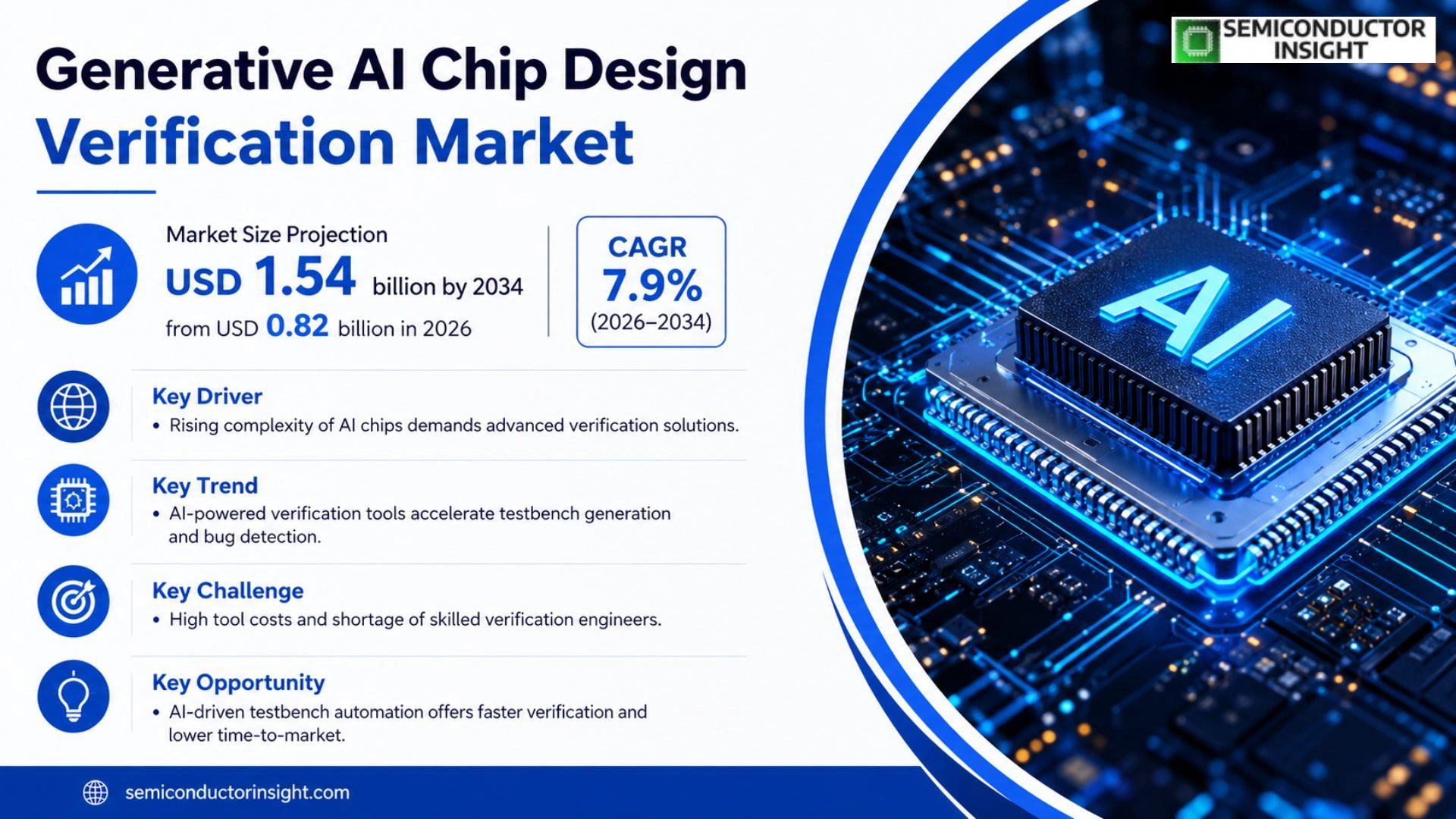
Global Generative AI Chip Design Verification market size was valued at USD 0.78 billion in 2025. The market expands from USD 0.82 billion in 2026 to USD 1.54 billion by 2034, reflecting a CAGR of 7.9% over the forecast horizon.
Generative AI chip design verification encompasses software and hardware solutions that employ large‑scale language models and diffusion techniques to automatically generate test vectors, perform corner‑case analysis, and predict failure modes across semiconductor layouts. By automating traditionally manual verification steps, these tools accelerate time‑to‑market while preserving functional correctness.
The sector gains momentum because semiconductor manufacturers are confronting unprecedented design complexity as process nodes shrink below 3 nm and heterogeneous integration becomes commonplace. Investments from major foundries into advanced electronic‑design‑automation (EDA) platforms enable designers to leverage generative models for early‑stage validation, thereby reducing costly silicon respins.
MARKET DRIVERS
Escalating Chip Complexity Fuels Verification Demand
Designers of generative‑AI accelerators now contend with transistor counts that eclipse traditional GPUs, pushing verification cycles to the limit. Early‑stage detection of timing violations and power‑budget breaches has become a competitive differentiator, prompting firms to invest heavily in automated verification suites tailored for AI workloads.
Regulatory Scrutiny on AI‑Enabled Hardware
Legislative bodies across North America and Europe are drafting standards that require documented proof of reliability for AI chips destined for critical infrastructure. Compliance‑driven verification not only mitigates legal exposure but also reassures OEMs that the silicon can meet stringent uptime guarantees.
➤ Companies that integrate generative‑AI‑aware verification early in the design flow typically reduce tape‑out delays by up to 30 %.
Finally, the surge in AI‑centric edge devices,ranging from autonomous drones to smart cameras,creates a market where time‑to‑market advantage translates directly into revenue share, compelling chip makers to adopt verification platforms that can keep pace with rapid product iterations.
MARKET CHALLENGES
Scarcity of Skilled Verification Engineers
While demand for verification tools climbs, talent pipelines have not kept up. Engineers versed in both hardware description languages and generative‑AI model behavior are few, driving up labor costs and causing project bottlenecks for many design houses.
Other Challenges
Integration Complexity
Verification environments must now interoperate with AI frameworks such as PyTorch and TensorFlow. Bridging the semantic gap between software‑level model specifications and silicon‑level timing models adds layers of orchestration that many legacy tools cannot handle efficiently.
MARKET RESTRAINTS
High Capital Expenditure for Advanced Toolchains
State‑of‑the‑art verification platforms command licensing fees that can exceed several million dollars per year. For mid‑size semiconductor firms, these outlays strain cash flow, leading some to postpone adoption until ROI becomes unmistakable.
MARKET OPPORTUNITIES
AI‑Generated Testbench Automation
Emerging solutions that leverage generative AI to synthesize test vectors and corner‑case scenarios promise to slash verification effort dramatically. Firms that pioneer such automation can offer faster verification cycles and differentiate themselves in a crowded marketplace, opening new revenue streams through service‑based licensing models.
Generative AI Chip Design Verification Market Trends
Generative Verification Accelerates Early‑Stage Design
The market measured USD 0.78 billion in 2025 and is projected to reach USD 1.54 billion by 2034, reflecting a steady compound increase of roughly 7.9% per annum. This trajectory is anchored in the shift from manual test‑vector creation to algorithmic generation of verification artifacts. By leveraging large‑scale language models and diffusion techniques, vendors supply tools that draft corner‑case scenarios, predict failure modes, and synthesize test patterns directly from RTL descriptions. The practical outcome is a measurable compression of design cycles, allowing silicon teams to submit tape‑outs with greater confidence in functional integrity. For customers, the reduction in respin frequency translates into lower NRE spend and a more predictable product launch timetable.
Other Trends
Heterogeneous Integration Validation
The advent of sub‑3 nm nodes has forced designers to combine logic, memory, and analog blocks within a single package. Verifying such heterogeneous assemblies demands a verification engine that can understand divergent design‑rule sets and cross‑domain interactions. Generative AI tools respond by producing multi‑discipline verification suites that automatically reconcile power‑grid constraints with high‑frequency signal integrity checks. This capability helps manufacturers avoid costly post‑silicon debugging, especially as the number of IP contributors expands across the supply chain. Companies that adopt these AI‑driven workflows report a 15‑20% improvement in first‑pass yield for complex system‑in‑package (SiP) projects.
Foundry Partnerships Expand Tool Adoption
Leading foundries have begun to embed generative verification solutions into their standard design‑kit offerings, positioning the technology as a prerequisite for access to advanced process nodes. By co‑investing in EDA platforms, these fabs reduce the barrier for smaller design houses to exploit AI‑generated test environments without building in‑house expertise. The strategic alignment creates a feedback loop: as more designers rely on the tools, the underlying models gain richer data, further refining prediction accuracy. The business implication is a gradual elevation of the baseline verification quality across the ecosystem, pressuring legacy EDA vendors to accelerate their AI integration roadmaps.
COMPETITIVE LANDSCAPE
Key Industry Players
Generative AI Chip Design Verification – Competitive Overview
The verification space is dominated by the traditional EDA giants that have leveraged their deep silicon‑design pedigree to integrate generative‑AI modules into existing suites. Synopsys, for instance, has woven large‑language model capabilities into its VCS and Verdi platforms, positioning the firm as the de‑facto standard for high‑performance ASIC and SoC validation. Cadence’s JasperGold family now offers AI‑assisted assertion‑based checking, allowing customers to extract edge‑case scenarios that would otherwise require manual scripting. Siemens’ Mentor Graphics, backed by substantial foundry collaborations, has introduced diffusion‑driven pattern generation that accelerates early‑stage corner analysis. Collectively, these incumbents control the bulk of market revenue, benefit from long‑term licensing contracts, and enjoy direct pipelines to the most demanding semiconductor designers operating at sub‑3 nm nodes.
Beyond the established leaders, a wave of specialist firms is shaping niche segments of the market. Graphcore has released a verification stack tuned for its intelligence processing units, emphasizing seamless model‑to‑silicon traceability. Edgecortix focuses on low‑power AI accelerators, providing a lightweight generative test‑vector engine that aligns with edge‑device constraints. Tenstorrent and Cerebras each offer verification add‑ons that exploit their massive parallelism to simulate large‑scale neural workloads more efficiently than conventional tools. Smaller players such as Mythic and Horizon Robotics contribute domain‑specific verification libraries that cater to vision‑oriented AI chips, while startups like SambaNova are experimenting with AI‑driven design‑for‑test (DfT) methodologies that could redefine cost structures for next‑generation data‑center processors.
List of Key Generative AI Chip Design Verification Companies Profiled
- Synopsys
- Cadence Design Systems
- Siemens EDA (Mentor Graphics)
- ANSYS
- Graphcore
- Edgecortix
- Tenstorrent
- Cerebras Systems
- Mythic
- Horizon Robotics
- SambaNova Systems
- Qualcomm AI Chip Division
- Intel Corporation (AI Accelerator Group)
- Arm Holdings (AI IP)
- Google Cloud TPU Verification Team
Segment Analysis:
| Segment Category | Sub-Segments | Key Insights |
| By Type |
|
Model‑Driven Verification
|
| By Application |
|
Logic Verification
|
| By End User |
|
Fabless Chip Companies
|
| By Design Phase |
|
Front‑End Design
|
| By Adoption Horizon |
|
Early Adopters
|
Regional Analysis: Generative AI Chip Design Verification Market
Leading chip makers and verification software firms are forging alliances that embed generative AI modules into existing design flows, shortening validation loops and fostering a shared roadmap for tool evolution.
The region benefits from a dense pool of AI researchers and verification engineers, enabling rapid translation of academic breakthroughs into commercial verification platforms.
Venture capital firms with a focus on semiconductor AI are allocating capital toward startups that promise to automate rule‑checking and coverage analysis via generative models.
Government initiatives that reward reduced silicon development timelines are encouraging firms to adopt AI‑centric verification, improving overall ecosystem efficiency.
Europe
European chip designers are leveraging a strong heritage of formal methods, integrating generative AI to complement rigorous mathematical verification. The blend of legacy verification discipline and emerging AI tools yields a hybrid approach that appeals to safety‑critical industries such as automotive and aerospace. Policy frameworks that prioritize sustainable chip production further motivate manufacturers to adopt AI solutions that cut down on costly re‑spins, thereby aligning environmental goals with design efficiency. Collaborative consortia across the EU are also standardizing data formats, which eases the exchange of AI‑generated verification artefacts among partners.
Asia‑Pacific
In the Asia‑Pacific corridor, rapid expansion of fab capacity is accompanied by a surge in demand for verification acceleration. Companies in China, Taiwan, and South Korea are experimenting with generative AI to address the sheer volume of design variants emerging from heterogeneous integration strategies. The region’s cost‑sensitive environment drives a focus on AI tools that automate repetitive verification tasks, freeing engineers to concentrate on architectural innovation. Local governments are also subsidizing AI‑enabled EDA tools, hoping to lift the overall competitiveness of their semiconductor supply chains.
South America
South American markets, while smaller in scale, are cultivating niche expertise in low‑power chip verification. Start‑ups in Brazil and Argentina are adopting generative AI to predict power‑budget violations early in the design cycle, a capability that resonates with the region’s emphasis on energy‑efficient devices for IoT applications. Partnerships with North American vendors provide access to cutting‑edge AI models, enabling local firms to offer verification services that meet global quality expectations without extensive in‑house R&D.
Middle East & Africa
The Middle East & Africa region is witnessing initial deployments of AI‑augmented verification within emerging data‑center projects and defense contracts. Investment funds are beginning to recognize the strategic value of shortening chip validation timelines, prompting early adoption of generative AI platforms. Training programs linked to regional universities are building a pipeline of engineers capable of bridging AI techniques with traditional verification practices, laying the groundwork for a more self‑sufficient ecosystem in the years ahead.
Report Scope
This market research report provides a comprehensive analysis of the Generative AI Chip Design Verification Market , covering the forecast period 2026–2034. It offers detailed insights into market dynamics, technological advancements, competitive landscape, and key trends shaping the industry.
Key focus areas of the report include:
- Market Overview: The report begins with an overview outlining its current market scenario, key growth indicators, and industry transformation drivers. It discusses macroeconomic factors, demand–supply balance, regulatory landscape, and the strategic role of semiconductors in powering advancements across industries such as automotive, telecommunications, consumer electronics, and industrial automation.
- Market Size & Forecast: Historical data and future projections for revenue, unit shipments, and market value across major regions and segments.
- Segmentation Analysis: Detailed breakdown by product type, technology, application, and end-user industry to identify high-growth segments and investment opportunities.
- Regional Insights: Insights into market performance across North America, Europe, Asia-Pacific, Latin America, and the Middle East & Africa, including country-level analysis where relevant.
- Competitive Landscape: Profiles of leading market participants, including their product offerings, R&D focus, manufacturing capacity, pricing strategies, and recent developments such as mergers, acquisitions, and partnerships.
- Technology Trends & Innovation: Assessment of emerging technologies, integration of AI/IoT, semiconductor design trends, fabrication techniques, and evolving industry standards.
- Market Drivers & Restraints: Evaluation of factors driving market growth along with challenges, supply chain constraints, regulatory issues, and market-entry barriers.
- Stakeholder Insights: Insights for component suppliers, OEMs, system integrators, investors, and policymakers regarding the evolving ecosystem and strategic opportunities.
Primary and secondary research methods are employed, including interviews with industry experts, data from verified sources, and real-time market intelligence to ensure the accuracy and reliability of the insights presented.
FREQUENTLY ASKED QUESTIONS:
What is the current market size of Generative AI Chip Design Verification Market?
-> Generative AI Chip Design Verification market expands from USD 0.82 billion in 2026 to USD 1.54 billion by 2034, reflecting a CAGR of 7.9%
Which key companies operate in Generative AI Chip Design Verification Market?
-> The reference highlights involvement of major semiconductor manufacturers and leading EDA platform providers, but specific company names are not enumerated.
What are the key growth drivers?
-> Key growth drivers include the increasing design complexity as process nodes shrink below 3 nm, the rise of heterogeneous integration, and substantial investments from leading foundries into advanced EDA platforms that incorporate generative AI techniques.
Which region dominates the market?
-> The reference does not specify a dominant region for the market.
What are the emerging trends?
-> Emerging trends involve leveraging large‑scale language models and diffusion techniques to automatically generate test vectors, perform corner‑case analysis, and predict failure modes, thereby automating verification and reducing costly silicon respins.

Get Sample Report PDF for Exclusive Insights
Report Sample Includes
- Table of Contents
- List of Tables & Figures
- Charts, Research Methodology, and more...
 Download Sample Report PDF